My Exciting, Memorable and Disappoint Return to Gampel to See UConn-Xavier

This January has been four weeks of heartbreak for Huskies fans, and probably the most challenging month the program has experienced since the final years of Kevin Ollie’s tenure. At this time last month, fans were rightfully believing UConn was the best team in the nation and would win the Big East. Now, the Huskies are 5-6 in conference play after Wednesday’s home loss to Xavier, and both Husky nation and the wider college basketball fanbase are wondering if the team is capable of pulling itself together in February, or will instead stumble into the conference and NCAA tournaments.

Together with an electric crowd, I got to see UConn up close at both its best and worst in at Gampel Wednesday against Xavier in an 82-79 loss. In the first half which ended with UConn down 15 points, I saw a team that is a mess both offensively and especially defensively. This collection of players is incapable of both stopping  opponents one-on-one and making high-quality shots, and does not communicate well with one another on either end of the floor. In the second half, the Huskies became a completely different team. They constantly both attacked the basket and scored on layups and free throws, while hitting both open and challenging perimeter shots. On defense, they used both multiple zones and constant ball pressure to force turnovers and generally just make a formidable Musketeers offense uncomfortable (and yet they still scored more points in the second half). As a result, UConn came roaring back into the game and almost made an unforgettable comeback. It cut the deficit to one multiple times, but a few costly mistakes on multiple ends in the final moments thwarted a comeback, resulting in the Huskies falling to 5-6 in the Big East and still searching for answers on how to beat the best teams in the conference.

It was very sad to see UConn lose in person at Gampel, especially sense you could sense how eager the fans were to see the Huskies get a win they desperately needed. Still , I loved the experience and will remember the game for a long time. Despite losing to Xavier, there were a few positives both the team and the fans could take from the games, which they can hopefully learn from and use to get back on track in February. At the same time, there were weaknesses that continued to present, which UConn needs to mitigate and solve if it wants to be a threat in March. Below, I go into detail about both some positive and negative observations I took from the game.

The Positives

  1. Jordan Hawkins Continues to Emerge as a Star

During the preseason, there was a lot of talk about how Hawkins had significantly improved as an offensive player and could emerge as one of the best scorers in the Big East. In non-conference play and the early portion of the Big East schedule, Hawkins was a reliable scorer but only occasionally took over games. Over the last four games however, Hawkins has been the Huskies best player and carried the team even when he has gotten very little help. The sophomore has scored 20 or more points three times and averaged 23 while shooting 42 % from three and over 53% overall, even as the team has gone 1-3.

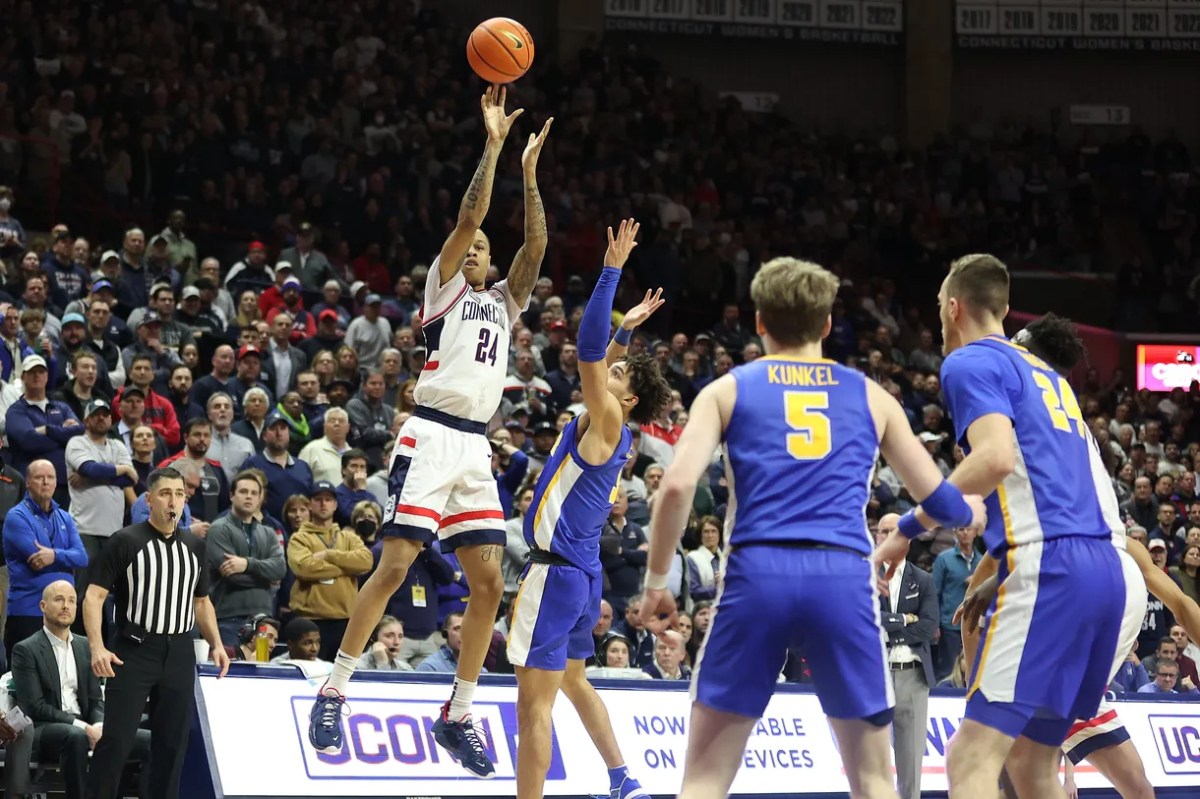
Hawkins was sublime against Xavier in the second half after a quiet start, and finished with 28 points while shooting 5-10 from beyond the arc and making all seven of his free throws. Despite the Musketeers defense keying in on him, Hawkins was able to get free off screens and knock down huge 3-pointers, even with defenders draped over him several times. He also continued his recent habit of attacking the basket when the opportunity arose. Hawkins was able to make some challenging layups and consistently get himself to the charity stripe. He single-handedly kickstarted the UConn offense and got the team and the crowd back into the game, and was the best player on the court. It’s just a shame that his effort couldn’t be rewarded with a comeback win.

Besides his scoring, Hawkins has visibly taken on a bigger leadership role in the last month, while continuing to be a solid rebounder and defender. Hawkins still can improve his ball handling (he had three turnovers against Xavier) and tighten up his defense, but if he continues to play at this level than he will be in position to be drafted high in the first round of the NBA draft if he chooses to leave UConn after the season. Hawkins is demonstrating that he is capable of leading the Huskies on a possible March Madness run, something no other Husky is doing right now. Let’s just hope the team gets back on track and becomes capable of going on such a run.

  • Tristen Newton Seems to be Turning a Corner on Offense

For much of the Big East schedule, Newton has been a disappointment at point guard. The senior transfer, whom was one of the best offensive players in the American Athletic Conference at East Carolina last season at shooting guard, was playing extremely passively on offense earlier this month and appeared uncomfortable running the offense. Yes, Newton had been inconsistent on offense the entire season, but gone was the player early in the season whom constantly attacked the basket and got to the free throw line, was a credible 3-point threat, and handled the ball effectively. In addition to Newton’s lack of aggressiveness, he appeared to struggle with sharing the responsibility of running the offense alongside Andre Jackson, who was injured and then coming off the bench when Newton got off to a strong start on the season. Combine Newton’s poor offensive play with an inconsistent performance on defense, and UConn fans had a legitimate gripe with the big-time transfer.

In the two games before the contest against Xavier (at Seton Hall and home against Butler), Newton finally started to demonstrate the aggressiveness Dan Hurley was looking for. He scored 11 points in both games while going a combined 11-12 at the free throw line, and had a combined six assists (unfortunately, Newton also committed five turnovers). Amazingly, this was the first time he had scored in double figures in consecutive games for the first time all season. Newton’s awakening from his slumbers set the stage for a very strong performance against the Musketeers.

Newton gave his all against Xavier offensively. He was UConn’s best player in the first half while almost everyone else was struggling, and continued to attack the rim in the second half while also hitting two timely treys. Newton finished with 23 points, tying a season high, and went 6-12 from the field and 9-11 on free throws. These were the most field goals Newton had drained in a game for the Huskies. While Newton made some poor decisions with his passing, committing five turnovers, he did a very strong job of moving the ball and pushing the tempo, especially in the second half, while playing with high intensity throughout. Newton recognized he needed to step up with Andre Jackson and the other guards besides Hawkins struggling, and he helped UConn right the ship in the second half and put Xavier’s defense on its heels in the second half. It may not have been quite good enough for a win, but Newton helped demonstrate what the team’s offense needs to do if the Huskies are going to go on a winning streak.

Hopefully, Newton’s memorable performance Wednesday can continue to be built upon. Newton’s better at earning free throws than almost anyone in college basketball, and if he can sustain his improved shooting and tighten up his ball handling and defense, than UConn may finally have the versatile player they thought they were getting out of the transfer portal. Newton may not be able to fit the role of a traditional point guard, but if he continues to play to his strengths and emerge as a leader, it will take a huge load off of Jackson, Adama Sanogo, and the rest of the team’s guards. I think that Newton can sustain this level of play and Dan Hurley can push him effectively. As a result, the Huskies will improve in February and hopefully when it matters most in March.

  • The Use of Zones and Heightened Pressure on Defense Caused Xavier to be Less Efficient in the Second Half

Even as UConn’s man-to-man defense has sucked and been extremely foul-prone for the last month, particularly when guarding players that are attacking the paint, Dan Hurley has been extremely reluctant to make any adjustments, whether that is playing zone or planning Sanogo and Donavon Clinigan together. This has resulted in the team allowing opponents to come back and win multiple games, and the players to ultimately lose confidence on both ends. After his defense’s ugly performance in the first half against Xavier however, Hurley finally took the plunge and made significant defensive adjustments in the second half, which were responsible for the Huskies nearly making an incredible comeback. It  may have taken way too long to happen, but Hurley’s flexibility on the defensive end may be a great sign going forward.

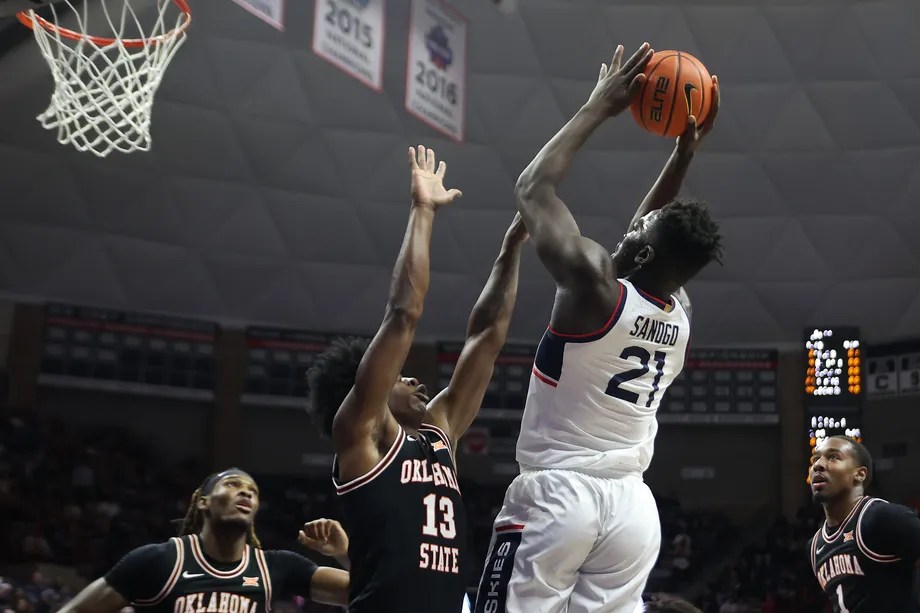
While UConn was more likely to struggle against defending Xavier’s elite offense playing man-to-man, it’s poor defense in the first half was very predictable. The Musketeers jumped out to a 9-0 lead and were ahead by double digits for almost the entire half, and ultimately went into the break shooting 50% and up 2-24. The Huskies got beat off the dribble constantly and allowed many open layups, and did a poor job of defending the rim. They also surprisingly struggled to stop Xavier beyond the arc, allowing several open threes as players did a poor job of closing out. Alex Karaban, Jackson and Sanogo especially struggled on defense, with Jackson continuing his habit of allowing players to below by him and then picking up ticky-tack fouls going for steals.

As fans are well aware of, Hurley isn’t a coach who makes quick adjustments or inclined to change up his defense. But with Xavier again shredding UConn on that end, he finally decided he had no choice but to switch up to a zone. Bu alternating between 1-3-1 and 2-3 zones and pressuring the Musketeers full-court, the Huskies were able to regularly force turnovers and offensive fouls and caused them to look discombobulated, especially as the half wore on. Jackson was especially effective on defense with these adjustments, as they allowed him to use his athleticism to hound defenders. UConn’s aggressive defensive certainly got the crowd into the game, and it also allowed the offense to get more fastbreak opportunities and open shots everywhere on the floor.

I strongly feel that if the Huskies hadn’t adjusted on defense, it would have easily lost by double digits. Playing zone and upping their ball pressure made the team much better on both ends of the floor, and allowed it to be in position to possibly win. While UConn should be much more effective playing man-to-man in the next two games at DePaul and Georgetown, Hurley absolutely should continue to experiment with playing zone and pressuring ballhandlers in half-court sets for a few minutes. He could possibly even play Sanogo and Clinigan together and see how effective they are on both ends. The same goes for experimenting in practice. By doing all this, UConn can be in better position to slow down Marquette’s elite offense and earn a huge home win next Tuesday.

  •  The Crowd Was Outstanding

The XL Center can be an intimidating environment for opposing players, as it can host more fans. However, it cannot compare to Gampel Pavilion, especially when it is sold out and many students show up. The crowd was charged from the opening tip, and were able to still maintain solid energy throughout the first half even as UConn played terribly. However, it was the second half when the energy ramped up. As the Huskies began to force turnovers and Hawkins caught fire, the crowd noise became deafening. They stayed standing throughout the remainder of the game, and all this excitement helped rattle the Xavier players and cause timeouts. Even when UConn couldn’t get over the hump and take the lead in the final minutes of the game, the crowd continued to provide players encouragement. The fan’s excitement was infectious to experience in person, and heartwarming to see considering how much the team has been struggling. Let’s hope the Huskies can turn things around and reward the fanbase for its support.  

The Negatives

  1. The Poor Play from the Bench, Karaban and Jackson

UConn’s bench play has been weak for much of the Big East schedule after being a huge strength during the nonconference schedule, and it was no different against Xavier. The quartet of Naheim Alleyne, Hassan Diarra, Clinigan and Joey Calcaterra scored just six points and grabbed three rebounds in 35 minutes while shooting 2-9 and recording no assists. Calcaterra and Alleyne largely couldn’t hit the broad side of a barn, going 1-6 from three. Clinigan had maybe his worst game of the season, missing two crucial free throws and picking up two ugly fouls in just seven minutes. His struggles forced Sanogo to play 33 minutes. None of the other bench guys particularly distinguished themselves defensively, either.

Karaban’s struggles weren’t a huge surprise on defense. He was facing a pair of strong big men in  Zach Freemantle and Jerome Hunter who are both bigger and stronger than the freshman. Still, Karaban did not box out great and grabbed just three rebounds in 35 minutes. He was mostly MIA on offense, scoring just five points with only one assist and missing two of three 3-pointers. The freshman will bounce back offensively, but he needs to be more aggressive and badly get stronger in the offseason. It will be a huge help when Samson Johnson fully returns from injury and takes some of those minutes.

While Karaban’s inconsistency is to be expected from a freshman, Andre Jackson’s is much more concerning. The junior ability to score just enough and keep defenses honest has completely evaporated in January (just under five points per game on 30% shooting overall and under 25% from deep). Jackson, who started Wednesday’s game by missing his first seven shots and was 3-12 overall, still rarely scores on anything more than dunks, floaters or open 3-pointers. Worse, Jackson’s passing and decision-making has gone down as the Huskies have floundered. He has averaged nearly two turnovers per game in January and made crucial ones against Seton Hall and Marquette. Jackson’s assist numbers have gone down (he had two against Xavier , and he is regularly playing out of control and asking teammates to make plays they are incapable of doing. For example, in the second half Jackson threw an alley-oop pass to Sanogo on a fastbreak, even though Sanogo doesn’t have the vertical left to finish that play, missed an open dunk and putback, and was called for a controversial goaltend which he also fouled on, leading to a 3-point play which halted a UConn run. And in addition to Jackson’s offensive struggles, I have also talked about the overaggressive defense which has regularly put the junior captain in foul trouble, and Jackson’s inconsistency with keeping players from driving by him.

While other players haven’t been great lately Jackson’s decline has hurt the Huskies very badly. His play has declined across the board, as well as his leadership and confidence in games. Jackson will have to play more under control on offense while figuring out where he can best contribute and reestablish his identity as a lockdown defender. His level of play took a jump around this time last year. If Jackson can do that again, it will take pressure off of the Huskies stars and allow the team to be a big threat again both in the conference and especially nationally.

  • The Huskies Yet Again Played a Bad Half, and Made Critical Mistakes in the Final Minutes  

In all of UConn’s six losses, a big theme is the team not playing competitively for all 40 minutes. Usually this has been the case in the second half, as the team was either up or tied at halftime in the first five losses. Wednesday’s game was a big reversal, with UConn playing its worth first half of the season by far. It looked all out of sorts on both ends, and Dan Hurley took way too long to call timeouts and refused to change up his defense despite his players getting burned on that end. Whether the team was not well-prepared enough or tin a state of shock after falling behind by so much can be debated, but either way the opening 20 minutes were an embarrassment. There is no good reason for the Huskies to put together a full game and make the changes to ensure they do.

By falling behind by 15 at halftime, the Huskies had almost no margin for error during their comeback. After they cut the deficit to a basket in the final minutes multiple times, errors raised their ugly heads. First, Newton was called for an offensive foul when driving to the basket along the right baseline with 4:03 remaining and the score 73-72, with the officials ruling that he pushed off. Then with score 78-77, Hawkins slipped on a drive and lost the ball before fouling two minutes later. After a layup by Jack Nunge, Newton had a very similar turnover a minute later. UConn was able to force a turnover on the next play, but Dan Hurley than called a timeout with 20 seconds left as Hawkins drained a jumper, wiping away the basket. Xavier called a timeout 11 seconds later with the same score to give the Huskies a chance to set up a final scoring play, but whatever was drawn up was blown up by excellent Musketeers defense. Desmond Claude bailed them out when he fouled Newton with two seconds left, but he unfortunately made the second free throw he was trying to miss, depriving the team’s bigs any chance at scoring on a putback. In a vacuum, most of these errors were understandable considering how desperate the team was playing and their urgency to finally take the lead. However, they added up, and UConn was handed its second consecutive loss by a basket.

Throughout Hurley’s tenure in Storrs, UConn has been sadly famous for losing close games to good teams again and again. It looked like things may finally change after the 14-0 start, but so far that has proven to be just a mirage. To put it bluntly, UConn needs to learn how to execute down the stretch and make winning plays in close games, and fast. Otherwise, it is not going far in tournament play yet again, and Hurley’s seat will start to get warm.

  • A lack of Fundamentals and Smarts When Playing Man-to-Man Defense

I’ve alluded to the poor defense in the first half throughout this article, but I had to devote an individual section to it considering just how lousy the D was. Among other things, it featured:

  1. Doing a terrible job of limitingdribble penetration, leading to either quality layups or open baskets for bigs or kickouts to the perimeter for open shots
  2. Poor help defense and communication among players, helping lead to Xavier foul shots as well
  3. Poor rim protection, particularly by Sanogo
  4. A loss of confidence by the entire team, which carried over onto the offensive end.

Almost all defenses would initially struggle to stop the Musketeers, and their ball movement and ability to make tough shots was remarkable to see in person. Still, there is no excuse for UConn’s man defense to be this bad against every strong opponent. Even if playing zone is somewhat effective, you can’t do that for 40 minutes against any opponent. I hope that the Huskies worked a lot on improving their defense in every facet of the game during their 6-day layoff between games, and that it will pay dividends immediately.  

  • Dan Hurley needs to be better  

Hurley is a solid coach and a great program-builder and recruiter. Players and recruits seem to love competing for him and Hurley’s high-energy style. That being said, at some point Hurley needs to figure out the issues with this team and start beating tough opponents so the players are ready for March Madness and UConn gets a good seed. He needs to make quicker adjustments, especially in-game, be willing to remove players for a short time if they are not executing, and just be more flexible on both ends of the floor. Hurley prides himself at being a defensive coach, and it’s up to him to figure out a way to improve the Huskies man defense and put players in position to succeed. Ditto on the offensive end, especially with getting more out of the bench players. Starting the season so well was thrilling, and this is probably Hurley’s most talented team at Storrs on paper. But it ultimately doesn’t matter if the team isn’t mentally tough and the program fails to go on a tournament run.  
UConn Must Execute on Defense to Beat Xavier

With UConn primed to play its biggest game of the season tomorrow home in Storrs against Xavier and your esteemed writer in attendance (a Christmas present), it is a good time to look at the No. 19 Huskies (16-5, 5-5 in the Big East) and figure out what they needs to do well to shut down the No. 12 Musketeers (16-4, 8-1), which is first in the conference and has an elite offense. Xavier has the best starting five offensively in the conference and can score efficiently from all areas of the floor, as UConn learned in its devastating 83-73 loss on New Year’s Eve.

The Huskies looked great on both ends of the floor in its 86-56 win against Butler on Saturday, but it’s hard to say the team is rounding a corner in any way when the Bulldogs are already a bad team that was missing its best player. UConn must beat Xavier and go over .500 again to show it can be an upper echelon team in the Big East and gain momentum heading into what should be two comfortable wins at DePaul and Georgetown. It should be favored to win at Gampel, but there are multiple areas the Huskies must play well in to emerge victorious, starting with playing quality defense.

Below, I talk about what UConn needs to do well defensively to win Wednesday. I am not sure if the team has the skills and mental fortitude to slow down Xavier’s offense and win what should be a close game, but it’s time for the team to put up or shut up. I look forward to being there with nervous anticipation, and will provide you dear readers with my observation’s on the team’s performance in many areas and the crowd atmosphere within the next few days. Let’s go!

The Defense Needs to be Smart and Flexible  

Starting in mid-December against Georgetown, UConn’s previously elite D began to slip, and the Xavier loss initiated lousy defensive performances in each of its losses over the next three weeks, with the team’s win against Creighton the lone receipt. After the Huskies took a 50-43 lead three minutes into the second half in Cincinnati, Xavier’s offense started dominating their defenders and never let up. UConn could not stay in front of Xavier’s guards, and they attacked the basket constantly, either scoring around the rim or finding bigs Zach Freemantle, Jack Nunge and Jerome Hunter for easy baskets. Most frustratingly, the Huskies were unable to play smart defense and avoid unnecessary contact, resulting in 23 free throws on 28 attempts. Ultimately, the Musketeers shot over 60% inside the arc and scored 1.12 points per possession (PPP). With all the talent Xavier has, they are fully capable of repeating this success Wednesday.

The inconsistent defense and inability to defend players without fouling continued in the next game at Providence, with the Friars making 29! free throws and winning by 12 despite making five fewer field goals tan UConn. After a strong performance against Creighton, the defense again wilted throughout the next two games against Marquette and St. John’s, as the team’s scored at least 1.10 PPP. After a great first half defensively against Seton Hall, the Huskies allowed the Pirates to score 41 points and shoot over 60% in the final 20 minutes to come back from 17 down and hand UConn a devastating last-second loss.

In these four losses, the team continued to struggle mightily with defending the rim. The guards were beat off the dribble constantly and Husky bigs could not defend the rim effectively, leading to layups or free throw opportunities. The Husky defenders did a particularly poor job of staying in front of their man and avoiding biting on pump fakes, leading to either touch fouls as players reached for the ball as a player got past them or guys jumping in the air and fouling opponents after they faked a shot (Andre Jackson and Alex Karaban seemed like were the biggest offenders in these categories). UConn has shot fewer free throws than their opponents in all five losses and recorded more turnovers in four. UConn players have seemed to frequently miscommunicate with each other and leave players wide open after going to defend another opponent, leading to easy baskets. Of course, all these issues seemed to crop up down the stretch in these losses, leaving the Huskies looking rattled. Combine all these factors with not boxing out consistently on rebound opportunities and an obvious lack of hustle at times, and you have some of the poorest defending since Dan Hurley’s first year in Storrs.

While UConn looked much more disciplined on defense against Butler, they were still playing a team that lacks guards who can attack off the bounce and which was missing star big man Manny Bates. In Xavier, it is matching up against a squad that shoots 39.7% from three and is also excellent in the paint. First, Husky players just need to fight harder to get over screens and stay in front of their man when defending one-on-one. It sounds cliché, but players have been lazy and fundamentally unsound on defense at times, especially when also struggling offensively. Along the same lines, defenders need to avoid committing costly ticky-tack  touch fouls or leaving their feet on defense after fakes. If the Huskies can control their hands and stay on the floor when defending, then they should avoid the foul trouble which has plagued them and force Xavier to win by taking tough shots. In addition, players need to recognize they can’t overextend too much on the Musketeers out on the perimeter, as it could result in easy drives to the basket and defenders being unable to recover. As great of a 3-point shooting team as Xavier is, UConn needs to be more concerned with protecting the paint and avoiding fouls. It has defended the perimeter extremely well throughout the season, and I think it will do a solid job again Wednesday. Finally, the Huskies and especially their bigs need to box out more effectively, especially off perimeter shots and Hurley needs to reiterate this to his guys. I would hope the ending against Seton Hall gets that message across to the team.

At the same time, UConn and Hurley need to make adjustments. Freemantle absolutely dominated Karaban last game using his size and athleticism, and could absolutely do so again if he is not double-timed. In some situations, Hurley needs to be willing to try double-teams on other hot players as well. In addition, he should be willing to let players switch defensively in certain situations. UConn should play zone as well if Xavier is scoring easily. A 2-3 zone could prevent guards from being able to easily score in the paint or get the ball into the bigs. Such a zone could also allow the Huskies to use both Sanogo and Clinigan for small stretches, providing both rim protection and a big advantage on the boards. With Samson Johnson finally back from injury, he can hopefully provide the team much needed rim protection. I am sure UConn has a detailed defensive game plan ready they will try to follow. What they need to do is be able to adjust when things aren’t going the team’s way. The Huskies defense failed to do that at Xavier and all their losses.

During Hurley’s tenure at UConn, the program has hung its hat on being relentless on defense and shutting down the paint. The team was doing that earlier in the season, and it still has great defensive numbers overall when you look at analytics, including being ranked 13th nationally on KenPom. It is time for the Huskies to regain their identity and play strong defense for 40 minutes. While the offense must meet certain goals as well, UConn will ultimately win or lose with their defense. Time to buckle up.

Freshman Evaluation: Yarin Hasson Brings Offensive Talent From Israel to Storrs

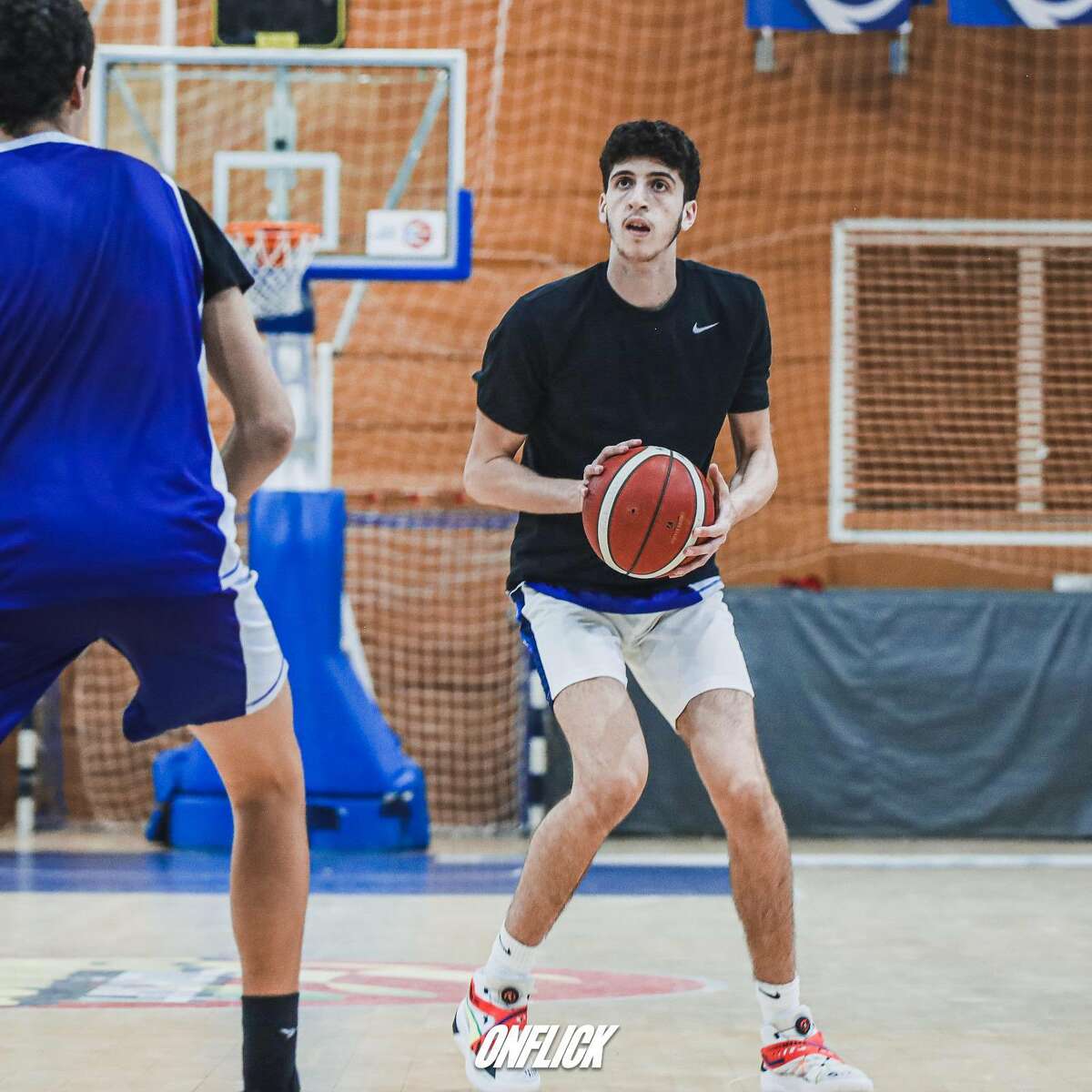
Alone with fellow freshman Apostolos Rummglou, Israeli native Yarin Hasson is hopefully the first step in UConn becoming a destination for international players. It may take a while for the versatile 6-9 forward to make an impact in actual games, as he faces a steep learning curve and most get significantly stronger. But Hasson, whom committed to UConn in late August, offers the offensive skills Dan Hurley has began looking more and more from his big men: quality perimeter shooting and passing.

Hasson, who only just turned 18, played his high school ball for Gimnasia Realit in Rishon Le-Zion. He is also a member of Israel’s U18 national team and played for the Maccabi rishon le Zion club team. The big is considered one of the best prospects in the country.

Hasson, who was encouraged to play in the U.S. by recruiter and countryman Yuval Shaham, committed to the University of Denver last spring. After admission issues with the school however, he chose to decommit and was recruited by a number of schools. Hurley and assistant Luke Murray discovered Hasson a few months, and were impressed by his YouTube videos and the Zoom conversations the trio had.

For Hasson, the coaches and school made an immediate impression on him.

“When I talked with Coach Hurley and Coach Murray, I really liked what they said to me,” Hasson told CT Insider. “They like to work hard, they have passion for the game. I liked that because that is my mindset, too.”

While there is little video out there of Hasson right now, the clips available immediately show why the Huskies decided to go after him as a developmental piece. Hasson showcases a good stroke from deep, quality passing ability and the ability to score inside as well. In addition, Hasson has been praised for his basketball IQ. Down the road, it’s easy to imagine that he could be a dangerous weapon on offense in multiple ways. While there is little information about Hasson’s defensive ability, he said he believes he could be an effective shot blocker.

As promising as Hasson is, he will not be a finished product for a while. Sham and the UConn coaches have said that he needs to become much stronger and adapt to the Huskies strength and conditioning program. Hasson, whom just turned 18, will also be much younger than the average freshman. As strong as his basketball IQ is, he obviously has a steep learning curb with the level of competition the Big East offers compared to the leagues he has competed in before. Hasson will be a valuable practice player this season, but I strongly doubt he won’t get any real minutes for at least another season.

Hasson quickly made a strong impression on his new teammates when he arrived in Storrs. Andre Jackson in particular has a lot of praise for him back in September. The junior singled out Hasson’s energy level and focus, and gave him kudos for his ability to adjust quickly to a new country and culture.

If Hasson is successful at UConn, the program may finally be able to consistently start getting international players to come, something that has not happened since the reign of Jim Calhoun. Hurley has made it clear he would like to bring on the occasional international player, particularly since they have the reputation of being more fundamentally sound than the average U.S. player coming out of high school.

Hasson is particularly unique because he may be able to open a pipeline to attracting Israeli players, something that UConn had great success with in the early years of Jim Calhoun’s tenure. In particular, Nadav Henfeld and Doron Sheffer were key building blocks to the Huskies becoming a preeminent program. Hasson spoke about the appeal UConn still has for Israeli players and fans.

“In Israel, UConn is really an iconic university and it’s really well-known here,” Hasson said. “Second, UConn is for real a big (basketball) school, a really high-major school, in the Big East. “I believe I can play at this level.”  

Hasson is exactly the type of player UConn should be bringing to Storrs to fill out the roster and serve as a developmental piece. His work ethic and basketball IQ will make him a valuable practice player, and Hasson’s versatile offensive game will immediately be a valuable skill set. If Hasson can get stronger and adjust to the level of competition over the next two years, he should be a valuable rotation player as an upperclassman. Throw in the possibility Hasson’s success could attract quality international players, and he offers a ton of upside.

Freshman Evaluation: Alex Karaban set to Bring Diverse Offensive Game to Team

Karaban, a Massachusetts native, played two seasons at the New Hampton School, earning the New Hampshire Gatorade Player of the year for the 2021-22 season. After committing to play at UConn last August, Karaban played part of a post-grad year at IMG Academy in Florida before joining UConn during the spring semester. Karaban got the opportunity to work out, compete in practice and watch his older teammates from the bench during games.

During his senior season at New Hampton, Karaban averaged 25.8 points, 8.7 rebounds, 2.9 assists and 1.9 blocks per game while connecting on 60.3% of his field-goal attempts. He led the school to the NEPSAC Class AAA tournament championship, being names the MVP of the title game. As a member of the AAU team Expressions Elite, he averaged 18.4 points, 7.4 rebounds, 2.4 assists and 1.6 blocks and earned selection to the All-Peach Jam Second Team. At the time of his commitment, Karaban was ranked 42nd in his class by ESPN.

Karaban is a 6-8 forward and entered UConn weighing 230 but had since lost 15 pounds as of the middle of August. He is a high-quality midrange and outside shooter but can also use his bulk to beat defenders at the rim. Karaban is also considered a solid passer and is an outstanding free throw shooter. He should develop into a strong rebounder for the Huskies, and multiple writers have particularly singled out Karaban’s work on the offensive glass.

Karaban will be a work-in-progress on defense at the start of his career. He was considered a solid defender in high school, particularly when playing team defense. Karaban will likely most have to work on developing more speed and improving footwork. His basketball IQ, which was signaled out for praise by Dan Hurley when Karaban committed, should help in this area and allow Karaban to adjust to different defensive schemes. It will be interesting to see if Karaban becomes an effective shot blocker over the course of his UConn career.

Karaban’s stock has only risen since the team has returned to consistently practicing over the last two months. Much of the information coming out of practice has indicated that Karaban has consistently impressed the team with his shooting, rebounding and overall effort and basketball IQ. Hurley admitted a few days ago that Karaban had a solid chance to start at forward. Although I believe Samson Johnson will be the nominal starter at the four to start the year, I’m very confident the pair will split starter’s minutes while Andre Jackson is out with injury the first two weeks of the season.

While Karaban may not be the most acclaimed recruit Hurley has recruited to Storrs during his tenure, he may be the one I am most excited to watch. The ability Karaban could have to stretch the floor makes him stand out from any other freshman big man. When you add on Karaban’s ability to score and rebound around the rim as well and basketball IQ, he could quickly become something special. If Karaban is successful, it will only help UConn’s ability to attract top recruits in the Northeast and more versatile bigs. Now just become more refined on defense, Alex.

Naheim Alleyne Brings Experience and Shooting to Storrs

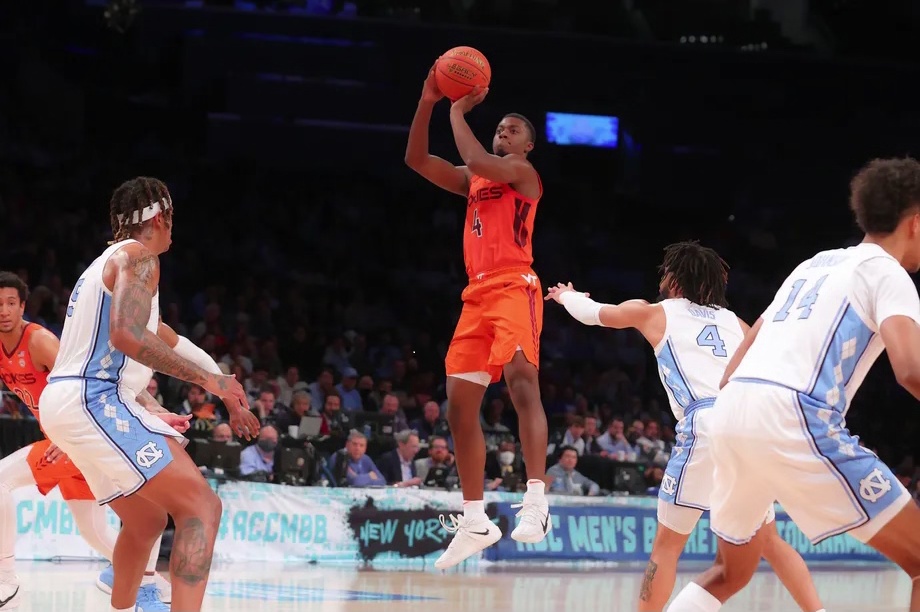
Naheim Alleyne had three strong years at Virginia Tech, averaging 9.9 points. But after a tough first-round NCAA tourney loss for the Hokies, Alleyne was looking for a fresh start in the transfer portal. That’s when Luke Murray and UConn came calling.

While the “6-4” shooting guard was heavily pursued by programs looking for shooting, Murray was the only assistant coach who directly messaged Alleyne on Instagram. Alleyne then forged a close connection with the rest of the assistant coaching staff, and once he met Dan Hurley in person and saw the school up close, Alleyne realized the Huskies were the perfect fit for him.

UConn met the three criteria he was looking for in a program: skill development, a strong relationship with the coaches, and an appealing campus environment. Meanwhile, Alleyne was fulfilling the Huskies desire for a veteran guard who could reliably put the ball in the basket and bring a winning mentality.

As a player, Alleyne profiles as a sharpshooter, reliable ballhandler and skilled defender. He is a career 38.7% 3-point shooter and has been very consistent from deep throughout his career. Last season, he shot 37.3% from three and was twenty-third in ACC play at 37.9%. He made three or more treys in 10 games. With Virginia Tech, Alleyne especially provided himself adept moving without the ball and shooting off of screens.

Overall on offense, Alleyne averaged 9.6 points per game last season with an effect field goal percentage of 48.2% and a true shooting percentage of 51.8%. Alleyne’s shooting inside the arc was again underwhelming (38.8%), but he did shoot over 85% at the line. Alleyne scored in double-digits 17 times and was strong in February during ACCC play, averaging 10 points. However he struggled in the ACC tourney even as the Hokies won, averaging just 6.5 points, and scored four on 1-3 shooting in their first round NCAA tourney loss to Texas.

While Alleyne is known for the three, he has the ability to be a solid midrange shooter as well as take the ball to the rim and score. Alleyne is not going to be a guy who regularly creates his own offense, but he can make a shot from anywhere on the floor with enough spacing. At the same time, Alleyne has the passing ability to find open teammates anywhere on the floor.

Alleyne is a very reliable ballhandler, as he committed just over one turnover per game last season. In ACC play, his turnover percentage of 13% was 19th in the conference. While Alleyne averaged just 1.5 assists, he is universally regarded as a good passer and that percentage should go up if UConn is able to knock down outside shots and spread the floor. Alleyne should especially be able to find teammates like Adama Sanogo and Andre Jackson open inside for easy looks. Because of Alleyne’s size and length, the Huskies can also rely on him to break the press in certain situations.

With his size and agility, Alleyne should be a handful against any guard or small forward he defends. He is known for his aggressiveness and active hands as well as his ability to avoid fouls. The senior transfer averaged a steal a game and had six games with double digit steals last season. With how well Alleyne seems to fit Dan Hurley’s defensive system and the coach’s ability to teach it, I could easily see these numbers going up.

Alleyne certainly has lofty goals now that he has arrived in Storrs. He told the Courant that his goal is to win both the Big East title and national championship as well as improve as a player. He also wants to show more emotion on the court at UConn, emulating Dan Hurley as much as he can.

I believe Alleyne was another great portal pickup for UConn. He’s the ideal 3-and-D player, and we know he want be intimidated playing in the Big East after facing so much talent in the ACC. All the feedback about Alleyne so far this offseason has been positive. Alleyne will definitely push Jordan Hawkins for the third guard spot in the starting lineup, although it’s more likely that he would be the first guard of the bench. Alleyne found a great landing spot, and I look forward to seeing him drain threes in my dreams.

Observations on Big East Tournament Games and Team Overall: Sanago at a Crossroads, Martin on Fire, and Questions About 3-Pointers

With the best UConn men’s basketball team since the 2014 season (in my humble opinion) ready to enter the NCAA tournament, a lot of fans will want to just completely focus on the tourney results and not dwell on what the Huskies accomplished either during the regular season or Big East tournament. There are a lot of valuable observations and lessons that can be taken from their conference tournament performance as the No. 3 seed, a quarterfinal win against Seton Hall and semifinal loss to eventual champion Villanova. In particular, I learned a lot from the performances of Adama Sanago and Tyrese Martin and how the team used them in the games.

The 62-52 quarterfinal win against sixth-seeded Seton Hall on Thursday was easily one of UConn’s best performances of the season. Its defense was elite, holding the Pirates to 18 points in the first half and just 0.87 points per possession on 35.7% shooting. The defense, particularly Andre Jackson and Isiah Whaley, absolutely shut down Jared Rhoden and Alexis Yetna, holding the dynamic duo to a combined 13 points on 4-21 shooting. While the Huskies were not exactly lighting MSG on fire as they shot 36.1%, they 17 points each from R.J. Cole and Tyrese Martin, outrebounded Seton Hall 46-33 (five players had five or more boards), limited their turnovers and shot 12-14 from the free throw line, all formulas to tournament success.

While the UConn-Villanova semifinal game on Friday wasn’t quite as exciting as the second between the two a few weeks ago, it was close. While UConn came out on the losing end of a 63-60 game, it gave the Wildcats everything they had and led in the final minutes of the first half and early in the second. What ultimately did the Huskies in was their offensive struggles in the paint and beyond the arc and inability to stop Villanova from scoring at the rim in the second. After Jermaine Samuels and Brandon Slater burned UConn on 3-pointers in the first, Samuels continued his excellent play in the second and Colon Gillespie put on an offensive clinic, finding teammates for buckets with bounce passes and finishing with 10 assists. The Huskies inability to finish shots at the rim and find quality 3-point shooting opportunities doomed them as they tried to make a comeback. Martin was their only reliable offensive player on the night, scoring 19 on 7-17 shooting and grabbing seven rebounds and two steals.

While UConn may have lost in the Big East tournament semifinals for the second consecutive year, their outstanding win against Seton Hall and solid performance against Villanova, which is a No. 2 seed in the NCAA tournament, bode well for how compeubjtitive they can be in March Madness. The Huskies, whom are seeded No. 5 in the West Region, will play No. 12 New Mexico State in the first round and should be solidly favored. After the Big East tourney, fans and the medica can feel up about the play of Martin and Andre Jackson, UConn’s excellent rebounding, especially on the offensive end, and overall defense on the interior. However, there are legitimate concerns about the play of Adama Sanago, UConn’s inconsistent shooting and the thinness of the bench. I address these subjects and more below, as well as my overall positivity about the team’s ability to go on a tournament run.

The Curious Case of Adama Sanago

There are two versions of Adama Sanago. One is the Sanago that is scoring effectively and aggressively around the basket, getting teammates involved on offense and dominating on both the boards and defense while avoiding foul trouble, even if these elements aren’t all happening at the same exact time. The other is the Sanago that is hesitant on offense and missing easy shots at the rim and or not sharing the basketball with teammates when well-guarded, struggles with foul trouble and gets lost on defense, leading to easy baskets for opponents. Good Sanago is the extremely gifted sophomore who was named First-Team All-Big East and nominated for the Kareem-Abdul-Jabber Award, which recognized the top five big men in the country. Unfortunately, the Huskies got Bad Sanago on offense at the Big East Tournament, and it especially cost them against Villanova.

After consecutive games where he didn’t play well offensively and struggled on defense against Creighton, Sanago ended his regular season on a high note against DePaul with a double-double of 26 points and 11 rebounds, giving fans hope that he would have strong games against Seton Hall and then Villanova. Sanago had been excellent against both teams in UConn’s most recent games against them. Instead, he had ugly offensive performances against both teams. Sanago shot just 2-11 against Seton Hall and scored just six points, and then had 15 points on 6-15 shooting against the Wildcats and went 3-7 from the free throw line. Sanago committed two turnovers in both games and had a single block between the two, coming against the Pirates. There were bright spots, as Sanago grabbed a combined 24 rebounds against the teams and generally avoided foul trouble while playing solid defense.

Against Seton Hall, Sanago did not obtain a lot of high-quality shots, as the Pirates did a very good job of not allowing him to get position deep in the paint and playing him aggressively without fouling. However, there was still no excuse for Sanago not to make at least a couple of more shots. While his performance was concerning, it was less of an issue with the Huskies ahead virtually the entire game, and I was pretty confident that he would have a better game against a Villanova defense that wasn’t quite as good or had the length of Seton Hall. I was very wrong. Despite being able to establish strong position in the paint and getting a decent amount of open looks against the Wildcats, Sanago consistently missed shots within five feet of the rim, a few times even badly. While he was able to get to the line seven times, Sanago missed four of the shots. The sequence that summed up his struggles came when he got the ball on four straight possessions and scored just one point, missing free shots and a free throw during the stretch. Sanago still ended the game with a double-double of 15 points and 13 rebounds and was far from the only UConn player that had an ugly offensive day, as Isiah Whaley went scoreless and R.J. Cole 1-6 on 3-pointers. However, his team probably would have won if Sanago had hit just two or three of his open looks at the rim.

For Sanago, who played poorly in last season’s first-round NCAA tourney loss to Maryland, it is time to step up Thursday. He should have a big advantage against New Mexico’s state front line and if the Huskies most likely face Arkansas in the second round, a favorable matchup as well. Sanago needs to start either using the backboard or dunking the ball more on his shots to make it easier for him to score, and absolutely needs to involve his teammates more when well-guarded against the high-quality defenses he could consistently face in March Madness. At the same time, he needs to show a killer instinct offensively every second he is on the floor. I am expecting Sanago to rebound well against any opponent he faces and play good defense against most of them as long as he avoids foul trouble. If he isn’t efficient and smart offensively however, UConn will be in trouble and games could turn ugly.

Tyrese Martin Emerging as a Star on the Biggest Stage

My man crush on Martin is well-documented, and every UConn fans knows how important his versatility on both ends of the floor has been to the team’s success this year. He still seems to be overshadowed by Cole and Sanago and not fully appreciated by the media however, as he was snubbed for each of the All-Big-East teams despite averaging 13.5 points, 7.6 rebounds and 2 assists per game despite missing four games due to a wrist injury and dealing with lingering effects to his wrist throughout the season. Martin, whose big personality and competitiveness has always been a treat to see, was sufficiently motivated by the slight and said he would get back at it by trying to earn the conference tournament MVP award. While he didn’t quite reach that goal, Martin still earned a place on the All-Tournament team by averaging 18 points, 7.5 rebounds and 2 steals and assists against Seton Hall and Villanova.

Martin was outstanding on both ends in each game and especially against Seton Hall. The senior forward spent the whole game trash-talking the Pirates and absolutely shut down Pirates star Jared Rhoden, limiting him to 7 points on 2-13 shooting. Martin made some tough mid-range shots whenever the Huskies needed them, distributed the ball well (4 assists) and was strong on the boards as always with 8 rebounds. Against Villanova Martin was by far the most reliable offensive player, going 4-8 from three, and helped keep UConn in the game in the second half with multiple 3-pointers. As in the first game, his defense and rebounding continued to be strong.

Martin could be a nightmare for New Mexico State and any other NCAA Tournament opponents to content with. His ability to contribute in nearly every facet of the game, as well as his 3-point shooting (43.9%) in Big East play, can allow him to make a difference even if his shot isn’t falling. In addition, Martin is arguably UConn’s emotional leader along with Whaley and can help his teammates get through any struggles and intimidate opponents. As long as Martin is having a strong offensive game and can mostly avoid his issues with fouling and turnovers, it will be very hard for the Huskies to lose to an opponent.

UConn Continues to Dominate the Boards While Improving its Ball-Handling

Everyone already knows the Huskies rebounding prowess, especially when on offense, but there were still occasional games throughout the season when UConn had fewer rebounds than opponents even when the team had a clear advantage in this area normally. This has not been a problem lately, as the Huskies won the rebounding battle comfortably in the final few regular season games and then against Seton Hall and Villanova. This especially made a huge difference against Seton Hall, as their second-chance opportunities helped overcome a poor shooting night. While UConn did not convert on many of its second-chance opportunities against the Wildcats, their offensive rebounding helped to eat up clock and limit Villanova’s scoring opportunities. The Huskies talent on the boards will help nullify New Mexico State’s strength in this area as well. If they advance and most likely face Arkansas, they are better on the boards on paper as well.

While UConn’s struggles where turnovers have been a problem throughout the season, it has improved its ball-handling remarkably since early February, a huge factor in the team’s success late in the season. That continued in the Big East tournament, as the Huskies committed 17 turnovers against 22 assists, and only 7 versus Villanova. As a team, their turnover rate of 17.4% ranks 110th in the country. It is still higher than a team of their caliber should have, but the improvement is a good indicator for NCAA tourney success. New Mexico State forces turnovers just 16.4% of the time and Arkansas 17.4%.

Most of UConn’s improved numbers in the turnover department can be attributed to the improvement of Andre Jackson when handling and passing the ball. After being a turnover machine at times for much of the season, Jackson has not committed more than one turnover in six consecutive games while averaging four assists per game during this span. Jackson has not been as reckless when running the fastbreak and cut down on making risky passes that teammates are not ready far while still showcasing his outstanding his outstanding court vision. While his minutes have been limited, Jalen Gaffney has been more careful with the ball when running the paint recently, and Jordan Hawkins has been more disciplined with his dribble when handling the ball, although Dan Hurley has rarely put him in the position to do so. If these players can continue to limit their turnovers and guys like Martin and Sanago can be more disciplined with the ball, then UConn’s offense can run a lot smoother in the tournament.

The 3-Pointer Conundrum

Entering the season, many fans were worried about how well UConn would shoot from deep after they didn’t get a sharpshooter on the transfer market. It was actually significantly better on 3-pointers than myself and many others thought they’d be, draining 35.3% of them overall (79th in the country) and 35.7% in conference play (fourth). While Cole and Gaffney’s numbers from deep fell, Martin improved significantly, as did Polley to a small extent and Jackson significantly. Add on the contribution of Hawkins (33.3%), and the Huskies 3-point shooting numbers were actually a strength of the time. At the same time, they were pretty inconsistent against high-caliber team and struggled mightily on threes in the last four games of the season (27.3% against Creighton and 30% against Seton Hall). The team also had issues getting Polley open for 3-point opportunities, with an example being him taking no more than three 3-pointers in any of the last five games.

After missing three games due to a concussion suffered against Creighton, Hawkins is expected to be able to play a significant number of minutes against New Mexico State. His presence will help make it easier for UConn to get good 3-point shooting opportunities in the NCAA Tournament. To go on a tournament run, it is essential that the Huskies shoot well from deep. It’s not only a skill that’s been demonstrated to be a barometer for tournament success over time, but will make it easier for Sanago to score as defenders will be drawn away from him. Martin needs to continue to make threes at a consistent clip, Cole needs to be more consistent and another player (likely Hawkins, Whaley or Jackson) will need to contribute at a decent clip. Most importantly, the team needs to find a way to get Polley a decent number of opportunities in every game it plays, particularly shots where he is set, and he needs to do his job and be the sniper he was recruited to the program to be. New Mexico State has held opponents to just 30% from deep (20th in the country), so the Huskies have their work cut out for them.  

While there’s legitimate concern about UConn’s ability to make threes, the bigger issue is allowing threes. It allowed all opponents to shoot 34.5% (233) and conference opponents to make 35.8% of treys). It allowed their last three opponents to shoot over 33% from three, and generally allowed a lot of opponents and players who weren’t particularly good from three this season to have very good nights against its defense (See Brandon Slater and Jermaine Samuels against Villanova). Part of opponent’s success from three against UConn is due to its defensive system, which prioritizes guarding the rim and not allowing ball handlers to beat them off the dribble. While the hard hedge is very successful on defense a majority of the time, it can make it harder for players to close out late on 3-point shooters. As I discuss more below, the Huskies have to be willing to make defensive adjustments to limit quality 3-point opportunities if a player or full team is going off. The players also need to communicate with one another to help limit kickouts and make sure players are capable of closing out efficiently.

New Mexico State and Arkansas are both poor 3-point shooting teams, although Vermont is an excellent one if they managed to pull off the upset against the Razorbacks. While a lot of luck is involved when team’s have especially good games from deep, I could absolutely see that being a big Achilles heel for UConn whenever it loses.

Will Dan Hurley be Flexible?

Hurley had a very good year. He continued to be an excellent defensive coach, tweaked things on offense in the second half of the season that allowed it to become more efficient and began to win more close games as the season went on. Hurley was also instrumental in helping Jackson and especially Sanago make big leaps as sophomores. At the same time, Hurley needs to be willing to make adjustments in a couple of areas in certain situations during March Madness, especially if the Huskies are losing to New Mexico State or another opponent down the round.

The first area UConn and Hurley need to be flexible is with their starting lineup. It has consistently started games out slow and a huge factor in this is the lack of offensive power in its regular lineup with Jackson and Whaley. As elite of a defender as Whaley is, I think that the team would generally be better off starting Polley or possibly Hawkins (although I very much doubt that will happen). Starting Polley involved could help him get going early and allow the Huskies to possibly stretch the floor at the same time, which could be a huge boom for Sanago. I am almost completely sure that Hurley would ride the starting lineup he has all season, but it would be interesting to see him change it and throw a wrinkle into the game plan of opponents, especially considering the strength of New Mexico State’s defense.

A second area Hurley needs to be flexible is making sure to his players that they cannot fall into a habit of feeding Sanago and watching him work, especially if Sanago is struggling. Instead, Sanago needs to be told to pass the ball out or to cutting teammates if he is not in good scoring position and then find methods for allowing Sanago to score more easily. Sanago should be very effective against New Mexico State, but UConn would need to continue to follow this strategy against any opponent it faces. Finally, Hurley needs to be way more flexible with his defense if the Huskies are struggling in the man-to-man and with playing the hard hedge, which would involve practicing it a decent amount in the leadup to Thursday’s game. I’d like to see him throw in some variation of a zone if the defense is shaky. Ditto with a box-and-one defense. If the team is consistently struggling to stop a single player, which in this scenario would likely be Aggies star Teddy Allen, I believe Hurley shouldn’t hesitate to double-team said player. Finally, I would love to see the Huskies press ball-handlers in an effort to get more transition opportunities. When you’re in the win-or-go-home situation of an NCAA tourney game, a team shouldn’t hesitate to try anything that might give them a better chance t

Observations About Last Week’s Games: Sanago is Inconsistent, Defensive Breakdowns Against Seton Hall and Questions About 3-point Shooting

This is the first of two articles I am going to write about the UConn men prior to their Big East tournament quarterfinal game against (likely) sixth-seeded Seton Hall (20-9) or No. 11 Georgetown (6-24), arguably the worst power conference team in the country. UConn, which easily swept the Hoyas and split their contests with the Pirates, suffered a frustrating 64-62 loss at Creighton last Tuesday before playing very well on Saturday’s Senior Day against a feisty DePaul squad in the 75-68 win. With their final win, the Huskies earned the tournament’s No. 3 seed when Creighton fell to Seton Hall later that day. The team officially ends the regular season 22-8, 13-6 in Big East play and having won six of seven games. It is the fewest losses a UConn team has had during a full regular season schedule since 2014, the last year it won a championship.      

No one except for R.J. Cole had a particularly effective game in the 64-62 loss to Creighton, which ended up being the only team to sweep the Huskies in conference play. The senior scored 20 points and had four assists, with the only black mark being his 2-7 shooting from three. Tyrese Martin scored 11 and had 5 rebounds but was limited to 25 minutes due to foul trouble and ended up fouling out, and the only other player with more than six points was Tyler Polley, who hit two 3-pointers. UConn’s offensive line was mostly ugly across the board, as it shot just over 40% and went 6-22 from beyond the arc while getting to the line just five times and making only two free throws. It took care of the ball (six turnovers) but had just seven assists. While it had 12 offensive rebounds, the team was ultimately outrebounded 37-33.

I talk a lot more about Adama Sanago below, but offensively he struggled to finish shots and convert on second-chance opportunities against “7-1” Ryan Kalkbrenner and help defenders, ultimately shooting just 6-16 for 13 points, although he had 16 rebounds. Andre Jackson and Isiah Whaley were left open purposefully by the defense as a gambit to force them to make outside shots and it worked, as the two combined to shot just 3-15 for 8 points. Jackson took a number of ugly jump shots in particular and was 0-6 from three. The Huskies shot selection was iffy throughout the game and Sanago and others could not finish shots at the rim. The inconsistent production by the big men and lack of outside shooting was a big factor in why the team trailed 34-24 at halftime, and even after they got it going early in the second half, that deficit and their defensive deficiency’s UConn was experiencing made a comeback win too steep of a hill to climb. It tied the game a couple of times, the last time at 50 on a Martin jumper with 8:18 to go, but never led.

Now about those defensive deficiencies, which again I discuss further below. UConn allowed Creighton, a decent offensive team that was missing its starting point guard and had gotten blown out by 21 against Providence a few days before, to shoot 49% overall and 53.5% on 2-pointers and earn 14 assists against 10 turnovers. In the first half it allowed big man Arthur Kaluma to go off and drain three treys despite being a terrible shooter from deep, and generally was able to beat defenders off the dribble and score in screen and roll action. The Huskies upped their ball pressure at the start of the second half and were able to force enough poor shots and turnovers to come back and tie the game, but the Bluejays and coach Greg McDermott eventually figured things out. McDermott began going to Kalkbrenner in the screen and roll action at the rim, and continued to feed him when adjustments were made. The rest, as they say, is history, with Sanago being the main player successfully targeted by Creighton. Kalkbrenner finished with 22 points, 20 in the second half, on 10-14 shooting and 10 rebounds. Kaluma put up 15 and Ryan Hawkins 13, 6 rebounds and 3 assists.

There was one other big factor that possibly led to the loss. Jordan Hawkins, who had already been hit in the previous game, picked up a concussion on a great screen by Kalkbrenner that the much smaller freshman didn’t see. Hawkins, who was scoreless in five minutes up to that point, had to be removed from the game and is in concussion protocol, meaning he will almost definitely miss the Big East Tournament and could be a question mark for the Huskies first NCAA Tournament game as well. I will talk about the ramifications of this more in the next article, but suffice to say that his absence could cause huge ramifications on both sides of the ball and make it more difficult for the team to hit perimeter shots and space the floor.    

The win over DePaul Saturday went much smoother, as the Huskies controlled the action for most of the game and dominated the paint throughout. Sanago scored 12 of the team’s opening 14 points as he got the ball in excellent scoring position and overpowered defenders, and kept up his dominance on offense and the boards throughout the half, scoring 20 points. Whaley and Martin were also efficient in the first half and Jackson did a strong job of helping to run the offense and on defense. After some lax defense early, UConn tightened up and eventually took a double-digit lead, going into the locker room up 40-29. It continued to play well for most of the second half, with Martin especially doing an excellent job on the board and earning second-chance paints, and led 70-53 with 4:29 to go. Unfortunately, the Huskies continued their habit of taking their foot of the gas and let another inferior opponent make the game closer than it should be. DePaul star Javon Freeman-Liberty finally woke up after being held in check most of the night, and drained multiple threes to help cut the deficit to just five points before UConn closed the game out at the free throw line.

After maybe his most checkered game of the season, Sanago bounced back with 26 points and 11 rebounds on 10-16 shooting. Martin was a wrecking crew with 19 and 16, while Whaley went for 10 and 6. Jackson did a little bit of everything with 7 points, 8 rebounds and 4 assists. The only concerns on offense were UConn’s 3-point shooting, as it went 3-12, and the struggles of Cole, who ran the offense effectively but shot 1-9 for 3 points. The team outrebounded DePaul 49-31. The Demon Deacons shot just 39.4% overall but went 10-26 from beyond the arc. Freeman-Liberty had 22 and shot 3-5 from three.

Last week’s games offered plenty of exciting moments and reasons for optimism heading into tomorrow night, as well as some frustrating moments and reasons for pessimism entering the Big East Tournament. As I will discuss more in the next article however, overall, I am very excited to see the Huskies compete at MSG and legitimately believe this squad has the chance to win the whole thing if things fall their way. At their best, they have the athleticism and strength on defense to shut down the paint and alter perimeter shots as well as generate turnovers. On offense, they have the best big man in the Big East and one of the best guards and can score in a variety of ways and be dominant on the fastbreak and offensive boards. Certainly, winning the Big East tournament would be a great accomplishment for Dan Hurley and demonstrate that he is one step closer to making UConn a dominant program again.

Below, I discuss how the Seton Hall and DePaul games demonstrated the strengths and weaknesses of Sanogo’s game, the need for Dan Hurley to make adjustments on defense, the rocky but rewarding development of Andre Jackson and the team’s struggles from beyond the arc, among other topics.

The Ying and Yang of Adama Sanago

At this point, devoted UConn fans understand how important Sango is to the team’s success, and the ramifications it has on the team when he struggles on one or both ends of the court. He is one of the best big men in the country and especially on offense and as a rebounder, which was recognized by him being named to the Big East All-First Team on Monday. And yet when he struggles offensively, he can be a black hole and affect the Huskies spacing, and against certain opponents and big men he can struggle defensively, especially with all the hedging Dan Hurley asks his bigs.

Against Seton Hall, he struggled from the start and everything snowballed from there. On offense, Cole and others were able to get the ball to Sanago, but the Pirates defenders did a strong job of pushing him away from the basket without fouling. The sophomore struggled to finish make shots even if they were of high quality, with a lot of his misses just barely rolling off the rim. Sanago earned just two free throws, making one, and could have done a much better job of trying to force contact or attempting dunks. When he got the ball Sanago almost never passed it out even when he wasn’t in good shooting position, a frustrating habit that has consistently been an offensive weakness. Ultimately, Sanago shot just 6-16 to finish with 13 points and was visibly upset by his struggles. To his credit he was still great on the offensive boards, grabbing 5, and finished with 16 rebounds overall.

Even with Sanogo’s offensive struggles, UConn shot over 47% on 2-pointers and was efficient enough on offense in the second half to pull out a win. It was his weaknesses on defense, especially in the second half, that was probably the biggest factor in the Huskies losing. To be fair, Sanago had 6 blocks and was far from the only player that struggled defensively in the final 10 minutes of the game, and much of his defensive weakness was due to the system UConn uses, which I discuss more below. But in the end, the lasting image of the game for me will be Sanago being out of position or late to get back on Kalkbrenner as he easily made layups or dunks on screen and rolls. The defense decided to stick with Sanago doing hard hedges up near the 3-point line instead of initially defending the paint or playing Kalkbrenner one-on-one and it paid the price. By the end of the game, it was completely clear that Sanago, who played 37 minutes, was spent on both ends.

One great skill of Sanago is that he has repeatedly been able to rebound from subpar performances to play very well in the following game or games. I already discussed his play against DePaul above (26 points on 10-16 shooting and 11 rebounds) and Sanago definitely set the tone early and demonstrated UConn could get off to a strong start and dominate the Demon Deacons inside. He will definitely need to demonstrate this ability if the Huskies advance in tournament play. Sanago is the type of player who can carry the team on a run in the Big East and NCAA Tournaments, but his teammates and coach need to put him in position to succeed and he needs to be willing to involve others on offense.

The Creighton Loss Exposed the Weaknesses UConn Can Suffer from on Both Ends of the Floor

Again and again, the Bluejays have demonstrated to fans and opponents the best methods to beating UConn in different ways. Last week, they demonstrated how its inconsistent shooting, how best to attack the Huskies with screens and rolls and their reluctance to quickly change things up defensively.

On offense, the game showed how difficult it is for UConn to score if Sanago and other bigs are held in check and it is not making shots from the perimeter, as Cole cannot do everything himself. The Pirates invited Jackson and Whaley to take 3-pointers and the pair obliged, combining to go 1-9. Much has already been said about Jackson’s ugly stroke and as conference play as gone on his numbers from beyond the arc have predictably gone down. Whaley is inconsistent at best from beyond 15 feet, and if teams are able to effectively guard Polley and Hawkins on the perimeter then the Huskies are in trouble. It would have ben nice to see Cole and Martin pick up the slack against Seton Hall, but the first shot 2-7 from there and Martin took just one three partly due to his foul trouble. Throw in a mix of good defense on Sanago, limiting fastbreak opportunities and rebounding well and rebounding well defensively, all of which the Pirates did, and you are almost guaranteed a win.

As I said earlier, UConn was able to rebound in the second half against Seton Hall because of its effectiveness from midrange and ability to avoid turnovers. However, it was burned from deep by Kulama in the first half, falling behind by as much as 16. After the Huskies fought back to tie the game multiple times, the Pirates figured out how to effectively attack them in the screen and roll repeatedly for baskets, as well as beat them one-on-one when necessary. Because of how frequently UConn hedges, it has occasionally had trouble limiting offenses that have the size and speed to counter them, which Seton Hall certainly does. The defense has also occasionally struggled to defend guards off the dribble or strong big men one-on-one and unfortunately did this in the loss.

While I cannot guarantee whether switching up the defense would have resulted in a win against Seton Hall, I share the belief with many fans that Dan Hurley is too slow to make defensive adjustments. Yes, he has started to make more adjustments in certain games recently, such as playing a zone for short stretches or doubling a player who was giving his defender trouble. And the success of Hurley’s defenses at UConn speaks for itself. Still, he failed to go to some type of zone or double Kalkbrenner to try and limit the Pirates success on screen and rolls in the final 10 minutes of the game and instead watched them score easily again and again. It was inexplicable and Hurley deserved every ounce of criticism he got for these decisions. In tournament play, he cannot afford to fail to be flexible and not give his players as many resources as they need to succeed and win. I just hope Hurley realizes that he will need to roll the dice at times.

Against DePaul, UConn overcame its continued struggles from deep by bullying its opponent inside. However, Seton Hall has at least some of the same qualities as Creighton that gave the Huskies trouble, as does Villanova if the Huskies advance. It will be fascinating to see if they can overcome this and win.

UConn is Again Off from Three

After multiple games where the Huskies shot well from deep and were able to pull off a key win streak, the Huskies crashed back down to Earth the last two games, shooting 9-34 treys (26.5%). With Hawkins almost totally absent due to his concussion, the only other reliable 3-point shooters were Polley and Martin and they only took eight between the two of them, although they hit five. Cole (2-11, Jackson (1-7) and Whaley (1-4) all struggled from beyond the arc. UConn ended the Big East season having hit 35.7% of their threes, good for fourth.

The Huskies will need to be able to hit threes against Seton Hall and whatever opponents it faces in tournament play from there. It is doable against the Pirates, who ranked middle of the pack in the percentage of 3-pointers it allowed in conference play. They were unstoppable in the January loss to SHU, shooting 14-23, but just went 4-18 from deep in the win against it three weeks ago. UConn will need to consistently play inside out, get 3-point opportunities off of fastbreaks and find ways to get Polley open (he has the flu but will almost definitely play). While Sanago and Cole will always be options A and B, the Huskies need to find ways to get Polley open (he had the flu but is going to play as of Wednesday morning) and Martin to take more 3-pointers. With Hawkins out, Hurley may need to sacrifice his defense and rebounding to a small extent and play at times with more shooters such as Akok Akok and Jalen Gaffney until he returns. Considering UConn’s offense is pretty vanilla much of the time, it will need to hit enough 3-pointers to keep defenses honest in its remaining games.  

 We Saw the Best and Worst of Andre Jackson

The sophomore shooting guard demonstrated both how infuriating and fun he is to watch against Creighton and DePaul. Against the Bluejays, he took a few inexplicable threes and missed all six attempts (I find it hard to believe that Hurley gave him the go-ahead to take those shots), likely in an effort to help the Huskies overcome Sanogo’s struggles. While he may have been deliberately left open to take perimeter shots, Jackson would have been better off attacking defenders off the dribble and trying to get to the rim for easy looks and to draw fouls. The size of Creighton and Jackson playing on the perimeter more than usual helped nullify his rebounding skills and he ended the game with just three, all offensive. Jackson continued to handle and pass the ball well and finished with 3 assists against 1 turnover, but his playmaking ability was limited by the sow halfcourt game both teams were playing. Creighton’s focus on forcing Jackson to beat it from outside and general ability to play at a tempo where he is much less effective was the perfect antidote. He needs to realize what he can do offensively if his 3-point shot isn’t following against a similar opponent.

On the other hand, against DePaul Jackson flashed all the skills that make him such a nightmare for opponents to prepare for. He had 8 rebounds and 4 assists with only one turnover, played solid defense and scored 7 points, getting to the rim for two baskets and knocking down a quality 3-point opportunity. Jackson was in his element throughout the game as he got a chance to run the floor and set Sanago and Whaley up for good looks inside. As always, his passing was a pleasure to watch.

Even if Jackson doesn’t score a ton of points, he could be very effective in tournament play, especially against opponents who haven’t seen him before. His court vision and athleticism are second to none, and Jackson has improved his decision-making and accuracy on passes a ton in the second portion of the Big East schedule. He can almost always be relied upon for some rebounding and dominate on the I boards against the right opponent, and Jackson has legitimately become a strong defender, even if he can sometimes fall into playing “matador” defense. Going forward, Jackson just needs to trust himself and not try to do too much. To me, that means he should be more aggressive attacking the hoop and rely less on his 3-point shot, continue to not force passes to teammates, avoid foul trouble and play with a consistently high motor the entire game. I am not sure Jackson can be a reliable force on the tournament stage. But if he is, he can take over multiple games.

What UConn Needs to Do to End the Regular Season Well

The buzz surrounding the UConn men’s basketball program right now is the highest I can remember in years, possibly since the 2014 season. The 21-7 Huskies, who are 12-5 in the Big East, have won five straight, are third in the Big East standings and strengthening their case for a high seed in the NCAA tournament. For the third consecutive season, the program is playing its best basketball at the end of the season. In particular, UConn has been playing outstanding offense recently, particularly from beyond the arc.

Creighton and DePaul would like nothing better than to extinguish the Huskies momentum in their last two regular season games in the coming days. Creighton, in particular, has never lost to them in five games and wants to maintain that superiority and sweep the season series between the teams. If the Bluejays win at home Wednesday night, they can finish third in the conference standings if they and UConn finish with the same record. And while DePaul is currently 10th in the Big East standings at 5-13, the Demon Deacons have been a handful for many of the conference’s best teams, including the Huskies at the end of January. While UConn is playing very strong overall, there are areas they need to improve on or be more efficient in.

The aspects of the game the Huskies either need to improve or continue to play well in against Creighton tonight and DePaul Saturday are numerous. While the team may be flying high right now, Creighton is a very tough environment to play in, and a loss to DePaul would be an embarrassing slipup and leave UConn with a bad taste in its mouth entering the Big East tournament at MSG. Not to mention that a loss to either team would move the team to a fourth-place seed in the tournament and possibly a tougher second-round matchup. Below, I discuss what UConn must do tonight and Saturday to win and maintain the excitement around the team.

  1. Tyler Polley and Jordan Hawkins need to continue being effective on offense, preferably at the same time

When Polley and Hawkins are both playing well offensively the Huskies have proven to unstoppable, as exhibited by the team’s 5-0 record when the pair scores in double digits. All season long Polley and Hawkins have been touted as UConn’s x-factors and it’s been proven to be true during this most recent win streak. Polley is on one of his vaunted multi-game hot streaks from deep, as he shot 7-12 from three and averaged 12 points against Xavier, Villanova and Georgetown and drained one of the most memorable shots of the season with his three against ‘Nova in the comeback during the final minute. At the same time, Polley went 9-10 from the line against them and Georgetown. Hawkins has improved immensely on defense, and the improvement on that end has earned him more playing time and the ability to figure things out at that end. The freshman played well on offense in his 14 minutes against Xavier, scoring 7 points via a 3-pointer and four free throws. He then had one of his best offensive performances of the season against the Hoyas Sunday, scoring 11 in 21 minutes on 3-6 shooting and making a spectacular dunk. Hawkins shooting from deep has slowly improved and he is demonstrating the ability to effectively attack the basket, a skill the Huskies definitely need more of.

When one or both of the sharpshooters are feeling it in a game, UConn’s offense is much more efficient. Space opens down low for Adama Sanago and others to get good looks at the basket, the team can play inside-out and move the ball well side-to side, they have more options on fastbreak plays, and players have good chances for offensive rebounds if Polley or Hawkins happens to miss. When Polley comes off the bench for Isiah Whaley or Sanago and plays with the other starters, these lineups rank 7th and 8th in the Big East in adjusted team efficiency margin per Evan Miya.

It is particularly important that Polley and Hawkins as well as the other bench players play well against Creighton. The Bluejays have the top defense in the Big East according to KenPom, and h against Cave held opponents to 31% from three in conference play, which also ranks first. In the first matchup with Creighton, UConn had one of its worst offensive performances of the season in a 59-55 loss, with Polley and Hawkins combining to go 0-7 from the field and the team 5-21 from deep. If the pair can hit a handful of 3-pointers and open up the team’s spacing, it will open up the team’s spacing and give them a leg up in what will probably be a low-scoring and physical game. If they can get to the line, that would be valuable as well since the Bluejays normally allow few foul attempts.   While the Huskies should be able to perform well on offense against DePaul, it would be great for Polley to end his regular season career with a strong performance on Senior Day.

  • Adama Sanago needs to end the regular season with a bang

Adama had arguably his worst game of the season Sunday against Georgetown, especially considering the level of competition. He fouled out in just 18 minutes, putting up only 6 points and 2 rebounds while committing 5 turnovers. Sanago seemed disengaged and let the refs quick whistle affect him, and with the rest of the offense humming teammates didn’t look for him as much as normal. Sanago needs to stay out of foul trouble and avoid ones out on the perimeter against Creighton and DePaul while playing disciplined on offense. That means establishing position in the paint and not forcing shots out too far from the basket, and passing the ball back out effectively if he does not have good position, which will help Sanago to avoid turnovers. Finally, he will need to block out effectively on both ends and put himself in position for putbacks.

Sanago also struggled to score in the first game against Creighton, putting up 8 on just 3-10 shooting, and had only one block. His performance against DePaul was also mediocre, as he only finished with 10 points. The Bluejays are tremendous at depending in the paint and allow opponents to shoot just 43.4% on 2-pointers, eighth-lowest in the country. Against their big front line, Sanago will need to establish position deep have success in the paint early and often, while passing out successfully when necessary and to avoid turnovers. The sophomore has shown the ability to play very well against big men he struggled against in rematches (he just did last week against Villanova and Eric Dixon), and I am confident he will do so against Creighton and then continue to stay engaged and have a good game Sunday against the Demon Deacons.  

  • Avoid turnovers!!

I realize the 16 turnovers UConn had against Georgetown was somewhat of an outlier, as they were largely the result of Sanogo’s struggles and then the benchwarmers not being prepared for the Hoyas press in the last two minutes of the game. Still, the Huskies are a team that has enormous struggles taking care of the ball at times, especially in conference play (their turnover percentage of 18.3% is eighth in the Big East). Even though Creighton’s defense does not force many turnovers and UConn had just nine against them in the first game, we have seen the offense have multiple games where they committed costly unforced turnovers against teams that don’t rely on forcing them.

To carry over their success at limiting turnovers from the Villanova and Seton Hall wins, the Huskies offense must make sure not to force passes to players who are well-defended or not ready, avoid playing out of control and make sure that they throw the ball over defenders if they are being pressed or trapped, especially along the baseline. The UConn players also need to make sure that they have a tight grip on the ball and are dribbling the ball high to make the team less susceptible to steals. Among the players, Sanago, Whaley and Tyrese Martin must do their best to avoid the turnover issues they have experienced recently, while Andre Jackson needs to continue distributing the ball efficiently while not forcing passes or trying to make plays that are overly flashy.

The defense needs to be more disciplined, especially when guarding the 3-point line

UConn’s defensive effort was lousy for most of the second half against Georgetown, which came into the game as the worst offense in the Big East. It did a poor job of guarding the rim and fouled way too much (though a late of that was on poor officiating), and the help defense was frequently too late both at the rim and on the perimeter. In general, the Huskies did not look like they were trying to extend much defensive effort once they got a comfortable lead, resulting in 1.15 points per possession. While I expect a much more robust effort against Creighton, a mediocre offensive squad that doesn’t shoot very well, UConn has struggled to guard the paint at times during February, even in wins, and their 3-point defense is eighth in conference play. Against a Bluejays squad that commits a lot of turnovers, the Huskies will need to avoid being beaten off the dribble and play tight defense without fouling, while also pressuring the ballhandlers to make steals more likely. At the same time, UConn will need to consistently provide help defense when necessary and avoid giving Creighton too many open looks from three. It shot 9-17 in the first matchup with UConn, arguably the biggest factor in their win. While DePaul is a weak offensive team, the Huskies need to continue playing good defense against it to give them momentum heading into the Big East tournament.  

Observations on the Win Against Villanova: UConn Sticks the Landing, Sanago and Whaley Own the Paint and the Importance of Ball Control

What can you say about UConn’s 71-69 win against Villanova on Tuesday night?

The most important win the program has had in the post-2014 era? Check. A win that demonstrated to college basketball fans the program cannot only challenge but beat the best of the Big East and that it is on the cusp of being a national power again? Check. An indication that the Huskies are gelling and playing their best at the right time? Check. I have more to talk about in regards to the importance of this win elsewhere on the blog. As far as observations go, however, the essential observation I had right after the win was that UConn was facing an excellent Villanova squad having a good night, and yet didn’t flinch and executed a great game pan that took advantage of the team’s biggest strengths and allowed them to overcome the Wildcats.

The resolve that the Huskies showed throughout the game, helped by the encouragement of the wonderful XL Center crowd, was admirable. After they got off to a very quick start led by Adama Sango, they consistently responded to Villanova’s baskets to keep it a back-and-forth game. When Dan Hurley was ejected with just under five minutes remaining in the first half (more on his ejection near the end of the article) and the Wildcats scored five points off of his two technical to go up 29-24, UConn could have tried to force the action or become flustered and fallen further behind by halftime. Instead, Kimani Young took over as head coach and the trio of R.J. Cole, Sanago and Isiah Whaley all made tough baskets and the defense clamped down to ensure the team led by one (33-32) at halftime.    

Throughout much of the second half, the Huskies kept up its high level of play even as Villanova did everything it could to gain control of the game. They came out like gangbusters and scored 10 points in less than three minutes to take a 43-36 lead, with Tyrese Martin draining two 3-pointers during this stretch. After the Wildcats quickly drained two threes to make it a one-point game, the next 10 minutes of game action were frustrating for UConn, as Villanova drained a succession of threes despite good challenges from Husky defenders and their offense struggled to score at the rim. With 7:55 remaining, Colin Gillespie hit a three to put his squad up 56-54. Again, UConn would not go easy, scoring five consecutive points in the next minute, including a three by Tyler Polley off a gorgeous pass by Andre Jackson, to go back up by three.

While the Huskies were largely able to shut off the paint, the Wildcats used their excellent ability to force contact to get to the free throw line and regain the lead. Adama Sanago scored four points to retie the game at 65, but free throws by Gillespie and Brandon Slater put ‘Nova up 69-65 with just 30 seconds left. With Villanova getting to the line at will and the Huskies struggling with turnovers for the first time all game, I have that I didn’t have much hope that the team could rally and win the game in that short of time. Luckily for me, I was mistaken. Young and UConn did everything right on both sides of the ball to pull off the comeback, setting off a wild celebration for fans at both the XL and elsewhere.

While the Huskies have had a very impressive February in general and are now on a four-game win streak where they have beat a quartet of squads that will or almost definitely make the NCAA Tournament, Tuesday night’s win was a clear indication that UConn can beat anyone and go on a deep run during March Madness. It also allowed the Huskies, who are third in the conference standings, to get revenge on a Wildcats program that have defeated them five consecutive times since 2014. They may still be the class of the conference, but its clear that UConn (and surprisingly Providence) will have something to say about this both now and in coming seasons.

There were a million observations on UConn’s win I have had from the minute after the game ended until now. Just a few of these described below include the decision-making and execution of Young and his players in the final 30 minutes, the Huskies ability to own the paint behind Sanago and Whaley, the importance of the team’s improvement from beyond the 3-point line, and the unforgettable ejection of Hurley. Enjoy.

Kamani Young and the Seniors Execute a Beautiful Comeback

If an uninformed viewer flipped on a TV during Tuesday’s game and had no prior knowledge that Young was an assistant (officially associate head coach) with no prior game coaching experience, they would probably think Young was an old pro as a head coach. In contrast to the always animated Hurley, Young projected an air of confidence and coolness while still strongly encouraging his players. If he was nervous, he certainly didn’t show it. Young did a good job of managing minutes, especially for Cole, and the offensive sets generally looked like they were run pretty efficiently, with the team ultimately finishing with 15 assists to Villanova’s 9. UConn also didn’t go on any extended periods of defensive lapses with Young on the bench.

Young made an especially memorable mark in the final 26 seconds with UConn trailing Villanova 69-65, with Polley, Cole and Martin executing his plays to a T. First, Young called a timeout to go over the next play and inserted Polley as the first option. The play design to set up Polley’s 3 began with a handoff from Andre Jackson to Polley, but having Martin and Cole right off the ball as scoring options made it so defenders were unable to help right away, and gave Polley the option to find either Martin or Cole on the wings as well as take the three. Polley made the right decision, each player was prepared and the basket came in just five seconds, allowing UConn plenty of time to make a quality stand on defense to get the ball back.

It was very smart of Young to tell the Huskies to pressure the Villanova player who got the ball after a basket and try and force a held ball (Cole ultimately was credited with the held ball and turnover) or turnover instead of just immediately fouling. While one can debate whether the held ball on Gillespie that gave them the ball back via the possession arrow was actually a held ball or foul (I am still not sure), it was clear the defense flustered Gillespie and put him in a dangerous situation, as it was clear the star was just trying to earn a foul and not make a basketball play. If the team had instead immediately fouled, they would have to face putting one of the best foul shooters in the country on the line and then almost definitely be down by three with less than 20 seconds remaining. Instead, UConn got the ball back trailing 69-68 with 17 seconds remaining, and Cole was set up for his signature play of his Huskies career (so far).

On Cole’s go-ahead basket with five seconds remaining, the two dribble handoffs that got the point guard isolated on the right side of the court and allowed Sanago to set a ball screen and be a decoy, leaving the right side totally open for Cole to drive. This great misdirection allowed Cole to go into the open paint carrying the ball on his right hip and Brandon Slater too late to get back and successfully challenge the layup. Young and his players understand how they could leave the Wildcats defenders vulnerable, and that Cole was ultimately the right man to guarantee them the win. He did that seconds later with the charge he drew on Gillespie, the last illustration of how the Huskies were able to limit the All-American inside the arc for 40 minutes.

 Young and the aforementioned players are at the point of the season where they understand the strengths of both the team and individual players on both ends, and with the help Hurley they demonstrated that knowledge in the final 0:26. Earlier in the season I wouldn’t think a win like this was possible, especially with Hurley not on the bench, but now I am at the point where I can expect it. Thank you Kamani Young. Let’s hope you’re not snatched up to be the head coach at another program too soon.

Whaley and Sanago Set the Tone on Both Ends

Sanago concluded a signature 3-game stretch with 20 points on 8-14 shooting, 6rebounds, and 3! assists, adding 2 blocks for good measure.  Against Seton Hall, Xavier and Villanova, the sophomore averaged 18.3 points, 10.1 rebounds and 2 blocks, demonstrating why he is going to be an All-Big East player. Against Villanova, Sanago continued to demonstrate his improved shot selection and positioning, establishing deep position for easy layups or jumpers. While Sanago missed a couple of bunnies, he more than made up for this with his passing, delivering a couple of pinpoint passes to others for layups or jumpers, and also avoided making any turnovers. Finally, Sanago took advantage of his opportunities at the charity stripe, knocking down 4-5 free throws. In comparison to his offensive performance in the game against the Wildcats nearly three weeks ago, Sanago took much better care of the ball and passed it back out when it was smart, his footwork was much more delicate and he got up for rebounds more effectively. The Sanago we saw at the XL Center Tuesday on offense demonstrated a ton of intelligence, strength and shot making ability.  

Sanago was nearly as valuable on defense as he was on offense against the Wildcats, however. After being limited by his early foul trouble in the team’s first meeting, Sanago was able to avoid it to a large extent and did an excellent job of primarily guarding Eric Dixon. Dixon, who had 24 points and 12 rebounds in the team’s first tilt, made only one field goal on four attempts and committed two turnovers. Sanago also played reliable help defense on Jermaine Samuels, Gillespie and others.   

While Sanago has more or less been pretty reliable all season, Whaley has been all over the place on offense and his defense has even been inconsistent at times. Starting with the second St. John’s win however, the super senior has been a rock on both ends when given the opportunity. Whaley had one of his most efficient offensive games of the season against Villanova, scoring 13 points on 4-5 shooting and going 4-4 from the line. Whaley, who grabbed three offensive rebounds, did an excellent job of beating defenders at the rim or earning putbacks and also stepped back for a key 3-pointer. With Sanago and Whaley leading the way, UConn absolutely dominated the Wildcats in the paint at times.

While he had just one block and no steals, Whaley’s outstanding defense on Tuesday was highly evident when you watched him defend Gillespie, a task he shared with Jackson. Whaley gave Gillespie littler room to maneuver with the ball, forcing him into either tough shots or stalled dribbles that hurt Villanova’s ball movement inside the arc. He and Jackson forced Gillespie into five turnovers and limited him to just four 2-point attempts. Factor in Whaley’s help defense on Villanova’s other guards as well as Gillespie, which helped lead to 14 turnovers, and you can see how Whaley’s speed and strength can allow him to be a great defender against various opponents come tournament time if he stays disciplined.

The Huskies Look Like a Different Team When Knocking Down 3-Pointers

While UConn was terrible at shooting 3-pointers against Seton Hall (4-18), they’ve been very effective beyond the arc in the remainder of the six most recent games starting with the Marquette win. They shot at least 33% in those other games, and against Xavier and Villanova it has shot over 40%, including 10-24 against the Wildcats. The improvement in the last two games was significantly driven by the awakening of Polley, who was 3-3 against the Musketeers and 3-6 against Villanova. Martin was almost as valuable as Polley against them, shooting 3-7 from deep and draining two huge threes at the beginning of the second half to give the Huskies momentum. Cole has shot solid from deep recently and Whaley and Jordan Hawkins have made important contributions from there at times as well. Even if Polley and Martin have been the most dangerous shooters on the team, having so many players capable from deep makes it tougher on defenses.

When UConn is knocking down threes (or at least shows a threat of doing so), it especially makes this offense more dangerous. Most obviously, effective outside shooting spreads the floor for Sanago and to a lesser extent Whaley, and makes it much easier for them to operate efficiently in the paint. It does the same for Cole when he drives for layups, as otherwise Cole’s height makes it much more difficult for him to score against large guards. If Jackson or Hawkins can better develop their 3-point shooting, then it will allow them to pull of shot fakes and drive for baskets easier.

The biggest exhibit for how much UConn’s improved 3-point shooting has helped them is that the team has easily scored more than a point per possession in six of the last seven games, with the exception being the 63-60 win at St. John’s on the 13th. The Huskies will for sure have another game or two where they struggle heavily from deep this season, but they have generally been better at shooting from deep then I thought they would be (86th in the country and fourth in the Big East) and can beat anyone if Polley and or Martin is on point from there.

UConn Finally Impresses With its Ball-Handling

After a Xavier win in which the Huskies nearly fell apart in the second half due to turnover issues and ultimately committed 18, they had a huge incentive to show they could be a disciplined offensive team. It was a challenge for the team to do so against a great Villanova defense, but UConn made it look easy while also making it seem like Villanova was the team who had issues with ball security.     

There were a few factors that allowed for UConn to handle the ball better on Tuesday. First, the Huskies ran tight offensive sets that demonstrated a lot of flow and emphasized ball movement and screens. For example, they rarely tried to force the ball too much into Sanago. In multiple games this season that has allowed opponents to get multiple easy steals, with the previous win over the Musketeers being a prime example. While Cole did a smooth job of running the offense like always, it was Jackson who was the most dynamic guard on offense. The sophomore finished with eight assists against just one turnover. While he certainly threw some impressive passes and set teammates up for easy baskets, Jackson was also in control and did not try to fire off passes’ teammates would not be ready for or that were uncatchable, a huge Achilles heel of his. Hopefully, the lessons Hurley, Young and the remainder of the coaching staff have tried to install in Jackson about the importance of being a disciplined passer are slowly paying off.

In addition to Cole and Jackson, multiple other plays demonstrated strong passing and ball-handling against Villanova. I already mentioned Sanago, and Martin had only one turnover after a sloppy performance the previous game. Jalen Gaffney gave Cole some valuable rest and did a much better job of running the offense then at most points this season. While Hawkins isn’t handling the ball much per say, he definitely seems to be more patient with it and is avoiding the senseless turnovers he was committing up until early this month. Only Whaley, who had four turnovers, fell into the trap of trying to do too much with the ball.

UConn will have a tough time with ball-handling frequently just because of the fact that they do not have a second reliable guard behind Cole who can also shoot, but when they play smoothly it can be pretty to watch and the team has more chances for good shooting opportunities, as well as opportunities for offensive rebounds. We’ll see if this was a special exception or if the team can largely avoid the turnover blues going forward.

Observations on Last Week’s Wins: Polley Wake Up, Cole Asserts His Importance and the Danger of Turnovers

Right now, all UConn men’s basketball fans have a right to feel giddy. The Huskies have won three games in a row and four of five against strong opponents, and this week moved up to the No. 21 spot in the AP Poll. The attention being paid to the program and the rising attendance at games the last two weeks indicates that there is the most excitement around the program in at least six years. And now with Villanova traveling to the XL Center Tuesday night in front of a packed house, the Huskies, now 19-7 and 10-5 in the Big East, could win their biggest regular season game arguably since the early days of the AAC, when Louisville was still a member. And yet, there are still a lot of questions and doubts surrounding the team even after impressive wins against Seton Hann and Xavier.

The wins against the Pirates and Musketeers, both at Gampel, were similar in a lot of ways. While UConn was strong on offense overall, it was their defense and rebounding which distinguished their play as a team. Both games featured excellent performances by RJ Cole and Adama Sanago, with the pair getting just enough help from their teammates to close out the games efficiently. Neither team was able to put together a full 40 minutes in either win, as the Huskies started slow against Seton Hall and had an ugly second half against Xavier, but they also showed confidence and teamwork even when things weren’t going right. The enthusiastic crowds at Gampel certainly helped.

With the game against Villanova looming, it’s appropriate to look back on the positive and negative observations to take from last week’s wins. These include the play of Adama and RJ, the defense and rebounding, and the continued struggles with turnovers.

 RJ Cole and Adama Sanago set the Tone for UConn

The further we get into the season, the more appreciation I get for R.J. Cole.  Most fans are very fond of Cole, but it can be hard to comprehend just how important he is to the program unless you regularly watch UConn. Cole is the one player who can be a consistent playmaker and can be relayed upon to hit tough shots or get to the free throw line. While the senior isn’t a natural point guard and can sometimes become too focused on getting his shot in expense of others, he is a reliable ball-handler and passer and does a quality job of avoiding turnovers. Cole’s strong defense can occasionally be negated by his lack of height, but there is no double he is one of the Huskies best two-way players and is especially good at earning steals and drawing charges. Finally, while Cole isn’t normally a vocal leader, it is clear he brings a sense of stability to the offense and inspires his teammates to be more disciplined. Just look at how much smoother the offense frequently appears with him at the point in contrast to others. Not bad from a transfer who jumped from a low major to the big bad Big East.

   While Cole had a strong day in the 70-65 win against Seton Hall (16 points on 7-11 shooting and three assists), Xavier was one of his signature performances of the season. After UConn began the second half committing turnovers on seemingly every play and Cole was briefly forced to the bench due to earning a third foul, the Huskies came close to blowing a 17-point halftime lead and as Tyrese Martin and Jalen Gaffney could not effectively run the offense. Once Dan Hurley brought Cole back to the floor with about 13 minutes to go, the team slowly became calmer and more disciplined. With others struggling to hit shots, Cole helped carry the offensive load as he drove for a couple of layups and set Jordan Hawkins up for a back-breaking three to put UConn up 59-50. With his offensive play and solid defense, Cole got the team back on track and allowed them to slowly pull away from the Musketeers. While Cole will struggle to score more against Villanova’s big guards, I am confident he is capable of running the offense with the same efficiency he showed on Saturday.

Sanago did a great job last week and especially in the Seton Hall win of re-asserting his dominance after the foul trouble that limited him against Villanova and Xavier in the first matchup. Against Seton Hall, Sanago did an outstanding job of asserting his dominance early, recorded 12 and 9 rebounds in the first half, and managed to play discipled defense with only foul in 32 minutes while blocking three shots. He allowed UConn to get off to a great start and withstand the Pirates comeback later in the first half, and then made some big baskets in the second to put the Huskies in control. Against Xavier, the sophomore really didn’t do anything scoring-wise after the first 2-0 minutes when he pushed around their defenders for 15, but he continued to rebound and finished with nine boards, four offensive, and two blocks. Finally, Sanago again only had one foul in 38 minutes. The only negative for Sanago against Xavier was his four turnovers, but Hurley admitted after the game that this was partly due to the team trying to force the ball into Sanago to much at the beginning of the second. Villanova is a tough matchup for Sanago, but as long as he can find a way to stay out of foul trouble and not force shots, he’s very capable of having a quality day.

Tyler Polley Provides a Shot in the Arm

As his is style, Polley’s season has been all over the place. The super senior’s main role is supposed to be that of team’s 3-point specialist and sniper, but Polley’s numbers from beyond the arc had been down for the second consecutive season, as he came into the Xavier game shooting 33.9% in conference play. Polley had gone 1-9 from there in the previous three games, and had not hit more than two 3-pointers in one since a 3-4 day in the first St. John’s game. A lot of factors went into Polley underperforming from deep, including defenses constantly keying in on him, Pollfive ey not getting set for shots, and teammates not doing a good enough job of finding him when he was open. To his credit, Polley has played solid defense and extremely valuable late in the game as a free throw shooter, but he needed a game where he filled his niche. Enter Saturday against Xavier.

Polley’s shot was completely on point against Xavier. He easily drained the trio of threes he took, even when they were well-defended. Polley used shot fakes and step-backs to give himself room on the shots, something he doesn’t do enough when taking threes. Add a midrange jumper and five three throws (including three he earned when fouled on a 3-point attempt, and it added up to 16 points, Polley’s third highest total of the season and first double-digit scoring game since January 18th. Polley also did an excellent job of using his height to break Xavier’s press late in the game. He gave the Huskies a lot of momentum early with his shooting and then executed well on both ends to pull the game out. That’s the mark of a senior leader and what they are looking for from Polley.

As many have said, Polley can be an ex-factor for UConn the remainder of the season. If he is on from deep and finding other ways to score while also playing solid defense, than that could elevate UConn’s offensive ceiling and allow them to beat any opponent if the team is also playing solid in other areas. Meanwhile, if the performance at Xavier is an anomaly and Polley returns to being very inconsistent from deep and a non-entity on offense at times, then the Huskies will find it that much harder to score and more pressure will be put on the team’s top players (Cole, Adama and Tyrese Martin). A lot of it will depend on his teammates, but Polley can make a new legacy at UConn the remainder of the regular season and come tournament time.

UConn Reestablishes its Identity as a Defense and Rebounding First Team

In the losses to Villanova and Xavier, UConn underperformed on the defensive end, especially with guarding the paint, and did not control the defensive boards and gave up too many second-chance opportunities. While it was understandable the Huskies would have trouble shutting down an elite offense it doesn’t match up with well, it didn’t make much sense on paper against Xavier, which has had a mediocre offense in Big East play. It was also very disappointing to see that UConn underperformed on the boards against both teams, as they should have been able to effectively use their size and athleticism to get the upper hand on Wildcats and Musketeers players.

Against Seton Hall and Xavier, the defense built on its performance against St. John’s and was completely dominant at times. It held the Pirates and Musketeers to 42.6% and 38.3% inside the arc, and limited Xavier to 5-17 shooting from three. It also held Xavier to 0.90 points per possession, and limited star guard Paul Scruggs to 3 points. UConn earned six blocks in both games, with Sanago earning three in the first game and Whaley four in the second. In both wins, the defense did an excellent job of defending and altering shots at the rim and ramping up ball pressure. Against Xavier, the Huskies did a much better job of defending from behind the arc then they have recently, and the player’s help defense was extremely efficient. In both games, the defense kept their opponents from going on long runs and were able to recover from a few lax possessions or brief struggles. That ability to suffocate the defense and generate offense from that is what can make UConn an elite team, and I am confident it can continue to play at a high level as long as the defense is creative.

It was also great to see the team elevate its rebounding after a few games where it underperformed. Sanogo’s ability to avoid fouls against both teams and go up to get offensive rebounds allowed him to fulfill his destiny as a great all-around big man. Martin had double-digit rebounding games against both Seton Hall and Xavier, and it was smart of him to focus on rebounding and defense when his shot wasn’t falling on Saturday. And Whaley and Andre Jackson were a nuisance on the boards, as they always are. UConn needs to keep up its energy and box out to continue that level of rebounding against Villanova, especially on the offensive end. If it doesn’t rebound well against ‘Nova, I see no possibility of the team winning.

The Huskies Decision Making When Moving the Ball Needs to be Better

Ahhh, the opening minutes of the second half against Xavier. Where to begin? I don’t remember any game I watched where a team committed so many turnovers in almost no time (10 in the first seven minutes of the second, to be precise), and how many of them were preventable. Yes, Xavier did a great job of ramping up its defense to start the second and were pressuring ball handlers.  But there’s no excuse for Jackson, Jalen Gaffney and Martin throwing sloppy and off-target passes inside to no one in particular, and resulting in baskets for the Musketeers. The Huskies were stubborn about forcing the ball into Sanago even when he was very well-defended (Hurley admitted after the game that the team was too focused on doing this), and for some inexplicable reason Jackson was out of the game when Cole was sitting due to foul trouble, leaving the team with no reliable ball-handler against a pressure defense. UConn has to do a better job of substituting in situations like this, and it needs to look at film to better understand what went wrong during this stretch and how the team can still handle the ball effectively if Cole is sitting. That stretch was inexcusable, and it cannot happen again.