Starting with UConn’s coming-out party as a national power in the early 90’s up through Kevin Ollie’s 2014 championship squad, the Huskies had plenty of signature regular season performances over the span of just a few days, with these weeks frequently being a signal of tournament success down the line. These unforgettable weeks dried up in the last few years of Ollie’s tenure, and Dan Hurley had not quite brought them back even as the program improved the last three seasons. Until now.
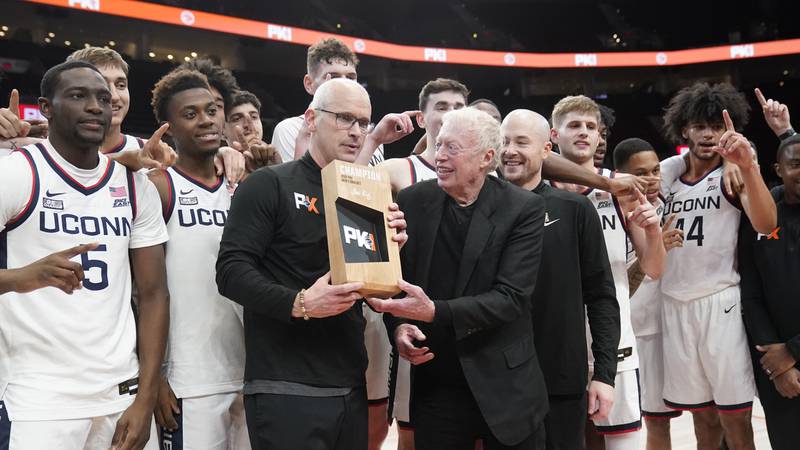
UConn‘s performance at the Phil Knight Invitational over Thanksgiving weekend was remarkable. The Huskies curb—stomped their way through the competition in Portland to win the championship. They blew out Oregon on Thanksgiving and then wearing down and pulling away from Alabama and then Iowa State in the tourney title game. Ultimately, UConn won the games by an average of 19 points, improving to 8-0 and jumping all the way to No. 8 in the AP Top 25.
As I discuss more below, the games were especially satisfying to watch because of the unique ways UConn won them. Against Oregon, it won 83-59, setting a program record for 3-pointers made in a game with 17 and completely shutting down the Ducks backcourt. It then beat a highly talented Alabama team with more excellent defense and star performances by Adama Sanago and Jordan Hawkins. Finally, the Huskies overcame Iowa State’s relentless defense and foul trouble, relying on their dominance of the boards and great performances on both ends by freshman Donavon Clinigan and Andre Jackson to win 71-53. The team’s depth and cohesiveness were reflected in Clinigan being awarded the tournament MVP.
UConn has won all its games by at least 15 points, and scored over 70 in each while holding opponents under 60 five times. It has shot up to No. 6 in the KenPom standings, and is the only program in the country that is ranked in the top 10 in both the site’s offensive and defensive algorithms. It is also the highest UConn has been ranked in the poll since it was ranked eighth in January of 2012. The team’s start makes a compelling case that it is the most talented team UConn has had since then, and that the Huskies are very capable of winning the Big East and going on a significant run during March Madness. I know that things can change quickly, especially due to injury, but I am sky high on the Huskies right now.
Here are a few observations about UConn’s play at the Phil Knight Invitational.
Huskies Display Their Ability to Pull Away Against Quality Opponents
Last season, UConn had an ugly habit of getting ahead against good teams, and then allowing them to rally back before losing by a few baskets. It hurt their seeding in the NCAA Tournament and then defined its loss to New Mexico State in the first round. This group is very different however, and eventually put its boot on the neck of Alabama and Iowa State and did not take it off.
First, the Huskies poor shooting early in the second half allowed the Crimson Tide to rally from 14 points down and tie the game multiple times. With less than nine minutes remaining, UConn completely flipped the script when Sanago and Hawkins returned from foul trouble and Newton got hot. Sanago and Newton went on a 16-1 run all their own. Sanago started dominating in the paint and hit a three, while Newton started bullying his way to the line and hit a three, ultimately giving the Huskies a 68-53 lead with less than six minutes remaining. Sanago finished with 25 points, and Newton had 9 with eight assists and four steals. Three other players (Hawkins, Alex Karaban, and Joey Calcaterra) were in double figures.
While UConn led the entire time against ISU, the Cyclones were able to keep it close with their defense, as the Huskies struggled to make shots and committed a lot of sloppy turnovers. ISU got it to within single digits in the open minutes of the second half, and trailed 53-48 with 9:47 remaining and Hawkins on the bench with four fouls (He would never return). Alex Karaban immediately kickstarted a 7-0 run with a three, and the Huskies ability to continue to dominant the boards, attack the basket and get easy looks and free throws for Newton and Clinigan, and most importantly play outstanding defense let them immediately regain control of the game and cruise to the victory. Clinigan had 15 points and 10 rebounds on 5-6 shooting, and Andre Jackson was everywhere on defense and contributed 10 points, 13 rebounds and five assists.
The mental toughness and poise UConn so far in not only these two games and throughout the season has been remarkable to see. Even when it has been cold on offense or struggling with foul trouble or turnovers, the players and Dan Hurley have been calm and communicated well with one another, eventually finding a solution to these problems. This is despite incorporating so many new players, who have immediately brought into UConn’s culture and established chemistry with the returnees. These qualities that the team has showed it should be able to keep its cool against any team, no matter the stage.
Offense Shows Remarkable Depth Throughout the Entire Invitational
Throughout the preseason, Hurley and his staff along with the players were always talking about how UConn would have great depth and more versatility on both ends due to their experienced transfers and the skills of Karaban and Clinigan. Through the first five games, that depth was on display and much needed because of the absence of multiple starters at different times. Still, fans still needed to see that many players could make an impact against quality teams, and the Phil Knight Invitational was a perfect stage to have their questions answered. Suffice to say, the Huskies answered any and all doubters.
Tristen Newton was the lynchpin of the offense through all three games. Newton averaged 15 points, 5.7 assists and 4 rebounds while also snatching six steals. He shot 52% overall, 8-12 from three and 15-17 at the free throw line. Newton is becoming more comfortable as the team’s point guard, and displayed poise, a strong handle, and the ability to find open teammates for quality scoring opportunities, especially against Oregon and Alabama. While Newton was still inconsistent at making shots inside the arc, his 3-point shot was much cleaner in the tourney and he demonstrated the ability to both shoot from the top of the key and off screens. And of course, Newton continued to be a machine at getting to and converting at the free throw line, especially during scoring runs. Newton has clearly become more comfortable from game to game, and I think he has already established himself as a strong replacement for R.J. Cole.
Adama Sanago did not quite play at an All-American level in the Invitational, but he was still solid offensively against Oregon and dominant at times versus Alabama. Sanago plaid second fiddle to Newton in the quarterfinals bit still had a very efficient day, scoring 12 points on 5-7 shooting with 6 rebounds (2 offensive). In the semifinals, he was a huge handful in the paint on his way to 25 points on 8-12 shooting, 4 rebounds and 2 blocks. Sanogo did an outstanding job in that game of both bullying defenders and scoring on jumpers and shot fakes, as well as passing out of the post. His offensive performance against Ohio State was ugly and marred by foul trouble (just 4 points on 1-5 shooting in 22 minutes), but Sanago at least contributed some solid defense to make up for it. Considering how hard-working and intelligent Sanago is, I have no doubt that he will get in the gym and work on what he needs to do to be more efficient against Oklahoma State Thursday and going forward.
The rest of the team made their unique contributions on offense throughout the three games. Hawkins brough some much needed sharpshooting in the first two games, scoring a combined 34 points and shooting 42% overall and 8-20 from three. He showed the ability to knock down contested 3-pointers and help the Huskies go on key runs, while also driving to the hoop and making layups or free throws when needed. Alex Karaban continued to be a Swiss-Army knife for UConn, scoring when needed (especially on the perimeter), getting big offensive rebounds, and doing an outstanding job of moving the ball to teammates for scoring opportunities. Clinigan, who we will talk about more later, was a nightmare for the three opponents as a substitute for Sanogo. His height and bulk made it almost impossible for the defenders to contain Clinigan on alley-oops or putbacks, at least without fouling. The Bristol freshman also averaged 3 offensive rebounds in the tournament. Joey Calcaterra continued to be deadly on the perimeter, shooting 6-10 from three and averaging almost 10 points, and recorded four assists against Oregon. While Jackson’s scoring did not show up until the championship game, the junior still had five assists both in that game and against the Ducks, and grabbed three offensive rebounds against Alabama and ISU. Finally, Hassan Diarra came up with seven huge points in just 15 minutes, in addition to his usual strong defense.
UConn’s offensive depth is reflected in all the analytics they have recorded this season. It has assisted 65.9% of field goals, which ranks 10th in the nation. The team is 13th in offensive rebounding percentage (38.1), 19th in effective field goal percentage (56.8), 23rd in 2-point percentage (57.7), and 59th in 3-point percentage (37.1). The Huskies bench outscored its starters against Iowa State, and came close to doing so in the other two games. With the improved shooting and ball movement and handling of this year’s squad, UConn can have good offensive nights against any opponent, something which certainly not the case last season.
Defense and Rebounding Continues to be Outstanding Against Big Time Programs
Over the last few seasons, UConn has been defined by its consistently strong defense and proficiency on the boards. So far this season that has not changed, especially with the added depth the team has. In the Phil Knight Invitational, the Huskies held Oregon, Alabama, and Iowa State under 45% shooting and 31.8% from three overall. Alabama and Oregon committed 21 and 17 turnovers respective, resly, and all three opponents had more turnovers than assists. Finally, UConn outrebounded Oregon and came close to doing so against an excellent rebounding Crimson Tide Squad. It then whipped Iowa State on the boards, outrebounding the Cyclones 46-19!, leading to a ton of second-chance points and fastbreak opportunities.
While the Huskies team defense was ultimately what stood out, there were a few individual players who had great performances. Newton did an excellent job of pressuring ball handlers up front and forcing difficult passes, and had a combined seven assists against Oregon and Alabama. The 6-5 Newton’s defensive rebounding was also excellent as always. Hawkins was a little too aggressive at times, resulting in foul trouble, but ultimately continued to demonstrate his improvement as an on-ball defender. The duo of Sanago and Clinigan shut down the frontcourt frequently. Sanago was great on the defensive boards and consistently altered shots. Clinigan completely blocked shooters from getting to the rim, and grabbed a combined 14 defensive rebounds in the three games and had four blocks against Oregon. Ultimately however, UConn’s great defensive performance was captured through the incomparable work of Jackson.
Jackson established himself as arguably the best defender in the Big East last season, and despite playing just four games so far, he may be the favorite for that crown. The junior’s on-ball defense was spectacular in the tournament against both guards and forwards. Jackson constantly forced difficult passes and altered shots, and helped set up steals and blocks for both himself and teammates. He also did an outstanding job of rebounding on defense and recorded several contested rebound opportunities. Jackson had two steals against Oregon and Iowa State, blocks against Alabama and ISU, and averaged six offensive boards per game, including 10 against the Cyclones. Jackson’s athleticism and hustle was constantly on display in the three games as he leapt off the TV screen, and impressed both the announcers and opposing coaches. The Invitational was another reminder of why Jackson can be one of UConn’s most valuable players even when he is not scoring much.
Dan Hurley Continuing to Come into His Own as a Head Coach
After UConn’s first-round loss in the NCAA Tournament last season, there was a lot of grumbling about Hurley’s ability to take UConn to the next level. That grumbling kicked into overdrive after the Huskies had four players transfer in the offseason. Hurley blocked out these criticisms and immediately set about looking for quality transfers who could address the program’s shortcomings last season (inconsistent outside shooting, ball-handling, quality defenders on the perimeter and small forward with size), and be a good fit alongside the remaining roster as well as Karaban and Clinigan. Hurley seems to have hit the jackpot with his portal additions, and made adjustments to UConn’s playing style which have turned them into a more well-rounded squad. Factor in all of this as well as Hurley’s calmer demeanor on the sidelines, and you have a squad that is looking like one of the best squads in America after this past weekend.
At the PKI85, Hurley did a great job of making substitutions which had an immediate impact on both ends, especially offense. This was especially apparent in the finale against Iowa State when Hurley took out Hawkins with nearly 16 minutes remaining when he got two fouls (the second a technical for arguing the first call), and did not put him back in for the rest of the game. This sent a message to Hawkins about he needed to better control his emotions and be more disciplined on defense. Hurley also recognized that Sanago was struggling and rode Clinigan as a result, being rewarded with a dominant performance that helped the Huskies pull away. Other examples of smart decisions in the final included Hurley recognizing that Diarra matched up well against the Cyclones and using him heavily in the first half with Newton in foul trouble, giving Jackson significantly more minutes, and maintaining his cool when the referees were making very questionable foul calls. The ability to effectively substitute, maintain composure and allocate minutes was consistently on display against both Oregon and Alabama as well. Throughout the tournament, Hurley also switched up defenses when needed, with examples being occasionally using zone and relying on the high hedge regularly against the Crimson Tide.
The maturity and adaptability Hurley has demonstrated from the beginning of his UConn tenure until now has been remarkable. He will make poor decisions and deal with significant challenges as UConn plays more close games and must face quality Big East opponents at least two times, but this is a mature team that appears to be more prepared for those challenges than last season. If Hurley can keep these Huskies as one of the best teams in America, Storrs will continue to be a destination for great recruits and transfers as long as he is there.



 HUSKY NATION