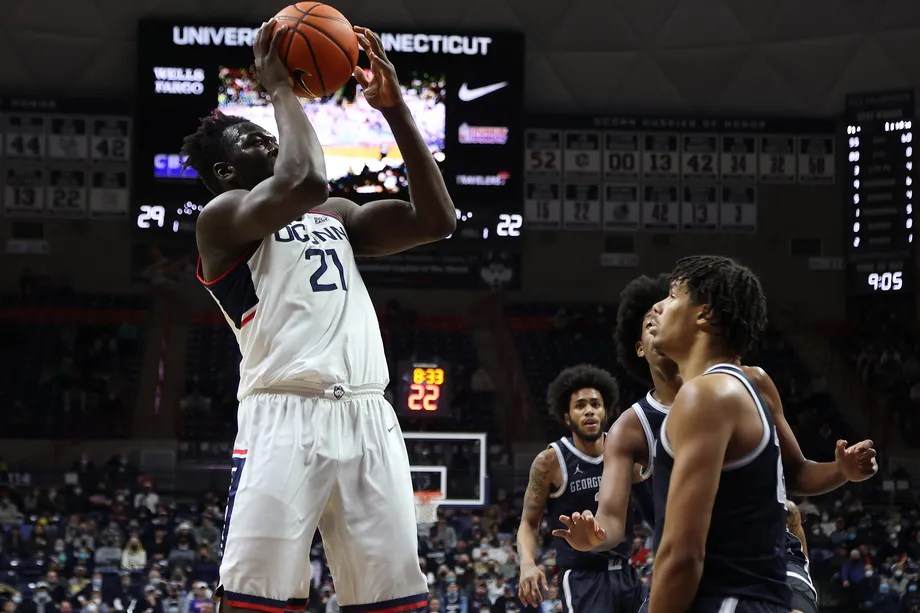
Freshman Evaluation: Alex Karaban set to Bring Diverse Offensive Game to Team

Karaban, a Massachusetts native, played two seasons at the New Hampton School, earning the New Hampshire Gatorade Player of the year for the 2021-22 season. After committing to play at UConn last August, Karaban played part of a post-grad year at IMG Academy in Florida before joining UConn during the spring semester. Karaban got the opportunity to work out, compete in practice and watch his older teammates from the bench during games.

During his senior season at New Hampton, Karaban averaged 25.8 points, 8.7 rebounds, 2.9 assists and 1.9 blocks per game while connecting on 60.3% of his field-goal attempts. He led the school to the NEPSAC Class AAA tournament championship, being names the MVP of the title game. As a member of the AAU team Expressions Elite, he averaged 18.4 points, 7.4 rebounds, 2.4 assists and 1.6 blocks and earned selection to the All-Peach Jam Second Team. At the time of his commitment, Karaban was ranked 42nd in his class by ESPN.

Karaban is a 6-8 forward and entered UConn weighing 230 but had since lost 15 pounds as of the middle of August. He is a high-quality midrange and outside shooter but can also use his bulk to beat defenders at the rim. Karaban is also considered a solid passer and is an outstanding free throw shooter. He should develop into a strong rebounder for the Huskies, and multiple writers have particularly singled out Karaban’s work on the offensive glass.

Karaban will be a work-in-progress on defense at the start of his career. He was considered a solid defender in high school, particularly when playing team defense. Karaban will likely most have to work on developing more speed and improving footwork. His basketball IQ, which was signaled out for praise by Dan Hurley when Karaban committed, should help in this area and allow Karaban to adjust to different defensive schemes. It will be interesting to see if Karaban becomes an effective shot blocker over the course of his UConn career.

Karaban’s stock has only risen since the team has returned to consistently practicing over the last two months. Much of the information coming out of practice has indicated that Karaban has consistently impressed the team with his shooting, rebounding and overall effort and basketball IQ. Hurley admitted a few days ago that Karaban had a solid chance to start at forward. Although I believe Samson Johnson will be the nominal starter at the four to start the year, I’m very confident the pair will split starter’s minutes while Andre Jackson is out with injury the first two weeks of the season.

While Karaban may not be the most acclaimed recruit Hurley has recruited to Storrs during his tenure, he may be the one I am most excited to watch. The ability Karaban could have to stretch the floor makes him stand out from any other freshman big man. When you add on Karaban’s ability to score and rebound around the rim as well and basketball IQ, he could quickly become something special. If Karaban is successful, it will only help UConn’s ability to attract top recruits in the Northeast and more versatile bigs. Now just become more refined on defense, Alex.

Tristen Newton Should be Playmaker Team Needs at Point

Despite UConn’s success the last three seasons, the program has not been blessed with a reliable scorer and playmaker at point guard. Enter Tristen Newton, formally of East Carolina. He was heavily recruited after entering the transfer portal when the Pirates season ended and the Huskies pounced on him quickly to fill their hole in the backcourt. After his official visit, Newton was quickly on board with playing in Storrs.

Newton was considered one of the top guards in the entire transfer portal and for good reason. He averaged 17.7 points, 5 assists and 4.8 rebounds for the 15-15 Pirates, regularly carrying the team in the AAC. Barring an injury, Newton seems penciled as Newton’s primary point guard next season (although Andre Jackson should run the offense to a decent extent).

The “6-5”, 190 pound Newton can score from anywhere on the floor and is particularly adapt at getting to and finishing at the rim, as well as reaching the free throw line. He was automatic from the stripe last season, shooting 87.9% overall and leading the American with an 87.4% mark. Factor in Newton’s ball-handling, ability to make plays for teammates and rebound and defend, and it’s clear he could have been successful day one at whatever program he transferred to.

Newton’s advanced stats as a junior show why he was a star for ECU. Newton had a true shooting percentage of 57.5% and an effective field goal percentage of 49.9%. In conference play, he ranked 16th in true shooting percentage. While Newton isn’t a huge threat from beyond the arc, his mark of 33.3% last season was more than respectable. Newton’s assist rate in conference play ranked second at33.2, and his overall rate of 34.4 was 24th in the nation. Newton demonstrated he could he could carry an extremely heavy workload last season, averaging the highest percentage of minutes of any AAC player and the third-most percentage of possessions.

Newton’s arrival should give the team a reliable three-true outcome scorer. In particular, Newton can both stretch the floor and effectively find teammates for good scoring opportunities. His versatility will especially be key if Hurley chooses to play four-out on offense for stretches. I can just imagine Andre Jackson and Adama Sanogo getting a lot of quality scoring chances because of Newton’s ability to create.

On defense, Newton’s steal percentage last season was 2.4% and he was excellent on the defensive boards for a point guard, grabbing 13.1% of his opportunities. Newton had multiple steals in 14 games, and five or more rebounds in 15 games. His size and athleticism will allow him to reliably pressure ball-handlers, and Newton’s rebounding ability can help UConn get out ahead of teams and and effectively run the fast-break. Dan Hurley also mentioned that Newton’s length will possibly allow the Huskies to play zone more.

Newton is expected to become UConn’s to-to player from day one along with Adama Sanogo. However, he certainly knows there are things he can immediately improve on both now and throughout the season. Newton specifically pointed to improving his strength and conditioning to withstand the tougher competition in the Big East.

Newton embraced the Huskies when he entered the portal after Hurley and the coaching staff demonstrated knowledge of his background and game, something that was not true of many programs that reached out to Newton. His bond continued to strengthen with the coaches and players once Newton reached campus. Like many players, he appreciates Hurley’s passion on the court.

“Ever since the first phone call, I knew that they cared about their players,” Newton said. “They’re players’ coaches. They’re going to push you hard and want the best for you. That’s what drew me here.”

It’s a question mark right now how likely Newton is to use his extra year. On one hand, he can be a signature player for the Huskies and a leader embraced by fans. On the other hand, Newton can put himself in position to be drafted if he has a strong season.

Newton can surpass R.J. Cole and Tyrese Martin as maybe the highest-impact transfer in UConn history. In particular, he can be the key to the program becoming much more versatile on offense and finally lead them to a tournament run again. If Newton is successful with the Huskies, it will only make them more appealing for transfers going forward. Bring him on!

Hassan Diarra Comes Home to Storrs

When Hassan Diarra was starring for Putnam Science Academy in high school, UConn heavily recruited the four-star recruit hard but came up short for the shooting guard, who decided to head to the Southwest and Texas A&M. When Diarra was ready for a new opportunity after his sophomore season, however, it didn’t take much time for Diarra to decide to come home.

Diarra, a ‘6-2’ shooting guard, averaged 6.2 points and 1.4 assists last season and 6 points in his two seasons with the Aggies, who just missed the NCAA tournament last season. He added 19 assists last season in 39 games. Diarra developed a reputation for clutch shooting last season, hitting three 3-pointers that either tied or won the game for Texas A&M. Diarra is certainly not scared of the big moment, telling the media “I think it’s just a testament to how hard I work. I work hard every day, and it showed in the biggest moments.”

Diarra showed some growth last season but still has a lot of room for improvement with the Huskies, who he can play up to three seasons with due to the extra Covid-19 year available. He improved his shooting significantly as a sophomore, going up 13 points in his offensive rating according to KenPom and recording solid jumps in his effective field goal and true shooting percentages as well (to 43.8 and 48.7). Diarra cut down his turnover rate by 7.3 points to 21.4, and improved his assist rate in conference play. After a tough start to conference play, Diarra ultimately ended up with seven double-digit scoring games and ultimately had 11 on the season. The muscular Diarra is a solid finisher and shot 48.7% inside the arc during conference play.

Diarra does not have a great handle and committed multiple turnovers in 12 games. However, he will be capable of providing additional ball-handling when necessary and support Tristen Newton, Andre Jackson and Jordan Hawkins with running the offense during short spurts. Diarra will likely compete with Hawkins for starter’s minutes. A key factor for Diarra earning more minutes is improving his 3-point shooting. He knocked down 31.2% beyond the arc as a sophomore and drained multiple threes in eight games.

Diarra should be a solid defender for the Huskies. He has demonstrated the ability to use his size and athleticism to body up on defenders and pressure the ball. Diarra has a knack for getting steals and earned a steal rate of 2.5% with the Aggies last year, forcing multiple ones in six games.

The long-standing relationship that Hassan’s brother Mamadou has with the UConn program certainly didn’t hurt when Diarra was deciding to transfer. Mamadou played briefly for UConn under Kevin Ollie before injuries ended his on-court career, and has been a member of the coaching staff for four years now. He was recently promoted to the role of Director of Player Development. Ultimately however, Hassan told the media that his final decision in where he transferred came down to the relationship with the coaches, where he could see himself thriving, and the program having winning as a priority.

Diarra is especially valuable to the program as a skilled player who will be with the program for at least two years (barring him transferring) and can develop under the tutelage of Dan Hurley. As a junior, he will likely play 15-20 minutes at most. Diarra should play significantly more minutes next season at shooting guard if Tristan Newton and Naheim Alleyne choose to not use the super senior year available to them due to Covid-19 or Andre Jackson decided to pursue a professional career.   

UConn was in need of two-way players who have had proven success at a high level, and Diarra absolutely fills that niche. If he can provide an immediate impact on defense and continue to become more well-rounded on offense, the Huskies could find themselves with an indispensable piece and fan favorite in Hassan’s final season in Storrs.

Transfer Joey Calcaterra Brings Reliable Outside Shooting to Bench

The former San Diego Torrero will be leaving the West Coast Conference and heading to the East Coast for his sixth and final college season. Calcaterra, a ‘6-3’ shooting guard, played four seasons for USD and averaged 8.5 points and shot 34.4% from three as a regular starter last season. Calcaterra struggled with injuries at times, missing two games, and had a shooting slump in the middle of the season that caused his rate states to go down in comparison to his sophomore and junior seasons, when he averaged double figures.

If one just briefly looks at Calcaterra’s stats from last season, they can be forgiven for wondering why the Huskies would want to bring in a super senior transfer from a mid-major conference that isn’t elite in any one area, especially as the program’s likely final transfer portal acquisition. But looking closer, you recognize that Calcaterra’s perimeter and free throw shooting, passing and experience makes him a great fit for the Huskies as a rotational guard, especially considering Dan Hurley’s stated desire to play a 4-out offense.

In addition to his injury issues, part of Calcaterra’s offensive inconsistency last season was due to the lack of help his teammates gave him. San Diego’s offensive efficiency was ranked 298th on KenPom, and players assisted on just over 39% of field goals, the fourth-worst mark in the nation. Calcaterra is much more suited to playing a catch-and shoot game than creating off the dribble, and it’s easy to see how having to constantly create his own scoring opportunities as well as for others could depress both the sharpshooter’s overall stats and efficiency. With UConn, Calcaterra will benefit from open, high-quality shots and be pressured into turnovers less.

In Storrs, Calcaterra should be an effective off the bench sniper who can consistently provide 10-20 quality minutes on offense, especially against defenders he matches up well with physically that he can shoot over. Calcaterra should be able to get good looks both when set and on the move off of screens. While his shooting splits were mostly down across the board as a fifth-year senior (41/.2/34.4/86.8), they were much more efficient during his pandemic-shortened junior year (44.6/37.7/867), when his true shooting was at 62.3%, and even Calcaterra’s sophomore campaign. When you go back and look at videos of his shooting stroke from last season it appears to be as technically sound as ever, even if the ball didn’t go in the basket as much. With UConn, I expect Calcaterra to improve on his shooting percentage from three as he’s given more space to operate. Even if he doesn’t, similar shooting numbers should be more than acceptable with the other perimeter threats joining the Huskies both through the portal and as freshman.

The feedback fans have gotten back about Calcaterra’s performance in practice and scrimmage since he arrived should make them even more confident about his ability to be a “microwave scorer” off the bench. Associate head coach Kimani Young called him “the best shooter by far” in the summer sessions in early August, and both Andre Jackson and Jordan Hawkins testified to Calcaterra’s shooting prowess as well as his leadership ability.

Calcaterra’s ability to contribute in areas other than perimeter shooting are a little more up in the air. White he could act as a secondary ball handler for brief stretches of time against certain opponents, he was an unspectacular ball handler and passer with the Toreros and did not show the ability to create plays off the dribble for others. This is borne out by both video and Calcaterra’s stats, as he has averaged more turnovers than assists every year of his college career (his rates were 10.8% to 19.5% last season). UConn fans know after last season that its team needs as many spare ball handlers as possible, but don’t expect Calcaterra to soundly develop a great handle or playmaking skills anytime soon. Hurley and the Huskies didn’t recruit him for that role, and it’s mostly fine.

Calcaterra’s ability to be an effective defender is also up in the air. While he is widely seen as a hard worker on that end, Calcaterra may struggle to cover more quicker and more athletic perimeter players who he doesn’t have a size advantage on. At the same time, what was considered strong defense against WCC opponents will definitely not carry over against top Big East and additional power conference foes. Calcaterra’s overall box plus-minus was -2.4 last season. Dan Hurley has shown the ability to especially coach up and help improve players on the defensive end however, and I expect him to be able to do the same for Calcaterra. And again, the transfer is at UConn to provide depth and versatility on offense in likely limited minutes.  

While Calcaterra’s defense and ball-handling may not make a positive impact in his final college season, it is heartening to see how eager he was to play for a prestigious program like UConn and willing to take a reduced role to play for a winner. When he officially transferred, Calcaterra told the media that “It’s just an exciting time to be a part of such a historic program and successful program and the opportunity itself is just really a blessing,” and “I know nothing’s gonna be given to me. Obviously, they have a great roster already, so I’m just excited to get out there and play with the guys that are on the roster.” Every program needs experienced guys who take that mentality, especially as the transfer portal becomes a much bigger part of the game. The Huskies need experienced starters to set an example for such a young team, and Calcaterra’s ability to do so is just as important as the stats he will put up.

After becoming more familiar with Calcaterra over the past few weeks, I think he was a great pickup as a reliable and heavily experienced shooting guard who should be able to regularly play 10-15 minutes and have a few standout performances when his 3-pointers are following. You can’t do much better for a sixth backcourt option, especially now that Hurley has committed to regularly playing a 4-out offense. I can immediately see Calcaterra becoming a favorite of myself and many other loyal fans. One thing is for certain: Hurley’s quartet of transfer pickups (Calcaterra, Tristen Newton, Hassan Diara and Nahiem Alleyne) has to be one of the most impressive of any power conference team and bodes well for their chance of improvement.    

The Start of Something: No. 5 Huskies Trying to Get Their First Tourney win in 6 Seasons Against No. 12 NMSU

No. 5 UConn and No. 12 New Mexico State of the WAC should be a very interesting game in the West Regionals and a matchup of teams whose strengths are very similar. The Huskies define themselves largely by their defense and rebounding and the Aggies do the same, with each team especially strong at shot-blocking and defending the rim overall. In addition, each squad has a lot of experience and coaches who have been her before (Chris Jans coaches NMSU). The areas that separate the teams besides the level of competition they faced is UConn’s superior ball-handling, athleticism and free throw shooting, areas which I think can be significant factors to the Huskies winning. All in all, it’s a pretty favorable matchup for the good guys.

Background on New Mexico State’s Season

The Aggies went 24-6 and 13-4 in the regular season before defeating Grand Canyon and Abilene Christian as a No. 4 seed in the WAC Tournament. They rank 86th on offense and 73rd on defense according to KenPom, and their best wins came against Davidson and at Washington State out of conference and then a trio of wins against Grand Canyon. However, NMSU had a number of ugly losses such as at Chicago State (339th in KenPom), Sam Houston State by 25 (143rd) and New Mexico (155th) at home.     

New Mexico State, which plays at a similar tempo to UConn), is led by guard Teddy Allen, who was named WAC Conference Player of the Year. Allen, who played earlier in his career for both West Virginia and Nebraska, averaged 19.3 points and 6.8 rebounds and is outstanding inside the arc and at the free throw line, where he shoots 86.5%. Allen is the definition of a volume scorer, putting up over 30 points in four games. Jabari Rice is the only other Aggie who averages double-figures at 12.2 per game and also leads the team in assists with 3.2. Forward Johnny McCants has a very similar game to Isiah Whaley and he is an elite defender, averaging 1.8 blocks per game to go along with 8.5 points and 5.3 rebounds. Right next to him, Will McNair averages 6.7 and 4.9. Jans used a deep rotation during the season, as 11 players averaged more than 10 minutes, and follows the 2-foul rule strictly, meaning a player will be sat down if they pick up two in the first half. While Allen took by far the most 3-pointers on the team, Rice was the most reliable regular 3-point shooter among the players expected to play, shooting 34.2%.

New Mexico State’s defensive shooting numbers were great across the board after adjustments, as it held opponents to a 45.5% effective field goal rate (20th in country), 30% on 3-pointers (24th) and 45.8% on 2-pointers (30th) as well as a block rate of 12.9 (31st). However, the Aggies almost never earned steals, as their percentage ranks 332nd in the country, and they force turnovers on just 16.9% of possessions (266th). The NMSU EFG % of 52.2 is 79th in the country and it shoots 54.2% inside the arc, good for 26th on KenPom, but shoots just 33% on 3-pointers and 69.3% on free throws. Their offensive rebounding percentage of 33.2% is 41st on KenPom. Finally, it turns the ball over on over 20% of possessions and Allen, Rice and McCants average at least two turnovers per game, with Allen at 2.8.

When UConn is on Offense

This is a very good matchup for Sanago, who badly needs to get going after his lackluster offensive play in the Big East Tournament. He has the footwork and strength to score effectively against the 6-10 McNair, his likely defender, and UConn should make a point of trying to get the big bis oy going early. Sanago has shown a consistent ability to bounce back after he has a tough game or two and as long as he makes intelligent decisions with the ball, I think he should have a very good game. I think that Martin is also set up well to have a strong offensive game. While he may have a tough time making 3-pointers on the Aggie D, Martin can clean up on the offensive glass and bully Rice and fellow guard Clayton Henry, both “6-4”, using his size and strength.

While R.J. Cole is significantly smaller than all of the NMSU starting guards (Allen is “6-6”), he has the shot-making skills and basketball IQ to find ways to score against the trio and possibly get them in foul trouble. If Martin struggles from beyond the arc, it would be valuable for Cole to make a couple of threes and just keep the defense honest while giving him more room to operate. It’s hard to know what you’ll get with Andre Jackson offensively from game to game, but his athleticism and size should allow him to get good scoring opportunities if he wants it, especially in transition (more on that just below). Cole, Jackson and Martin should all make a point of trying to attack Allen when they can, as he is not seen as a good defender and foul trouble in the first half could force him out of the game and put the Aggies in trouble. Jalen Gaffney could be a valuable offensive piece in this game when he replaces Cole because of his size and ability to attack the basket along with his tournament experience. I wouldn’t be surprised to see him put up a couple of points.

With the Aggies capable of shutting down the paint, UConn will have to find ways to get Polley good 3-point looks consistently to help open up the offense. These could come off of screens, in transition, kickouts and similar examples. Polley needs to make sure that he moves without the ball to get open and shouldn’t hesitate to look for ways to score in the midrange or at the rim as well using his size. Polley may be able to do a better job of getting open today versus a Big East Team which is more familiar with how to effectively defend him.  If Tyler Hawkins is available and capable of playing around 10-15 minutes, he can also be another 3-point shooting threat as well as a decoy. Finally, Whaley may have to step out of the paint and possibly even behind the line to get a few good looks against McCants.

I believe UConn’s ace in the hole for this game is the opportunity they could have to dominate New Mexico State in transition. It is facing a less athletic and lengthy team that is very susceptible to turnovers, and the Huskies are certainly capable of playing at a high tempo if they choose to do so. Players like Jackson, Cole and Martin are built for playing transition basketball and highly effective at it as long as the Huskies are disciplined. If it becomes a turnover-fest on the Aggies part, I think UConn could run them out of the gym.

When UConn is on Defense

On defense, everything begins and ends with stopping Allen. While he isn’t the most efficient scorer, his shot-making abilities and ability to get into the lane and draw fouls allows him to put up huge numbers and be one of the top mid-major players in the country. It seems like UConn’s optimal strategy will be to trwhoey and push Allen out past the 3-point line and have him take 3-pointers or difficult midrange shots. To do that, the Huskies and specifically Whaley and Sanago will need to communicate well and run the hard hedge to run Allen off of the 3-point line and force him into passes or low-quality shots. The main defenders on Allen will likely be Martin and Jackson, and they both have the size and athleticism to successfully defend Allen if they can be disciplined and not fall for pump-fakes or euro-steps. If Allen ends up taking a lot of 3-pointers, UConn still needs to focus on closing out on him effectively. If Allen is forced into the role of distributor, it could help lead to scoring opportunities, as he is prone to turnovers (2.8 per game). And if UConn can’t stop Allen effectively in the man-to-man, then Hurley has to swallow his pride and either double-team him or switch to new defenses to keep him in check. Make Allen work and think as much as possible on both offense and defense to tire him out, and everything else should fall into place.

Aside from Allen, Rice is the other player UConn will need to key in on, as he is the main distributor for the Aggies. Rice will most likely have some combination of Jackson, Martin and Cole on him, and whomever is guarding him will similarly have to pressure Rice when he has the ball in his hands without fouling and force him into low-percentage shots. I am confident Sanago and Whaley can successfully defend McCants and McNair effectively, and believe that Whaley can outplay McCants because he has a higher offensive ceiling and McCants is extremely prone to turnovers (22.8% turnover rate). While New Mexico State has demonstrated that they are skilled at avoiding having their shots blocked, the combination of Sanago and Whaley is almost definitely better than any other duo the Aggies have seen in conference play, and UConn should be able to block or at least alter a decent number of shots. The Huskies will need to defend Henry closely on the perimeter, as he shoots 37.5% from three.

The Huskies should be able to force plenty of turnovers against New Mexico, especially if they’re intimidated by the environment or come out slow. I’d like to see Hurley press ballhandlers a decent amount, especially at the end if its close. Jackson, Martin and Cole all can press players effectively and force turnovers and Cole is especially adept at nabbing steals from opponents. If UConn can force turnovers and pressure the ball without fouling, defend the rim well and keep Allen somewhat in check, then I think the team will be in fine shape at the end.

In Conclusion

New Mexico is the type of team that could have been a reliable upset pick against the right opponent, especially with a player who can take over the game in Allen. I think that UConn’s strengths match up well to New Mexico State’s, and its overall talent level is higher. When you throw that in with the Aggies turnover issues and mediocre 3-point and foul shooting, there is a stark contrast between the teams. Last but not least, I don’t think this years Huskies squad, especially the seniors, is going to hide from the moment. They are on a mission to prove this is a top program again, and that starts with making some noise in march. New Mexico State will keep it somewhat close with its defense and the play of Allen, but I am comfortable picking UConn to win by somewhere between 8-10 points.  

Observations on Big East Tournament Games and Team Overall: Sanago at a Crossroads, Martin on Fire, and Questions About 3-Pointers

With the best UConn men’s basketball team since the 2014 season (in my humble opinion) ready to enter the NCAA tournament, a lot of fans will want to just completely focus on the tourney results and not dwell on what the Huskies accomplished either during the regular season or Big East tournament. There are a lot of valuable observations and lessons that can be taken from their conference tournament performance as the No. 3 seed, a quarterfinal win against Seton Hall and semifinal loss to eventual champion Villanova. In particular, I learned a lot from the performances of Adama Sanago and Tyrese Martin and how the team used them in the games.

The 62-52 quarterfinal win against sixth-seeded Seton Hall on Thursday was easily one of UConn’s best performances of the season. Its defense was elite, holding the Pirates to 18 points in the first half and just 0.87 points per possession on 35.7% shooting. The defense, particularly Andre Jackson and Isiah Whaley, absolutely shut down Jared Rhoden and Alexis Yetna, holding the dynamic duo to a combined 13 points on 4-21 shooting. While the Huskies were not exactly lighting MSG on fire as they shot 36.1%, they 17 points each from R.J. Cole and Tyrese Martin, outrebounded Seton Hall 46-33 (five players had five or more boards), limited their turnovers and shot 12-14 from the free throw line, all formulas to tournament success.

While the UConn-Villanova semifinal game on Friday wasn’t quite as exciting as the second between the two a few weeks ago, it was close. While UConn came out on the losing end of a 63-60 game, it gave the Wildcats everything they had and led in the final minutes of the first half and early in the second. What ultimately did the Huskies in was their offensive struggles in the paint and beyond the arc and inability to stop Villanova from scoring at the rim in the second. After Jermaine Samuels and Brandon Slater burned UConn on 3-pointers in the first, Samuels continued his excellent play in the second and Colon Gillespie put on an offensive clinic, finding teammates for buckets with bounce passes and finishing with 10 assists. The Huskies inability to finish shots at the rim and find quality 3-point shooting opportunities doomed them as they tried to make a comeback. Martin was their only reliable offensive player on the night, scoring 19 on 7-17 shooting and grabbing seven rebounds and two steals.

While UConn may have lost in the Big East tournament semifinals for the second consecutive year, their outstanding win against Seton Hall and solid performance against Villanova, which is a No. 2 seed in the NCAA tournament, bode well for how compeubjtitive they can be in March Madness. The Huskies, whom are seeded No. 5 in the West Region, will play No. 12 New Mexico State in the first round and should be solidly favored. After the Big East tourney, fans and the medica can feel up about the play of Martin and Andre Jackson, UConn’s excellent rebounding, especially on the offensive end, and overall defense on the interior. However, there are legitimate concerns about the play of Adama Sanago, UConn’s inconsistent shooting and the thinness of the bench. I address these subjects and more below, as well as my overall positivity about the team’s ability to go on a tournament run.

The Curious Case of Adama Sanago

There are two versions of Adama Sanago. One is the Sanago that is scoring effectively and aggressively around the basket, getting teammates involved on offense and dominating on both the boards and defense while avoiding foul trouble, even if these elements aren’t all happening at the same exact time. The other is the Sanago that is hesitant on offense and missing easy shots at the rim and or not sharing the basketball with teammates when well-guarded, struggles with foul trouble and gets lost on defense, leading to easy baskets for opponents. Good Sanago is the extremely gifted sophomore who was named First-Team All-Big East and nominated for the Kareem-Abdul-Jabber Award, which recognized the top five big men in the country. Unfortunately, the Huskies got Bad Sanago on offense at the Big East Tournament, and it especially cost them against Villanova.

After consecutive games where he didn’t play well offensively and struggled on defense against Creighton, Sanago ended his regular season on a high note against DePaul with a double-double of 26 points and 11 rebounds, giving fans hope that he would have strong games against Seton Hall and then Villanova. Sanago had been excellent against both teams in UConn’s most recent games against them. Instead, he had ugly offensive performances against both teams. Sanago shot just 2-11 against Seton Hall and scored just six points, and then had 15 points on 6-15 shooting against the Wildcats and went 3-7 from the free throw line. Sanago committed two turnovers in both games and had a single block between the two, coming against the Pirates. There were bright spots, as Sanago grabbed a combined 24 rebounds against the teams and generally avoided foul trouble while playing solid defense.

Against Seton Hall, Sanago did not obtain a lot of high-quality shots, as the Pirates did a very good job of not allowing him to get position deep in the paint and playing him aggressively without fouling. However, there was still no excuse for Sanago not to make at least a couple of more shots. While his performance was concerning, it was less of an issue with the Huskies ahead virtually the entire game, and I was pretty confident that he would have a better game against a Villanova defense that wasn’t quite as good or had the length of Seton Hall. I was very wrong. Despite being able to establish strong position in the paint and getting a decent amount of open looks against the Wildcats, Sanago consistently missed shots within five feet of the rim, a few times even badly. While he was able to get to the line seven times, Sanago missed four of the shots. The sequence that summed up his struggles came when he got the ball on four straight possessions and scored just one point, missing free shots and a free throw during the stretch. Sanago still ended the game with a double-double of 15 points and 13 rebounds and was far from the only UConn player that had an ugly offensive day, as Isiah Whaley went scoreless and R.J. Cole 1-6 on 3-pointers. However, his team probably would have won if Sanago had hit just two or three of his open looks at the rim.

For Sanago, who played poorly in last season’s first-round NCAA tourney loss to Maryland, it is time to step up Thursday. He should have a big advantage against New Mexico’s state front line and if the Huskies most likely face Arkansas in the second round, a favorable matchup as well. Sanago needs to start either using the backboard or dunking the ball more on his shots to make it easier for him to score, and absolutely needs to involve his teammates more when well-guarded against the high-quality defenses he could consistently face in March Madness. At the same time, he needs to show a killer instinct offensively every second he is on the floor. I am expecting Sanago to rebound well against any opponent he faces and play good defense against most of them as long as he avoids foul trouble. If he isn’t efficient and smart offensively however, UConn will be in trouble and games could turn ugly.

Tyrese Martin Emerging as a Star on the Biggest Stage

My man crush on Martin is well-documented, and every UConn fans knows how important his versatility on both ends of the floor has been to the team’s success this year. He still seems to be overshadowed by Cole and Sanago and not fully appreciated by the media however, as he was snubbed for each of the All-Big-East teams despite averaging 13.5 points, 7.6 rebounds and 2 assists per game despite missing four games due to a wrist injury and dealing with lingering effects to his wrist throughout the season. Martin, whose big personality and competitiveness has always been a treat to see, was sufficiently motivated by the slight and said he would get back at it by trying to earn the conference tournament MVP award. While he didn’t quite reach that goal, Martin still earned a place on the All-Tournament team by averaging 18 points, 7.5 rebounds and 2 steals and assists against Seton Hall and Villanova.

Martin was outstanding on both ends in each game and especially against Seton Hall. The senior forward spent the whole game trash-talking the Pirates and absolutely shut down Pirates star Jared Rhoden, limiting him to 7 points on 2-13 shooting. Martin made some tough mid-range shots whenever the Huskies needed them, distributed the ball well (4 assists) and was strong on the boards as always with 8 rebounds. Against Villanova Martin was by far the most reliable offensive player, going 4-8 from three, and helped keep UConn in the game in the second half with multiple 3-pointers. As in the first game, his defense and rebounding continued to be strong.

Martin could be a nightmare for New Mexico State and any other NCAA Tournament opponents to content with. His ability to contribute in nearly every facet of the game, as well as his 3-point shooting (43.9%) in Big East play, can allow him to make a difference even if his shot isn’t falling. In addition, Martin is arguably UConn’s emotional leader along with Whaley and can help his teammates get through any struggles and intimidate opponents. As long as Martin is having a strong offensive game and can mostly avoid his issues with fouling and turnovers, it will be very hard for the Huskies to lose to an opponent.

UConn Continues to Dominate the Boards While Improving its Ball-Handling

Everyone already knows the Huskies rebounding prowess, especially when on offense, but there were still occasional games throughout the season when UConn had fewer rebounds than opponents even when the team had a clear advantage in this area normally. This has not been a problem lately, as the Huskies won the rebounding battle comfortably in the final few regular season games and then against Seton Hall and Villanova. This especially made a huge difference against Seton Hall, as their second-chance opportunities helped overcome a poor shooting night. While UConn did not convert on many of its second-chance opportunities against the Wildcats, their offensive rebounding helped to eat up clock and limit Villanova’s scoring opportunities. The Huskies talent on the boards will help nullify New Mexico State’s strength in this area as well. If they advance and most likely face Arkansas, they are better on the boards on paper as well.

While UConn’s struggles where turnovers have been a problem throughout the season, it has improved its ball-handling remarkably since early February, a huge factor in the team’s success late in the season. That continued in the Big East tournament, as the Huskies committed 17 turnovers against 22 assists, and only 7 versus Villanova. As a team, their turnover rate of 17.4% ranks 110th in the country. It is still higher than a team of their caliber should have, but the improvement is a good indicator for NCAA tourney success. New Mexico State forces turnovers just 16.4% of the time and Arkansas 17.4%.

Most of UConn’s improved numbers in the turnover department can be attributed to the improvement of Andre Jackson when handling and passing the ball. After being a turnover machine at times for much of the season, Jackson has not committed more than one turnover in six consecutive games while averaging four assists per game during this span. Jackson has not been as reckless when running the fastbreak and cut down on making risky passes that teammates are not ready far while still showcasing his outstanding his outstanding court vision. While his minutes have been limited, Jalen Gaffney has been more careful with the ball when running the paint recently, and Jordan Hawkins has been more disciplined with his dribble when handling the ball, although Dan Hurley has rarely put him in the position to do so. If these players can continue to limit their turnovers and guys like Martin and Sanago can be more disciplined with the ball, then UConn’s offense can run a lot smoother in the tournament.

The 3-Pointer Conundrum

Entering the season, many fans were worried about how well UConn would shoot from deep after they didn’t get a sharpshooter on the transfer market. It was actually significantly better on 3-pointers than myself and many others thought they’d be, draining 35.3% of them overall (79th in the country) and 35.7% in conference play (fourth). While Cole and Gaffney’s numbers from deep fell, Martin improved significantly, as did Polley to a small extent and Jackson significantly. Add on the contribution of Hawkins (33.3%), and the Huskies 3-point shooting numbers were actually a strength of the time. At the same time, they were pretty inconsistent against high-caliber team and struggled mightily on threes in the last four games of the season (27.3% against Creighton and 30% against Seton Hall). The team also had issues getting Polley open for 3-point opportunities, with an example being him taking no more than three 3-pointers in any of the last five games.

After missing three games due to a concussion suffered against Creighton, Hawkins is expected to be able to play a significant number of minutes against New Mexico State. His presence will help make it easier for UConn to get good 3-point shooting opportunities in the NCAA Tournament. To go on a tournament run, it is essential that the Huskies shoot well from deep. It’s not only a skill that’s been demonstrated to be a barometer for tournament success over time, but will make it easier for Sanago to score as defenders will be drawn away from him. Martin needs to continue to make threes at a consistent clip, Cole needs to be more consistent and another player (likely Hawkins, Whaley or Jackson) will need to contribute at a decent clip. Most importantly, the team needs to find a way to get Polley a decent number of opportunities in every game it plays, particularly shots where he is set, and he needs to do his job and be the sniper he was recruited to the program to be. New Mexico State has held opponents to just 30% from deep (20th in the country), so the Huskies have their work cut out for them.  

While there’s legitimate concern about UConn’s ability to make threes, the bigger issue is allowing threes. It allowed all opponents to shoot 34.5% (233) and conference opponents to make 35.8% of treys). It allowed their last three opponents to shoot over 33% from three, and generally allowed a lot of opponents and players who weren’t particularly good from three this season to have very good nights against its defense (See Brandon Slater and Jermaine Samuels against Villanova). Part of opponent’s success from three against UConn is due to its defensive system, which prioritizes guarding the rim and not allowing ball handlers to beat them off the dribble. While the hard hedge is very successful on defense a majority of the time, it can make it harder for players to close out late on 3-point shooters. As I discuss more below, the Huskies have to be willing to make defensive adjustments to limit quality 3-point opportunities if a player or full team is going off. The players also need to communicate with one another to help limit kickouts and make sure players are capable of closing out efficiently.

New Mexico State and Arkansas are both poor 3-point shooting teams, although Vermont is an excellent one if they managed to pull off the upset against the Razorbacks. While a lot of luck is involved when team’s have especially good games from deep, I could absolutely see that being a big Achilles heel for UConn whenever it loses.

Will Dan Hurley be Flexible?

Hurley had a very good year. He continued to be an excellent defensive coach, tweaked things on offense in the second half of the season that allowed it to become more efficient and began to win more close games as the season went on. Hurley was also instrumental in helping Jackson and especially Sanago make big leaps as sophomores. At the same time, Hurley needs to be willing to make adjustments in a couple of areas in certain situations during March Madness, especially if the Huskies are losing to New Mexico State or another opponent down the round.

The first area UConn and Hurley need to be flexible is with their starting lineup. It has consistently started games out slow and a huge factor in this is the lack of offensive power in its regular lineup with Jackson and Whaley. As elite of a defender as Whaley is, I think that the team would generally be better off starting Polley or possibly Hawkins (although I very much doubt that will happen). Starting Polley involved could help him get going early and allow the Huskies to possibly stretch the floor at the same time, which could be a huge boom for Sanago. I am almost completely sure that Hurley would ride the starting lineup he has all season, but it would be interesting to see him change it and throw a wrinkle into the game plan of opponents, especially considering the strength of New Mexico State’s defense.

A second area Hurley needs to be flexible is making sure to his players that they cannot fall into a habit of feeding Sanago and watching him work, especially if Sanago is struggling. Instead, Sanago needs to be told to pass the ball out or to cutting teammates if he is not in good scoring position and then find methods for allowing Sanago to score more easily. Sanago should be very effective against New Mexico State, but UConn would need to continue to follow this strategy against any opponent it faces. Finally, Hurley needs to be way more flexible with his defense if the Huskies are struggling in the man-to-man and with playing the hard hedge, which would involve practicing it a decent amount in the leadup to Thursday’s game. I’d like to see him throw in some variation of a zone if the defense is shaky. Ditto with a box-and-one defense. If the team is consistently struggling to stop a single player, which in this scenario would likely be Aggies star Teddy Allen, I believe Hurley shouldn’t hesitate to double-team said player. Finally, I would love to see the Huskies press ball-handlers in an effort to get more transition opportunities. When you’re in the win-or-go-home situation of an NCAA tourney game, a team shouldn’t hesitate to try anything that might give them a better chance t

What UConn Needs to Do to End the Regular Season Well

The buzz surrounding the UConn men’s basketball program right now is the highest I can remember in years, possibly since the 2014 season. The 21-7 Huskies, who are 12-5 in the Big East, have won five straight, are third in the Big East standings and strengthening their case for a high seed in the NCAA tournament. For the third consecutive season, the program is playing its best basketball at the end of the season. In particular, UConn has been playing outstanding offense recently, particularly from beyond the arc.

Creighton and DePaul would like nothing better than to extinguish the Huskies momentum in their last two regular season games in the coming days. Creighton, in particular, has never lost to them in five games and wants to maintain that superiority and sweep the season series between the teams. If the Bluejays win at home Wednesday night, they can finish third in the conference standings if they and UConn finish with the same record. And while DePaul is currently 10th in the Big East standings at 5-13, the Demon Deacons have been a handful for many of the conference’s best teams, including the Huskies at the end of January. While UConn is playing very strong overall, there are areas they need to improve on or be more efficient in.

The aspects of the game the Huskies either need to improve or continue to play well in against Creighton tonight and DePaul Saturday are numerous. While the team may be flying high right now, Creighton is a very tough environment to play in, and a loss to DePaul would be an embarrassing slipup and leave UConn with a bad taste in its mouth entering the Big East tournament at MSG. Not to mention that a loss to either team would move the team to a fourth-place seed in the tournament and possibly a tougher second-round matchup. Below, I discuss what UConn must do tonight and Saturday to win and maintain the excitement around the team.

  1. Tyler Polley and Jordan Hawkins need to continue being effective on offense, preferably at the same time

When Polley and Hawkins are both playing well offensively the Huskies have proven to unstoppable, as exhibited by the team’s 5-0 record when the pair scores in double digits. All season long Polley and Hawkins have been touted as UConn’s x-factors and it’s been proven to be true during this most recent win streak. Polley is on one of his vaunted multi-game hot streaks from deep, as he shot 7-12 from three and averaged 12 points against Xavier, Villanova and Georgetown and drained one of the most memorable shots of the season with his three against ‘Nova in the comeback during the final minute. At the same time, Polley went 9-10 from the line against them and Georgetown. Hawkins has improved immensely on defense, and the improvement on that end has earned him more playing time and the ability to figure things out at that end. The freshman played well on offense in his 14 minutes against Xavier, scoring 7 points via a 3-pointer and four free throws. He then had one of his best offensive performances of the season against the Hoyas Sunday, scoring 11 in 21 minutes on 3-6 shooting and making a spectacular dunk. Hawkins shooting from deep has slowly improved and he is demonstrating the ability to effectively attack the basket, a skill the Huskies definitely need more of.

When one or both of the sharpshooters are feeling it in a game, UConn’s offense is much more efficient. Space opens down low for Adama Sanago and others to get good looks at the basket, the team can play inside-out and move the ball well side-to side, they have more options on fastbreak plays, and players have good chances for offensive rebounds if Polley or Hawkins happens to miss. When Polley comes off the bench for Isiah Whaley or Sanago and plays with the other starters, these lineups rank 7th and 8th in the Big East in adjusted team efficiency margin per Evan Miya.

It is particularly important that Polley and Hawkins as well as the other bench players play well against Creighton. The Bluejays have the top defense in the Big East according to KenPom, and h against Cave held opponents to 31% from three in conference play, which also ranks first. In the first matchup with Creighton, UConn had one of its worst offensive performances of the season in a 59-55 loss, with Polley and Hawkins combining to go 0-7 from the field and the team 5-21 from deep. If the pair can hit a handful of 3-pointers and open up the team’s spacing, it will open up the team’s spacing and give them a leg up in what will probably be a low-scoring and physical game. If they can get to the line, that would be valuable as well since the Bluejays normally allow few foul attempts.   While the Huskies should be able to perform well on offense against DePaul, it would be great for Polley to end his regular season career with a strong performance on Senior Day.

  • Adama Sanago needs to end the regular season with a bang

Adama had arguably his worst game of the season Sunday against Georgetown, especially considering the level of competition. He fouled out in just 18 minutes, putting up only 6 points and 2 rebounds while committing 5 turnovers. Sanago seemed disengaged and let the refs quick whistle affect him, and with the rest of the offense humming teammates didn’t look for him as much as normal. Sanago needs to stay out of foul trouble and avoid ones out on the perimeter against Creighton and DePaul while playing disciplined on offense. That means establishing position in the paint and not forcing shots out too far from the basket, and passing the ball back out effectively if he does not have good position, which will help Sanago to avoid turnovers. Finally, he will need to block out effectively on both ends and put himself in position for putbacks.

Sanago also struggled to score in the first game against Creighton, putting up 8 on just 3-10 shooting, and had only one block. His performance against DePaul was also mediocre, as he only finished with 10 points. The Bluejays are tremendous at depending in the paint and allow opponents to shoot just 43.4% on 2-pointers, eighth-lowest in the country. Against their big front line, Sanago will need to establish position deep have success in the paint early and often, while passing out successfully when necessary and to avoid turnovers. The sophomore has shown the ability to play very well against big men he struggled against in rematches (he just did last week against Villanova and Eric Dixon), and I am confident he will do so against Creighton and then continue to stay engaged and have a good game Sunday against the Demon Deacons.  

  • Avoid turnovers!!

I realize the 16 turnovers UConn had against Georgetown was somewhat of an outlier, as they were largely the result of Sanogo’s struggles and then the benchwarmers not being prepared for the Hoyas press in the last two minutes of the game. Still, the Huskies are a team that has enormous struggles taking care of the ball at times, especially in conference play (their turnover percentage of 18.3% is eighth in the Big East). Even though Creighton’s defense does not force many turnovers and UConn had just nine against them in the first game, we have seen the offense have multiple games where they committed costly unforced turnovers against teams that don’t rely on forcing them.

To carry over their success at limiting turnovers from the Villanova and Seton Hall wins, the Huskies offense must make sure not to force passes to players who are well-defended or not ready, avoid playing out of control and make sure that they throw the ball over defenders if they are being pressed or trapped, especially along the baseline. The UConn players also need to make sure that they have a tight grip on the ball and are dribbling the ball high to make the team less susceptible to steals. Among the players, Sanago, Whaley and Tyrese Martin must do their best to avoid the turnover issues they have experienced recently, while Andre Jackson needs to continue distributing the ball efficiently while not forcing passes or trying to make plays that are overly flashy.

The defense needs to be more disciplined, especially when guarding the 3-point line

UConn’s defensive effort was lousy for most of the second half against Georgetown, which came into the game as the worst offense in the Big East. It did a poor job of guarding the rim and fouled way too much (though a late of that was on poor officiating), and the help defense was frequently too late both at the rim and on the perimeter. In general, the Huskies did not look like they were trying to extend much defensive effort once they got a comfortable lead, resulting in 1.15 points per possession. While I expect a much more robust effort against Creighton, a mediocre offensive squad that doesn’t shoot very well, UConn has struggled to guard the paint at times during February, even in wins, and their 3-point defense is eighth in conference play. Against a Bluejays squad that commits a lot of turnovers, the Huskies will need to avoid being beaten off the dribble and play tight defense without fouling, while also pressuring the ballhandlers to make steals more likely. At the same time, UConn will need to consistently provide help defense when necessary and avoid giving Creighton too many open looks from three. It shot 9-17 in the first matchup with UConn, arguably the biggest factor in their win. While DePaul is a weak offensive team, the Huskies need to continue playing good defense against it to give them momentum heading into the Big East tournament.  

Observations on Win Against St. John’s: Huskies take Step Forward and Demonstrate the Ability to Come Back, Rebounding and Defense top Notch, and Martin the Man Yet Again

This UConn season has been topsy-turvy from the moment it started, and the last week it was no different. While I am generally going to focus on observations that can be taken from Saturday’s 63-60 win over St. John’s at Madison Square Garden, there were a lot of storylines that could be taken from Friday night’s 74-68 loss at Xavier, including the Huskies poor paint defense and slow start, lack of rebounding, and controversy over foul trouble. While Saturday’s win wasn’t a great effort by any means, UConn (17-7-8-5) answered a lot of questions, especially its ability to come back in a conference road game.

The first half against St. John’s was fast-paced and ugly on offense with UConn entering halftime up 30-29. It shot just 38% and consistently missed open shots at the rim and beyond the arc, shooting 4-13. It also made some boneheaded turnovers, not a big surprise considering its play in recent games. However, R.J. Cole displayed his shot-making abilities and scored well around the rim, finishing with eight points. Andre Jackson committed two turnovers but displayed his ability to do a little bit of everything, earning five points, eight rebounds and two assists. The Huskies were hurt on both ends and especially on offense as Adama Sanago committed two fouls early after scoring six points and had to sit the remainder of the first half, mirroring his first half at Xavier. Tyrese Martin also had foul issues and did not score in the 20 minutes.

The defense was outstanding in the first half, holding St. John’s to 34% shooting and playing excellent D around the rim while earning some memorable blocks. While the Johnnies similarly struggled from behind the arc, it rebounded well and made some tough shots around the rim. Dylan Addae-Wusu was probably the best player on the court in the opening 20 minutes, scoring 12 points and playing well on defense. Star guard Julian Champagne was shut down by Isiah Whaley in the first half, making just two baskets.

Both teams continued to trade baskets in the opening eight minutes of the second half, with UConn holding a 45-44 lead going into the under-12 timeout. Martin immediately woke up and was the offensive catalyst for the Huskies, draining a trio of 3-pointers as his teammates did a good job setting him up. Meanwhile, Champagnie managed to get open in the middle and scored seven points.

With the way things were going a team was bound to go on a run eventually, and unfortunately it was the Johnnies who did it first. Following a Jordan Hawkins three they scored 11 consecutive points over roughly three minutes to take a 55-48 lead. St. John’s was able to beat UConn defenders off the dribble and score at the rim, benefiting from poor communication and help defense by the Huskies. The athletic Montez Mathis made two layups and scored six points during the run, which ended with a Stef Smith three that bounced off the rim multiple times. On the other end, UConn failed to score despite multiple open shots, with Sanago also struggling with his touch at the rim.

I talk about UConn’s 15-3 run in the final 7:46 to take the lead and secure the win against one of its biggest rivals, but it was very impressive seeing the team go on a 15-5 run to finally come back to win a game by fewer than five points. There were a number of heroics during the run, including the continued brilliance of Martin on offense, Whaley’s 3-point lead to take the lead, and the great defense by the Husky big. It seemed like every player on the floor contributed however, and showed great composure.

Martin again showed his ability to catch fire and carry the team offensively for stretches, scoring 17 points in the second half, and draining 4-6 3-pointers. Cole had 14 points and five assists, and Whaley was brilliant on both ends, scoring 11 on 5-6 shooting and recording five blocks and three steals. Jackson committed five turnovers but had four assists and an insane 16 rebounds. UConn had 14 assists. Sanago played just 23 minutes and was largely denied the ball in the second half. He scored just one basket after his hot start and shot 4-13 with three turnovers. The Huskies got just eight points from their bench, with Polley and Hawkins combining to shoot just 1-9 from three. They also continued their ball security issues, committing 15 turnovers against 14 assists.

On defense, the Huskies recorded 13 blocks and five steals. In addition to Whaley’s five, three other players had two blocks. It outrebounded St. John’s 52-41 and dominated the defensive boards grabbing 39 led by Jackson’s 14. Five UConn players earned at least five rebounds.

The Huskies are currently third in the Big East and ranked No. 20 on KenPom, and have a huge rematch against Seton Hall (15-8, 6-7) on Wednesday night at Gampel. They will be looking for revenge against the Pirates, who beat UConn 90-87 in overtime on January 8th after the team’s long layoff due to Covid-19. Before that game is played, there are important observations to take from Saturday’s win below, including the importance of pulling off a comeback win, the play of Martin, UConn’s strong internal defense and rebounding, and continued issues with finishing and bench contributions.

UConn Shows its Toughness and Composure in Final Minutes

When the Huskies came out of a TV timeout and almost immediately allowed a 3-pointer to Smith with 7:46 remaining, they were trailing 55-48 and reeling. St. John’s was in the midst of an 11-0 run and UConn looked fatigued. Its defense had suffered multiple breakdowns that allowed the Johnnies to easily get in the paint and they were hitting tough shots while the Huskies continuously missed open shots. Like multiple rock fights that turned into close losses this season, it looked like poor shooting and shaky defense at the worst time was going to doom UConn.

After Friday’s loss however, UConn wasn’t ready to again live this experience however, especially in front of a loyal audience of fans at MSG. The players, especially the seniors, executed enough in all phases of the game to pull out the win. On offense, Whaley and Martin carried the Huskies on an 11-0 run with their shooting, finishing and offensive rebounding abilities. Whaley demonstrated excellent touch around the rim and his strength, making a nifty layup and earning a 3-point play on his putback to give the team a 56-55 lead with 3:46 remaining. Whaley earned five points off of putbacks during the run. Meanwhile, Martin had four points, draining a three in his defender’s face, and multiple rebounds. As a duo, Martin and Whaley not only got the offense going doing the run, but gave the team a healthy dose of energy that the other players fed off of. Soon, every player was not only having fun but playing with a lot of composure and focus.

In the final two minutes, Sanago and Cole gave the others some offensive help. Sanago, who had been playing strong defense despite not making shots, scored in transition on a layup, with Cole feeding him a nice pass. Cole then closed out the game with two free throws to give the Huskies a 3-point lead with 12 seconds remaining, making the clutch free throws late that he didn’t in some losses.

It was on the defensive end and the boards where UConn really won the game, however. I will go more into the exquisite play of the defense and the team’s rebounding in the final 7:46, but all fans really have to know is that St. John’s went 2-12 to end the game while committing two turnovers and having two shots blocked. The Huskies were challenging almost every shot while causing the Johnnies to rush them, pressuring the ball and gobbling up rebounds. They seized momentum after a few key stops and displayed more energy and athleticism, and St. John’s looked just overwhelmed, especially since they were getting almost no second-chance opportunities and unable to get out in transition. It was wonderful to see the vintage UConn defense again on display after going missing for the majority of the few previous games.

The Huskies have a lot more talent than St. John’s, and on paper they shouldn’t have had that much trouble with them, especially with Posh Alexander out with injury. All the players and Dan Hurley are aware of how hard it can be to win road games in the Big East and the program’s issue with coming out on top in close games. Being able to see them stay calm and collected down seven and continue to execute their offensive game plan while tightening up the defense was extremely rewarding however. From the energy they showed on the floor and bench it was clear that UConn was resolved to win the game and play all out but smart on both ends of the floor, and that was the formula to success. Bravo. C opponent. I

Tyrese Martin, Swiss Army Knife

For the second time recently, Martin was silent in the first half and then a monster in the second half. After going scoreless in the opening 20 minutes, he had 17 points on 8-13 shooting, including four 3-pointers, eight rebounds and two blocks. The senior’s trio of threes kept the offense afloat and the team in front despite its slow second-half start. As already discussed, he made some big offensive plays during the team’s comeback, including the final field goal of the game and rebounded very well down the stretch, including his own misses. Martin also played his usual energetic defense while avoiding foul trouble in the second half and earned two blocks in the process.

Just as important as his actual statistical impact in the game was Martin’s emotional one. With his technical in the first half after some jawing with a St. John’s player, Martin signaled that both he and the team could not be pushed around. In the second half especially, it was easy to see how Martin’s intensity and words of encouragement were inspiring his teammates to up their energy level and execution. And even when Martin didn’t execute well himself (i.e., missing shots at the rim), he did his best to make up for it. Martin and Whaley are clearly UConn’s emotional leaders, and the more complementary players need to match their intensity and effort if the Huskies are to reach their full potential.

Defense and Rebounding Operating on Full Cylinders

UConn’s biggest strengths are supposed to be its defense, particularly in the paint, and rebounding, as well as its depth to a lesser extent. And yet that hasn’t been a consistent feature, even in wins. Entering the St. John’s game, UConn’s defense had played poorly against Xavier and especially Villanova, and even in the win against Marquette it wasn’t quite up to the Huskies usual standards. The Huskies did not communicate well or provide necessary help at times, and the team was being beaten 1-on-1 inside more than myself and other fans expected. Even Whaley, the team’s best defender and one of the best in the Big East, was not playing defense at the level expected of him and admitted as much. Combine all this with Hurley’s reluctance to rely heavily on non-man-to-man defenses or double-team, and the defense was in a tough place when not executing well. Hurley certainly noticed the inconsistency, saying defensive improvement was the biggest need for UConn.

From the opening tip, UConn’s defense was overwhelming. It consistently altered shots at the rim and did a good job of pressuring the ball while mostly keeping St. John’s off the offensive glass. The Huskies were rarely beat off the dribble or allowed open shots at the rim, and challenged a large percentage of the Johnnies perimeter shots (to their credit, they made enough tough shots to stay right with UConn in the first half). Even with the absence of Sanago for most of the first half, Whaley, who was particularly suffocating on defense, and multiple teammates picked up the slack.

After continuing to play strong on defense early in the second half, it had its lull midway through the second half that allowed St. John’s to take a 7-point lead. The defense eventually found its bearing however, and played its best stretch to end the game. It seemed like they come close to blocking every inside shot, made it difficult for players to handle the ball and closed out well on the perimeter. With the Johnnies unable to knock down shots and open up the offense, they were stuck and Whaley, Martin and a rejuvenated Sanago were there to reap the benefits. With UConn playing a mid-tier Seton Hall offense on Wednesday night without Bryce Aiken, there is no reason it cannot play close to the same level.

While UConn had still usually been outrebounding opponents most games, it did not against either Xavier or Villanova and hadn’t been winning the rebounding battles at the same margins as it did earlier in the season. The Huskies needed to return to not only controlling the offensive but especially the defensive glass, and it did against the Johnnies. They were almost always limited to one shot, rarely of high quality, and the Huskies did an excellent job of boxing them out and outmuscling players for rebounds. UConn players appeared to do a strong job of reading bounces off missed shots well and getting in position for rebounds, and it was clear that St. John’s players were frustrated by their second opportunity. Considering one of St. John’s biggest strengths is their skill on the offensive glass, UConn players need to bring the same concentration and execution Wednesday night.

Sanago Limited Yet Again

Adama had his worst offensive game since November against St. John’s by shooting just 4-13 for 8 points in 23 minutes while committing three turnovers. Sanogo’s foul trouble in the first half killed his solid start, and the sophomore struggled with his touch all night. He also again committed multiple travels when double-teamed due to waiting too line to pass the ball back out. Sanago was still a net positive with his defense, but his willingness to pass out of the post has seemingly diminished after he had started doing it more a few weeks ago. As far as the fouls, Sanago needs to be smart with how physical he is playing defenders far from the hoop and learn to moderate his physicality. Early foul trouble limited Sanago’s contributions last year, and if it continues to be a problem every opponent will be gunning to take him out early. Seton Hall will be a good opportunity for Sanago to get back on track and demonstrate he can shot down a strong big man in Alexis Yetna.

Observations on UConn’s Win Against Georgetown: An Unforgettable Offense, the Front Line Continues to Own, and Hawkins Comes Alive

It’s fun to watch offenses dominate in all facets of the game, isn’t it? More than anything else, that’s the observation to take away from UConn’s 96-73 beatdown of Georgetown on Tuesday night at Gampel. It was one of the Huskies most complete wins of the season, and ultimately by several metrics one of the best offensive games any D-1 team has had this season and one of the five best by the program since 2002. The game also again showcased the impressive chemistry and joy the team has displayed in January. One thing is certainly clear: UConn has absolutely owned Georgetown since returning to the Big East.  

The UConn offense was firing on all cylinders from the get go as they pushed the pace off Georgetown turnovers and missed shots and found Adama Sanago for open shots in the paint. Sanago opened the game with a dunk off a beautiful pass with Andre Jackson, who then had a spectacular fastbreak dunk a few possessions later. After Georgetown called its first timeout following a layup by Tyrese Martin, the Huskies began to expand their shooting range. With the help of some crisp passing, Akok Akok, Jordan Hawkins and Tyler Polley made consecutive three pointers (all assisted open), to push UConn’s lead to 28-19 with 9:28 remaining in the first half. Each trey was taken before the Hoyas defense could get set to challenge the shot.

Even as UConn was hitting everything however, Georgetown was doing a good job of keeping pace with them offensively, scoring 15 consecutive points on 3-pointers, two by Donald Carey to cut the deficit to 36-31 with 4:54 to go. The Hoyas were on fire from deep the entire first half, shooting 8-13. The defense did a poor job rotating and did not sufficiently challenge 3-pointers despite this being by far Georgetown’s biggest offensive strength.

In the last five minutes of the half the Huskies again put some distance between them and the Hoyas.  Whaley scored multiple baskets off of offensive rebounds and UConn scored multiple second-chance points, taking advantage of quality ball pressure and loose handles by Georgetown players. Polley ended the half by making all his free throws after being fouled on a three to give the Huskies a 52-40 halftime lead. Martin scored 12 points in the half and his team had 11 points off turnovers. Still, the Hoyas managed to stay in the game by shooting 53.3%, with Aminu Mohammed dominating UConn inside and out to score 13.

Both offenses started slow in the second half as the game became more physical and there were unforced turnovers. UConn missed multiple shots around the rim and Georgetown struggled from the perimeter. The Huskies slowly stretched out their lead, and a fastbreak dunk and putback by Whaley putback gave him 13 points and made it 62-46 with 13:37 to go. Eventually, an open 3-pointer by Hawkins off a pass by Gaffney put the Huskies up 69-52 just before the 12-minute mark. They eventually figured out how to break the press the Hoyas started the half with to get quick shots, and focused on attacking the paint and scoring at the rim. Meanwhile, the defense, led by Whaley, did a much better job of challenging shots and rebounding at the rim to start the half and benefited from Georgetown finally getting cold from the outside.

Over the next few minutes UConn slowly built its lead. The got a great open look for Hawkins out of a timeout and he drained the three to push the lead to 20 points. Sanago then took over with six consecutive paints deep in the paint, with the final two baskets coming on pinpoint passes by Jackson from the top of the key, extending UConn’s run to 12-0, which lasted just over three minutes. During this run, the Huskies kept the Hoyas out of the paint as they missed jumper after jumper.

After a couple of baskets by Georgetown, UConn went on one last run with 7:48 to go. Sanago had a putback before it scored four points with the help of a flagrant foul, with the 9-1 run ending on a beautiful 3-pointer by Cole. The Huskies extended their lead over 30 in the final minutes as both teams emptied their benches and the Hoyas went on a scoring spree to make the final score look closer than the game was.

UConn ultimately shot exactly 50% and 41.7% 10-24) and 78.3% (18-23) from the free throw line, and the offense as a whole scored 1.45.9 points per possession. This was the best PPP mark by any team in the country this season and  Five players (Sanago, Whaley, Hawkins, Cole, Martin) scored at least 13 points, with Sanago leading the way with 19 and Whaley and Hawkins tying season highs with 15. Sanago had 18 points and 8 rebounds as well as 2 blocks and steals. Whaley went for 15 and 7 and Martin 14 and 8. Cole added 7 assists and 6 rebounds, and Jackson had five dimes. Hawkins went 4-7 from three. UConn had 21 assists to 7 turnovers and 27 fast-break points, it’s best number against high major competition. It had 19 offensive rebounds to Georgetown’s 12 and outrebounded them 40-28 in total.

Georgetown shot 4% and 11-21 from three. Mohammed had 15 points and 7 rebounds and shot 3-4 from deep and Colin Holloway and Donald Carey put up 11 and 10, each making two threes. After a poor defensive effort in the first half, UConn held the Hoyas to 37% shooting in the second half. Led by Whaley, they defended much better around the rim and rebound better, and improved their rotations on the perimeter, allowing the Huskies to consistently contest outside shots. They had 6 blocks and 5 steals.      

There are a lot of fun thoughts to take from UConn’s win against Georgetown. Here are a few significant observations I experienced.

UConn Has Legendary Offensive Performance

I’ve already gone through most of the remarkable offensive numbers, from the 1.45 points per possession (one of the best program marks this century) to having five players score in double digits and eight at least five to the shooting splits (50%/41.7%/78.3%). In addition, every player who played more than five minutes had an offensive rating over 100 on KenPom. Even without these numbers however, any fan watching could see this performance represented all of UConn’s players at their very situational best.

The players did an outstanding job of moving the ball and attacking the defense off of turnovers and missed shots. UConn’s acclaimed offensive depth was completely on display, from Hawkins (and Akok’s) ability to be a sharpshooter off the bench to Sanago and Whaley’s ability to dominate in the paint and on the board to Martin’s versatility on both ends to Cole and a lesser extent Jackson’s ability to beat defenders and create plays. At their best, there are so many ways the Huskies can score that a team can only contain them so much. That’s even more true when they are avoiding turnovers and unforced errors, as the team has mostly done the last few games.      

Adama Sanago and Isiah Whaley Continue to be a Potent Duo

Sanago continued to be a dominant force against Big East opponents, scoring 19 points in just 23 minutes due to foul trouble. The Georgetown defenders were helpless to stop Sanago when he established good position, as he shot 8-14 and 3-4 from the line. The sophomore also showed off his athleticism with a fastbreak dunk, passed well out of double teams and played solid defense, earning two blocks. Sanago is now averaging 18.2 points, 13.2 rebounds and 3.6 blocks in the past five games, and no Big East team has shown they can contain him when Sanago is healthy.

While Sanago is the big man who aways looks smooth, Whaley is currently doing the dirty work. After a tough stretch where he underperformed and dealt with health and injury issues, Whaley has averaged 13 points and 8.5 rebounds in the past two games while shooting 12-20. He is currently doing a great job of boxing out defenders and grabbing offensive rebounds for easy putbacks. Whaley was by far UConn’s most effective defender against Georgetown and did a great job of altering shots and grabbing defensive rebounds. Whaley’s energy and leadership ability seems like it is returning to the level Husky fans are used to. If he can continue to be a high-quality defender while getting his outside shot going again, Whaley will be even harder to stop.  

Jordan Hawkins is the Microwave Man

The freshman who came in with big expectations has had a very topsy-turvy year, marked by confidence issues and inconsistent ball handling and shooting. As UConn has gotten deeper into Big East play however, Hawkins is finally starting to show the offensive skills fans were expecting from him. After demonstrating the ability to score in the paint against Butler, Hawkins finally came alive beyond the arc against Georgetown by going 4-7 from three to help the Huskies pull away. Hawkins 3-point shot has usually looked very smooth even when he is off, but recently it appears that he is doing a better job of moving without the ball and getting open opportunities with his feet set. When you combine his abilities from deep with his quality free throw shooting and ability to beat defenders at the rim, Hawkins can provide instant offense off the bench. Hawkins also avoided any turnovers against the hoyas, a issue that has plagued him all season.

Like a lot of talented freshmen, Hawkins has shown a lot of inconsistency and been unable to record multiple strong games in a row (he was scoreless in the second game against Butler). The Georgetown win has a great one for him to build on, as it was the best he’s shot from three in a long time and Hawkins avoided turnovers and played solid defense. After strong performances in two of the last three games, I would hope that he can build some momentum and at least begin shooting well from deep game to game. It’s clear that Hurley and his teammates will do their best to put Hawkins in a position to succeed, as they have been emphasizing playing better defense and working on his ball-handling technique. Now it is on Hawkins to fulfill his promise as UConn begins playing tougher teams.

@@Observations on Huskies Pair of Wins Against Butler: Struggling Players Get Going, Sanago Stays Dominant and UConn Shows Versatility

With UConn having back-to-back games against Butler last Tuesday and Thursday (the result of the December game against the Bulldogs being cancelled and then rescheduled due to the Huskies Covid-19 issues), it had a great opportunity to get two comfortable wins against a weaker opponent. UConn had been unable to do so before last week against mid or high-major conference teams, with most of its wins instead being nail-biters. While the wins were very different, the Huskies succeeded in their task and extended their winning streak to three games. The games also showed UConn’s versatility and their ability to win in multiple ways.

UConn defeated Butler 76-59 Tuesday night before winning 75-56 at Hinkle Fieldhouse two days later. It improved to 13-4 overall and 4-2 in the Big East with the wins, while the Bulldogs fell to 9-9 and 2-4 in conference play. Both wins were the team’s biggest since a rout of Grambling State in early December. As of Sunday night, the Huskies were ranked 18th on KenPom, and moved up to No. 20 in the AP Poll on Monday. Tuesday’s win was also the first time they have held a team under 60 points since December 4th.

In Tuesday’s win at the XL Center, UConn quickly demonstrated the talent disparity between it and Butler, leading nearly the entire game and never allowing the Bulldogs to go on a second-half run to get within striking distance. While the Huskies started slow offensively their defense was excellent from the get go, and they eventually caught fire in the final five minutes of the first half, establishing momentum that would last for a long time.

After the Bulldogs hit two free throws to cut the deficit to 25-16 with six minutes remaining in the first, UConn would flip the script with three consecutive 3-pointers (two by Andre Jackson and one by Tyler Polley), giving it a 17-point lead. Ultimately, the Huskies ended the half on a 14-8 run to take a 39-25 lead into the break, allowing just a single field goal in the process. This stretch was fueled by outstanding interior defense and ball movement, with the Huskies pushing the pace and consistently getting open shots. Jackson and Polley were the primary beneficiaries of these looks and took advantage.

After a poor first half, Adama Sanago came out of the locker room firing and made two baskets to open the second half and give UConn a 19-point lead. Butler made a spirited 13-4 run when the Huskies got cold from the outside, and a tough layup by Simas Lukosius cut their lead to 47-36 with 14:39 to play. This was the last sustained run the Bulldogs would go on until garbage time however, as R.J. Cole and company began to attack the paint for baskets and find one another for quality looks inside. UConn pushed their lead to 15 and eventually 20 at 65-45 on a 3-point play by Jackson with 4:49 to go before going on to win by 17. Its defense in the paint continued to be suffocating for much of the second half, ultimately finishing with 10 blocks, and Butler does not shoot well enough from outside or the midrange to make up the difference. In the final minutes the Huskies were finally able to get their young benchwarmers into the game, with freshman Samson Johnson and redshirt sophomore Richie Springs making baskets.

Cole was the standout offensive performer in the win, scoring 17 and shooting the most efficiently he had in a while (4-7 from the field and 8-9 at the line) while adding six rebounds and three assists. Four other players scored in double figures and Sanago had his third consecutive double-double with 13 points, 15 rebounds and four blocks). Jackson was everywhere with 12 points, 10 rebounds and three assists, Jordan Hawkins had his best game in a long time with 14 points on 5-9 shooting, and Polley scored 10 to round out the double-digit scorers. On defense, the Huskies bottled up Butler to the tune of 31% shooting and shut down their top scorers Bryce Golden and Bryce Niz, allowing the pair just 10 combined points on 3-16 shooting in 56 minutes. In addition to the four blocks by Sanago, Akok Akok had three and Isiah Whaley two. UConn outrebounded Butler 49-39.   

After UConn had dictated tempo two nights prior, Butler did so in their home gym during the first half Thursday. It played a methodical and physical style, and it worked as the Huskies couldn’t score anywhere besides right at the basket and struggled with ball security, committing seven turnovers while shooting 28.6%. They went scoreless multiple times for long stretches, and the trio of Cole, Jackson and Tyrese Martin were defended very well and had poor shot selection, going on to shoot 2-15 in the first 20 minutes. It was Sanago and Whaley who carried the offense to their 24 first-half points, combining for 16 on 7-11 shooting to get UConn to get 24 points. Sanogo’s footwork around the basket was excellent and Whaley crashed the boards to earn multiple putbacks. Despite the lack of offensive firepower, the Huskies managed to trail just 28-24 at halftime due to their aggressive defense and poor shooting by Butler, who made 39.9% of their looks and committed seven turnovers.

 As the second half started, UConn regained the lead roughly three minutes in and claimed it for good when Martin hit a jumper with 11:55 left to make it 40-38. The Huskies continued their outstanding defense in the first eight minutes and Martin, who had struggled offensively for a few games and during the first half, suddenly woke up and anchored an 11-0 run. Martin scored eight points in this run, including two 3-pointers, and was just warming up.

After going up by two, Martin and UConn began attacking the paint, sharing the ball efficiently and pushing the tempo, when possible, to establish a commanding lead. However, Butler refused to go quietly despite continuing to shoot poorly, instead doing their best to live at the free throw line. Jalen Gaffney and Martin scored consecutive baskets off Bulldogs turnovers to go up 10 with 6:16 to go, but they quickly answered with a three and free throws to cut the deficit to 57-52. The Huskies stayed calm and Cole, who did a strong job running the offense despite offensive struggles, found a wide-open Martin for a three with 3:;59 to go, and Polley solidified the win with a three on the next possession, again set up by Cole. In the final 4:18, UConn outscored an exhausted Butler 18-4, with eight curtesy of Martin.

Martin, who scored just two points in the first half, put up 25 in the second to finish with 27 on 7-11 in 15 and 11 points. Whaley grabbed 10 rebounds for a double-double, while Sanago just missed out on a double-double with nine and added three blocks. Jackson struggled mightily with his shot but still earned seven rebounds and five assists. Cole had a season-low four points on 2-8 shooting but ran the offensive effectively and committed just one turnover. The Huskies improved their perimeter defense on Thursday and held Butler to 4-19 from three and 38% from the field, and outrebounded the Bulldogs 39-25 after struggling on the boards early.

As discussed more, the two wins last week were very encouraging, no matter the level of competition. They continued to show how formidable UConn’s defense can be at its best, its depth, and that certain players can take over when necessary, among other signs. Beating Butler by nearly 20 points twice gives me the confidence that the Huskies will play well against low level Big East teams in Georgetown and DePaul this week, and be in good position to play well during the team’s tough early February schedule. Below, I look at the most encouraging observations from last week’s performances as well as important developments fans possibly saw in players and the performance of Dan Hurley.

Once Again, We Were Reminded That UConn Can Win in Multiple Ways When Needed

There were plenty of lessons for myself and other fans to learn and see from both wins over Butler. In the first win, I saw that UConn could be in control from start to finish against major conference opponents, which it had not done all season beforehand. At the same time, the Huskies demonstrated that their depth, though sometimes overstated, can come from less obvious sources at times. In addition to the strong games from Cole and Sanago, Jackson’s first career double-double, 3-4 shooting from long distance, three assists against one turnover and strong distance showed how dangerous he can be on both sides of the ball at times. As raw as Jackson is, the fact that he can already put together games like this shows how indispensable the sophomore is to UConn’s success. Combine all this with the 14-point game from Hawkins (more about him below) and 10 by Polley, and it was just too much for Butler to deal with. UConn’s ability to establish a comfortable lead quickly also allowed Hurley to distribute minutes more evenly and get his least experienced players into the game, both of which the team needed desperately.

There were even more lessons to take from the second win. First, it reminded fans that UConn can recover from lousy offensive performances in the first half if the defense can play at high-caliber level and just one or two players are able to keep the team in the game offensively. This is exactly what happened with Sanago and Whaley. In the second half, the Huskies reminded Butler that it has more players than just Sanago or Cole who can go off and take over a game. Martin’s performance was the best half any Husky has played offensively this season. I talk about him more below, but the shot-making ability and strength Martin showed against the Bulldog defenders is a reminder that he is a great compliment to Sanago and Cole.

This was the best job UConn has done in closing out a game this season by far considering it was only up by five with four minutes to go. It avoided the turnovers, defensive mistakes and poor offensive execution seen in the team’s close losses or overtime wins. The Huskies put their foot on the necks of an opponent and made it impossible to stop them. Hopefully, they will be able to build on that momentum in the next week. Finally, it was wonderful and surprising for me to see how decisively UConn was able to win with Cole making no impact as a scorer (although he still ran the offense well when not dealing with foul trouble). This was the first time Cole did not reach double figures in two months, and yet Martin stepped right into his role of offensive leader and Gaffney at point guard (more on him below) while the bigs still produced. I don’t know if the Huskies could survive Cole scoring so few points against a formidable opponent, but it was a great learning experience.

At the same time, the Butler wins was also evidence of things observers already know. UConn has a consistently strong defense that can be elite. The Huskies are one of the best rebounding teams in the country, especially on the offensive end. And of course, they do not give up on a game even after a tough stop or if they are not executing one on side of the ball. UConn consistently demonstrated all these skills in both games, and with their athleticism and strength Butler could not keep up for 40 minutes.

Martin and Whaley Have the Bounce-Back Games They Desperately Needed

When Martin returned from his wrist injury by scoring a combined 40 points against Providence and Marquette on 15-30 shooting, I was certain that he was close to being fully recovered and could reliably continue to be part of a dangerous trio with Sanago and Cole. But after UConn returned from their 17-day delay on the 8th at Seton Hall, Martin was largely ineffective in the next three games, averaging just a combined nine points on 10-27 shooting and five rebounds while play a ton of minutes a game. I am not sure how much the layoff and or a case of Covid-19 and a lack of full practice hurt Martin, but it was clear starting with the Seton Hall game that Martin’s wrist was still bothering him and that it was affecting his shooting, especially close to the rim. At the same time, Martin didn’t seem to be showing the same energy and toughness on both sides of the ball against Seton Hall, St. John’s and the first game against Butler. Combine all this with Martin not rebounding at the same rate and occasionally struggling with turnovers (five against Seton Hall), and he had seemingly temporarily lost his status as the team’s third banana to Jackson.

I am not sure what adjustments Martin exactly made or what was said in the locker room to him before coming out in the second half, but he was aggressive from the opening tip and never let up. Martin used his agility and strength to bully the weaker Bulldogs inside and found ways to get open on the perimeter for threes, which were all right on the money. He used every opportunity to push the action and attacked unprepared defenders and found open teammates for good opportunities when appropriate. Martin seemed to realize that the UConn offense was stuck in the mud at halftime and needed him to take over the shot creator role Cole usually occupies with pleasure. Martin is so versatile that he can contribute well even when shooting poorly, but having a third player alongside Cole and Sanago who can carry the offense at times is a huge luxury.

For Whaley, he entered Thursday’s game determined to up his defensive play and contribute more on offense and the boards after being called out by Dan Hurley as someone who needed to step up and be more efficient and energetic. Whaley has had myriad health issues all season and was reportedly the player who took the longest to recover from Covid-19. Before Thursday, the super senior had scored just 10 points and six rebounds in three January games, albeit with eight blocks. Whaley showed fatigue on the court at times, part of why Hurley played him for just 10 minutes on Tuesday. Most worryingly, Whaley’s defense had visibly slipped, as he was getting beat one-on-one at the rim more and not providing help defense as efficiently. Add this all up, and “The Wrench” was missing.

        It was clear before the game that Whaley knew he had to play better and he answered Hurley’s challenge Thursday. Along with Sanago he carried the offense in the first half as the guards struggling, crashing the glass and earning putbacks with a ferocity he had rarely demonstrated this season and stepping out for a pair of jumpers. Whaley ultimately finished with 12 points and had 10 rebounds, six offensive, for a double-double, his first of the season. This was also the first time Whaley pulled down multiple offensive rebounds since the loss to Providence. On defense, Whaley looked very quick and strong and consistently altered Butler’s passing and shooting at the rim, even if he was credited with only one block. With the confidence boost from his showing and a few days off, Whaley can hopefully keep up his mojo, especially on defense, for the rest of January before the schedule gets tougher. Let’s just pray for no injuries.

Another Awesome Week for Adama

A new week, another two signature performances from Adama. The sophomore has been money since returning as a starter against Seton Hall, and averaged 14 points and 12 rebounds against the Bulldogs along with a combined seven blocks. Sanago was smart about picking his spots in the two wins. In Tuesday’s home contest, he focused on crashing the boards and playing tight defense in the first half while struggling on offense and then got some easy looks at the rim in the second half courtesy of his teammates. In the second game, he was unstoppable around the rim in the first half before stepping back in the second as Martin took over, while playing good defense throughout. Sanago has a ton of energy in both games and got back on track at the free throw line on Thursday, making all five opportunities. He should continue to feast on opponents against Georgetown Tuesday night, as the Hoyas are very poor defensively in the frontcourt.

Hawkins and Gaffney Remind Fans of Thir Talents

Before last Tuesday, Hawkins had been in a prolonged shooting slump and was still struggling with ball security and on defense. These factors had all combined to lower his minutes significantly and Hawkins entered the night having not played more than 12 minutes since December 11th against St. Bonaventure. In the four games since, he had scored just nine points on 3-14 shooting and 2-9 from 3-point land and one assist against five turnovers, including three versus Seton Hall in nine minutes. Hurley was pulling Hawkins at the first signs of ball-handling or defensive issues instead of preferably sticking with the freshman and setting up good opportunities for him to score, but Hawkins was also shooting himself in the foot by missing open shots and assignments and committing turnovers at the worst time. It was a no-one situation for Hawkins, Hurley and the team, one that Hawkins could only escape from.

And that he did. Hawkins scored 14 points in just 18 minutes, going 4-5 inside the arc and 3-4 at the free throw line. While the guard continued to struggle with his deep shot, going 1-4 from three, all of Hawkins looks were of high quality. Instead of settling for threes like he has demonstrated a tendency to do at times, Hawkins used his athleticism to attack the basket and get open mid-range and layup opportunities while also forcing contact. He showed better handle than normal and the ability to get himself open for teammates instead of standing around and watching. Hawkins also showed more defensive intensity than fans have been accustomed to, a trait that will earn him a lot of points in Hurley’s book.

Hawkins reverted back to his previous struggles in seven minutes on Thursday, missing both shots he took while picking up two fouls. However, if Hawkins can have two or three games in a row where he shoots and handles the ball effectively, particularly if he is making shots from behind the arc, I can see him experiencing the late freshman year development as the last star recruit the Huskies brought in, James Bouknight. He can start by learning from his mistakes and not getting down when he commits one, as all great players are able to do.

Gaffney did not put up a highly impressive line in Thursday’s away win, scoring six points and going 4-5 at the line, grabbing three rebounds and dishing two assists in 17 minutes. What stuck out to me however, was how he did this.

Gaffney appeared disengaged on offense recently, not scoring more than four points since December 11th, and the 3-point shot that was such a big weapon last season had almost disappeared from his arsenal. With Gaffney at the paint instead of Cole, the offense had been looking very methodical and uncreative, and the junior himself seemed to always spend way too much time dribbling around instead of setting himself or teammates up for good scoring opportunities. Alongside the inefficient offense Gaffney had been playing uninspired defense and consistently beaten off the dribble by quality guards despite his height. After a long period where Dan Hurley continued to play Gaffney heavily despite fans’ protests, he began to call out Gaffney for his performance, urging him to step up as a primary ballhandler and secondary scorer, and reduce his minutes and instead give more ballhandling duties to Jackson. Hurley made it clear that it was on Gaffney to be more dynamic and efficient on both ends of the ball to become a primary member of the Gaffney again.

Against Butler, Gaffney finally did not shy away from the challenge of picking up minutes when Cole was struggling with shooting the ball. When running the offense, he clearly pushed the tempo more than normal and began running plays earlier in the clock then we’ve seen before. This helped Gaffney find the UConn bigs and Martin for quality looks right at the basket. Gaffney also seemed to avoid dribbling with his back turned more than normal, a tendency that I just hate to watch and makes it take longer for him to either find teammates or avoid defensive traps. With the ball in his hands, Gaffney attacked the basket more than he has in a long time and earned the most free throw attempts he has had since December 11th, ultimately upping his percentage to a 78.3%. Finally, Gaffney demonstrated improved footwork on defense and helped teammates out effectively, earning a block and steal in the process.

I would really like Gaffney to get his 3-point shot going again even if he is used less as a scorer this season. If he can do this and then run the offense efficiently when needed wile playing improved defense, then there is no reason Gaffney can’t become a reliable backup guard again and put himself in position to take on a bigger role next season. We’ve all seen flashes of Gaffney’s talent. Now he just needs to demonstrate it more frequently.