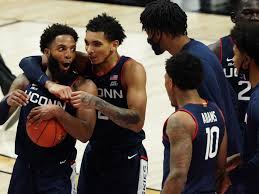
Game observations on Providence loss: UConn looks disjointed, offense goes cold, and Sanogo continues hot streak

UConn entered Wednesday’s game at rival Providence desperately needing a win to keep their NCAA tournament hopes on track after a tough loss to Seton Hall. Their need to win only increased more when it was announced just before the game that James Bouknight would not play. Providence was similarily in a must-win mode after having lost four of five to fall to 9-10 and 5-8 in the Big East. The game would come down to who showed more toughness and efficiency.

UConn did not rise up to the challenge. Instead, they seemed to lack energy for all 40 minutes and performed poorly on both ends, especially in the second half. Meanwhile, Providence executed well and controlled the pace, getting contributions from throughout the roster. This resulted in a 70-59 loss, the Huskies (8-5,5-5 in Big East) fourth in five games.

While the absence of Bouknight and uncertainty over his return is obviously taking a toll, it cannot be used as an excuse, especially when the Friars were also missing top players due to injury issues. It’s time for the UConn players as well as Dan Hurley to not make excuses and play better as a team. As of Friday afternoon, they are currently sixth in the Big East and off the bubble for the tournament.

After leading by one at halftime, UConn and Providence briefly traded baskets to open the second half before the Friars star point guard David Duke made a layup to give them a 40-38 2:45 in. This kicked off a 17-6 Providence run that put it up 55-44 with 9:49 remaining. During this, the Friars pushed the tempo and got multiple easy layups, with the Husky defenders either beaten off the drible or out of position. Providence also regularly got fouled going to the rim, as UConn kept being called for touch fouls. Nate Wilson and Noah Horchler scored six and five points, respectively during the run. Meanwhile, the UConn point guards struggled to bring the ball up against the Providence press and generally wasted a lot of time just throwing the ball from side to side, leaving players having to rush shots in the final seconds of the clock. The Huskies went cold even on open shots, missing five three-pointers.

After falling behind by 11, UConn finally got ont rack for a short time. It went on an 11-3 run, which was ignited by tighter defense by UConn (it had both three steals and blocks during this stretch), quicker and easier shots, and offensive rebounding, as well as missed free throws by the Friars. Whaley and Sanogo each had dunks during the run. However, Polley again missed a 3-pointer when he had an opportunity to tie the game at 58 with 3:15 remaining, and Providence closed it out from there, hitting eight free throws in the final three minutes to win by 11.

Sanogo had one of his best all-around games despite foul trouble, scoring nine points and grabbing eight rebounds while making five blocks. Cole led the Huskies with 14 points on 5-12 shooting and earned six assists, but had five turnovers. He again slowed down in the second half, scoring just five points. Martin had 13 points and nine rebounds. Whaley again struggled, scoring just four points in 29 minutes before fouling out, and Jalen Gaffney had a disappointing game after earning the start at point guard, recording four points and an assist in just 16 minutes due to foul trouble. Tyler Polley had his worst shooting game of the year, going 2-12 overall and 1-8 on 3-pointers despite a number of open looks. Wilson and Duke led the way for Providence, as the former had 17 points on 6-8 shooting and six rebounds, and the latter 17 points, six assists and three steals. Horchler had nine points and 10 rebounds, and A.J. Reeves had 10 points and six assists.

As a team, UConn shot just 36.5% in the second half and 40% for the game. Polley was not the only player who struggled from behind the arc, as the team went 4-20. The Huskies were beat in nearly every statistical category. Providence controlled the boards, grabbing 39 to UConn’s 34, and the Friars lohad 14 assists to UConn’s nine. Providence also had a big advantage at the foul line, making 18 free throws to UConn’s five. The lone bright spot was in blocks, as the Huskies had eight.

Any way you look at it, this was a very disappointing game and probably the most frustrating loss UConn and its fans had had in some time. The team seemingly lacks confidence right now and isn’t playing well in any facet of the game, and Hurley doesn’t seem to necessarily have answers. The whole James Bouknight saga and the question of if and when he will return had seemingly cast a cloud over the program. I don’t know what the answers to these problems are, but suffice to say Saturday’s matchup with Xavier is a must-win game.

Here are my observations on the loss to Providence and UConn’s play:

The Huskies offense never gets going

This applies to every element of the game, but especially on the offensive end. Providence head coach Ed Cooley was very smart to play the press knowing that UConn generally doesn’t run and play uptempo, and the offense played right into Providence’s hands. The Huskies rarely tried to run and quickly break the press, typically taking nearly 10 seconds to get the ball within 20 feet of the basket. After that, it seemed like it generally took at least 10 seconds for a shot to be taken, and many of this were covered or came lot in the shot clock. Even with UConn struggling from the outside, the players did not try and feed the post or drive and either shoot it or get to the foul line nearly enough. Both when the team went cold in the middle of the second half or tried to come back late, the Huskies did not try to play more quickly or run unique offensive sets to generate points and momentum.

After the game, Hurley clearly expressed his frustration with the pace of play and the offense not being more agressive. That’s all well and good to hear, but what changes are he and the players going to make to get the offense playing more efficiently. I understand Hurley’s desire to try and play more slowly without Bouknight so that it keeps scores lower and makes it more likely UConn can win games, but that is currently not working, and the defense isn’t playing well enough to hold opponents in the 50s or low 60s anyway. What’s the arm in running different offensive sets that catch opponents off guard, or playing more uptempo and try to generate easier baskets and opponent turnovers. The Huskies need to worry less about Bouknight coming into save the offense and instead get the offense to work even without him.

UConn lacks energy and focus

While the offense was certaintly the biggest issue against Providence, the defense didn’t execute well either. Players were regularly unable to close out on shooters in time, especially on 3-point shots. While the big men protected the rim well and got some key blocks, the guards were beaten off the dribble at key times, especially in the second half. It seemed like the defenders did a poor job communicating with one another, especially in plays such as the pick and roll. While some guys already struggling on defense (like Polley) continued to have tough days, others like Martin did not perform up to their standard. UConn’s defense has been on a slide for a while now, as it has allowed at least 70 points to four of their last five opponents, the exception being the Butler win on Jan. 26th. In the adjusted efficiency ratings on kenpom.com, the Huskies are now 45th in the country at 94.3 points, which is more than 20 points higher than two weeks ago.

The lack of energy is also being reflected in UConn’s rebounding numbers. It has not won the rebounding battle in the last three losses, and had fewer offensive rebounds against both Seton Hall and Providence, despite that being the Huskies biggest strength. While they still have excellent offensive rebounding numbers (third in Big East play with 11.9 per game and sixth in the country in KenPom in averaging offensive rebounds on 15.3% of misses), UConn is 10th in Big East play in defensive rebounding with 23.3 per game, and its average of 35.2 per game is now sixth out of 11 teams. Against the Friars, the Huskies lost the rebounding batte 28-23, and its 10 offensive rebounds were two fewer than Providence’s. They were again beaten to long rebounds and loose balls and allowed costly second chances, while being one-and-done when shooting. Whether that’s a matter of UConn players not giving enough effort or more likely just misjudging rebound opportunities and being outworked, the Huskies need to reestablish their rebounding as a huge strength to be successful.

Finally, the UConn players and Hurley aren’t demonstrating enthusiasm and excitement when playing. Watching the bench against Providence, you did not see the players cheering on one another and celebrating big plays, and Hurley definitely looked displeased a lot. Hopefully against Xavier, the team will make a conscious choice to come out with as much energy as possible and maintain an air of positivity, one that can help lead to a win.

Sanogo and Andre Jackson are again huge bright spots

While fans were definitely frustrated with the play of UConn’s older players, Sanogo and Jackson each had very strong afternoons. Sanogo did an excellent job on the boards and made some tough shots, again demonstrating strong footwork. He also continues to improve on defense by altering and blocking shots more effectively and bodying up on defenders, although he still needs to improve on keeping his hands up and avoiding costly touch fouls. The growth that Sanogo has shown as a player over just a few weeks is amazing, and I am sure he will continue to improve the rest of the season.

Jackson has displayed exciting offensive abilities and athleticism since returning against Seton Hall. He had six points, four rebounds and two assists against Providence in 28 minutes. Jackson made a number of highlight-reel plays, including another memorable dunk and a few difficult passes. He is an inconsistent shooter and still pretty raw on defense, but I think Jackson is arguably the most athletic UConn player besides Bouknight and will be essential to any success the team has the remainder of this season.

The James Bouknight Experience

After it was announced Bouknight was not playing, Hurley said in the post-game interviews that an outside surgeon had operated on Bouknight to take out his bone spurs, and that he wasn’t close to returning. Suffice to say, it was frustrating to hear Hurley only reveal this information about the surgeon now, and have his statement contradict the previous ones that Bouknight would be a game-time decision for each game before his return. Now we cannot know when exactly Bouknight will get clearance to play this season if at all (I would guess it will beanother week at the earliest), and have to speculate on how the question of when Bouknight returns is affecting his teammates. I have to imagine that they are frustrated about how to approach games and prepare with his status up in the air, and that their struggles without him are only eroding confidence. Hurley needs to help his team cultivate the idea that the rest of the season is their oppurtunity to prove how good they can be without Bouknight, and that this will result in UConn elevating its play and beating tough opponents. That way, it will again be prepared to again be one of the best teams in the Big East when Bouknight returns.
Observations on win against Butler: UConn shows its depth, the defense steps up, and the Huskies get a decisive win

After two tough losses to St. John’s and Creighton, UConn was in serious need of a bounce-back win against a hot Butler squad at home Tuesday night. It came out strong from the opening tip and played efficiently on both sides of the ball, winning 63-51.

In the first half, the key to the Huskies (8-3, 5-3 Big East) success on the offensive end was the 3-pointer. After they took a 12-10 lead 8:53 into the game, the team hit six consecutive 3-pointers over roughly the next eight minutes, ultimately taking a 34-20 advantage. UConn would maintain a double-digit lead for the remainder of the game. During this run, the struggling Tyler Polley and Jalen Gaffney each hit two treys. The Huskies ultimately shot 6-9 from the outside in the half on their way to a 38-24 lead.

UConn was largely successful from behind the arc in the opening 20 minutes due to quality ball movement and players moving well without the ball. They were able to find open space and get set before shooting, which was a challenge in the losses. Polley especially benefited from teammates getting him the ball when open after constantly being defended tightly against St. John’s and Creighton. The Huskies , who started the game pushing the ball more than normal, also did an effective job of passing the ball into the post and setting screens to get open baskets at the rim in the first half, with Tyrese Martin and Isiah Whaley being the main beneficieres. UConn would shoot 62.1% in the half, with Martin and Polley leading the way with 9 and 8 points and the bench outscoring the Bulldogs (5-8, 4-6)) 14-7.

The Huskies defense, which had been inconsistent in the losses, was even better than the offense in the first half. It limited Butler to 29.6% and 1-11 on layups, and recorded both five steals and blocks. UConn did an excellent job of defending at the rim and providing help when necessary as well as avoiding fouls, and rarely allowed Bulldogs players quality open looks.

In the second half, the Huskies continued to play strong defense throughout even as they cooled off offensively. They were able to maintain a comfortable lead and squash any possible runs. After a few jumpers helped the Bulldogs go on a 8-2 run and cut UConn’s lead to 49-39 with just over nine minutes left, it put its foot down and went on an 11-2 spurt to take a 19-point lead with 5:54 remaining. Martin and R.J. Cole each made multiple impressive shots during the run. The Huskies defense continued to shut down the paint, and only Bryce Golden was able to shoot well from the perimeter for Butler.

UConn’s shooting percentage was both 50% from the field and 3-point line. Meanwhile, it allowed its fewest points of the season and limited the Bulldogs to 34.5% shooting and 7-21 from three. Golden shot 5-7 from three and scored 19, but his fellow starters scored 24 combined points on 11-38 shooting. The Huskies finished with nine blocks and six steals, and jumped up to 24th in KenPom’s defensive efficiency rankings.

Martin was outstanding from the field after struggling the previous two games, shooting 7-9 on his way to 20 pooints. The junior was able to make a wide array of shots, such as floaters and layups, which he has struggled to finish. Martin also again flashed his 3-point shooting ability, making 2-3. He has scored in double figures in five straight games. Cole handled and shot the ball well, scoring 11 on 4-7 shooting to go along with five assists. Polley and Sanogo each had eight points, and Whaley smacked seven blocks. UConn distributed 14 assists.

Tuesday night’s win was just the game UConn needed. The team played arguably its most well-rounded and consistent game of the season, and showed a ton of confidence against an opponent that is playing well. The win again showed that the Huskies are capable of beating anyone even with James Bouknight out. With the games that were originally scheduled to follow postponed (Villanova and St. John’s), UConn will get a lot of time to prepare for a tough matchup against Seton Hall on Feb. 6th, with Andre Jackson and Bouknight possibly playing.

Here are my five observations on the win against Butler:

The Huskies get impressive efforts across the board

Dan Hurley and UConn fans have stressed the importance of finding one or two primary scorers with Bouknight out. While that has not necessarily happened yet, most of the Huskies stepped up on at least one end against Butler. Martin had his best shooting game of the season and scored in double figures for the fifth consecutive game. Cole continued to play well on both ends of the floor and did not force shots while moving the ball well, and scored in double figures for the third straight game and recorded five assists for the fourth consecutive game. Gaffney built on his solid performance against Creighton, recording six points and three assists in 27 minutes. Pollley showed a better touch on 3-pointers and improved his rebounding. In the paint, Whaley had a monster defensive performance with his carrer-high seven assists, showing improved energy and his ability to guard all five positions. Finally, Sanogo (who again showed off good low-post moves) and Josh Carlton combined for 10 points and 12 rebounds in 30 minutes.

Without Bouknight, UConn has a very small margin of error, even against marginal opponents like the Bulldogs. Multiple players will have to step up on both ends of the floor until he comes back, and Tuesday’s win displayed how impressive the Huskies can be when they play as a team.

Martin steps up as a team leader

While Martin still needs to be a little more consistent on offense, he is continuing to establish himself as UConn’s top offensive player right now. Martin is averaging just under 16 points and six rebounds per game in the last five contests amd shooting roughly 48% from the field. On the season, Martin is now averaging 11.9 and 7.2 rebounds on the season while shooting 47.8%.

Tuesday was the guard’s best shooting game of the season (7-9) and stands with the first DePaul game as his best offensive performance. Martin demonstrated that he is capable of finishing at the rim when concentrating, and that he can finish tough floaters over defenders and stretch the floor by hitting dribble pull-up 3-pointers. Martin’s defining play came in the final seconds of the first haf when he did a cross-over and hit a floater over defender Jair Bolden as time expired. Few players do not have the smarts and shot-making ability to make that play, and UConn is lucky Martin has that gift. He is already defining himself as one of the best transfers the Huskies have ever had.

UConn returns to playing high-quality defense

Against Creighton and especially St. John’s, the defense had disappointing efforts. The Red Storm shot 49% and the Bluejays 51% overall, and Creighton shot 18-27 on 2-pointers. Both squads also killed the Huskies in the second half, scoring over 40 points. The defense especially struggled to stop these squads at the rim and on screens, constantly allowing open layups.

UConn’s defense was much better in all aspects of the game against Butler. Both the man-to-man defense and especially the help D was excellent, with players revolving over to help teammates stop drives and constantly contest shots. Sanogo continued to show improved defense, and Whaley, who was called out by Hurley to play with more energy, met his coach’s demands. He continued to display his ability to guard all five positions on his way to the seven blocks, as well as his remarkable ability to hedge. Whalley is now averaging 2.8 blocks per game, and is a prime contendor for Big East Defensive Player of the Year. The Huskies reminded opponents that they can shot down any and all opponents and star scorers.

Cole and Gaffney played well as a tandem at point guard

While Cole has consistently improved in recent games, Gaffney was struggling mightily and losing minutes. That’s why it was so rewarding to see both play efficiently. Cole (29 minutes) and Gaffney (27) combined for 17 points on 6-18 shooting and eight assists against four turnovers. Each handled the ball well and consistently found open teammates, and avoided taking reckless shots. They each also pushed the tempo more than in recent contests, putting the Bulldogs on their heels. It was especially rewarding to see Gaffney play efficiently, and if he continue to play smart while being more agressive, he can take pressure off Brendan Adams and help UConn be a more complete team.

UConn makes sure to keep the pressure on

Over the last few years, the Huskies have made a habit of allowing teams to get back into games after taking comfortable leads, and losing some of these contests as a result. Even more than in the AAC, this is a huge handicap when facing the heavy competition the Big East offers. That was why it was so rewarding to see UConn take a double-digit lead and then maintain it throughout, while quickly responding to any run by the Bulldogs. It was a good example of maturity and confidence, and hopefully it will continue when UConn gets similar leads against toughter competition this season.

Observations on loss to Creighton: Huskies fight hard but fade, shooting is poor, and Sanogo’s coming-out party continues

Note: I know this article is being published after UConn already beat Butler on Tuesday. It was delayed by some family issues I have experienced the last few days. However, hopefully it can serve as a comparison piece to the Huskies performance against the Bulldogs. Thank you for reading.

After an ugly loss to St. John’s, No. 23 UConn played much toughter and with more energy at No. 11 Creighton on Saturday and were able to stay with the Bluejays for over 30 minutes despite poor shooting. In the final 10 minutes of the game however, Creighton shot the lights out and pulled away against the short-handed Huskies, winning 74-66.

Just like in UConn’s previous two games against Butler and St. John’s, the team struggled mightily on the offensive end. The Huskies missed a lot of layups and shots in the paint despite getting many second-chance opportunities, and struggled to run smooth offensive sets and get easy scoring opportunities against Creighton’s strong defense.

UConn (7-3, 4-3 in Big East) had just 13 points with seven minutes left in the first half before finally getting on track offensively. It started the second half well and kept pace with Creighton on the offensive end in the opening minutes, but the Bluejays defense eventually tightened up and helped ensure UConn hit few perimeter shots, allowing their offense to pull away. The Huskies finished the game shooting 36.5% overall and 7-23 from three. Meanwhile, Creighton couldn’t miss in the game’s final minutes. After shooting 43% in the first half, it shot 58% in the second.

Uconn liked like they could be on the verge of getting blown out in the early minutes of the game, as it started 6-27 and trailed 23-13 with seven minutes remaining in the first half. The Huskies finally got on track in those last few minutes and trailed by just one at halftime, 29-28.

Cole helped lead this comeback and ignite a 9-0 run, scoring eight points in the final 4:27 and making a beautiful crosscourt pass to Brendan Adams for a wide-open three that cut the deficit to one. Cole did an excellent job handling the ball during this stretch and showed some nifty moves while hitting contested jumpers. UConn’s defense, meanwhile, played very well in the final seven minutes against one of the country’s best offenses. It consistently limited the Bluejays to one shot and forced a few key turnovers and consistently challenged shots on the peremiter. The Huskies also benefited from Creighton struggling at the free throw line.

UConn absolutely obiliterated the Blue Jays on the glass in the first half, grabbing 26 rebounds and recording an 11-1 advantage in offensive boards. Nearly every player did their best to crash the glass, and the team did an excellent job of outhustling Creighton’s players to rebounds. However, the Huskies didn’t come close to generating the number of points they should have from their rebounding prowess, as they had very few second chance points despite a ton of great opportunities. For the half, UConn shot just 29.4% and 2-9 from three. Cole and tje Bluejays Denzel Mahoney each had 10 points in the 20 minutes.

The Huskies offense continued to play well at the beginning of the second half, keeping pace with Creighton in the first few minutes even as the Bluejays offense began to return to its high-flying ways. UConn attacked earlier in the shot clock instead of their recent custom of playing hot potato with the ball for much of its possessions. Adama Sanogo led the way, scoring seven points in the opening 9:42, and a dunk by the freshman off a pass by Jalen Gaffney tied the contest at 50.

From that point, it was downhill on both sides of the ball. On defense, UConn allowed Creighton to go on a 12-0 run after tying it, and the Buejays shot 7-13 in the last 10 minutes, while also making 11 free on 19 attempts. Mahoney led the aforementioned run, scoring five points and assisting on a Marcus Zegarowski 3-pointer. Creighton did an outstanding job moving the ball and avoiding turnovers in the second half, committing just two (it had nine for the game). The Bluejays were constantly able to penetrate the middle of the floor and get open jumpers, and also hit many open shots. The offense also wore the Huskies down by getting to the rim for either layups or free throw attempts. The Huskies were in foul trouble throughout the second half, and Sanogo and Martin fouledo ut. Finally, Creighton did a better job of rebounding in the half, grabbing just one less than UConn.

On offense, the Huskies struggled to make jumpers and 3-pointers in the final 10 minutes, shooting 5-15. It was hard for UConn to go inside near the end due to foul trouble, and the team continued to miss shots at the rim.

Creighton got good offensive contributions up and down the lineup despite not playing to its loftly offensive standards. Four players finished in double figures, with Manhoney shooting 8-14 and 3-7 from three on his way to 20 points. Zegarowski struggled from beyond the arc, shooting 1-5, but still finished with 15 points, and Ryan Kalkbrenner scored 10 points in 22 minutes. The Bluejays got to the line 32 times, but made just 20 free throws.

Cole led UConn in scoring, finishing with 14 points and going 6-7(!) from the line while also adding five assists. However, he again slowed down after a hot start, scoring just four points in the second half. Sanogo was rewarded for his performance against St. John’s by earning 20 minutes despite foul trouble and made the most of it, scoring a season-high 13 point on 5-9 shooting and grabbing five rebounds. Sanogo could have had even more if it was not for his inconsistent footwork and ball handling, as he committed five turnovers. Martin scored 11 points but disappeared for minutes of a time on offense, and Whaley had 10 points and nine rebounds but shot 4-13. Finally, Tyler Polley again had an ugly day, going scoreless and 0-4 from three in 17 minutes. The senior had just one rebound and no assists. The Huskies had 14 assists but 12 turnovers, and recorded just three steals.

As I elaborate upon below, UConn has nothing to be ashamed about losing to Creighton. Despite missing Bouknight as well as Andre Jackson and Akok Akok due to a bruished shin, the Huskies fought the Bluejays to a draw for 30 minutes, did an outstanding job on the boards, and played solid defense in the first half. UConn understandably were worn down and got in foul trouble largely because of Creighton’s athleticism, and the Bluejays are capable of going on scoring tangents like they did in the second half against any team. However, UConn’s inability to make easy shots in the paint and at the rim and earn so few second-change points is embarassing, Bouknight or no Bouknight. You cannot be one of the top teams in the Big East if you are not making open layups (the Huskies were 6-16 on layups in the game) or bunnies at the rim. The team has a thin margin of error right now, and they could be in danger of losing every game without their star if these struggles continue.

Below are five observations on the loss to Creighton:

This team’s inability to make layups and other shots at the rim is stupifying

For UConn to beat Creighton, they would have had to shoot very efficiently. Instead, the offense was extremely inconsistent and struggled to make shots inside 15 feet for all 40 minutes, despite getting many open looks. The Huskies shot 6-16 on layups (37.5%) and rarely scored on their second-chance opportunities despite grabbing 18 offensive rebounds.

While myself and others would have liked UConn to occasionally push the tempo more and shoot earlier in the shot clock, the team’s offensive approach made sense against the Bluejays. Slowing down the tempo and crashing the boards on missed shots limited their scoring opportunities and took away possessions. If the Husies had made their layups and second-chance opportunities at a decent clip, then they probably could have kept the game close throughout and have a decent chance at the upset. UConn’s inability to score on second-chance opportunities was front and center when it grabbed two or three offensive rebounds off misses on multiple possessions and still failed to score on shots surrounding the basket. On one possession, players missed four consecutive shots.

As of Monday night, the Huskies were shooting just 52.7% on shots at the rim (layups, dunks, and tip-ins), which ranked 325th in the country in Division I, out of 347 teams. Only one power conference team (Washington St.) ranked lower than UConn. Five Huskies were shooting under 50% on 2-pointers and three (Adams, Gaffney, and Cole) were under 40%. There are plenty of factors for why many players are struggling so much at shots at the rim and on 2-pointers. The most glaring include poor footwork, rushing shots (paging Whaley), either not taking the right angles on shots or failing to go up strong, and only occasionally getting out in transition. Despite UConn’s size and depth in the frontcourt, it seems the team rarely dunks.

Its hard to imagine the team won’t improve its shooting rate at the rim, but it has to work at finding strategies and drills in practice that can help lead to such improvement, Otherwise, there is almost no way the team can play over .500 with Bouknight out.

UConn’s performance on the boards was remarkable

The Huskies have been an elite rebounding team this season and one of the best offense rebounding teams in the entire country and the best in the Big East, even with Akok barely playing. In the previous two games, however, DePaul had the same number of rebounds as UConn and St. John’s controlled the boards in their wins. Against Creighton, UConn bounced back and dominated the boards from start to finish. It ultimately outrebounded the Bluejays 43-27, and grabbed 18 offensive rebounds to Creighton’s five. Despite the Bluejays players being more athletic than the Huskies players, they showed great rebounding instincts and crashed the boards on every missed shot, beating Creighton to the ball again and again. It’s just a shame the offensive rebounds rarely resulted in points.

What’s most remarkable about UConn’s rebounding ability is that it has multiple guards who are nearly as good on the boards as the Huskies bigs. Against Creighton, Adams tied Whaley for the team lead in rebounds with nine, and his four offensive rebounds led UConn. Martin, who is quickly establishing himself as one of the best rebounding guards in the program’s recent history, grabbed five (three offensive) and Cole had four boards. Sanogo had five rebounds and Carlton managed to grab four in just 10 minutes of play. The Huskies rebounding prowess should allow them to be competitive in every game, with or without Bouknight.

Sanogo continues to play at a high level

After a strong performance against St. John’s in which Hurley inexplicably sat freshman for the final 12 minutes, Hurley said that Sanogo had earned more playing time and would get it as long as he continued to work hard in practice and plays well on offense. Sanogo rewarded Hurley for his decision by scoring 13 points on 5-9 shooting and grabbing five rebounds in 20 minutes of play before fouling out. He continued to show good touch around the basket and the ability to manuever around defenders. While Sanogo’s footwork was shaky at times (he committed five turnovers and traveled multiple times), I’m confident he can improve in this area with by concentrating better and not rushing his shot.

After the game, Sanogo praised Sanogo’s performance but said it’s a problem when the center is UConn’s best offensive player. That is certaintly true. However, it is awesome to see how many strides Sanogo has made on offense recently. At the moment, he is the Huskies most efficient big when shooting at the rim (54.2% for both effective field goal percentage and shots at rim). Even with Sanogo’s inconsistency on defense and his limited passing ability, he absolutely deserves to have more minutes than Carlton, and is making up for the abscence of Akok. If Sanogo continues to improve at this rate, he could be the best big man UConn has had since Andre Drummond in a season or two.

This was a strong effort by the Huskies overall

After a deflating loss to St. John’s and looking like Creighton could below them out early, it was nice to see the Huskies not get discouraged and play so hard from start to finish. The players displayed a lot of energy and toughness, and many of them looked confident despite facing the conference’s second-best team without Bouknight. UConn played very good defense in the first half, and still managed to hold the Bluejays offense under their season average despite Creighton shooting the lights out in the last few minutes. As frustrating as it was to see the offense play so poorly, the Huskies put themselves in good position to win and definitely could have pulled off the upset if they shot more efficiently. Even if the offense only slightly improves, UConn can beat anyone.

Hey, UConn actually made free throws!

It was awesome to see the Huskies shoot 16-18 from the line. Now can they shoot near that rate in another game, please?

Observations on loss to St. John’s: The defense collapses, UConn’s offense stagnates, and Hurley errs in an ugly loss

We all suspected this could be coming.

Over the last four games, UConn did an admirable job of winning tough games without their star to improve to 7-1. The Huskies earned a signature win against Marquette and won on the road, with different players stepping up in each game. The defense had consistently played very well, led by R.J. Cole and the bigs. It was all good enough to earn them their first Top 25 ranking in five years. That all came to a crashing loss in the second half against St. John’s Monday, all while Adama Sanogo inexplecably sat on the bench for the final 12 minutes.

The No. 23 Huskies, who led St. John’s 49-41 with 12:57 remaining and by eight with just under nine minutes left, was outscored 25-13 for the remainder of the game to lose 74-70. The Red Storm (8-7) took their first lead with 4:24 to go and took the lead for good on a layup by Posh Alexander at 2:35. UConn had just one field goal in the last five minutes and missed four free throws, including two by Tyrese Martin with 18 seconds left. For the game, the Huskies shot just 15-23 from the line.

Led by Cole’s hot start from behind the arc, UConn jumped out to a 21-7 lead over the first 7:17. For the remainder of the half, however, the Red Storm tightened up their defense and forced UConn into a half-court game. The Huskies struggled from the outside while missing shots in the paint. While St. John’s struggled from the perimeter and got just three points from Julian Champagnie, the Big East’s leading scorer, it was able to beat UConn in the paint and rebounded well, cutting into the deficit. The Huskies led 33-30 at the half.

Early in the second half, UConn played better in the paint, led by Sanogo and Isiah Whaley (9 points and 8 rebounds). Sanogo showed good footwork and obtained multiple good shots against the Red Storm defense, scoring twice, and Whaley scored on a hook shot and a goaltending call. A Huskies 6-0 run forced a St. John’s timeout and gave them a 49-41 lead.

Just when it seemed UConn was in control of the game and ready to hit a double-digit lead, St. John’s got going. Ellington hit consecutive 3-pointers to put the Red Storm within three, as head coach Mike Anderson went to a five-guard lineup. To counter this and protect against their speedy guards and outside shooting, Danny Hurley removed Sanogo for the rest of the game despit his great play. Fans freaked out in response as the Huskies lead withered away.

UConn was able to tread water in the next few minutes despite poor shooting and turnovers with the help of Martin, who got to the line repeatedly and scored seven consecutive points. Eventually however, the Huskies poorus defense and their offensive struggles caught up with them. St. John’s, led by Alexander, continuisly beat UConn in the paint for either layups or free throw opportunities, with players providing no help defense and unable to keep the guards in front of them. Despite Hurley’s efforts to to counter the Red Storm’s peremiter shooting by removing Sanogo, it didn’t work. Champagnie hit a 3-pointer to cut the deficit to two with 7:21 left, and St. John’s took its first lead of 64-63 with 4:24 to go on an Earlington three.

From there, UConn’s free throw woes and paint defense cost them. Cole missed multiple free throws, and layups by Alexander and Champagnie gave St. John’s a 71-67 lead with 1:21 to go. Martin drained an open three on the following possession, but then missed his free throws that could have given the Huskies the lead. They had one last change down 72, 70, but Polley rushed a three that was wildly off to seal the loss.

UConn had its worst defensive performance by far against St. John’s, allowing the Red Storm to shot 49% and 46.7% from three. St. John’s scored at will in the paint at will in the second half, and at the same time, the Huskies frequently got beat to loose balls and allowed offensive rebounds and generally were just outhustled on both ends. The Red Storm got great production from bench players Earlington (15 points, 5-8 from the field) and Dylan Addae-Wusu (10 points, 5 rebounds). Alexander was their best player, finishing with 18 points and six assists. Champagnie, the conference’s leading scorer rallied from his poor start to finish with 12 points and made seven free throws.

Meanwhile, UConn mostly struggled on offense and reguarly missed open layups and other easy sots. For the second consecutive game, the Huskies underperformed on the boards. Both teams had 34 rebounds.

Cole hit all his threes early, and finished with 16 points and five asists on 6-16 shooting. Sanogo was the Huskies best all-around player in his limited minutes, scoring a season-high 12 points on 6-11 shooting to go with five rebounds and a block in 17 minutes before he disappeared. Martin had an up-and down game, finishing with 14 points but shooting 4-11, and had six assists. Polley was lousy all-around, going 2-8 and 1-6 from three for seven points, grabbing only one rebound, and getting dominated on defense.

It was a poor effort, to say the least. Even without Bouknight, UConn is definitely a better team than St. John’s, who come in having lost three consecutive games and had not beaten a top-00 team in the KenPom ratings. UConn did not play up to their ability in all facets of the game, and fell apart when they seemed to be in control. Hurley called it a “brutal” loss, and that is a great way to describe it. Hopefully, the loss will serve as a wake up call, and the Huskies can work on their issues and finding the right personal in practice the next few days. Starting Saturday with Creighton, things don’t get easier for UConn, as they will also have games against No. 4 Villanova and a hot Butler team over the span of six days. If nothing else, the team needs to play with the effort and intensity they are capable of.

Below are six observations on the loss to St. John’s:

The defense was abysmal, especially in the paint

I sound like a broken record, but UConn played both poor team and individual defense against St. John’s. In the paint, the Huskies could not stay in front of the Red Storm’s guards, and the big men and others mostly failed to switch off their men and provide the necessary help defense to try and stop them. St. John’s coach Mike Anderson made a brillant tactical decision to go to a five-guard lineup for the last 10:40 of the game after UConn went on a run, and Hurley and the players had no answer for it. Ultimately, the Red Storm made 50% of their 2-pointers. The Huskies always looked a step slow, and they did not show the same urgency as normal in getting to rebounds and loose balls, even as the game slipped away. One has to wonder if the team let up after taking its large lead and got discouraged by their defensive struggles and just couldn’t get back on track. The one bright spot was with the turnovers, as St. John’s had 18 and UConn had 12 steals.

After the Red Storm, a below-average 3-point shooting team, struggled from the arc in the first half, they were much better at the start of the second half. This was a large part of why Hurley made his fateful decision to remove Sanogo. It didn’t matter however, as St. John’s went 6-9 from three in the second half. It did a good job of moving the ball well and finding open 3-point shooters whom the Huskies were unable to rotate over on.

No UConn player had a particularly strong defensive game. The “6-9” Polley was constantly overmatched by the Red Storm’s quick and smaller guards, and sadly got no help. Josh Carlton was almost completely MIA, playing just three minutes, and Whaley did not make his usual defensive impact and allso did not provide help defense at crucial times. Sanogo actually made a couple of good defensive plays against Champagnie, earning a block and steal, but was removed from the game because of Hurley’s worries that he couldn’t keep up on defense against the quicker guards. Gaffney and the usually reliable Brendan Adams struggled on defense, with Gaffney picking up four fouls in just 11 minutes. Even Cole wasn’t as good as normal. Martin probably had the biggest impact on defense, earning six steals.

Dan Hurley has a poor game, making some inexplicable moves

Hurley is a very good recruiter. He is a great teacher of defense and is able to consistently develop and motivate his players. However, he has always had a streak of stubborness and had struggles with in-game coaching. These weaknesses were definitely on display Monday.

First, it made no sense for Hurley to take out Sanogo midway through the second half when he was playing at his best and the team was on a run, and then never put Sanogo back in as St. John’s was owning the paint and in the process of coming back and winning. In the final three minutes before Sanogo came out, he scored twice and assisted on a basket by Whaley to give UConn a six-point lead. While guarding Champaigne, he also blocked a shot and helped force a turnover. Sanogo showed great footwork and a variety of efficient low post moves, including an impressive hook shot, and he got himself open even on the shots he missed. Add his rebounding ability, and in the first 27 minutes Sanogo had been the Huskies best player on the day alongside Cole.

Hurley justified the removal of Sanogo to he and the fans by saying he could not play against St. John’s five-guard lineup, as he would have been able effectively defend the guards due to his size. You can understand the argument on paper to a point, but even if Sanogo had struggled on defense, he would have continued to give UConn an advantage on offense, allowing them to attack the paint and play an effective in-out game. It’s not like Whaley really stepped up on either end in the abscence of Sanogo. Anyway, once UConn’s offense started sputtering, there was no reason not to try and insert Sanogo back in to try and give it a pick up. I hope that Hurley realizes he made a mistake, and shows more trust in Sanogo late in games.

Besides the decision to remove Sanogo, I also don’t understand why Hurley did not try and do more to alleviate the Huskies defensive struggles in the paint. With Polley not making shots or rebounding and getting torched on defense, why not remove him and insite either Carlton or Sanogo again to defend the paint and give the team more size on the offensive end. Carlton may not have been able to defend St. John’s guards, but he could have possibly given UConn an offensive boost as well as a coming presence with his experience. I know Hurley is not found of playing zone, but the Huskies could have swihtched to it to give the Red Storm a different look and attempt to slow down their offense. Hurley was not flexible enough, and let Anderson and St. John’s dictate UConn’s game plan instead of the team sticking with what was working. Hurley should never take that step, and hope he realizes his mistake.

The one other fining I am interested in is what Hurley said to his players in the huddle to the players in the second half as they struggled and St. John’s rallied. Whatever he said to try and motivate the players didn’t work, and the players werent really exhibiting excitement or confidence on their faces. Maybe Hurley will need to change what he says and ajustments he makes when in a similar game situation.

Can someone make some damn free throws, please?

Against Creighton, R.J. Cole failed to make free throws in regulation that would have put the game out of reach. Against St. John’s, Martin, Cole, and others failed to hit free throws that could have guranteed the win, with Martin’s two misses with 18 seconds left the most painful. Martin, who got off to a hot start from the line, shot 5-8 there, and Cole was 2-4. Gaffney, who is the team’s top free throw shooter, took just one. In the game’s last nine minutes, UConn went just 7-12 from the line.

The Huskies free throw struggles have cropped up in many games, not just against St. John’s and Creighton. They are shooting just 69% as a team overall and 68% in Big East games, which is sixth in the conference. Bouknight is an excellent free throw shooter (81%), but he is out. Three of the other four guards (Cole, Adams, and Martin), are average or below average free throw shooters for guards. Cole and Martin, who each have 28 attempts, are shooting 71% and 61% respectively. Cole has earned a reputation as someone who misses free throws in close games, and Martin is very inconsistent despite seemingly having a good shooting motion. Gaffney is excellent at the line at 83%, but right now his disappointing play is causing him valuable minutes. The big men are all below average at the line, and Polley does not get there enough despite shooting 85% at the charity stripe.

There isn’t a simple solution to UConn’s struggles at the line in crunch time, especially without Bouknight. Right now, however, it is a big problem when most of your primary ball handlers cannot be trusted to make free throws in key late game situations. There isn’t a ton of time to work on free throw shooting drills in practice, but let’s hope that Hurley finds time to fit them in and that players figure out techniques that will make them more comfortable shooting free throws and improve their mindset and form.

Tyler Polley looks lost on both ends of the floor

After a slow start to the season, Polley had stepped up in the previous three games propr to St. John’s in place of Bouknight, averaging just over 18 points per game and shooting 13-24 from three. Monday’s performance was easily Pollley’s worse of the season, however. I have already discussed his defensive struggles, but Polley’s shot was also off all day, as he hit just one of six threes and scored only 7 points. It was the senior forward’s worst offensive performance since the first game against DePaul.

Polley was unable to hit any open threes and did not get set on many of his attempts and rushed multiple shots, most egregiously his airball three at the end of the game with the Huskies down one. Polley just seemed to try and do too much on offense, and got caught up in playing hero ball in the process. He also grabbed just one rebound and had no assists in 26 minutes. There is no excuse for a”6-9″ player to do nothing on the boards, especially against a small lineup. Polley has never been a strong rebounder, but is averaging just 2.6 per game. When his shot is not falling, he has to find other ways to contribute. That is what senior leaders are supposed to do.

The guards again played inconsistently

The three main guards against St. John’s (Cole, Martin and Adams-Gaffney played just 11 minutes) combined for 39 points and 9 assists. That’s good on paper. The numbers are deciving when you look closer, however. The trio shot just 11-30 (37%) and 6-18 inside the arc. They combined for 6 turnovers, and Martin had 6 rebounds, lower than his season average. While the three had 9 assists (5 by Cole) and handled the ball decently, they and their teammates were sloppy with the ball at times and the trio did not consistently generate good scoring opportunities for teammates.

Cole had a pretty solid game overall, finishing with a team-high 18 points and 5 assists and shooting 4-7 from three. The junior came out like ganbusters and hit four threes early. However, he faded down the stretch and did not make a field goal in the final 12:57, missing his final three shots. Cole again repeated his frustrated habit of driving into the paint and getting his shot blocked by larger opponents, failing to either pass to an open teammate or using his footwork to create an open shot such as a floater or hook. Martin scored 14 and had 6 rebounds (three offensive), but shot just 4-11 and 1-4 from three. He made some clutch shots near the end, but again missed open shots in the paint throughout the game. And of course, he and Cole missed key free throws that could help earn the win. Finally, Adams took just three shots in 30 minutes and committed four fouls, finishing with 7 shots overall. All three, particularly Adams, did not play up to their usual standards on defense. Finally, Gaffney again had a lousy game, scoring just 3 points in 11 minutes and struggling on defense to the tune of four fouls.

I trust UConn’s guards to rebound and play their usual strong defense over the next few games. However, they need to play better on offense, particularly in regards to shooting and creating quality shots for teammates. Most importantly, Gaffney needs to get back on track and show the confidence and athleticism he displayed at the end of last season.

Observations on Butler and DePaul wins: Martin continues to impress, defense steps up and UConn shows resilence

It is very tough to win three consecutive road games in the Big East, especially when your superstar gets injured and misses the last two games. UConn was able to overcome the absence of James Bouknight at Butler and DePaul on Saturday and Monday, winning the first game 72-60 and the second 60-53. Tyres Martin and Tyler Polley led the way on offense, and the Huskies defense continued to play excellent. In all, the three road wins moved UConn to 7-1 and 4-1 in the Big East, and earned their first Top 25 ranking in the AP Poll in five years at No. 25.

Against Butler, the Huskies built on their offensive performance in the Marquette comeback win and played well on that end without Bouknight. UConn scored 39 points in the second half and shot 10-21 from three. It had 13 assists and went 12-15 from the free throw line. Polley kept up his hot shooting in the win, shooting 5-8 from three and scoring 19 points. Martin had 15 points and 7 rebounds (3 offensive), and went 3-4 from three. Brendan Adams and Isiah Whaley each had 9 points, with Adams dishing 3 assists.

The Huskies defense was somewhat inconsistent, but held the Bulldogs to 5-15 from the 3-point line and forced 15 turnovers. Whaley was the standout defensive player, earning 3 blocks. UConn also again controlled the boards, outrebounding Butler 30-27.

While the Huskies were in control throughout against Butler, their second matchup with DePaul was an ugly back-and-forth affair. After leading most of the game, they fell behind 51-47 with 5:36 remaining. After a huge 3-pointer by R.J. Cole,Tyrese Martin carried the team down the stretch, scoring seven of their final 1o points. UConn’s already tenacious defense completely clamped down, holding the Blue Demons scoreless in the final 4:29 and commited six turnovers, and the team won by seven.

The Huskies have not been a strong offensive team even with Bouknight, and Monday’s game showed how tough it is for them to win without him, especially if their shooting is poor. UConn shot 40.4% and 5-18 from three against DePaul’s aggressive defense. They also struggled at the free throw line, shooting 13-24. UConn committed 14 turnovers and had just 10 assists. It also struggled on the boards, with the Blue Demons grabbing 39 rebounds to the Huskies 29. Martin was the catalyst, especially in the closing minutes. He finished with 19 points, shooting 7-14. Polley cooled down somewhat on offense, but still finished with 12 points and four rebounds. Cole hit his huge 3-pointer and finished with 12 points and four assists.

UConn’s defense was outstanding in both the opening and closing minutes of the game. It jumped out to a 17-6 lead 7:57 in, and held DePaul to nine points in the final 10 minutes while forcing 12 turnovers during this span. The Blue Demons committed 24 turnovers overall, as the Huskies guards and Whaley got their defense completely out of sorts and caused players to struggle with handling the ball and getting open shots. UConn’s guards combined for 13 steals, with Martin and Cole grabbing five and four, respectively. Whaley had two steals and blocks. DePaul shot 5-12 from three, and leading scorers Javon Freeman-Liberty and Charlie Moore combined for 17 points on just 8-23 shooting.

UConn is currently third in the Big East standings behind Villanova and Creighton at 4-1 as of Wednesday afternoon. They are 22nd in Ken Pomery’s rankings, with the 38th-ranked offense and 16th-ranked defense. This will be discussed in a seperate post, but it will be very interesting to see how well the offense will continue to perform without James Bouknight, whom it was just announced underwent surgery on his left elbow and will be out an “indefinite period of time”. It has been written online that he will be out 2-4 weeks from the time of the injury, which would put Bouknight’s likely return at the second week of February. Suffice to say, his teammates and especially the guards will need to consistently play better and pick up the scoring slack.

Below are five observations on the wins against Butler and DePaul:

Tyrese Martin continues to emerge as a scorer and team leader

Prior to the last two games, Martin had shown promise and strong rebounding skills, but had played inconsistently on offense. The junior transfer stepped up on both ends against Butler and especially DePaul, acting as the go-to guy alonside Polley. Martin scored 33 points in the two games (15 and then 18), shooting a combined 12-26. He grabbed 11 rebounds (5 offensive) and had five steals against DePaul. Martin shot 3-4 from three against Butler. For the season, he is now averaging 10.6 points and 7.9 rebounds.

Martin did an excellent job of slashing to the basket in both games and using his strength against defenders. He also demonstrated that he can score from the peremiter when open, which will help UConn spread the floor in certain games. Martin continues to be an excellent rebounder, constantly crashing the boards and displaying strong instincts. He has created much-needed second opportunities for the Huskies inconsistent offense. Martin has seemed to improve significantly on defense over the course of the season, with DePaul being his coming out party on that end. His closeouts and help defense has been very strong, and along with Cole he is making it difficult for players to create easy scoring opportunities.

More significamt and enjoyable than Martin’s individual stats however, was seeing him take over the DePaul game when UConn was floundering on offense. After it fell behind 53-49, Martin relentlessly attacked the basket and created shots and got to the line, ultimatelly making the Huskies last three field goals. He also assisted on Cole’s 3-pointer that cut the deficit to one, and continued to play high-quality defense. Martin showed a lot of toughness and leadership ability, and he should be one of the team’s leaders going forward. Martin will have a lot to say about whether UConn continues to play well without Bouknight.

Polley keeps up his quality shooting

Polley didn’t quite keep match his great game against Marqueete, but he continued to play very well against Butler and was solid against DePaul. Polley led the team with 19 points against Butler, shooting 5-8 from three and 4-4 at the free-throw line. Polley cooled off some against DePaul, but still finished with 12 points, going 3-8 from three. He also contributed more on the boards in the win, grabbing four rebounds after having none against Butler. For the season, Polley is now averaging 10.1 points and shooting 45.7% from three. Polley also played solid defense in the wins.

After the road games, Polley has shown that he can consistently help space out the offense and create more opportunities inside for the other bigs and especially the guards. If Polley can continue to shoot well from beyond the arc and on jumpers, he and Martin can be the main catalysts on offense and somewhat make up for Bouknight’s offense. Hopefully, Polley will also improve his rebounding performance over time.

This defense is really, really good

I already talked about the defense’s excellent performances in the two games above, but I had to signal it out again here. After five conerence games, UConn has cemented itself as the best defense in the Big East and one of the best in the country. As of Thursday, the Huskies D rank first in conference play in 3-point percentage (28.3%) and points allowed (60.3), second in field-goal perecentage (41.4), and third in blocks steals (7.8). In the national rankings, UConn is 18th in blocks per game (5) and 24th in points allowed (61.8). The Huskies ability to play quality team defense (defending ball screens, guard the passing lanes, closeout, hedge), while also having quality on-ball defenders and shot blockers, will make them a headache for every opponent to face. Even if UConn’s offense is struggling, its defense is good enough to keep them in every game.

Cole is taking control of the point guard spot, while Gaffney looks lost

Cole has taken steps forwards on offense since the Marquette game, when he shot 1-6 and had 5 points. He scored 19 points overall in the two games, shooting 3-9 from the field in each, and his 12 points against DePaul was his first double-digit scoring effort since the Creighton matchup. Cole also made multiple 3-point shots for the first time since that game, draining 2-4. He also got to the line more against the Blue Demons, making four free throws. Cole continued to distribute the ball well in the wins, totaling six assists against just two turnovers.

The junior continues to show deficiences in his offensive game. At “6-1”, it is difficult to score in the paint against taller guards and bigs, and yet Cole has a bad habit of taking low-percentage shots in these situations. He is an inconsistent 3-point shooter who is better at making catch-and-shoot threes than creating them. If Cole can improve in these last two areas and diversify his shooting game so it focuses more on scoring in transition and on floaters and jumpers, than there is no reason why he cannot score regularly in double-digits. I am confident that Cole will continue to be a strong floor general and quality defender, and we have seen that he does not lake for confidence. With the abscence of Bouknight and his increase in minutes, this is Cole’s to step up, tale on an even bigger leadership role, and live up to the expectations fans had based on his performance at Howard.

As for Gaffney…yeesh. The sophomore, who is averaging 5.8 points and 1.8 assists overall in 21.4 minutes, has seen these averages drop to 3.8 points and 18 minutes in conference pay. In the Big East, Gaffney is shooting 26.3% overall and 1-8 from three, and has not scored more than five points in a game. He also has the same number of turnovers as assists with none. Finally, Gaffeney’s defense continues to be inconsistent and he struggles with keeping his man from getting by him. He had a decent performance against Butler with five points, four rebounds and three assists, but slipped to three points and one assist against DePaul, shooting just seven shots in the wins and making three. Gaffney’s minutes have steadily dropped, and he played a season-low 11 against the Blue Demons. It is clear that the starting point guard job is Cole’s to lose right now.

Gaffney has frequently played too tentavily all season, and the trait has become more pronounced in conference play. He regularly passes up open shots and is not aggressive enough in creating plays. Despite being the best free throw shooter at this time, Gaffney has only taken more than four in one game. His defense is not good enough to make up for his offensive weaknesses, and Gaffney continues to loook like a deer in headlights too much. His play has regressed since the end of his freshman season, and he needs to take a step forward far a la Whaley last season. Gaffney improving is a huge key to the Huskies playing well through the abscence of Whaley. Hopefully he, along with the help of Hurley and teammates, can improve his game in practice and then bring that and intensity to games.

Akok Akok returns but makes little impression

It was awesome to see Akok finally return in the Butler game after a ruptured Achilles and hamstring strain. Husky fans should probably expect his impact to be limited in the next couple of weeks though. Akok played just nine minutes combined against Butler and DePaul, and did not record a rebound or block (his one basket came on a dunk). It’s clear that the sophomore center is still physically limited, and the ijuries and complications of Covid-19 definitely hurt Akok’s development. Expect Hurley to continue to ease him back in the rotation, and hopefully he will be an effective player by the middle of next month. Can’t wait to see him next year when Akok can finally play a full season.

Observations on UConn’s win over Marquette: Polley emerges, Whaley steps up, and one of the great combacks I’ve seen

Sitting down to watch UConn’s game against Marquette Tuesday night, I expected an exciting game against a solid team that would likely result in a close win. I was certainly right about the game being exciting. I didn’t expect it to be an 11-point win, however.

I kid, I kid. When we got to halftime with James Bouknight having hurt his elbow and scoring only six points and the Huskies trailing 31-23, I was just happy the game was so close and frustrated with having expereienced one of the worst-shooting halves in recent memory. After the Golden Eagles went on their 10-0 run to start the second half and led by 18 with 15:41 remaining, I was certain UConn would loose and just wanted to end the game playing well and with Bouknight still able to play. I never expected the team would go on a huge comeback run to win, and that it would be led by Tyler Polley. I am extremely happy to have been proven wrong.

Polley, whose shooting stroke had been inconsistent this season after his return from injury, drained a career-high 23 points in the final minutes, as well as five three-pointers. Meanwhile, Isiah Whaley played great on both sides of the ball and was a beast on the boards, finishing with 15 points and 13 rebounds. He even hit a three-pointer! The two seniors would score 74% of UConn’s points on the night. Ultimately, the Huskies would go on a 40-11 run to win 65-54 and improve to 5-1 overall and 2-1 in the Big East.

UConn’s defense was outstanding, particularly in the second half. It held Marquette to 38.6% shooting and 5-18 from three. In the final 11:12 of the game, the Golden Eagles scored just eight points. The Huskies did a great job of playing team defense and shutting down the paint, forcing Marquette into tough shots from the premiter.

After looking lousy in the first half, the UConn offense was much more efficient in the second half. The team played with much more urgency after the first timeout and did a great job of playing quicker and moving the ball. Polley’s shooting helped open up the floor for everyone, and while he and Whaley dominated the action, all players were involved. On the boards the Huskies had 15 offensive rebounds, and outrebounded Marquette 42-28 overall.

As of Wednesday night, UConn is ranked 25th in Ken Pomeroy’s rankings, with the nation’s 33rd-ranked offense and 32nd-rated defense. It’s averages of 15.8 offensive rebounds per game is third in the country, 42 rebounds is 28th in the country, and 63.5 points allowed is 46th. In conference play, the Huskies lead all teams in offensive rebounds per game (15), three-pointers allowed (5.3), three-point percentage allowed (25.8), and points allowed (63.7).

Below are five observations on the phenomenol win against Marquette:

Tyler Polley becomes a sharpshooter again

It has been a long road back for Polley, who missed the second half of last season after tearing his ACL. In the first five games, he looked tenative shooting the ball and did not display the same athleticism or three-point shooting ability he has shown throughout his career. After scoring 15 points in the season oepener against Central Connecticut, Polley scored only five points over three games, and missed the Creighton matchup due to his COVID-19 test results not being in before the game. Polley had only shot 3-11 from three before Tuesday’s game.

Polley went scoreless in the first half and was largely invisible. But after he made a 3 to cut Marquette’s lead to 43-31 with 14:37 remaining, a light switched on for Polley, and by extension his teammates. Polley went 5-6 on threes the remainder of the second half, and would shoot 8-12 for the game and make three free throws to finish with a career-high 23 points.

As UConn’s ball movement improved in the second half, Polley made shots both when covered and wide open, and by extension opened the floor for the rest of his teammates. As it became clear Polley was in the zone, he was very agressive and showed no hesitation. In addition to his offense Polley provided solid defense, using his “6-9” frame to help shut off the paint against defenders. It was a wonderful performance and arguably the signature game, of Polley’s UConn career so far.

As I have hit on in previous articles, Polley coming back to form is essential for this team to be successful. He should be UConn’s most reliable 3-point shooter and provide the team tought defense if he is healthy. I feel the Marquette win will give Polley a lot of confidence and encourage him to be aggressive. The win also shows how important Polley is to the Huskies as a leader. I can’t wait to see how Polley will look like in the next few games.

Isiah Whaley, the man teammates feed off of

In the days leaeding up to the Marquette game, Dan Hurley called on Whaley to provide the attitude and energy he showed at the end of last season that myself and other fans had fallen in love with. Whaley took his message to heart and played like a monster from the opening tip.

The senior helped carry UConn in the first half and the beginning of the second as Bouknight struggled and other teammates hadn’t begun getting going yet. He was constantly attacking on both ends, protecting the rim on defense and scoring there on offense, as well as doing an outstanding job grabbing rebounds. Whaley did an especially good job at hedging when defending Golden Eagle players. He also showed the ability to step out and make shots on the premiter, including his first career 3-pointer. Most importantly to myself, Whaley successfully played aggressive defense without fouling, particularly on screens, an issue that has plagued Whaley all season. He must continue to do this for the Huskies to be at their most efficient on both ends.

Whaley showed off all the abilities that can make him such a special player on Tuesday. Just as important, however, he displayed the intangibles that he provides UConn. The energy he showed on the floor and bench when interacting with teammates visibly inspired them and helped lead the team’s comeback. Whaley’s leadership is sorely needed on this squad, and I know he and Polley can help teammates improve both in practice and games. Whaley won’t put up statistics this good in every game, but if he brings the same energy and leadership, the Huskies will reach their potential.

The advantage of depth

Coming into the season, it was clear that UConn would have a lot of depth, especially when Akok Akok came back (we’re almost there guys)! But through six games, it is evident that depth is the Huskies biggest strength. While Bouknight can always be relied on as the team’s top offensive player and star (even when he was injured and couldn’t shoot effectively on Tuesday, using him as a decoy confused the defense and got players open), at least one other player has stepped up to help lead the team in each game on both ends of the floor. Outside of Polley against Marquette, Whaley played well in multiple games, including the huge win against USC, Josh Carlton was great against USC and DePaul, and Tyrese Martin has immediately established himself as an excellent rebounder and a valuable contributer.

The depth has especially been valuable on defense and in rebounding. UConn has multiple quality defenders, particularly in the frontcourt, and plays good defense as a team. While R.J. Cole has struggled on offense, he immediately showed he is an excellent defender and can shut down quality guards. The Huskies have excellent rebounders throughout their roster, and this allows them to have an advantage on the boards even when players struggle with foul trouble.

For UConn to reach their full potential, it would be ideal if a player could clearly be a Robin to Bouknight’s Batman. Even if this does not necessarily happen, however, the team’s depth will make them tough to beat in the Big East and when they play teams unfamiliar with them in the NCAA tournament.

This win can be a significant stepping stone goes ing forward

As important as beating a very good USC team on Dec. 3rd was the team’s resume and various rankings, beating Marquette was more significant. It was UConn’s first road win in the Big East in more than six years, and first road win overall since last season’s finale against Tulane. It came against a good team and program which defeated excellent Wisconsin and Creighton teams earlier this season. Most important, it showed that this year’s squad can keep their heads and come together to rally when they are struggling against a good team.

Beating Marquette showed a toughness and maturity the Huskies will need to be successful. Bouknight gets most of the attention from the national media, but the win showed that he does not define the team and UConn can win even when Bouknight struggles. I’ll be honest: If you had told me he would only score six points and get injured during the game, I would have told you the Huskies would lose by 10 to 15 points. Thank you, Huskies, for showing I am a fool.