
Six seasons ago, myself and UConn Nation were despondent and had no clue if UConn could become a premier program again. The Huskies were adrift in the American Athletic Conference, and head coach Kevin Ollie seemed constantly disengaged from players and unable to to coach them effectively on either side of the ball, despite leading them to a title in 2014. After UConn finished consecutive losing seasons, the administration found a way to escape Ollie’s costly long-term contract and fire him for cause, despite the violations discovered being dubious.
Athletic Director David Benedict eventually tapped URI’s Dan Hurley to be the Huskies next head coach. While Hurley had a good track level at the mid-major level (two wins in the NCAA tourney) and a reputation as an excellent player’s coach, there was no guarantee he could succeed in the demanding environment of Storrs.
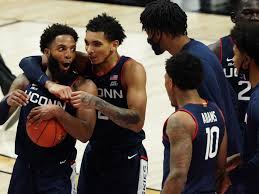
Cut to last Monday night in Houston, with the confetti falling down and UConn players and coaches as well as others celebrating the program’s fifth national championship after defeating San Diego State to win the title. It was a sight that I thought may never happen again after UConn fell apart in the second half of Ollie’s tenure, and the celebration almost moved me to tears.
While Hurley’s two previous tourney teams in Storrs were talented and very likable, this season’s squad was on another level. It had great depth, size and athleticism, which showed itself in different ways on each side of the ball.
On defense, the length and strength of Adama Sanogo and Donovan Clinigan allowed UConn to shut down the paint against most opponents, and the Huskies perimeter defenders were bigger and more effective than last season’s unit thanks to the additions of Naheim Alleyne and Hassan Diarra and improvement of Jordan Hawkins. And of course, Andre Jackson is one of the country’s best defenders at his best.
Offensively, Sanogo anchored one of the best frontcourts in the country, and UConn’s perimeter shooting, ball-handling and passing was consistently strong and elite at times. Hawkins lived up to his promise as one of the best pure shooters the program has ever seen, and Jackson continued to improve as a facilitator, and eventually as a scorer despite a limited skill set. UConn was one of the best rebounding teams in the country all season on both ends of the floor, and ranked second in offensive rebounding percentage at the end of the season.
Last year’s squad could be frustrating to watch offensively due to a lack of shooting and spacing in the front court, where Sanogo and Isiah Whaley could clog the paint. That was never a problem with this championship squad. It could score from anywhere on the floor while bullying opponents in the paint, drive to the rim effectively, and shared the bell as well as any team. (UConn’s rate of assist on made field goals was eighth in the country). At their best, this group of Huskies were extremely fun to watch and played with a sense of joy and toughness that was missing to some extent on Hurley’s earlier squads. It made nearly every game a must-watch event, which was a forgotten experience for myself and others.
As great as it was to UConn at their best in the regular season, it was just as rewarding seeing how it overcame the struggles of January to become a more well-rounded team, one that was again playing like on of the best in the nation by the end of the regular season. After losing six of eight in January, multiple players switched up their approaches on the offensive end and made both themselves and the team better as a result. Sanogo, Jackson and Hawkins especially stood out in this regard.
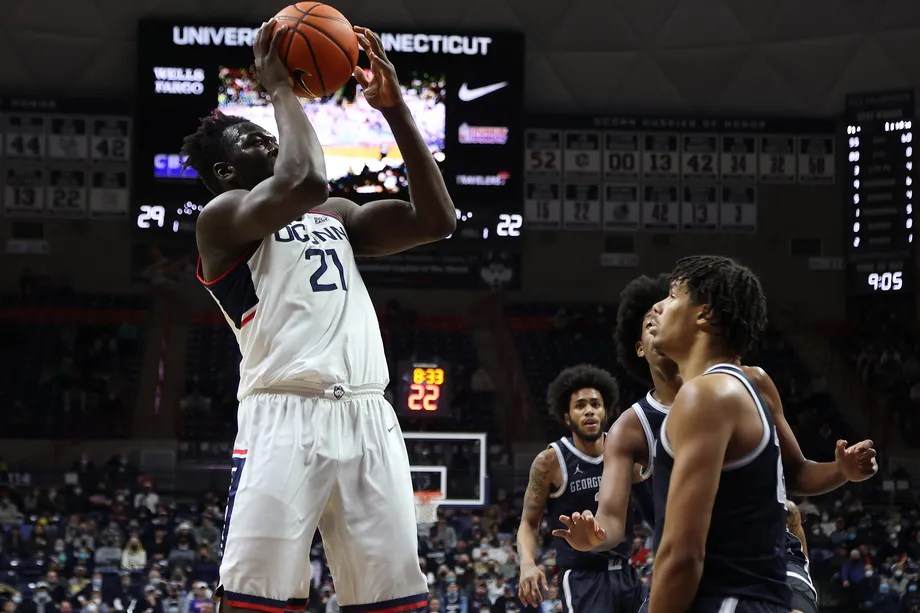
Sanogo, who was being constantly double-teamed, attacked the basket more directly instead of playing a traditional post-up game, and cut to the rim more for easy baskets and passes. Jackson, who was being goaded into shooting from outside and struggling mightily, got his confidence back on both ends by playing more in the “dunker’s spot” at the rim, which allowed him to score and rebound easily as well as make spectacular plays for others. Finally, Hawkins attacked the basket more for layups and free throw opportunities, while also benefiting from the improved spacing the offense had in February and March. At the same time the offense improved, UConn’s team defense got much more disciplined and focused, as the Huskies cut down on the unnecessary fouls and poor help D they played in January. Hurley’s ability to teach his players how to make these adjustments and his improved composure in games helped the UConn players compete with more confidence in games, and handle adversity when it cropped up. By the time the Huskies got to the latter stages of the NCAA tournament, they were able to always control games, ensuring there was no such adversity.
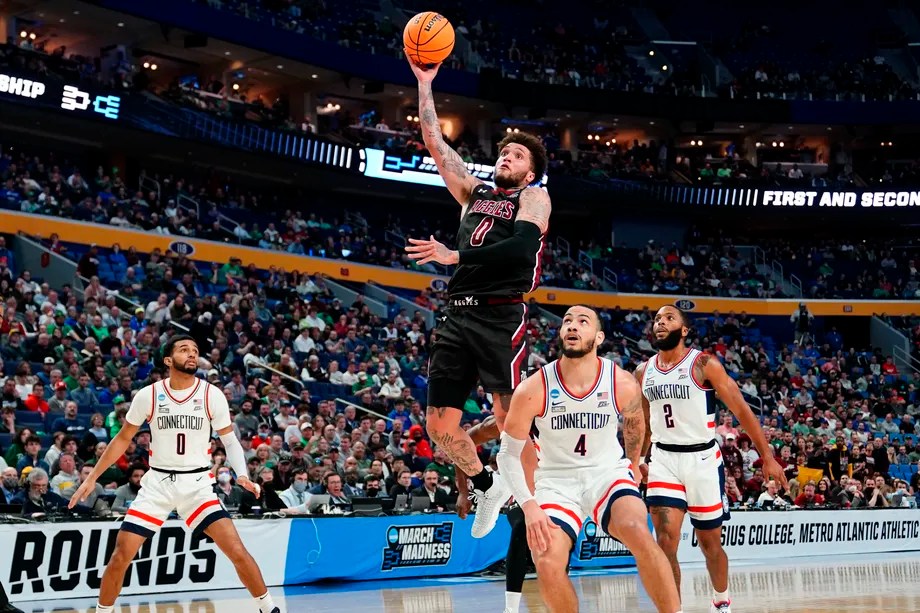
While it was easy to see UConn being capable of going on a Final Four run and maybe even winning the championship, never would I have imagined that it would dominate NCAA tournament opponents to that extent. They won the six games by an average of 20 points, and each win was by at least 13 points, including the 76-59 beatdown of San Diego State to win the title. The offense easily averaged over a point per possession (PPP) in each game while scoring 70 or more points, and held each t0 65 or fewer points and 0.95 or fewer PPP. Sanogo was the best player in the tournament, averaging over 17 points and a double-double, Hawkins averaged over 16 points and shot 50% from deep, and Tristen Newton was UConn’s best player in the championship game, scoring 19 points and earning 10 rebounds and 4 assists. Add all the intangibles Jackson brings and great performances by the bench throughout the tournament, and the perfect mixture for a championship is there.
Obviously, basketball fans who weren’t overly familiar with UConn fell in love with them as the team made its run. The team’s athleticism, shot-making and toughness jumped off the chart in each game, and it made a bunch of outstanding opponents look helpless at times. The basketball IQ and enthusiasm for the game every Husky displayed in March Madness was off the charts, as well as Hurley and the player’s composure in tight moments and ability to shack off poor plays. I know if I was a neutral fan, I would enjoy jumping on the UConn bandwagon. As nervous before and at points during each game, I was in ecstasy by the end of each win.
Now that UConn has five titles in 25 (technically 24) seasons under three different head coaches, everyone is debating over whether they qualify as a blue blood. I have always thought that title is meaningless in the grand scheme of things, especially considering how hard it is to define. All I know is that UConn wins championships when it goes deep in the tournament, and it is arguably the best men’s basketball program of the last 30 years, and that Storrs is the college basketball Capitol of the World. All I know is that this was arguably the most complete team top to bottom of any of the Huskies championship teams this century, and certainly my favorite to watch. And finally, I know that this championship has redeemed by belief that UConn can be a consistently elite program. Thank you, Dan Hurley and the 2023 championship UConn Huskies.
 HUSKY NATION