
With the Huskies having seven conference games remaining before the Big East tournament at this time last month, I thought it would be a good time to give grades to each player on the team for how they have played up to this point of the season. I decided to first focus on the bench, before moving on to the starters after the Marquette game tonight. This article focuses both on the player’s strengths as well as their weaknesses, and what they can do better in these final weeks. I will update this article after the Marquette game. Enjoy!
Donovan Clinigan: A-
Clinigan may have hit a little bit of a freshman wall recently, but there’s no denying that he has been a huge surprise on both ends and helped solidify the UConn frontcourt.
Coming into the season, Clinigan was still viewed as a project by many fans and reporters, even despite reports out of stores in the preseason that he looked much more game-ready than the staff had predicted. A large part of this was Clinigan dominating at Bristol Central instead of at a prep school, where many fans thought he should have gone for a post-grad season. However, the combination of losing weight and practicing against Adama Sanogo in practice every day has helped Clinigan become one of the best freshmen bigs in the country.
Clinigan is averaging 7.8 points on 72.7% shooting, 6 rebounds and 2 blocks in just 13.6 minutes per game. He has an offensive rating of 119.1 (103.8 in the Big East) with an effective field goal percentage of 69.4. While Clinigan almost never shoots more than five feet from the basket, his strength and improved athleticism allows him to bully almost any defender. Clinigan is already very strong at finishing shots and is a constant threat to score on dunks and lobs as well as put back shots due to his great offensive rebounding (he has rebounded 18.3% of opportunities this season). His one weakness is at the free throw line, where he shoots 52.4%. Clinigan’s rate and per-40 minute stats on offense are insane, and he definitely is more effective on that end than Sanogo as a freshman.
On defense, Clinigan has also established himself as one of the best shot blockers in the country already. He has blocked multiple shots in 13 games and four or more in five games, and his percentage of shots blocked is 14.9%. He has excellent hands, and his size and quick reaction speed allows Clinigan to constantly block and alter shots. He is also an excellent defensive rebounder, and has gobbled up more than 34% of opportunities in Big East play. Clinigan has a rebound in every game he has played and four games with 10 or more. Clinigan does struggle to guard without fouling due to over-aggressiveness and being fooled by his man, but I am confident he will learn to control it with his basketball intelligence, especially as referees give Clinigan more respect.
There’s no telling what heights Clinigan can reach as a sophomore and junior at UConn if he stays, and he arguably has the upside of someone like Zach Eddy, who is on his way to winning the Wooden award. Clinigan is struggling right now defensively and playing less due to foul trouble, but I am confident he will figure things out just like Alex Karaban did. Marquette could be a particularly good matchup for him, as he had 20 and 10 with 5 blocks in the first matchup with the Golden Eagles.
Hasan Diarra: C+
Diarra’s biggest selling point when UConn grabbed him from the transfer portal last season was that he had a reputation as a strong on-ball defender and high-energy point guard off the bench at Texas A&M. These traits have been on display throughout the season and during conference play. In just 14.5 MPG, Diarra is averaging nearly a steal a game and a steal percentage of 3.5%, and he’s had five games with multiple steals. Diarra is also plenty capable of blocking a shot despite his 6-2 frame. He generally does an excellent job of using his strength and athleticism to pressure ball handlers and pick off passes. If UConn pressured more on defense like I want them to do against certain opponents, he would be especially adept at doing so.
So why does Diarra have such a mediocre grade? As anyone who has watched UConn a decent amount this season, it’s because of his lack of production on the offensive end. Diarra is averaging just 2.9 PPG on 32.9% shooting., with an effective percentage of 37.1%. While he is putting up 2 assists per game, he also has a career-high turnover percentage of 28.9%. Diarra was never a great shooter at the line with the Aggies, but he has shot just over 53% at the line, nearly 20% worse than last season. Couple with that Diarra’s lousy perimeter shooting and habit of making costly turnovers, and there is a reason that he has never started this season even when Newton was struggling heavily. Unless there is an injury, I am sure Diarra won’t see the floor for more than 10 minutes at most the remainder of the season. It will be interesting to see how much playing time he gets next season with the arrival of Stephen Castle and possibly another strong transfer point guard to replace Newton.
Naheim Alleyne: C
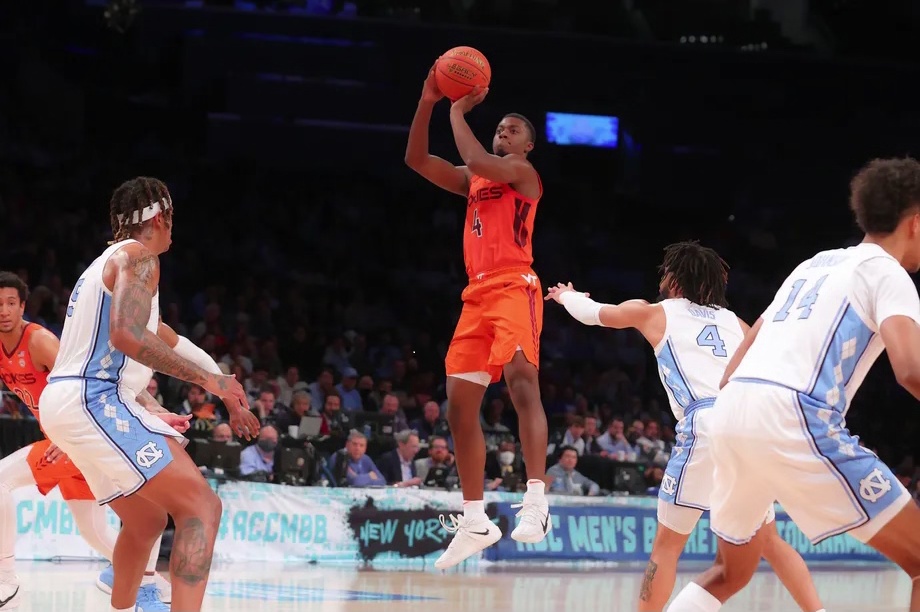
When Alleyne transferred from Virginia Tech to UConn for his senior season, I said that he should be a better version of Tyler Polley, as the two has a similar game but Alleyne plays much better defense. Alleyne has mostly lived up to the expectations on the defensive end, but his outside shot has pretty much deserted the guard for the entire season, leading to a bad domino effect for the entire team at times.
First, the good: Alleyne has been a strong perimeter defender for the Huskies, particularly during the first two months of the season. The 6-4 guard does a good job using his length to affect shots and has the athleticism to stay in front of his man. The biggest issue with Alleyne on the defensive end is his propensity to be too handsy and pick up fouls, a bad habit which has gotten worse against the tougher competition in practice. While Alleyne’s defense has still been better than most of his teammates in the last month as UConn struggled, he has not done as good of a job keeping his man in front of him and limiting penetration. Hopefully, Alleyne’s individual defense will pick up along with the team down the stretch.
Alleyne’s struggles from beyond the arc has been inexplicable this season, especially since it’s lasted all season and not just in conference play. After shooting over 38% from three during his ACC career, Alleyne is at 27.9% this year (28.6% in the Big East). He has not made more than one trey in a conference game, and only did it four times in nonconference games. Alleyne’s percentages inside the arc have also plummeted in conference play, and he rarely gets to the charity stripe. It’s no wonder Alleyne has not scored more than five points in a game this year and had his minutes dwindle consistently, and I am not surprised he has not started for Jackson at any point recently despite his struggles. Along with Calcaterra, Alleyne shooting closer to his career average on 3-pointers the rest of the season would make the Huskies a much bigger threat to end the regular season well and go on runs in March.
Update: UConn fans were waiting for Alleyne to have a breakout conference game and he finally came through on Tuesday, draining three 3-pointers on his way to 13 points. Alleyne’s treys constantly came at big moments, including one at the end of the first half that gave the Huskies a 16 point lead going into the break. Alleyne’s form looked great on the 3-pointers, and UConn’s excellent screening and passing gave the senior space on each shot. Alleyne’s defense was also steady as always and he played disciplined on that end, committing zero fouls. He recorded his highest point total of the season, and hit a trio of threes for only the second time. With Alleyne’s big bench performance and his general improvement over the last few games, I am bumping his grade to a C+. Even more than Calcaterra, Alleyne’s stronger overall game and accomplished history as a shooter can make him a microwave scorer for UConn thest last few weeks as long as he maintains confidence.
Joey Calcaterra: B
It’s been a roller-coaster season for Joey California. The fifth-year transfer from San Diego was the least heralded of Dan Hurley’s transfers but was a star for the first two months of Big East play. He averaged 9.1 points through 13 games while shooting over 50% from three and had a habit for coming up in the clutch moments. Combine this with Calcaterra’s energy and nifty passing, and it’s no surprise that he became a folk hero quickly for the whole fan base. Calcaterra was one of the biggest reasons for why the Huskies started 14-0.
After the high-water of a 14-point performance against Georgetown on December 20th in which he led the team to a 14-point performance, Calcaterra has crash-landed in the last 11 games. He has not scored more than 6 points in a game since and is now shooting 27.3% on three’s in the Big East. Calcaterra is similarly struggling inside the arc and has gotten to the line just once! Overall, his offensive ranking in conference games is 91.7 and true shooting percentage 36%.
Calcaterra has never been a particularly good defender due to his lack of athleticism. He was able to hold his own to some extent in the nonconference season, but he has predictability struggled against the stronger and more athletic guards in the Big East and been unable to keep his man from penetrating. With Calcaterra’s shooting struggles and lack of defense, his playing team has decreased significantly. Even if his shooting pics up again, Calcaterra will get fewer minutes than the first half of the season as Hurley shortens his roster.
This rating is probably a little too generous. However, I cannot imagine that Calcaterra’s shooting improves somewhat down the stretch, and it already has slightly over the last six games. Before the end of the year, I believe Calcaterra will give us a few more unforgettable moments and clutch shots. Long live Joey California.
Update: Calcaterra played within the flow of the offense in his 10 minutes. He moved the ball and screened effectively, and picked up a layup as well as earning an assist and rebound. Calcaterra surprisingly did not take a three. It was nice to see Joey California contribute without scoring, but he desperately needs to have a game where his shooting touch returns and Joey gains some confidence. Just like Alleyne, UConn is not going to reach his full potential if Calcaterra isn’t making big threes against good teams.
but on Johnson: Incomplete
Johnson has had a tough two years in Storrs, and so far appeared in just four games due to an ankle injury. After sustaining the injury in the opening game and missing two months, Samson finally returned on the 22nd against Butler. Johnson hasn’t looked bad in the limited minutes he has played, scoring a combined 11 points on 4-8 shooting, and grabbing six rebounds. However, he hasn’t played more than 7 minutes since returning and is getting back into game shape. I expect Hurley to give Johnson spot minutes here and there the remainder of the regular season, but don’t think he will play against any big-time opponents like Marquette barring significant foul trouble. While Johnson may not have the experience and stamina to fill the rim protection role UConn desperately needs yet, I hope decent minutes the remainder of the season and an offseason of working on his game will allow Johnson to unlock his potential next year.
Update: Nothing has changed. Johnson did not play at all against Marquette, and I would be shocked if he did against Creighton. There have also been no updates about how many minutes Johnson is capable of playing in a game. It looks more and more like this will sadly be a lost season for him.
Richie Springs: N/A
The 2023 season was obviously not destined to be we unleashed Springs. His only apparence in Big East play came for less than a minute against Butler, despite actually playing fairly well in the few minutes he got during the nonconference schedule. If Hurley isn’t willing to use Springs for even two or three minutes as a big body and rebounding threat as a junior, then I don’t think Storrs is theplace for Springs. Let’s hope for his sake that Springs transfers in the offseason and finds a low-major program where he can get valuable minutes and prove himself.




 HUSKY NATION