The Unforgettable Experience of UConn vs. Creighton

When I entered Gampel Pavilion Wednesday night to see UConn take on Creighton, I admit that I was apprehensive about the top-ranked Huskies ability to defeat the experienced Blue Jays, even at home. They have a strong offense that scores very effectively around the rim and can regularly knock down 3-pointers and is one of the best defensive teams in the country in many categories. Meanwhile, UConn was very inconsistent on offense in the preceding few games, struggled badly on the boards, and was not sure what it would get from Donavon Clinigan in his first game back from injury. Finally, Creighton had been the Huskies kryptonite since they rejoined the Big East, winning every game but one. I expected a close game in which UConn needed to limit Creighton in the paint and execute well on offense to win.

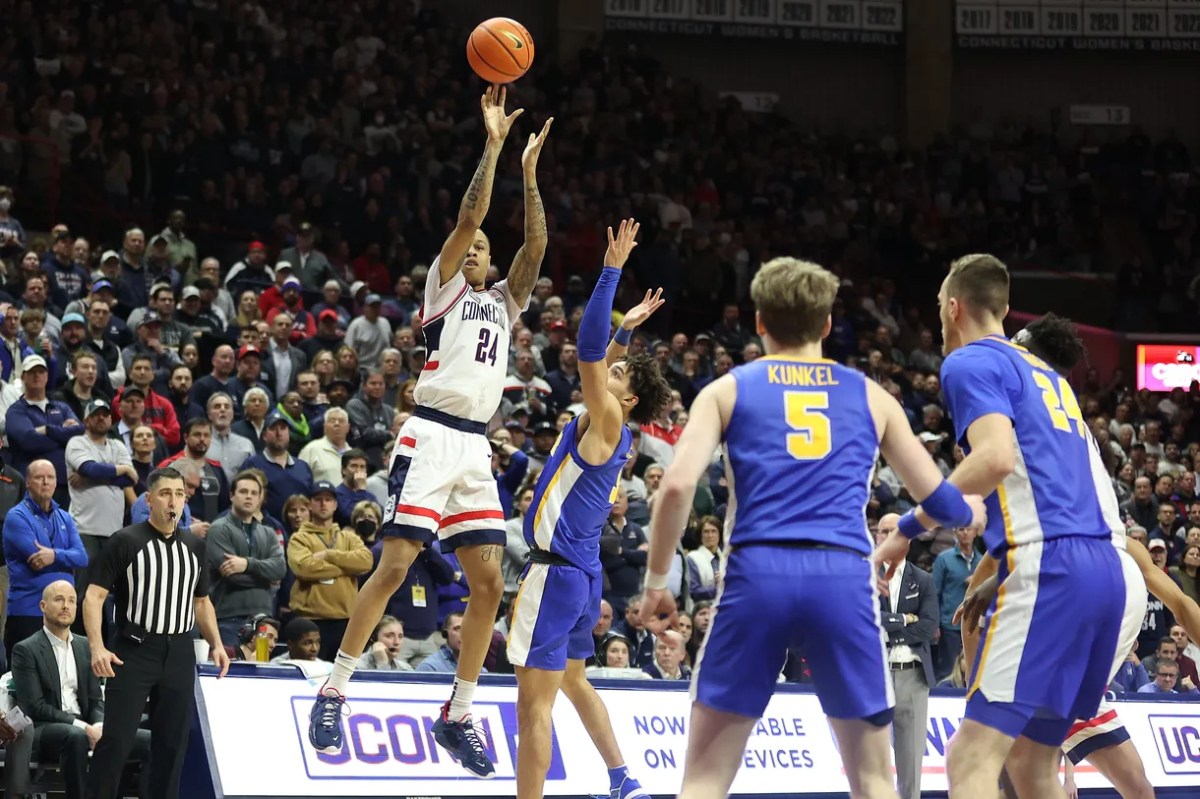
Instead, I saw UConn win comfortably 62-48 against one of the Big East’s top programs. The Huskies played absolutely suffocating defense, dominated the boards, and made clutch shots when needed in front of a rowdy crowd. The game, which was obviously a sellout, was one of the most memorable regular season wins for UConn in a long time. It was a joy and privilege to watch in person.    

Instead of writing my traditional detailed observations about one or multiple games, I have decided to cover the Creighton win. Instead, I am going to list and do a short discussion of what I enjoyed the most about UConn’s performance up close. I hope you enjoy it!

  • Being able to see Donavon Clinigan in his first game back from injury was a lot of fun. In 16 minutes, Clinigan was running the floor maybe the best he has had all season and was in better shape. Clinigan was excellent on defense, blocking two shots and denying Creighton the ability to take the ball to the rim and find star center Ryan Kalkbrenner. While Clinigan was rusty shooting the ball, going just 3-8 from the field for 6 points, he snatched five rebounds and recorded 2 assists. Finally, Clinigan fueled multiple runs and brought a ton of energy when out on the floor, including a memorable sing-along to Taylor Swift. If this was what the big fella looked like in his first game back, I could see him dominating opponents soon.
  •   UConn’s defensive performance was remarkable, especially when observing it up close. The unit never allowed Creighton’s players to get comfortable. The Huskies constantly pressured ball-handlers and rarely allowed the Blue Jays to run effective offensive sets. Their players were forced into taking difficult shots inside the arc or kicking it out for 3-pointers, with Creighton shooting just 6-26(23.1%) from there. UConn’s ability to fluster their ball-handlers led to 14 turnovers. Somehow, the Huskies limited the Blue Jays to 6 foul shots despite their aggressive defense. The 48 points were the fewest an opponent has scored in more than two seasons.
  • In addition to Clinigan, Stephen Castle and Hasson Diarra were especially great to see in person on defense. Castle, who covered multiple players but was on point guard Trey Alexander the most, hounded everyone he guarded and refused to let ball-handlers get downhill. The freshman forced a lot of poor shots and although he had only one steal, Castle was partially responsible for multiple turnovers. He is on another level defensively than most freshman. Diarra has always been an excellent defender and was all over the place in his 17 minutes on the floor. I also commend Samson Johnson for his defensive effort, as he was able to defend multiple players by hard hedging while still defending well. Hopefully the win will give Johnson, who had 4 points, 3 rebounds and a block, more confidence as a defender.
  • After a few games without Clinigan in which UConn struggled badly to rebound, it was dominant on that end throughout the game, kicking Creighton’s ass on that end 48-32. The Huskies were more physical and athletic than the Blue Jays players up front and did an excellent job blocking out and reacting to where the ball is coming off the rim. Six Huskies had at least 6 rebounds, led by Tristen Newton’s 8. By grabbing 21 offensive rebounds, UConn was able to offset its lousy shooting to some extent and control the clock better. The team won’t rebound this well every game, but having Clinigan back to handle center with Johnson will allow players to play their regular positions and make it easier to rebound.
  • UConn’s offensive performance was ugly. They shot roughly 35%, had only 13 assists and pretty much stopped scoring in the last six minutes of the game. Creighton was mostly able to keep the Huskies from attacking the rim or scoring in the paint effectively when playing half-court offense, and missed a lot of open midrange jumpers and 3-pointers. When they needed a player to step up and make a basket or create offense they turned to Newton, just as they’ve done all season. He hit tough jumpers, especially in the first half to give the team early momentum. The senior also was the only Husky that could consistently make threes, hitting two of four and having a third waved off due to a foul. Newton scored 16 points and was more efficient than either Alex Karaban or Cam Spencer, who each finished with 13. He may have not have gotten off to the best start in Big East play, but Newton has been one of the top players in the country this year, and the Huskies will go as far as Newton can lead them.
  • The crowd was outstanding all night against Creighton. Their energy and enthusiasm gave the UConn players a ton of energy and propelled runs, and the fans also helped to rattle Creighton. Everyone was loud and celebratory, and the students were very engaged. UConn gets good crowd support wherever they played, but the Gampel experience is a lot more fun because of the intimate setting and students leading the way for the rest of the crowd.

After a pair of games to open the conference that can be described as Jekyll and Hide for UConn, the wins against DePaul and at Butler this last week were a little more relaxing. There was still plenty to learn from them, however. The wins showed again the core players UConn can rely open and that they are continuing to develop a fuller bench, served as a coming out party for both Stephen Castle and the Huskies version of “small ball”, and that the team can earn a comeback win on the round against a solid Bulldogs team. They also again reinforced that UConn’s defense has a lot of work to do to be efficient in the Big East, and that players must learn how to do their jobs without relying on Donovan Clinigan to bail them out. All in all, it was a more satisfying week with more positives than negatives.

Four players (Castle, Cam Spencer, Alex Karaban, Hassan Diarra) averaged in double figures over the two games, with Newton scoring 17 against Butler. Karaban led the way with 16.5 points. The offense was in mostly fine form across the board against DePaul and Butler, scoring 86 points in Tuesday’s blowout and then 88 to take down the Bulldogs by seven. UConn shot over 58 percent from the field against DePaul and 54.5 percent from the field against Butler. It shot exactly 69 percent inside the arc in both wins and made roughly 42 percent of its 3-pointers after a significant stretch where the team had struggled from deep. In addition, the team continued to do an excellent job of rebounding and shared the ball well, especially in the first win. Besides the aforementioned players, Samson Johnson, Solomon Ball, and freshman forward Jaylin Stewart all had moments to write home about in at least one of the wins. The only offense negative was the Huskies surprising number of turnovers, which I discuss further down in the piece.   

The takeaway on the defense against both teams, especially Butler, was much less favorable. With Clinigan missing, Bulldog players were regularly able to beat Husky defenders off the bounce for scoring opportunities and kickouts to open perimeter shooters and had fun taking advantage of the small lineup with Karaban at center. I discuss it more below, but UConn players inability to consistently rotate well and help teammates was a bigger factor in their defensive struggles than any physical disadvantages. While DePaul averaged 0.84 points per possession and shot 35.7%, Butler shot over 47 percent and averaged 1.19 PPP.

Before Wednesday night’s big road matchup against Xavier, I go into detail below about the standout week of UConn’s new Big Three, how exciting Castle’s emergence is, the significance of the Butler win, the bench, and the defensive questions the team must answer with Clinigan injured. As always, this is proving to be another crazy Big East campaign with storylines galore.

 There’s a New Trio Driving the Bus for the Huskies

While there may be occasional exceptions, as Tristen Newton, Alex Karaban and Cam Spencer go the remainder of the month, so do the Huskies. The trio can all score points in bunches while facilitating for others, are solid rebounders, compete hard on both ends, and are fundamentally sound leaders for the team on and off the floor. The team feeds off these guys’ energy and demeanor during games and especially in the tensest moments, as seen at Butler. While they certainly make their share of mistakes, most fans and Dan Hurley trust Newton, Karaban, and Spencer explicitly. They rewarded that trust against the Blue Demons and Bulldogs.

Karaban and Stewart each had excellent offensive games against both DePaul and Butler. Karaban averaged 17.5 points and 7 rebounds and shot 73.6% overall and 7-10 on 3-pointers, while recording a combined 3 assists and blocks. Karaban did a much better job of attacking the basket and finishing layups through contact in the two wins, and finally made some open treys after being off from beyond the line for a while. Stewart and his old man game were as successful as ever, as he as he averaged 17 points, 5. rebounds and 3 assists while shooting over 59% and 7-14 beyond the arc. Stewart continued to do an excellent job of finishing shots and faking out defenders around the rim and on midrange shots, and anytime he gets an open look from three I think it’s going in, no matter how well defended Stewart is. The pair are both clutch players, as discussed more below, and Stewart made the most clutch play of the night late against Butler to preserve the lead.

Newton is a different case than his two teammates, as he has been in a funk lately since right before Big East play started. Newton went scoreless against DePaul, taking just three shots, and shot 3-12 from the field against Butler. He was reckless with the ball at times last week as well, committing a combined seven turnovers. However, he still averaged 6 assists and 3.5 rebounds and had 2 steals against the Bulldogs. Even when Newton wasn’t hitting shots Friday night, he willed himself to the free throw line in the second half and made 10 of his 13 attempts to secure the win. More than anyone else on the team, Newton remains the guy you want to go to inside to get a layup or force their way to the line.

The entire trio had signature moments in the Butler win during the second half. In the 15-4 run which gave UConn a 54-50 lead with 12:07 remaining, Karaban hit two 3-pointers that were assisted by Newton. Karaban later scored five straight points after Butler cut the deficit to one to take a 79-74 lead with 2:39 remaining. With less than 90 seconds to go, Spencer grabbed a tough offensive rebound, called timeout before falling out of bounds, and quickly hit a 3-pointer to basically secure the win. And even though his shot continued to be off, Newton hit 8 free throws in the second half.

Stephon Castle, Welcome to the Big Time    

Entering the season, we heard a ton about how Castle’s physicality and athleticism, knowledge of the game and athleticism. While we saw a few flashes of this at the beginning of the season and after he returned from injury, fans also saw a player who was hesitant to shoot and prone to playing out of control and making mistakes when he did take charge. Castle, whose defense had been ahead of his offense after returning, seemed to finally start figuring things out late against St. John’s. Last week, he looked right at home. Against DePaul and Butler, Castle scored 14 points in both games on nearly 70 percent shooting, averaged 6.5 rebounds and 5.5 assists, and added 3 steals. He also played his already customary intense defense against both guards and forwards and with all-out intensity in general.

Castle was excellent against the Blue Demons, looking for his shot early and often and shutting down multiple players. As the game went along, he began to focus more on facilitating for teammates and rebounding, and shared point-guard duties alongside Newton. Castle made all 6 of his 2-point attempts, earned 7 assists and had both a block and steal. Tuesday’s win was just a prelude to his game against the Bulldogs, in which he was the best player on the floor. Castle was solid offensively in the first half while the team struggled, even demonstrating his shooting range by hitting a 3-pointer. It was when the game sped up and UConn got in a roll that the freshman showed everything he could do, however. Castle was outstanding helping to run the offense and facilitating, especially on fast breaks. He finished layups and earned free throws, found teammates for open shots both in the paint and on the perimeter, and grabbed 9 rebounds, a majority of which were in traffic. Castle was most essential on defense, as he limited point guard Posh Alexander to 3 points and helped cause his 5 turnovers, and ultimately assisted in guarding all the Bulldogs guards and forwards. Castle was stronger and more athletic than arguably anyone Butler had on the floor, and they and his teammates knew it.

Castle’s last two games weren’t against top-tier conference foes, but it was high-opening seeing Castle live up to the height. He is a great defender who can be the “head of the snake” and help carry the Huskies on that end with Clinigan out. Castle is a very skilled finisher at the rim, especially for a freshman, and already looks like he will be able to help run the offense as the season goes on because of his passing and unselfishness. Most importantly, he plays with an energy and unselfishness that is special for a freshman. Castle’s versatility and ability to contribute in all facets of the game using his strength and athleticism is very reminiscent of Andre Jackson at his best. As Castle takes on a larger role as a scorer and gets more comfortable working together with Newton, he can be the program’s best freshman in years and UConn can reach its full potential.

The Supporting Cast is Developing ,

If the magic trio and Castle will be the main ones driving the team while Clinigan’s out, then it’s imperative that their supporting cast show it can contribute in multiple ways and play different styles as the Huskies go with smaller lineups. It mostly succeeded against DePaul and Butler. Samson Johnson has been generally effective as the starting center, and scored 8 points in both wins on 8-10 shooting, averaged 3 blocks, and grabbed 6 rebounds against the Bulldogs. While Johnson is continuing to show good touch in the paint and is generally an effective defender, he needs to stop picking up needless fouls. The junior had four in both games and combined to play just 43 minutes as a result. Every minute Johnson is out, it is going to make it easier for opponents to score and rebound at the rim.

After an off week, Hassan Diarra had another great pair of games, scoring a combined 23 points (14 against DePaul) while going 4-6 from deep, averaged 3 rebounds and had five assists against the Blue Demons, all while playing bulldog defense. Diarra was always valuable because of his defense and energy, but his improved ball handling, shooting and veteran leadership has made him indispensable to the Huskies and put Diarra neck-and-neck with Solomon Ball for the role of first guard off the bench.

Speaking of freshman, he had another solid game against DePaul, hitting two 3-pointers and finishing with 8 points while adding solid defense. It’s nice to see Ball improving his deep shot and continuing to bring energy on both ends. Now his next step is to be more active as a scorer and become more fundamentally sound as a ball-handler and defender. Finally, freshman forward Jaylin Stewart got some run as many fans had hoped for in the small-ball lineup, and generally made the most of it. He looked like he belonged out there on both ends and made the most of it in his 10 minutes against Butler, scoring and ab5 points and grabbing 3 boards. If Stewart can learn the system better in practice and get comfortable with his teammates in game settings, UConn could be eight deep again when Clinigan returns.

All Hail Dan Hurley

For a couple of years now, it’s been a running joke that Hurley can’t win close games in conference play, especially on the road. And for whatever reason, it has mostly been true. After the head coach won two close games against St. John’s and at Butler, both second-half comebacks, he can shut those critics up for now. Hurley did a great job rallying his players at halftime against Butler, emphasizing that they had to pick up their overall intensity and defensive effort and designing different defensive sets. He stayed on them as UConn rallied midway through the second half to take the lead, and wasn’t afraid to mix and match with players depending on foul trouble and putting the ball in Castle’s hands more. The offensive sets were much crisper in the final 20 minutes, and the players did a better job of pressuring the ball and helping on defense. Hurley seems to be consistently improving his in-game coaching and ability to make adjustments, and as a result I think this team will be more capable of bouncing back from deficits in conference play than last year’s.   

This Defense is Not up to UConn Standards

I knew that the Huskies were heavily reliant on Clinigan to fortify their defense, but I don’t think I realized just how reliant they were on the big man to bail them out. Against Seton Hall and then in two of the three games since, UConn has regularly allowed penetration with ease and given up easy layups or earned unnecessary fouls. This roster is less athletic than the typical Huskies squad, and its guards are vulnerable to being attacked and bullied. To make up for that, the defense is going to need to execute as well as possible and be creative. Instead, the rotations and help defense has been lousy, UConn has not been forcing turnovers, and they exacerbate this problem by being way too handsy when guarding when they know Big East officials are unreliable. Castle has been a godsend on defense, but the Huskies are going to have to be creative and play forms of zone or similar defenses when the competition amps up without Clinigan. Hurley’s teams have consistently improved on defense over a season, and I reluctantly believe that will be the case again.  

There’s No Such Thing as a Good Loss

To all UConn fans, I say don’t believe what you here. While the team showed a lot of toughness coming back and almost winning in a hostile environment in Friday’s 69-65 loss at Kansas, there is ultimately no such thing as a “good loss”. UConn did not play well against the Jayhawks, with no player having a strong all-around game besides Tristen Newton. In fact, if it wasn’t for an amazing performance by Newton, the team would have been blown out. The Huskies did a putrid job with penetrating the defense and creating easy scoring opportunities for much of the game, looked significantly less athletic than Kansas, and continued to have defensive lapses that ultimately allowed the Jayhawks to go on a decisive rally to end the game. Throw in a lousy performance at the free throw line (8-15) and Cam Stewart injuring both his toes and having it badly affect his shooting performance, and it was all too much for UConn to overcome. While this issues may have been for just one game, they are definitely ones that could affect the team’s performances against North Carolina and Gonzaga.

The Huskies are in a very vulnerable position heading into their game with the Tar Heels at MSG Tuesday night. With Spencer hobbled (the pain in his feet clearly affected his shooting accuracy against Kansas), Donovan Clinigan still dealing with a foot that continues to hurt him and affect his athleticism, and Alex Karaban ‘s injured finger possibly affecting his shooting accuracy as well, it isn’t an ideal time for the team to be facing such tough back-to-back opponents. Dan Hurley even admitted on Monday that Spencer, Clinigan and Karaban have been limited in practice, and that it is not a guarantee that Spencer will play. While Stephen Castle is likely to return against UNC, I am sure he will be on a minutes restriction. Considering that North Carolina has an elite offense that likes to push the ball, you have to hope that one or two of those aforementioned guys as well as Castle can keep up on both ends and be effective. Otherwise, there is a very good chance the Huskies will lose. It would help if Hurley was willing to play any freshman besides Solomon Ball if those players are struggling, even if he is reluctant to. The group did not play one minute against Kansas.

Below, I provide a brief analysis of the areas UConn struggled in against Kansas, and the possible steps they can take to get back on track against UNC. I still believe that the Huskies can be an elite team and beat anyone at their best. Now, it’s time to prove it against the Tar Heels and then Gonzaga.

UConn’s Offense Was Ineffective Against Kansas

There are ugly offenses, and then there was the Huskies offense against Kansas. While the team was ultimately able to get to 65 points and average 1.08 points per possession, those numbers do not tell the whole story. UConn started very cold, allowing Kansas to get out to a 16-5 start, and it remained very inconsistent from there. While a lot of the struggles can be attributed to the Jayhawks suffocating defense and the intensity of the crowd, the Huskies still could have done a lot of things better. Players did not try hard enough to move the ball on the perimeter or help Newton and Spencer by coming to the ball. UConn rarely pushed the ball off rebounds, and took to long to get into offensive sets, leading to low-percentage shots. While players were forced to take a lot of challenging perimeter shots because of Kansas’s ability to pressure the ball, they were still able to get enough open shots that everyone besides Newton should have been a little more effective from beyond the arc. The remainder of the roster shot 5-19 from three, with Karaban and Spencer combining to go 3-14. As tough as it may have been, the Huskies should have tried to attack the basket more and get more opportunities for offensive rebounds and free throws. Only three players reached the line. Finally, UConn had Clinigan setting too many screens instead of focusing on him playing in the low post. The sophomore took just seven 2-pointers and was unable to get enough easy shots, ultimately going just 3-7. UConn should have an easier time scoring against North Carolina. The Tar Heels have allowed every power conference team to score 70 points, struggle at defending the 3-point line and foul frequently.

The Defense Was Poor at the Worst Times

Like its overpowering defense, the Kansas offense was surprisingly efficient, especially at the beginning and end of the game. The Jayhawks jumped out to a 16-5 lead, making everything, and leaving the UConn players gob smacked. While they cooled off somewhat from there, they still went into halftime shooting over 50%. After shooting hot and cold for much of the second half, allowing the Huskies to briefly take the lead, Kansas seized it back by going on an 11-0 run starting with 6:53 remaining that featured three consecutive treys by Kevin McCullar, a subpar 3-point shooter, and Hunter Dickinson. McCullar hit one more backbreaking three to seal the game as UConn furiously tried to come back. Kansas, which had been inconsistent offensively against the best teams on its schedule and does not have great depth and shooters, definitely played its A game offensively at times. Shooting 9-14 from three is an obscene percentage, for instance. Still, the Huskies could have done a lot more to try and slow down Kansas.

My biggest frustration with the defense was that it just didn’t throw in enough wrinkles to try and slow down Kansas. Hurley didn’t have his players ramp up the ball pressure significantly and did not try and trap the Jayhawks until the final two minutes of the game. With the Huskies struggling so much to get good shots and allowing regular fastbreak opportunities off their poor shots, trying to play a defense that could hopefully lead to turnovers and easy baskets would have been a godsend. UConn also never played zone defense when Kansas was hot, and the one time it experimented on D by playing Clinigan and Sampon Johnson together, it blew up in the team’s faces, as the Jayhawks picked the moment to go on the 11-0 run that sealed their win.

While the Huskies decision to focus on guarding the paint instead of the 3-point line made sense at the beginning of the game because Kansas does not take many treys and the defense wanted to slow down Hunter Dickenson, UConn should have began playing the perimeter tighter earlier in the game. Even when they began doing so, players were consistently late on closing out. The defense had a habit of losing guys they were assigned to guard, leading to open jumpers, and were beaten off the dribble way too frequently, especially in the first half. The injury to Spencer did not help, as he is not particularly athletic or a good-on-ball defender even at full strength.

However, Karaban was by far the worst defender. He was abused off the dribble by the bigger and stronger KJ Adams, who finished with 18 points and was probably Kansas’s best all-around player. Once again, Karaban showed that he can be burned defensively by bigger guys, and his inability to keep his hands up while guarding ultimately led to Karaban fouling out. The one player I will give kudos for his defense is Clinigan, who did a great job of denying Dickinson the ball and altering his shots, holding the All-American to 3-8 shooting in the paint while blocking three shots. Hopefully, Hurley came up with some wrinkles to slow down North Carolina in practice while still protecting his hobbled players.

The Injuries Held Back UConn on Both Ends, and Stephen Castle is not Going to be an Immediate Solution

UConn was blessed to not have any long-term injury issues outside of the loss of Johnson, who would have played very little anyway. Maybe the gods are cursing them for their good fortune right now, as the current starting lineup looks like a MASH unit. The most concerning injury is to Spencer. As we saw against Kansas, his injured toes were a big factor in the senior’s 3-pointers constantly being short, affected his ability to play defense and drive to the basket, and even hindered his free throw shooting, as Spencer missed his first two attempts of the season. Spencer is a gamer and I expect him to play at least a little bit against North Carolina, but if his shots aren’t falling and his mobility is limited, I can’t expect Spencer to give UConn much on Tuesday.

While Clinigan has done a valiant job of playing through a foot injury that his still not fully healed, it is still limiting his athleticism and ability to grab rebounds and finish around the rim. Clinigan will again have to face an elite big man Tuesday in UNC’s Armando Bacot, and hopefully UConn’s guards will do a better job of getting him quality shots in the paint. Karban’s hurt finger is seemingly hurting his shot more than expected, as he has been terrible from beyond the arc in the last three games, including 2-7 against Kansas. Hopefully, it will recover quickly and Karaban will be smart by trying to score more at the rim and on free throws instead of 3-pointers. Finally, while I have high expectations for Castle and am glad his knee healed quickly, I don’t expect him to play a ton against North Carolina or to even be highly effective, at least as reflected in the box score. Castle has not yet faced a high-quality opponent, and it is going to take him a little while to get adjusted and get back up to game speed. Hopefully, all these injuries won’t be long term. In the meantime however, UConn will demonstrate their mettle if they can overcome them to beat North Carolina and then Gonzaga.

Extend the Rotation, Coach

This is more of a general issue I have with Hurley than just being focused on the Kansas game. I am never going to understand his reluctance to play most freshman extended minutes, even when it makes sense. UConn had one of the best recruiting classes in the country. With Spencer hobbling around, Karaban struggling on both ends and Solomon Ball mostly invisible against the Jayhawks, why didn’t he bring in Jaylin Stewart and possibly Jayden Ross, even if it had only been for three or four minutes at most. There wasn’t anything to lose, and Stewart has shown promise so far this season and Ross is a quality 3-point shooter. Yes, the freshman might not have been able to handle the intense environment of Allen Fieldhouse. But you don’t know until you try, and Stewart possibly could have made an impact at all against North Carolina and possibly Gonzaga, and will be unprepared for the rigors of conference play when it starts late this month. Hurley has to be willing to give a little rope, especially when the situation calls for it, and the Husky freshman deserve the opportunity to prove themselves. This is not a particularly deep team. Give the freshman consistent minutes as the season goes along, or Hurley may have most of them transfer.

Despite how frustrated I was after the Kansas loss, I believe UConn will beat North Carolina Tuesday. They match up with the Tar Heels better, and I cannot imagine the team will perform so poorly offensively outside of Newton for the second consecutive game. No matter what though, it will be a close game, and the Huskies still must prove they can win those. UConn has a lot of talent on both ends and is an elite offensive team and solid defensive one. It definitely lacks the depth or defensive ability last year’s squad had right now however and is not as good as that group was at this time last year. Against UNC, the Huskies have the chance to prove me wrong.

UConn Huskies Season Preview: The Returnees

After UConn’s unforgettable run to the program’s fifth national championship last season, the program’s offseason and the Huskies athletic department didn’t have a fun offseason. The team lost heated recruiting battles to Duke for blue chip recruits Cooper Flagg and Patrick Ngonbga, and UConn athletics just missed out on being accepted to the Big 12 starting in 2024. These setbacks somewhat obscured all the talent men’s basketball is returning from last year. This is before you even consider an incoming freshman class that could be the best the Huskies has had in more than a decade, which will be discussed in a later post. UConn is sixth in the AP preseason Top 25 poll and has a serious chance at winning consecutive national championships.

After the departure of Adama Sanogo, Jordan Hawkins and Andre Jackson, UConn will rely on the versatile trio of Tristen Newton, Donavon Clinigan and Alex Karaban. After playing a sidekick role in his first year in Storrs last season, Newton is expected to take on a much bigger role both offensively and as a team leader this year. The fifth-year senior guard is looking to be a much bigger offensive threat, similar to his role at East Carolina before transferring, while continuing to be one of the Huskies main facilitators. Newton averaged 10.1 points, 4.7 assists and 4.6 rebounds while shooting 36.6% from three last year. Newton is specifically looking to improve his overall shooting and ball handling, work ethic and defense this season. Dan Hurley was pleased with Newton’s performance in the preseason and during UConn’s games in Europe and scrimmages. At the same time, Newton will need to be a strong leader for the team both vocally and through both his work ethic.

Clinigan made a huge impression in limited minutes as a freshman backup center last season. The 7-3 monster from Bristol averaged 6.9 points, 8 rebounds and 3 blocks in just 15 minutes. He had a true shooting percentage of 63.4 and grabbed 29.4% of offensive rebounds and blocked 14.4% of shots. Clinigan, who showed much more athleticism than expected last year and was elite as a rim-runner, is seen as a lottery pick next spring by NBA scouts and has the potential to be one of the best big men in not only the Big East but the entire country. To do so, Clinigan will have to continue to be an elite rebounder and shot blocker while expanding his finishing ability at the rim and displaying a decent shooting touch outside the paint. If Clinigan does all this, the attention paid to him should provide quality scoring opportunities for his teammates.

It is also essential that Clinigan improve from the line so that opponents don’t employ the hack-a-Shaq method against him and get better at avoiding foul trouble. Ideally, Clinigan will average around 25 minutes per game. In the summer and preseason, Clinigan worked on improving his core strength and foot speed as well as shooting and was extremely effective in practice and game situations. Clinigan also worked on becoming a more vocal leader and being even more aggressive on offense. As long as Clinigan stays healthy and continues to improve, all of UConn’s opponents will struggle to contain him and the sky will be the limit for the fan favorite.

While Newton and Clinigan are a ton of fun to watch, my favorite player on the Huskies continues to be Alex Karaban. The sophomore forward was a virtual Swiss Army Knife as a freshman, averaging 9.3 points, 4.5 rebounds and 1.7 assists while shooting 47.6% from the field and 40.2% from deep. Karaban’s 125.9 KenPom offensive rating in Big East play was third in the conference, while his effective field goal percentage of 57.5% was seventh. Karaban showed remarkable basketball IQ and versatility on offense from the moment he stepped in Storrs. In addition to his shooting ability, he was a consistently a strong passer and rebounder and did an excellent job of screening for teammates to provide easy scoring opportunities. Karaban improved significantly as a defender over the course of the year and particularly at guarding at the rim. He also showed impressive stamina, regularly playing for over 30 minutes. Finally, Karaban displayed a clutch gene quickly, with 3-pointers at the end of the first half becoming a signature play for him.

Karaban was praised for his work ethic and leadership skills by Hurley and others last season, both traits that made him stand out compared to most freshman. Karaban is applying that work ethic to becoming a more aggressive player on both ends this season as well as a more vocal leader. On offense, Karaban will try to attack the basket more and average double-digit in points. On defense, the team hopes he will stop players off the bounce more effectively and be even better at defending opponents at the rim. Karban had a strong preseason and is fully capable of being one of the best players in the Big East and the team’s best player overall. If Karban does so, he will put himself in position to be an NBA draft pick this season or next.

Outside of UConn’s Big Three, the bench will rely on senior transfer guard Cam Spencer, backup junior transfer guard Cam Spencer, junior backup center Samson Johnson and backup senior point guard Hassan Diarra. Spencer will likely be the only one of the three that starts at least early in the season. The transfer from Rutgers averaged 13.2 points, 3.1 assists and 2 steals in his one season with the Scarlet Knights after transferring from Loyola of Maryland. He is expected to replace the 3-point shooting skills of Jordan Hawkins and Joey Calcaterra, while adding another strong ball handler and defender to UConn’s backcourt. Spencer shot 43.4% from deep last season, good for 44th in the country, and ranked eighth in the Big Ten at 42.7%. He made 89.4% of his free throws, 23rd in the country. During his college career, Spencer has shot 40.5 percent from deep, and 50.8% on field goals overall. Spencer was an excellent defender for the Scarlet Knights, recording a steal percentage of 3.9 overall and 3.4 in conference, ranking third. Spencer decided to transfer to UConn because of the opportunity to play against talented guards in the Big East and the competitiveness of the Husky players, and especially Hurley. Spencer has been praised by the team for his versatility and ability to open up the offense.   

Johnson may not be a starter like the Big Three (barring injury), but he is every bit as essential to UConn. The “6-10” junior center is an enigma, as he has played just 15 career minutes in 25 games due to injuries and ineffectiveness. Now, Johnson will be thrown into the fire as the backup to Clinigan. He was a four-star recruit out of New Jersey who grew up in Togo and was described by Hurley as having the talent and potential to be an NBA lottery pick. Johnson, who has a ‘7-5’ wingspan, has shown a lot of athleticism and speed when he’s played, and could be an effective shot blocker. However, he has looked uncertain on the court at times in games and has been prone to foul trouble. In the preseason and especially in the Huskies scrimmages, reports indicated Johnson was one of the top performers. In addition to his athleticism and speed, Hurley said Johnson is an excellent ball-screen offensive and defensive player because of his effectiveness in the lob game and ability to disrupt other big men. If Johnson lives up to expectations, he can play for15-20 minutes a game and combine with Clinigan to form a similar dominant duo like he had with Sanogo last season.

Diarra will be UConn’s main backup point guard. The ‘6-2’ senior from Queens had an up-and-down first season in Storrs, establishing himself as a high-energy defensive stopper but struggling offensively in a conference distinguished by hard-nosed defensive guards. Diarra had a stealing percentage of 3.6 last season and steven games with multiple steals. However, he averaged just 2.1 points and 1.8 assists while playing 12.1 minutes per game. Diarra shot just 30.1% overall and 18.9% from three after making 32.4% from deep as a sophomore at Texas A&M. He also was terrible from the free throw line for a guard after being solid as a sophomore, draining just 51.4 of his free throws. These offensive struggles outweighed Diarra’s value as a defender and ball handler come tournament time. In UConn’s run to the championship, he scored no points in 31 minutes.

Diarra will have the opportunity to get valuable minutes at guard as Stephen Castle acclimates to the challenges of playing at an elite program. He already is an excellent defender and will be an important leader to the young Husky guards. All reports have indicated that his shooting was improved across the board in the preseason. If Diarra can improve offensively, especially at finishing at the rim and developing a reliable jump shot, he will consistently be the first gusard off the bench and possibly push Castle for the starting job at point for at least the first portion of the season.

Sophomore Apostolos Romoglou is the one other scholarship player returning. Romoglou, the 6’8’ hybrid guard who appeared in 20 games last season playing garbage-time minutes and made two shots, has been praised for his shooting in practice and appeared to have solid ball-handling skills last season. However, don’t expect him to play any serious minutes unless he improves as a team defender.

UConn’s upperclassmen are very capable of taking UConn to a Big East title and on another Final Four run with the help of the freshman class. They have all the tools, from an elite big man and a pair of guards who are well-rounded and skilled ballhandlers and passers to the incomparable Karaban. They and a solid group of backups have good leadership abilities and a great coach to help them improve. If Castle lives up to his potential, then the Huskies will have one of the best starting five in the country. I expect everyone discussed in this article to improve and UConn to be a top 10 team for a solid portion of the season. Buckle up, everyone!

One Unforgettable Moment

Six seasons ago, myself and UConn Nation were despondent and had no clue if UConn could become a premier program again. The Huskies were adrift in the American Athletic Conference, and head coach Kevin Ollie seemed constantly disengaged from players and unable to to coach them effectively on either side of the ball, despite leading them to a title in 2014. After UConn finished consecutive losing seasons, the administration found a way to escape Ollie’s costly long-term contract and fire him for cause, despite the violations discovered being dubious.

Athletic Director David Benedict eventually tapped URI’s Dan Hurley to be the Huskies next head coach. While Hurley had a good track level at the mid-major level (two wins in the NCAA tourney) and a reputation as an excellent player’s coach, there was no guarantee he could succeed in the demanding environment of Storrs.

Cut to last Monday night in Houston, with the confetti falling down and UConn players and coaches as well as others celebrating the program’s fifth national championship after defeating San Diego State to win the title. It was a sight that I thought may never happen again after UConn fell apart in the second half of Ollie’s tenure, and the celebration almost moved me to tears.

While Hurley’s two previous tourney teams in Storrs were talented and very likable, this season’s squad was on another level. It had great depth, size and athleticism, which showed itself in different ways on each side of the ball.

On defense, the length and strength of Adama Sanogo and Donovan Clinigan allowed UConn to shut down the paint against most opponents, and the Huskies perimeter defenders were bigger and more effective than last season’s unit thanks to the additions of Naheim Alleyne and Hassan Diarra and improvement of Jordan Hawkins. And of course, Andre Jackson is one of the country’s best defenders at his best.

Offensively, Sanogo anchored one of the best frontcourts in the country, and UConn’s perimeter shooting, ball-handling and passing was consistently strong and elite at times. Hawkins lived up to his promise as one of the best pure shooters the program has ever seen, and Jackson continued to improve as a facilitator, and eventually as a scorer despite a limited skill set. UConn was one of the best rebounding teams in the country all season on both ends of the floor, and ranked second in offensive rebounding percentage at the end of the season.

Last year’s squad could be frustrating to watch offensively due to a lack of shooting and spacing in the front court, where Sanogo and Isiah Whaley could clog the paint. That was never a problem with this championship squad. It could score from anywhere on the floor while bullying opponents in the paint, drive to the rim effectively, and shared the bell as well as any team. (UConn’s rate of assist on made field goals was eighth in the country). At their best, this group of Huskies were extremely fun to watch and played with a sense of joy and toughness that was missing to some extent on Hurley’s earlier squads. It made nearly every game a must-watch event, which was a forgotten experience for myself and others.

As great as it was to UConn at their best in the regular season, it was just as rewarding seeing how it overcame the struggles of January to become a more well-rounded team, one that was again playing like on of the best in the nation by the end of the regular season. After losing six of eight in January, multiple players switched up their approaches on the offensive end and made both themselves and the team better as a result. Sanogo, Jackson and Hawkins especially stood out in this regard.

Sanogo, who was being constantly double-teamed, attacked the basket more directly instead of playing a traditional post-up game, and cut to the rim more for easy baskets and passes. Jackson, who was being goaded into shooting from outside and struggling mightily, got his confidence back on both ends by playing more in the “dunker’s spot” at the rim, which allowed him to score and rebound easily as well as make spectacular plays for others. Finally, Hawkins attacked the basket more for layups and free throw opportunities, while also benefiting from the improved spacing the offense had in February and March. At the same time the offense improved, UConn’s team defense got much more disciplined and focused, as the Huskies cut down on the unnecessary fouls and poor help D they played in January. Hurley’s ability to teach his players how to make these adjustments and his improved composure in games helped the UConn players compete with more confidence in games, and handle adversity when it cropped up. By the time the Huskies got to the latter stages of the NCAA tournament, they were able to always control games, ensuring there was no such adversity.

While it was easy to see UConn being capable of going on a Final Four run and maybe even winning the championship, never would I have imagined that it would dominate NCAA tournament opponents to that extent. They won the six games by an average of 20 points, and each win was by at least 13 points, including the 76-59 beatdown of San Diego State to win the title. The offense easily averaged over a point per possession (PPP) in each game while scoring 70 or more points, and held each t0 65 or fewer points and 0.95 or fewer PPP. Sanogo was the best player in the tournament, averaging over 17 points and a double-double, Hawkins averaged over 16 points and shot 50% from deep, and Tristen Newton was UConn’s best player in the championship game, scoring 19 points and earning 10 rebounds and 4 assists. Add all the intangibles Jackson brings and great performances by the bench throughout the tournament, and the perfect mixture for a championship is there.

Obviously, basketball fans who weren’t overly familiar with UConn fell in love with them as the team made its run. The team’s athleticism, shot-making and toughness jumped off the chart in each game, and it made a bunch of outstanding opponents look helpless at times. The basketball IQ and enthusiasm for the game every Husky displayed in March Madness was off the charts, as well as Hurley and the player’s composure in tight moments and ability to shack off poor plays. I know if I was a neutral fan, I would enjoy jumping on the UConn bandwagon. As nervous before and at points during each game, I was in ecstasy by the end of each win.

Now that UConn has five titles in 25 (technically 24) seasons under three different head coaches, everyone is debating over whether they qualify as a blue blood. I have always thought that title is meaningless in the grand scheme of things, especially considering how hard it is to define. All I know is that UConn wins championships when it goes deep in the tournament, and it is arguably the best men’s basketball program of the last 30 years, and that Storrs is the college basketball Capitol of the World. All I know is that this was arguably the most complete team top to bottom of any of the Huskies championship teams this century, and certainly my favorite to watch. And finally, I know that this championship has redeemed by belief that UConn can be a consistently elite program. Thank you, Dan Hurley and the 2023 championship UConn Huskies.

Starter Grades With a Month Left in the Regular Season

I wrote this article ranking the performance of the bench players on No. 21 UConn prior to the Marquette win last week, with an explanation of why I chose the grade. Now, I am publishing the article I wrote but did not publish last week assigning grades to the Huskies five main starters. I will provide updated grades/evaluations on the individual starters performance against Creighton shortly. This was a lot of work, but I enjoyed much of it. I look forward to seeing your feedback!

Jordan Hawkins: B+

Hawkins got a ton of press prior to the season for the improvement in his perimeter shooting and overall offensive game, and was named to the preseason All-Big East Second Team. It was evident that the sophomore would be UConn’s go-to scorer along with Sanogo if he played up to his potential. So far, Hawkins has mostly lived up to the hype offensively, and has been playing his best all-around basketball recently even if the team has been inconsistent overall. The season still has a long way to go, but Hawkins is making a case to be seen as one of the best shooters in UConn program history.

In 23 games (he missed three due to a concussion), Hawkins is averaging 16.4 points on 42.1% shooting overall and 40.1% on 3-pointers, while also making over 86% of his foul shots. These are all a huge leap from Hawkins freshman season, when the freshman showed a lot of potential but also delt with injury trouble and confidence issues and shot just 35.3% on 5.8 points per game.

Hawkins has been on fire in the last seven games, dating back to the loss to St. John’s on Jan. 15th. In that stretch , he has averaged 21.1 points and shot 50% on 88 attempts, while also draining 44.2% of 3-pointers and 92.5% of foul shots. Hawkins has had four 20-point games during this run, including 26 at DePaul in a win, and 31 in the heartbreaking loss to Seton Hall. For the season, Hawkins has scored 20 or more in nine games and in single digits just three times.

Hawkins has been a dangerous scorer all season, but he has flipped a switch in the last month. His movement without the ball, confidence and quick and fluid shooting form has allowed Hawkins to be lethal on 3-pointers coming off of screens. He has benefited greatly from UConn recently improving its screening on the perimeter, as it has given Hawkins open looks from beyond the arc. Earlier in the season and especially during the first month of conference play, Hawkins had struggled to get open looks at times because defenders were keying in on him and being as physical with Hawkins as possible without earning fouls. He also has shown the ability to go on individual runs and carry the Huskies for multiple minutes at a time and make clutch shots against tough opponents. Hawkins nearly led UConn back from a 15-point halftime deficit against Xavier, and his multiple treys early against Marquette gave the team momentum and put it in control for the remainder of the game.

As great as his 3-point shooting has been, what has especially impressed recently is Hawkins newfound focus on attacking the basket. Earlier in the season, he frequently focused on just shooting from deep and thus could disappear from games if defenders stuck on Hawkins . Since the beginning of January however, Hawkins has regularly used his athleticism and size to attack the basket for quality layup attempts, while also pulling up for quality midrange jumpers. Hawkins has recognized that the threat of his 3-point shot allows him to effectively fake out defenders and then drive for open looks, particularly in the paint. Hawkins has improved at finishing at the rim over the course of the season, and he is outstanding at forcing contact (including behind the 3-point line) to earn free throws, where he is money. Hawkins has made 55.6% of his shots inside the arc during this aforementioned hot streak.

Hawkins has also improved his offensive game as a sophomore in other areas. Hawkins is averaging 4 rebounds per game, double his average from last season, and has especially improved on the defensive boards. Hawkins has grabbed at least 5 rebounds seven times since the start of the New Year. He reacts quickly when in good position to grab rebounds, and his athleticism allows him to beat other guards to loose balls off the boards. While Hawkins ball handling still leaves a lot to be desired, he has improved his dribbling and passing this season and cut down on turnovers. Hawkins has committed more than three turnovers in a game just once. Meanwhile, Hawkins had dished out multiple assists in seven games.

On defense, I believe Hawkins has improved the most from one season to the next that I can remember by a UConn guard in recent program history. As a freshman, Hawkins lacked the strength to effectively guard bigger guards, and his footwork wasn’t efficient enough to stay in front of his man at times. This resulted in cheap fouls when Hawkins tried to force steals to make up for being beat off the dribble. While Hawkins upper-body strength will need to improve for him to be successful in the NBA, the strength training he did in the offseason has allowed Hawkins to better body up defenders. At the same time, he has improved his footwork and ability to force turnovers without fouling. Hawkins is averaging nearly one steal per game, and has earned multiple steals in six games. Hawkins size and agility has helped him develop the ability to block shots after not showing that skill as a freshman. He has blocked 15 shots and has four games with 2 blocks.

Hawkins can still continue to improve the remainder of the season in multiple areas. While it can be difficult for him to get quality perimeter shots in a game because of how much opponents focus on containing him, Hawkins needs to do a better job of being effective over 40 minutes. He has a tendency to explode on offense for a short amount of time and then disappear. Depending on when this occurs, Hawkins doing so can make it much more difficult for UConn to win, especially if his teammates are inconsistent. Hawkins can also fall into a tendency of focusing on taking 3-pointers at the expense of everything else, even if he is cold. Slowly but surely, Hawkins has developed more variety in his offensive game, but he can still run hot and cold like many shooters. I don’t know if Hawkins can do much to improve his ball-handling in season, but he still needs to strengthen his handle if he enters the NBA draft in the offseason. On defense, Hawkins can still be more disciplined and avoid either biting on fakes or reaching for the ball and picking up silly fouls that limit his playing time. Like seemingly all of the Husky guards, Hawkins sometimes fails to provide help defense or communicating on that end with teammates, allowing for easy drives to the basket for opponents.

As frustrating as this season has been for UConn as a whole, they have gotten nearly everything they could ask from Hawkins. He is developing into a great all-around player and not just a shooter, and has even displayed vocal leadership skills during games, a far cry from his lack of confidence as a freshman. Hawkins is one of the best players in the Big East, and has supplanted Sanogo as the Huskies best player. Hopefully, Hawkins will decide to return to Storrs for a junior season even if he has projected as a first-round pick. Either way, however he is capable of leading UConn on tournament runs and creating a memorable legacy.

Adama Sanogo: B+

Sanogo was selected as the preseason Player of the Year in the Big East and was also put on the Wooden Award watch list. While Sanogo’s season has probably not gone as smoothly as expected, he still has frequently been dominant offensively and a centerpiece for UConn alongside Jordan Hawkins.

Sanogo is averaging 17.2 points in 25 games, 2.4 more than last season. He has also been much more efficient offensively and is shooting more than 58% from the field, a significant improvement from last season. Sanogo has shown even better touch in the paint this year, while still bullying opposing bigs. Fans heard that Sanogo was working on his midrange and perimeter shooting during the offseason, and he has showed great form on 3-pointers while making over 39% on 33 attempts. Finally, Sanogo is shooting 75.9% on free throws, an excellent percentage for a big man. This efficiency has resulted in Sanogo having double-digit scoring performances in every game but two, eight 20-point games, and four double-doubles.

As great as Sanogo is offensively, he has been a black hole at times, especially during UConn’s January struggles. The offense has had a bad habit of feeding the ball to the junior at the expense of getting other players involved and creating good scoring opportunities for the entire lineup. Sanogo’s teammates have also failed to move without the ball towards Sanogo in these situations so that he has open passing lanes when guarded. At the same time, Sanogo has continued his habit of taking way too long to take shots in the paint, and not passing the ball out and repositioning when well-guarded. As a result, teams have easily been able to double-team Sanogo consistently and either force him into difficult shots or turnovers.

After UConn’s loss to Seton Hall, Hurley and the team made a few important adjustments offensively that has allowed Sanogo to still be effective, but within the normal flow of the offense. Hurley has positioned Sanogo at the top of the key and had him set screens for the guards regularly, allowing the Huskies and particularly Newton and Hawkins to get around defenders and attack the basket effectively. Instead of attempting all his shots in the paint or beyond the arc, Sanogo has attacked the basket from the top of the key a few times a game on layup attempts. Because of Sanogo’s strength and agility, this has been a very high-percentage play. Finally, Sanogo has finally started to pass the ball out of the paint more and shown better accuracy when doing so. He has averaged 2 assists over the last five games while committing just four turnovers. Sanogo’s growth as a player bodes well for the Huskies success during the remainder of the season.

While Sanogo’s scoring has continued to be elite, his rebounding and defense hasn’t lived up to the expectations he set last season. His rebounding has dropped from an average of 8.8 last season to 7.2, as have the percentage of both defensive and offensive rebounds he has grabbed. I would be very surprised if Sanogo reached last season’s mark of 10 games with double-digit rebounds unless UConn goes on a tournament run. Although part of Sanogo’s rebounding numbers going down is the result of having strong rebounding guards in Hawkins and Newton and the addition of Clinigan (even if they rarely play together) and Hurley having him defend on the perimeter, I believe that Sanogo has also demonstrated less effort on rebound opportunities and when boxing out. There could be a few reasons for this in theory, including Sanogo wanting to focus more on scoring or trying to avoid foul trouble, but it is disappointing to see Sanogo giving less effort on the boards at times. I hope that as UConn hits tournament play, Sanogo ramps up his effort on theboards andbecomes the elite rebounder he was last season.

Sanogo’s defense has also left something to be desired at times. With his strong footwork, Sanogo continues to be an effective one-on-one defender against most bigs. However, his help defense has been very inconsistent. Sanogo has been late on cutting off drives, and while he still does a solid job of altering shots he has ceased to be a shot-blocking threat. Sanogo has blocked just 16 shots this season and had multiple blocks in a game just three times, after averaging 1.9 per game last season. It is understandable that Sanogo wants to avoid defensive fouls considering how much responsibility he has on offense, and UConn’s system of having Sanogo consistently run high-hedge defense makes it difficult for him to get back and help teammates defend the paint. Still, Sanogo needs to stop getting caught watching the ball or half-heartedly blocking out defensively. UConn needs him to be a skilled two-way player to capture their remaining must-win games and tournament victories.

Tristen Newton: B

Newton’s season has been a bit of a roller coaster as well. The highly touted senior guard transfer had a tough time adjusting to UConn’s early on in nonconference play, but eventually appeared to be learning how to run its offense and be a complimentary scorer by the time of the Phil Knight Invitational. However, Newton’s scoring began to drop off a cliff at the end of the nonconference schedule, and through the first half of conference play in December until the middle of January. Newton wasn’t picking up the slack enough elsewhere on offense or defense to mitigate his disappearance, leading heavily to UConn’s struggles after starting 3-0 in the Big East. Since an ugly loss to St. John’s however, Newton has had a resurgence and flashed all the talent Huskies fans have heard about, and the team has subsequently fled off his versatility and energy. UConn needs a quality point guard, and Newton is finally filling the role.

Newton is averaging 10.5 points, 4.2 rebounds and 1.2 steals per game. He is averaging 4.4 assists, but has committed 2.3 turnovers per game. Newton ‘s shooting percentage inside the arc has dropped significantly due to his struggles, but he has continued to improve his 3-point shooting from last season and is now up to 34.9%. Newton continues to be money from the foul line, making 80.7 of hid free throws. He has scored in double figures 12 times and 20 or more points on four occasions. Newton earns a lot of his assists at his best, and has five games of at least six dimes. Finally, he has gotten to the 4-rebound mark 12 times. Newton has earned multiple steals in seven games.

Newton has been on a tear since the St. John’s loss on Jan. 18th. Since, he has averaged just under 15 points in six games, including 20-point performances at DePaul and against Xavier, while shooting 46.6% overall ,38.1% from deep and over 80% at the line on 38 attempts. Before this stretch, Newton had scored in double figures just twice in Big East play. He has done a little bit of everything else as well, averaging just over six assists and under five rebounds while grabbing two steals. Newton’s most impressive performance came in the signature win against Marquette, as he recorded 12 points and assists and grabbed 10 rebounds in 35 minutes. It was Newton’s second triple-double already this season, with Shabazz Napier being the only other Husky to accomplish this feat.

After an All-AAC Conference junior season at East Carolina in which he averaged roughly 17 points and 5 assists, expectations may have been too high for Newton. Yes, he was a versatile guard with size and strength and a nose for the basket, but the level of competition was a big step up for a player who is not a natural point guard, especially after the conference has had more depth than preseason reports indicated. It was always going to take him a while to create chemistry with players in regular season competition, and that only became harder when Andre Jackson returned to the starting lineup and the two had difficulty co-existing on the floor while Jackson tried to take on a point guard role that he unfortunately wasn’t well suited for.

After being generally effective on offense the first month-plus of the season and relying on his ability to get to the line to rack up points, Newton steadily faded to the background for a while. He stopped being aggressive offensively and rarely attacked the basket when the team desperately needed him to (From the first Xavier loss to the St. John’s game, Newton took jut 9 free throws and made 5). Newton looked reluctant to shoot a significant amount of the time, making difficult passes in the paint instead of attacking the basket for layup opportunities. Newton’s disengagement with the rest of the team offensively and relative defensive struggles was a direct reason why the Huskies became a one-trick pony on offense and suffered their 2-6 stretch in January.

Since that team, Newton has looked completely different. It appears that Dan Hurley talked to him and urged Newton to attack the basket more and initiate the offense quicker, and Newton embraced the challenge. He is now consistently driving the ball and playing more quickly, while also moving without the ball on the perimeter and getting better 3-point looks. Newton has also been highly effectively in the zone defenses UConn has employed and especially at pressuring ball handlers in the full court with his size and strength. He has consistently seemed to be having fun, and appears to be taking on a bigger leadership role during timeouts and other game situations. The UConn offense flows much better when Newton has the ball frequently, especially during significant moments. He is the lynchpin and floor general right now that UConn fans were looking for. A team needs a reliable point guard to have postseason success, and this version of Newton can finally bring it to the UConn program.

Andre Jackson: B-Jackson has been up-and-down as a player since the moment he arrived in Storrs, but his junior career has been a special case. When the junior is at the peak of his powers, he is extremely versatile, a team leader, and an absolute joy to watch. But when Jackson has played his worst, he has played out of control on both ends and been a black hole on offense, where his confidence has been shaken.

Jackson is averaging 5.8 points, 6.2 rebounds and 4.4 assists per game in 22 games, while shooting 36.4%. The point forward ‘s PPG and field goal averaging have gone down compared to his sophomore season, although Jackson’s assist-to-turnover ratio has improved significantly. He has four double-digit games for both points and rebounds, although he hasn’t scored in double digits in the new year. Jackson has dished out six or more assists in seven games, and come up with multiple steals in a significant number of games. Even if Johnson doesn’t score a lot of points in a game, at his best he’s a stat stuffer.

Jackson’s worst tendencies have slowly emerged however, with the New Year’s Eve loss at Xavier being the jumping off point for these struggles. In the 11 games since, Jackson has seen his scoring average and shooting percentage go slightly down. While he is averaging nearly the same assists, Jackson has Bommited multiple turnovers seven times. Even if Jackson’s raw stats have only gone down a little bit, he has made multiple mistakes on offense during crucial moments in each loss, while playing with a lack of intelligence on defense.

Jackson had had two distinct stages this season, with the last two wins against Georgetown and Marquette possibly signifying the start of a third stage. Starting with the Phil Knight Invitational Thanksgiving week until the end of December, Jackson contributed heavily on both ends and was the team’s sparkplug. The junior was doing a great job running the offense alongside Tristen Newton and finding scoring opportunities for teammates, while also grabbing offensive boards. Jackson was doing just enough to score via floaters, baskets at the rim and the occasional three, and with his teammates scoring so efficiently Jackson’s scoring wasn’t really needed. Most importantly, Jackson was playing exquisite defense, pressuring his man constantly and forcing turnovers and poor shots.

As the calendar flipped to the new year however, Jackson’s quality of play plummeted on both ends along with the team’s as a whole. He lost all confidence shooting the ball, and frequently had poor selection when doing so. Jackson frequently refused to attack the basket and occasionally turned the ball over when doing so. His floater (Jackson’s go-to-shot) deserted him, and he began to be bated into taking risky 3-pointers when defenders stay off of Jackson. This led to ugly shooting lines on threes like a 4-12 performance at Xavier and 0-3 marks against both Providence and the Musketeers. While Jackson continued to rebound well, he began to play out of control when running the offense and making risky passes that either led to turnovers or teammates not being in the right position to score.

What was more frustrating then Jackson’s struggles on offense was his disappearance on the defensive end. After living up to his accolades as a defender early Jackson declined heavily in the first half of the Big East schedule. Jackson become overaggressive on defense, committing silly fouls and having to be removed by Dan Hurley as a result, and repeatedly tried to block his man’s shots from behind instead of working harder to stay in front of players. Combine all of this with Jackson’s shaky help defense, and he was the player most responsible for the Huskies defensive decline when they lost six of eight games. Jackson’s defensive struggles carried over to the offensive end and caused the junior to become disengaged at times while not fulfilling his status as UConn’s leader.

After the Huskies second loss to Xavier and Jackson’s 2-point performance against DePaul, he and Hurley said that the coaches and Jackson were working to tighten up his defense and putting him in situations on offense where he could make plays more efficiently. In the wins since against Georgetown and Marquette, Jackson has demonstrated this hard work paid off. Jackson’s defense has continued to be aggressive while also more disciplined and focused. He held Hoyas star Primo Spears scoreless, and was et defending multiple Creighton players while helping to force poor shots and defenders. Jackson’s rebounding and passing was solid in multiple games, especially against Georgetown. Instead of taking jumpers and 3-pointers, Jackson focused on getting open for scoring opportunities around the basket on layups and putbacks and dunks, resulting in a combined 12 points on 5-12 shooting. It has been great to see Jackson not just more effective, but having a lot more fun on the court in these wins. When he is playing loose and with energy, all the other Huskies feed off of it.

The remaining regular season and tournament games will be huge for Andre Jackson’s legacy at UConn. Can he prove that he and the team have truly righted the ship? Can Jackson show improvement on offense while playing up to his potential in other phases of the game? And maybe most importantly, can Jackson truly be the leader of the next Huskies team that goes on a tournament run? Jackson is capable of answering all these questions with a triumphant yes. Now it’s just time for him to be a great player, and not just a great athlete.

Alex Karaban: B+

If Dan Hurley wanted to create a freshman big who is well-rounded offensively in a lab, he probably couldn’t do any better than Alex Karaban. The freshman power/small forward from Massachusetts’s has already demonstrated that he can score from nearly anywhere on the floor, particularly in the paint and behind the arc. When you combine that scoring ability with quality passing, solid rebounding and quickly-improving defense, and you have a Husky who is qualified to be the Big East Freshman of the Year.

Karaban, whom UConn has relied on heavily at forward with Samson Johnson out nearly the entire season, is averaging 9.8 PPG, 4.1 RPB, and 1.8 APG in 28.7 minutes. He is shooting 46.9% on field goals , 39.7% on 3-pointers and 82.1% at the free throw line. Karaban’s offensive metrics on KenPom and elsewhere are off the charts, especially for a freshman. He has scored in double figures 15 times, and has hit his season high of three 3-pointers in eight games, most recently in the last two wins. Karaban has scored in double figures five of the past eight games, with a high of 17 in the first matchup with Marquette. While Karaban doesn’t have any games with a huge amount of assists, he has dished out multiple ones in 12 games. Karaban was named the conference Freshman of the Week for the week of Jan. 29th after averaging 7.5 points, 4.5 assists and 4 rebounds, which was the fifth time this season he has received the honor.

Karaban ‘s best offensive skill right now is shooting 3-pointers. He is excellent at moving without the ball, has quality form and does not hesitate no matter the moment, has evidenced by his 3-pointer late at Georgetown that gave UConn a 63-61 lead it never relinquished. Karaban has already established a solid post game and can score effectively on both layups and post-ups. As Karaban works on getting stronger in the offseason, it could allow him to score more effectively in the post while also stretching defenders out beyond the 3-point line. In addition to scoring Karaban’s court awareness and basketball IQ has allowed him to be a quality screener in the pick-and-roll and an excellent passer, especially compared to the average freshman. Adama Sanogo and Donavon Clinigan have particularly benefited from Karaban’s passing skills.

On defense, Karaban has also consistently gotten better. While he needs to add a lot of upper-body strength and doesn’t have the athleticism a lot of the power forwards he’s facing in the Big East (a conference with excellent big men), Karaban has learned how to challenge shots and go after rebounds inside without fouling, and how he can position himself to challenge shots. Karaban’s recent improvement at avoiding foul trouble has allowed him to make a more consistent impact on offense, particularly from beyond the arc.

Alex Karaban quickly proved himself to be an indispensable player for the Huskies. Currently, I would argue he is their third-most reliable player beyond Jordan Hawkins and Sanogo. If Karaban is this developed as a freshman, I cannot imagine how good he will be as a junior or senior. Slowly but surely Karaban is building a legacy in Storrs, one that may lead to a tournament run in March.

My Exciting, Memorable and Disappoint Return to Gampel to See UConn-Xavier

This January has been four weeks of heartbreak for Huskies fans, and probably the most challenging month the program has experienced since the final years of Kevin Ollie’s tenure. At this time last month, fans were rightfully believing UConn was the best team in the nation and would win the Big East. Now, the Huskies are 5-6 in conference play after Wednesday’s home loss to Xavier, and both Husky nation and the wider college basketball fanbase are wondering if the team is capable of pulling itself together in February, or will instead stumble into the conference and NCAA tournaments.

Together with an electric crowd, I got to see UConn up close at both its best and worst in at Gampel Wednesday against Xavier in an 82-79 loss. In the first half which ended with UConn down 15 points, I saw a team that is a mess both offensively and especially defensively. This collection of players is incapable of both stopping  opponents one-on-one and making high-quality shots, and does not communicate well with one another on either end of the floor. In the second half, the Huskies became a completely different team. They constantly both attacked the basket and scored on layups and free throws, while hitting both open and challenging perimeter shots. On defense, they used both multiple zones and constant ball pressure to force turnovers and generally just make a formidable Musketeers offense uncomfortable (and yet they still scored more points in the second half). As a result, UConn came roaring back into the game and almost made an unforgettable comeback. It cut the deficit to one multiple times, but a few costly mistakes on multiple ends in the final moments thwarted a comeback, resulting in the Huskies falling to 5-6 in the Big East and still searching for answers on how to beat the best teams in the conference.

It was very sad to see UConn lose in person at Gampel, especially sense you could sense how eager the fans were to see the Huskies get a win they desperately needed. Still , I loved the experience and will remember the game for a long time. Despite losing to Xavier, there were a few positives both the team and the fans could take from the games, which they can hopefully learn from and use to get back on track in February. At the same time, there were weaknesses that continued to present, which UConn needs to mitigate and solve if it wants to be a threat in March. Below, I go into detail about both some positive and negative observations I took from the game.

The Positives

  1. Jordan Hawkins Continues to Emerge as a Star

During the preseason, there was a lot of talk about how Hawkins had significantly improved as an offensive player and could emerge as one of the best scorers in the Big East. In non-conference play and the early portion of the Big East schedule, Hawkins was a reliable scorer but only occasionally took over games. Over the last four games however, Hawkins has been the Huskies best player and carried the team even when he has gotten very little help. The sophomore has scored 20 or more points three times and averaged 23 while shooting 42 % from three and over 53% overall, even as the team has gone 1-3.

Hawkins was sublime against Xavier in the second half after a quiet start, and finished with 28 points while shooting 5-10 from beyond the arc and making all seven of his free throws. Despite the Musketeers defense keying in on him, Hawkins was able to get free off screens and knock down huge 3-pointers, even with defenders draped over him several times. He also continued his recent habit of attacking the basket when the opportunity arose. Hawkins was able to make some challenging layups and consistently get himself to the charity stripe. He single-handedly kickstarted the UConn offense and got the team and the crowd back into the game, and was the best player on the court. It’s just a shame that his effort couldn’t be rewarded with a comeback win.

Besides his scoring, Hawkins has visibly taken on a bigger leadership role in the last month, while continuing to be a solid rebounder and defender. Hawkins still can improve his ball handling (he had three turnovers against Xavier) and tighten up his defense, but if he continues to play at this level than he will be in position to be drafted high in the first round of the NBA draft if he chooses to leave UConn after the season. Hawkins is demonstrating that he is capable of leading the Huskies on a possible March Madness run, something no other Husky is doing right now. Let’s just hope the team gets back on track and becomes capable of going on such a run.

  • Tristen Newton Seems to be Turning a Corner on Offense

For much of the Big East schedule, Newton has been a disappointment at point guard. The senior transfer, whom was one of the best offensive players in the American Athletic Conference at East Carolina last season at shooting guard, was playing extremely passively on offense earlier this month and appeared uncomfortable running the offense. Yes, Newton had been inconsistent on offense the entire season, but gone was the player early in the season whom constantly attacked the basket and got to the free throw line, was a credible 3-point threat, and handled the ball effectively. In addition to Newton’s lack of aggressiveness, he appeared to struggle with sharing the responsibility of running the offense alongside Andre Jackson, who was injured and then coming off the bench when Newton got off to a strong start on the season. Combine Newton’s poor offensive play with an inconsistent performance on defense, and UConn fans had a legitimate gripe with the big-time transfer.

In the two games before the contest against Xavier (at Seton Hall and home against Butler), Newton finally started to demonstrate the aggressiveness Dan Hurley was looking for. He scored 11 points in both games while going a combined 11-12 at the free throw line, and had a combined six assists (unfortunately, Newton also committed five turnovers). Amazingly, this was the first time he had scored in double figures in consecutive games for the first time all season. Newton’s awakening from his slumbers set the stage for a very strong performance against the Musketeers.

Newton gave his all against Xavier offensively. He was UConn’s best player in the first half while almost everyone else was struggling, and continued to attack the rim in the second half while also hitting two timely treys. Newton finished with 23 points, tying a season high, and went 6-12 from the field and 9-11 on free throws. These were the most field goals Newton had drained in a game for the Huskies. While Newton made some poor decisions with his passing, committing five turnovers, he did a very strong job of moving the ball and pushing the tempo, especially in the second half, while playing with high intensity throughout. Newton recognized he needed to step up with Andre Jackson and the other guards besides Hawkins struggling, and he helped UConn right the ship in the second half and put Xavier’s defense on its heels in the second half. It may not have been quite good enough for a win, but Newton helped demonstrate what the team’s offense needs to do if the Huskies are going to go on a winning streak.

Hopefully, Newton’s memorable performance Wednesday can continue to be built upon. Newton’s better at earning free throws than almost anyone in college basketball, and if he can sustain his improved shooting and tighten up his ball handling and defense, than UConn may finally have the versatile player they thought they were getting out of the transfer portal. Newton may not be able to fit the role of a traditional point guard, but if he continues to play to his strengths and emerge as a leader, it will take a huge load off of Jackson, Adama Sanogo, and the rest of the team’s guards. I think that Newton can sustain this level of play and Dan Hurley can push him effectively. As a result, the Huskies will improve in February and hopefully when it matters most in March.

  • The Use of Zones and Heightened Pressure on Defense Caused Xavier to be Less Efficient in the Second Half

Even as UConn’s man-to-man defense has sucked and been extremely foul-prone for the last month, particularly when guarding players that are attacking the paint, Dan Hurley has been extremely reluctant to make any adjustments, whether that is playing zone or planning Sanogo and Donavon Clinigan together. This has resulted in the team allowing opponents to come back and win multiple games, and the players to ultimately lose confidence on both ends. After his defense’s ugly performance in the first half against Xavier however, Hurley finally took the plunge and made significant defensive adjustments in the second half, which were responsible for the Huskies nearly making an incredible comeback. It  may have taken way too long to happen, but Hurley’s flexibility on the defensive end may be a great sign going forward.

While UConn was more likely to struggle against defending Xavier’s elite offense playing man-to-man, it’s poor defense in the first half was very predictable. The Musketeers jumped out to a 9-0 lead and were ahead by double digits for almost the entire half, and ultimately went into the break shooting 50% and up 2-24. The Huskies got beat off the dribble constantly and allowed many open layups, and did a poor job of defending the rim. They also surprisingly struggled to stop Xavier beyond the arc, allowing several open threes as players did a poor job of closing out. Alex Karaban, Jackson and Sanogo especially struggled on defense, with Jackson continuing his habit of allowing players to below by him and then picking up ticky-tack fouls going for steals.

As fans are well aware of, Hurley isn’t a coach who makes quick adjustments or inclined to change up his defense. But with Xavier again shredding UConn on that end, he finally decided he had no choice but to switch up to a zone. Bu alternating between 1-3-1 and 2-3 zones and pressuring the Musketeers full-court, the Huskies were able to regularly force turnovers and offensive fouls and caused them to look discombobulated, especially as the half wore on. Jackson was especially effective on defense with these adjustments, as they allowed him to use his athleticism to hound defenders. UConn’s aggressive defensive certainly got the crowd into the game, and it also allowed the offense to get more fastbreak opportunities and open shots everywhere on the floor.

I strongly feel that if the Huskies hadn’t adjusted on defense, it would have easily lost by double digits. Playing zone and upping their ball pressure made the team much better on both ends of the floor, and allowed it to be in position to possibly win. While UConn should be much more effective playing man-to-man in the next two games at DePaul and Georgetown, Hurley absolutely should continue to experiment with playing zone and pressuring ballhandlers in half-court sets for a few minutes. He could possibly even play Sanogo and Clinigan together and see how effective they are on both ends. The same goes for experimenting in practice. By doing all this, UConn can be in better position to slow down Marquette’s elite offense and earn a huge home win next Tuesday.

  •  The Crowd Was Outstanding

The XL Center can be an intimidating environment for opposing players, as it can host more fans. However, it cannot compare to Gampel Pavilion, especially when it is sold out and many students show up. The crowd was charged from the opening tip, and were able to still maintain solid energy throughout the first half even as UConn played terribly. However, it was the second half when the energy ramped up. As the Huskies began to force turnovers and Hawkins caught fire, the crowd noise became deafening. They stayed standing throughout the remainder of the game, and all this excitement helped rattle the Xavier players and cause timeouts. Even when UConn couldn’t get over the hump and take the lead in the final minutes of the game, the crowd continued to provide players encouragement. The fan’s excitement was infectious to experience in person, and heartwarming to see considering how much the team has been struggling. Let’s hope the Huskies can turn things around and reward the fanbase for its support.  

The Negatives

  1. The Poor Play from the Bench, Karaban and Jackson

UConn’s bench play has been weak for much of the Big East schedule after being a huge strength during the nonconference schedule, and it was no different against Xavier. The quartet of Naheim Alleyne, Hassan Diarra, Clinigan and Joey Calcaterra scored just six points and grabbed three rebounds in 35 minutes while shooting 2-9 and recording no assists. Calcaterra and Alleyne largely couldn’t hit the broad side of a barn, going 1-6 from three. Clinigan had maybe his worst game of the season, missing two crucial free throws and picking up two ugly fouls in just seven minutes. His struggles forced Sanogo to play 33 minutes. None of the other bench guys particularly distinguished themselves defensively, either.

Karaban’s struggles weren’t a huge surprise on defense. He was facing a pair of strong big men in  Zach Freemantle and Jerome Hunter who are both bigger and stronger than the freshman. Still, Karaban did not box out great and grabbed just three rebounds in 35 minutes. He was mostly MIA on offense, scoring just five points with only one assist and missing two of three 3-pointers. The freshman will bounce back offensively, but he needs to be more aggressive and badly get stronger in the offseason. It will be a huge help when Samson Johnson fully returns from injury and takes some of those minutes.

While Karaban’s inconsistency is to be expected from a freshman, Andre Jackson’s is much more concerning. The junior ability to score just enough and keep defenses honest has completely evaporated in January (just under five points per game on 30% shooting overall and under 25% from deep). Jackson, who started Wednesday’s game by missing his first seven shots and was 3-12 overall, still rarely scores on anything more than dunks, floaters or open 3-pointers. Worse, Jackson’s passing and decision-making has gone down as the Huskies have floundered. He has averaged nearly two turnovers per game in January and made crucial ones against Seton Hall and Marquette. Jackson’s assist numbers have gone down (he had two against Xavier , and he is regularly playing out of control and asking teammates to make plays they are incapable of doing. For example, in the second half Jackson threw an alley-oop pass to Sanogo on a fastbreak, even though Sanogo doesn’t have the vertical left to finish that play, missed an open dunk and putback, and was called for a controversial goaltend which he also fouled on, leading to a 3-point play which halted a UConn run. And in addition to Jackson’s offensive struggles, I have also talked about the overaggressive defense which has regularly put the junior captain in foul trouble, and Jackson’s inconsistency with keeping players from driving by him.

While other players haven’t been great lately Jackson’s decline has hurt the Huskies very badly. His play has declined across the board, as well as his leadership and confidence in games. Jackson will have to play more under control on offense while figuring out where he can best contribute and reestablish his identity as a lockdown defender. His level of play took a jump around this time last year. If Jackson can do that again, it will take pressure off of the Huskies stars and allow the team to be a big threat again both in the conference and especially nationally.

  • The Huskies Yet Again Played a Bad Half, and Made Critical Mistakes in the Final Minutes  

In all of UConn’s six losses, a big theme is the team not playing competitively for all 40 minutes. Usually this has been the case in the second half, as the team was either up or tied at halftime in the first five losses. Wednesday’s game was a big reversal, with UConn playing its worth first half of the season by far. It looked all out of sorts on both ends, and Dan Hurley took way too long to call timeouts and refused to change up his defense despite his players getting burned on that end. Whether the team was not well-prepared enough or tin a state of shock after falling behind by so much can be debated, but either way the opening 20 minutes were an embarrassment. There is no good reason for the Huskies to put together a full game and make the changes to ensure they do.

By falling behind by 15 at halftime, the Huskies had almost no margin for error during their comeback. After they cut the deficit to a basket in the final minutes multiple times, errors raised their ugly heads. First, Newton was called for an offensive foul when driving to the basket along the right baseline with 4:03 remaining and the score 73-72, with the officials ruling that he pushed off. Then with score 78-77, Hawkins slipped on a drive and lost the ball before fouling two minutes later. After a layup by Jack Nunge, Newton had a very similar turnover a minute later. UConn was able to force a turnover on the next play, but Dan Hurley than called a timeout with 20 seconds left as Hawkins drained a jumper, wiping away the basket. Xavier called a timeout 11 seconds later with the same score to give the Huskies a chance to set up a final scoring play, but whatever was drawn up was blown up by excellent Musketeers defense. Desmond Claude bailed them out when he fouled Newton with two seconds left, but he unfortunately made the second free throw he was trying to miss, depriving the team’s bigs any chance at scoring on a putback. In a vacuum, most of these errors were understandable considering how desperate the team was playing and their urgency to finally take the lead. However, they added up, and UConn was handed its second consecutive loss by a basket.

Throughout Hurley’s tenure in Storrs, UConn has been sadly famous for losing close games to good teams again and again. It looked like things may finally change after the 14-0 start, but so far that has proven to be just a mirage. To put it bluntly, UConn needs to learn how to execute down the stretch and make winning plays in close games, and fast. Otherwise, it is not going far in tournament play yet again, and Hurley’s seat will start to get warm.

  • A lack of Fundamentals and Smarts When Playing Man-to-Man Defense

I’ve alluded to the poor defense in the first half throughout this article, but I had to devote an individual section to it considering just how lousy the D was. Among other things, it featured:

  1. Doing a terrible job of limitingdribble penetration, leading to either quality layups or open baskets for bigs or kickouts to the perimeter for open shots
  2. Poor help defense and communication among players, helping lead to Xavier foul shots as well
  3. Poor rim protection, particularly by Sanogo
  4. A loss of confidence by the entire team, which carried over onto the offensive end.

Almost all defenses would initially struggle to stop the Musketeers, and their ball movement and ability to make tough shots was remarkable to see in person. Still, there is no excuse for UConn’s man defense to be this bad against every strong opponent. Even if playing zone is somewhat effective, you can’t do that for 40 minutes against any opponent. I hope that the Huskies worked a lot on improving their defense in every facet of the game during their 6-day layoff between games, and that it will pay dividends immediately.  

  • Dan Hurley needs to be better  

Hurley is a solid coach and a great program-builder and recruiter. Players and recruits seem to love competing for him and Hurley’s high-energy style. That being said, at some point Hurley needs to figure out the issues with this team and start beating tough opponents so the players are ready for March Madness and UConn gets a good seed. He needs to make quicker adjustments, especially in-game, be willing to remove players for a short time if they are not executing, and just be more flexible on both ends of the floor. Hurley prides himself at being a defensive coach, and it’s up to him to figure out a way to improve the Huskies man defense and put players in position to succeed. Ditto on the offensive end, especially with getting more out of the bench players. Starting the season so well was thrilling, and this is probably Hurley’s most talented team at Storrs on paper. But it ultimately doesn’t matter if the team isn’t mentally tough and the program fails to go on a tournament run.  

UConn Dominant Across the Board in Winning The PK85 Invitational

Starting with UConn’s coming-out party as a national power in the early 90’s up through Kevin Ollie’s 2014 championship squad, the Huskies had plenty of signature regular season performances over the span of just a few days, with these weeks frequently being a signal of tournament success down the line. These unforgettable weeks dried up in the last few years of Ollie’s tenure, and Dan Hurley had not quite brought them back even as the program improved the last three seasons. Until now.

UConn‘s performance at the Phil Knight Invitational over Thanksgiving weekend was remarkable. The Huskies curb—stomped their way through the competition in Portland to win the championship. They blew out Oregon on Thanksgiving and then wearing down and pulling away from Alabama and then Iowa State in the tourney title game. Ultimately, UConn won the games by an average of 19 points, improving to 8-0 and jumping all the way to No. 8 in the AP Top 25.

As I discuss more below, the games were especially satisfying to watch because of the unique ways UConn won them. Against Oregon, it won 83-59, setting a program record for 3-pointers made in a game with 17 and completely shutting down the Ducks backcourt. It then beat a highly talented Alabama team with more excellent defense and star performances by Adama Sanago and Jordan Hawkins. Finally, the Huskies overcame Iowa State’s relentless defense and foul trouble, relying on their dominance of the boards and great performances on both ends by freshman Donavon Clinigan and Andre Jackson to win 71-53. The team’s depth and cohesiveness were reflected in Clinigan being awarded the tournament MVP.

UConn has won all its games by at least 15 points, and scored over 70 in each while holding opponents under 60 five times. It has shot up to No. 6 in the KenPom standings, and is the only program in the country that is ranked in the top 10 in both the site’s offensive and defensive algorithms. It is also the highest UConn has been ranked in the poll since it was ranked eighth in January of 2012. The team’s start makes a compelling case that it is the most talented team UConn has had since then, and that the Huskies are very capable of winning the Big East and going on a significant run during March Madness. I know that things can change quickly, especially due to injury, but I am sky high on the Huskies right now.      

Here are a few observations about UConn’s play at the Phil Knight Invitational.

Huskies Display Their Ability to Pull Away Against Quality Opponents

Last season, UConn had an ugly habit of getting ahead against good teams, and then allowing them to rally back before losing by a few baskets. It hurt their seeding in the NCAA Tournament and then defined its loss to New Mexico State in the first round. This group is very different however, and eventually put its boot on the neck of Alabama and Iowa State and did not take it off.

First, the Huskies poor shooting early in the second half allowed the Crimson Tide to rally from 14 points down and tie the game multiple times. With less than nine minutes remaining, UConn completely flipped the script when Sanago and Hawkins returned from foul trouble and Newton got hot. Sanago and Newton went on a 16-1 run all their own. Sanago started dominating in the paint and hit a three, while Newton started bullying his way to the line and hit a three, ultimately giving the Huskies a 68-53 lead with less than six minutes remaining. Sanago finished with 25 points, and Newton had 9 with eight assists and four steals. Three other players (Hawkins, Alex Karaban, and Joey Calcaterra) were in double figures.

While UConn led the entire time against ISU, the Cyclones were able to keep it close with their defense, as the Huskies struggled to make shots and committed a lot of sloppy turnovers. ISU got it to within single digits in the open minutes of the second half, and trailed 53-48 with 9:47 remaining and Hawkins on the bench with four fouls (He would never return). Alex Karaban immediately kickstarted a 7-0 run with a three, and the Huskies ability to continue to dominant the boards, attack the basket and get easy looks and free throws for Newton and Clinigan, and most importantly play outstanding defense let them immediately regain control of the game and cruise to the victory. Clinigan had 15 points and 10 rebounds on 5-6 shooting, and Andre Jackson was everywhere on defense and contributed 10 points, 13 rebounds and five assists.

The mental toughness and poise UConn so far in not only these two games and throughout the season has been remarkable to see. Even when it has been cold on offense or struggling with foul trouble or turnovers, the players and Dan Hurley have been calm and communicated well with one another, eventually finding a solution to these problems. This is despite incorporating so many new players, who have immediately brought into UConn’s culture and established chemistry with the returnees. These qualities that the team has showed it should be able to keep its cool against any team, no matter the stage.

Offense Shows Remarkable Depth Throughout the Entire Invitational   

Throughout the preseason, Hurley and his staff along with the players were always talking about how UConn would have great depth and more versatility on both ends due to their experienced transfers and the skills of Karaban and Clinigan. Through the first five games, that depth was on display and much needed because of the absence of multiple starters at different times. Still, fans still needed to see that many players could make an impact against quality teams, and the Phil Knight Invitational was a perfect stage to have their questions answered. Suffice to say, the Huskies answered any and all doubters.   

Tristen Newton was the lynchpin of the offense through all three games. Newton averaged 15 points, 5.7 assists and 4 rebounds while also snatching six steals. He shot 52% overall, 8-12 from three and     15-17 at the free throw line. Newton is becoming more comfortable as the team’s point guard, and displayed poise, a strong handle, and the ability to find open teammates for quality scoring opportunities, especially against Oregon and Alabama. While Newton was still inconsistent at making shots inside the arc, his 3-point shot was much cleaner in the tourney and he demonstrated the ability to both shoot from the top of the key and off screens. And of course, Newton continued to be a machine at getting to and converting at the free throw line, especially during scoring runs. Newton has clearly become more comfortable from game to game, and I think he has already established himself as a strong replacement for R.J. Cole.

Adama Sanago did not quite play at an All-American level in the Invitational, but he was still solid offensively against Oregon and dominant at times versus Alabama. Sanago plaid second fiddle to Newton in the quarterfinals bit still had a very efficient day, scoring 12 points on 5-7 shooting with 6 rebounds (2 offensive). In the semifinals, he was a huge handful in the paint on his way to 25 points on 8-12 shooting, 4 rebounds and 2 blocks. Sanogo did an outstanding job in that game of both bullying defenders and scoring on jumpers and shot fakes, as well as passing out of the post. His offensive performance against Ohio State was ugly and marred by foul trouble (just 4 points on 1-5 shooting in 22 minutes), but Sanago at least contributed some solid defense to make up for it. Considering how hard-working and intelligent Sanago is, I have no doubt that he will get in the gym and work on what he needs to do to be more efficient against Oklahoma State Thursday and going forward.

The rest of the team made their unique contributions on offense throughout the three games. Hawkins brough some much needed sharpshooting in the first two games, scoring a combined 34 points and shooting 42% overall and 8-20 from three. He showed the ability to knock down contested 3-pointers and help the Huskies go on key runs, while also driving to the hoop and making layups or free throws when needed. Alex Karaban continued to be a Swiss-Army knife for UConn, scoring when needed (especially on the perimeter), getting big offensive rebounds, and doing an outstanding job of moving the ball to teammates for scoring opportunities. Clinigan, who we will talk about more later, was a nightmare for the three opponents as a substitute for Sanogo. His height and bulk made it almost impossible for the defenders to contain Clinigan on alley-oops or putbacks, at least without fouling. The Bristol freshman also averaged 3 offensive rebounds in the tournament. Joey Calcaterra continued to be deadly on the perimeter, shooting 6-10 from three and averaging almost 10 points, and recorded four assists against Oregon. While Jackson’s scoring did not show up until the championship game, the junior still had five assists both in that game and against the Ducks, and grabbed three offensive rebounds against Alabama and ISU. Finally, Hassan Diarra came up with seven huge points in just 15 minutes, in addition to his usual strong defense.

UConn’s offensive depth is reflected in all the analytics they have recorded this season. It has assisted 65.9% of field goals, which ranks 10th in the nation. The team is 13th in offensive rebounding percentage (38.1), 19th in effective field goal percentage (56.8), 23rd in 2-point percentage (57.7), and 59th in 3-point percentage (37.1). The Huskies bench outscored its starters against Iowa State, and came close to doing so in the other two games. With the improved shooting and ball movement and handling of this year’s squad, UConn can have good offensive nights against any opponent, something which certainly not the case last season.

Defense and Rebounding Continues to be Outstanding Against Big Time Programs      

Over the last few seasons, UConn has been defined by its consistently strong defense and proficiency on the boards. So far this season that has not changed, especially with the added depth the team has. In the Phil Knight Invitational, the Huskies held Oregon, Alabama, and Iowa State under 45% shooting and 31.8% from three overall. Alabama and Oregon committed 21 and 17 turnovers respective, resly, and all three opponents had more turnovers than assists. Finally, UConn outrebounded Oregon and came close to doing so against an excellent rebounding Crimson Tide Squad. It then whipped Iowa State on the boards, outrebounding the Cyclones 46-19!, leading to a ton of second-chance points and fastbreak opportunities.

While the Huskies team defense was ultimately what stood out, there were a few individual players who had great performances. Newton did an excellent job of pressuring ball handlers up front and forcing difficult passes, and had a combined seven assists against Oregon and Alabama. The 6-5 Newton’s defensive rebounding was also excellent as always. Hawkins was a little too aggressive at times, resulting in foul trouble, but ultimately continued to demonstrate his improvement as an on-ball defender. The duo of Sanago and Clinigan shut down the frontcourt frequently. Sanago was great on the defensive boards and consistently altered shots. Clinigan completely blocked shooters from getting to the rim, and grabbed a combined 14 defensive rebounds in the three games and had four blocks against Oregon. Ultimately however, UConn’s great defensive performance was captured through the incomparable work of Jackson.

Jackson established himself as arguably the best defender in the Big East last season, and despite playing just four games so far, he may be the favorite for that crown. The junior’s on-ball defense was spectacular in the tournament against both guards and forwards. Jackson constantly forced difficult passes and altered shots, and helped set up steals and blocks for both himself and teammates. He also did an outstanding job of rebounding on defense and recorded several contested rebound opportunities. Jackson had two steals against Oregon and Iowa State, blocks against Alabama and ISU, and averaged six offensive boards per game, including 10 against the Cyclones. Jackson’s athleticism and hustle was constantly on display in the three games as he leapt off the TV screen, and impressed both the announcers and opposing coaches. The Invitational was another reminder of why Jackson can be one of UConn’s most valuable players even when he is not scoring much.

Dan Hurley Continuing to Come into His Own as a Head Coach

After UConn’s first-round loss in the NCAA Tournament last season, there was a lot of grumbling about Hurley’s ability to take UConn to the next level. That grumbling kicked into overdrive after the Huskies had four players transfer in the offseason. Hurley blocked out these criticisms and immediately set about looking for quality transfers who could address the program’s shortcomings last season (inconsistent outside shooting, ball-handling, quality defenders on the perimeter and small forward with size), and be a good fit alongside the remaining roster as well as Karaban and Clinigan. Hurley seems to have hit the jackpot with his portal additions, and made adjustments to UConn’s playing style which have turned them into a more well-rounded squad. Factor in all of this as well as Hurley’s calmer demeanor on the sidelines, and you have a squad that is looking like one of the best squads in America after this past weekend.

At the PKI85, Hurley did a great job of making substitutions which had an immediate impact on both ends, especially offense. This was especially apparent in the finale against Iowa State when Hurley took out Hawkins with nearly 16 minutes remaining when he got two fouls (the second a technical for arguing the first call), and did not put him back in for the rest of the game. This sent a message to Hawkins about he needed to better control his emotions and be more disciplined on defense. Hurley also recognized that Sanago was struggling and rode Clinigan as a result, being rewarded with a dominant performance that helped the Huskies pull away. Other examples of smart decisions in the final included Hurley recognizing that Diarra matched up well against the Cyclones and using him heavily in the first half with Newton in foul trouble, giving Jackson significantly more minutes, and maintaining his cool when the referees were making very questionable foul calls. The ability to effectively substitute, maintain composure and allocate minutes was consistently on display against both Oregon and Alabama as well. Throughout the tournament, Hurley also switched up defenses when needed, with examples being occasionally using zone and relying on the high hedge regularly against the Crimson Tide.

The maturity and adaptability Hurley has demonstrated from the beginning of his UConn tenure until now has been remarkable. He will make poor decisions and deal with significant challenges as UConn plays more close games and must face quality Big East opponents at least two times, but this is a mature team that appears to be more prepared for those challenges than last season. If Hurley can keep these  Huskies as one of the best teams in America, Storrs will continue to be a destination for great recruits and transfers as long as he is there.  

Observations on Last Week’s Win: A Dominant Sanogo, Strong Defense and Sensational Freshmen

It was a fun but tense first week of the season for UConn. The transfer-heavy Huskies, who were already missing Andre Jackson for the first few games due to a finger injury, had to endure Jordan Hawkins suffering a concussion early in its opener against Stonehill (Hawkins is progressing well and should make his return against UNC-Wilmington Friday). Despite the big loss and 3-point shooting struggles, UConn defeated Stonehill handedly 85-54, as freshman Alex Karaban and Donavon Clinigan immediately impressed.

On Tuesday, the team learned that Samson Johnson suffered a foot injury in the win and would be out indefinitely, leaving the Huskies down three starters for Friday’s matchup against Boston University. The players remained resultant however, with Adama Sanogo putting them on his back. After a strong first game, Sanogo was a monster against the Terriers, scoring 27 points on 12-15 shooting and grabbing 15 rebounds while also playing excellent defense. The offense improved and shot 10-21 from deep, and the Huskies again mostly played disciplined defense to win 86-57.

 Overall, UConn navigated the challenges of injury and a roster that lacked experience playing together in games with aplomb. Sanogo showed why he is a star, and each transfer and freshman who played demonstrated that they could bring unique skills to the table that make the team tougher to contain on both ends. The Huskies were sloppy on offense and lost focus on defense occasionally, but were largely in control throughout both games.

Below, I have a few observations on the positives and negatives I saw in the games as well as on the injury issues UConn’s experiencing:

  1. Adama Sanogo flashes new skills and shows why he was named pre-season Big East Player of the Year

After a breakout sophomore campaign, fans were excited to see what new skills Sanago showed and if he could step up when new players were struggling. Well, mission accomplished. Sanago averaged 23 points and 10.5 rebounds in the two wins while shooting 77%, and had a block and steal in each game. These numbers earned Sanago the Big East Player of the Week award. The junior center took advantage of the opponent’s small frontcourts to bully his way into the paint and get easy shots and rebounds. Sanago did an excellent job of finishing around the basket and displayed his remarkable footwork. Most importantly, he stepped out and hit jumpers outside of the paint in both wins, including two threes against BU. Sanogo’s form on these shots was impressive and bodes well for his ability to expand his range this season. Finally, Sanogo did a strong job of passing the ball out of the post and finding teammates, making impressive passes in both games.   

Sanogo also played strong defense against the overmatched Skyhawks and Terriers. His footwork was strong and he consistently altered shots. Sanogo was especially strong on the defensive boards and had 11 defensive rebounds against BU. If Sanogo can avoid foul trouble and stay healthy, he can be the lynchpin of an imposing defensive frontcourt.  

  • Transfers Show Strengths and Add Depth

It was a lot of fun to see the quartet of Tristen Newton, Naheim Alleyne, Hasson Diarra and Joey Calcaterra finally on the big stage for the Huskies, as I had no knowledge of them before they came to Storrs.

Diarra, a junior combo guard formerly of Texas A&M, probably had the best week of the quartet. He ran the point at times and averaged 8.5 points, 6.5 points and 4.5 rebounds. He was especially good against Stonehill, scoring 11 to go along with 7 assists, 5 rebounds and 3 steals. The speedy Diarra did an excellent job of attacking the basket in both games and made some excellent passes for assists. He was particularly effective in the fastbreak. Diarra, who was known as a strong defender coming in, used his strength to body up players and force challenging shots. His active hands forced deflections and turnovers and eventually led to fastbreak points.

Alleyne, a guard whom played at Virginia Tech for three seasons, easily slipped into the role of a strong perimeter shooter and defender. Alleyne averaged 9.5 shots on 40% shooting. He had 11 points and drained three threes against BU, and was able to score on floaters and layups against Stonehill when his 3-pointers were not falling. Alleyne played lockdown defense in both games, and his constant pressure led to 4 steals against Stonehill. The maturity and smoothness that Alleyne was said to play with was consistently on display in both wins.

Newton, a senior combo guard, was up-and-down in his opening games at UConn. The former ECU star averaged 10 points but surprisingly struggled with his shots, making just 27% of them. However, he did go 10-14 at the free throw line. While Newton certainly did not have trouble getting open shots and attacking the basket, he just was not able to finish at times or took ill-advised shots. Newton did grab an impressive 11 defensive rebounds on the week. While Newton mostly looked comfortable running the offense, his ball-handling was inconsistent. He had three assists in the opener but committed four turnovers against the Terriers. While Newton wasn’t known for his defense at ECU, he was solid on that end in both games and able to mostly stay on players. While fans may have had higher expectations for Newton entering the week, his inconsistency was understandable considering Newton was filling a different role than he did at ECU and playing in a different offensive system. As he gets more accustomed to the role Hurley wants him to play and his new teammates, I am confident Newton will be a strong guard at UConn and have some big games this season.

Finally, senior Joey Calcaterra, aka Joey California, offered some much needed 3-point shooting in his limited minutes. Calcaterra, who previously played for the University of San Diego, shot a combined 3-6 from deep in the two games and averaged 5.5 points. While his defense was shaky, he came up with 2 steals against BU and grabbed 4 boards. While Calcaterra will likely play limited minutes when Jackson and Hawkins return and must improve his defense, his 3point shooting can offer the Huskies some key scoring off the bench this season when necessary.

  • Freshman are fun!

While expectations were certainly high for Alex Karaban and to a lesser extent Donavan Clinigan entering the season, it is safe to say that fans didn’t expect the pair to have such good performances in their first two games for UConn. With injuries allowing the pair more playing time against Stonehill and BU, they took advantage and then some.

Karaban was touted as a big with a lot of offensive versatility and basketball IQ since arriving on campus, and he showed these skills off consistently last week. The freshman forward from New Hampshire averaged 11.5 points, 3.5 assists and 2 rebounds, and had a steal in each game. His performance earned him Big East Freshman of the Week honors. He showed the ability to both score in paint and hit the occasional jumper. Karaban, who scored 13 points against the Skyhawks and 10 against the Terriers, made up for his troubles from deep by attacking the basket for buckets and free throe opportunities. Karaban’s passing stood out more than his shooting, however. He had a combined 7 assists against just one turnover, displaying great court vision and ball handling. Karaban made excellent passes, especially in the paint. His basketball IQ was on display both with his passing as well as ability to move without the ball and execute pick-and-rolls.

On defense, Karaban occasionally lost players but played good team defense and guarded the basket occasionally when needed. Overall, Karaban displayed a ton of confidence and smarts on the court and the ability to make contributions wherever they were needed. His versatility should allow him to consistently make contributions even against tough competition.

As great as it was to watch all the Huskies last week, the most fun player to see was by far Donavon Clinigan, and I believe most fans would agree. In just 31 minutes, the gigantic Bristol native averaged 9.5 points, 7 rebounds and 3 blocks. Clinigan mostly subbed for Sanago, but occasionally played alongside him to create a highly imposing frontcourt. Clinigan did an excellent job of finishing shots and getting putbacks. He had four offensive rebounds against BU and reached the free throw line six times, making four shots. On defense, Clinigan did a strong job of anticipating shots and avoiding fouls. He had 4 blocks in the opener. Clinigan looked much quicker than expected while still displaying lots of muscle, showing the weight loss and strength training he put in during the preseason has been paying off. Clinigan will have a lot of ups and downs like any freshman big, especially against high-quality opponents, but he already looks like much less of a project than anticipated. And it is so much fan to have a Connecticut native to root for again.   

  • Defense and Rebounding Again Key to Team Identity

 For the last two seasons, UConn’s biggest strengths were their defense, especially in the paint, and rebounding, particularly on the offensive end. Stonehill and BU were not exactly Creighton and Villanova, but the Huskies looked pretty much the same last week. On defense, Alleyne, and Diarra pressured guards relentlessly and forced turnovers, and Sanogo, Clinigan and Karaban took terms altering shots and protecting the rim. UConn got a ton of put-backs and limited the opposition to very few second-chance opportunities. If it can consistently be strong in these areas when Jackson and Hawkins return like last year, the Huskies will have a chance to win pretty much every game.

  • Team Needs to be More Disciplined on Offense and Consistent from Deep

The largest areas of concern against Stonehill and Boston University was UConn’s sloppiness and lousy 3-point shooting against the Skyhawks and in the first half against the Terriers. The Huskies committed 29 turnovers against 33 assists in the wins. Newton’s ball-handling was surprisingly, as he had 6 turnovers and only 4 assists. Calcaterra was also loose with the ball, committing 5 turnovers, and Sanago had 5. Only Diarra and Karaban had strong assists-to-turnover ratios. The turnovers were less the result of strong defense by Stonehill and BU than UConn not protecting the ball well, leading to steals, and playing out of control at times. I am confident that Hurley will work with the players in practice to improve their ball-handling. When Jackson and Hawkins return and Newton hopefully gets more acclimated to his role, I believe the Huskies will be smarter with the ball against a large majority of teams.

UConn’s iffy 3-point shooting is a little stranger. Considering Alleyne came in as a proven sharpshooter, Diarra and Newton have been decent from three in their careers, and Karaban entered the program with a reputation as a strong perimeter shooter, and the level of competition the Huskies were facing, there is no reason they should be struggling this much. The team largely took high-quality threes in both games, with many shots rimming out. For now, I will chalk up this hiccup to the law of averages. Once Johnson and Hawkins return, UConn’s 3-point shooting should be better. It will need to be solid throughout the season to consistently stretch the floor and give Sanago more room to operate down low.

  • Richie Springs, Take a Bow

It has been a tough couple of years for Springs, who had to redshirt and then barely play the last two seasons. The junior has continued to work hard and stay upbeat however, and it paid off in the first half against BU when other bigs were in foul trouble. Springs had five points and two assists in 10 minutes while also grabbing a rebound. He looked composed on both ends and played solid defense in the paint. Springs has always looked solid in the very few minutes he’s played, and hopefully Hurley will reward him by giving him occasional minutes while Samson is out and UConn is playing an easy schedule.  

Fans Need to be More Positive About Team

During the few weeks leading up to UConn’s preseason against Stonehill Monday night, I noticed a frustrating trend from the Huskies fanbase: Way too many members of Husky nation are extremely cynical about this team. Yes, there is the small contingent whom are already certain UConn will be lifting the national championship trophy. But many, especially online, are constantly questioning the team’s reliance on transfers and the ability of certain players to live up to the hype. These fans are especially skeptical of Dan Hurley’s ability to adjust as a coach and lead the Huskies to greater postseason success.

I don’t mind reasonable skepticism about UConn’s ability to be successful this season, and share a lot of the same questions and concerns as these fans to some extent. However, this cynicism is misplaced. Yes, there will be growing pains as the team integrates a lot of new faces and probably new styles of play (four-out on offense and a faster pace of play, zone on defense), and the Huskies will eventually have to demonstrate they can consistently win close games against tough opponents. But there will also be more depth and likely offensive versatility than the last few seasons, players are primed to take large steps forward, and the transfers each offer clear strengths already. The beginning of the UConn season is a time for optimism, not worry.

First, I believe the fanbase is expressing too much concern about transfers Tristen Newton (senior guard), Hassan Diarra (junior guard), and Naheim Alleyne (senior guard). UConn has shown already that they can develop transfers from smaller conferences into impact players in R.J. Cole and Tyrese Martin, and that will continue.

Newton, a 6-5, 190-pound combo guard, had a huge season at East Carolina last season, averaging 17.7 points and 5 assists and earning First Team All-AAC honors. He averaged just under 12 points overall in three seasons at ECU. Newton showed last season that he can take over games and be a floor general against strong competition, and brings more size and speed to UConn’s backcourt.

As he gets comfortable against the tougher competition, Newton should develop into a go-to scorer for the Huskies. He does not need to be the guy constantly handling the ball for UConn with Andre Jackson and Diarra also right there, and I don’t expect him to be. Newton just needs to gain the trust of his teammates and Hurley and demonstrate reliable ball-handling. By the middle of the season, I think Newton will be main guy the team relies on to attack the rim and get big-time buckets and free throws in crunch time. Dan Hurley has indicated he has high expectations for Newton and that he needs to work hard to meet them, and I believe Newton can meet Hurley’s demands.

 While Newton’s success will likely depend on his ability to create offense for both himself and others and make baskets when the game is on the line, Darra’s will depend on him being a junkyard dog and doing all the little things, especially on defense. The 6-2, 190-pound combo guard from Queens and Texas A&M is highly regarded as an on-ball defender and can use his size and strength to force turnovers. He showed at A&M that he can be a primarily ball-handler when necessary, and improved his assist-to-turnover ratio tremendously from freshman to sophomore year.

While Diarra is still an inconsistent offensive player, he similarly made strides as a shooter and demonstrated he could be a threat behind the arch, most memorably in the Big 12 Tournament. Diarra was highly regarded by the Aggies coaches for his work ethic and competitiveness, and all reports indicate Hurley and his staff feel the same way. I strongly believe that Darra’s strength and competitiveness could help him develop into a solid rebounder for a guard of his size.

Diarra seems like he is destined to eventually become a fan favorite at UConn. With his defense, ability to play the point, and improved shooting, he could be a sparkplug off the bench or an ideal running partner for Andre Jackson, Newton, and Jordan Hawkins. Diarra showed off his versatility against Stonehill (11 points on 5-8 shooting, 5 rebounds, 7 assists, 3 steals) as well as his intensity. Reports coming out in the preseason said that Diarra was demonstrating improved shooting and the ability to run the offense effectively, and Hurley seems to get the most out of any player who plays all out. In a few years, Diarra could emerge just like Christian Vital did as a senior.

While Alleyne players shooting guard and not forward, it appears to me his game is a better, more complete version of Tyler Polley. The 6-4, 195-pound senior transfer was a reliable perimeter scorer in three seasons at Virginia Tech and made 37.3% of his threes for the Hokies last season. He is over 38% in his career from deep. While Alleyne missed all four threes, he took against Stonehill, there is no reason to think those numbers will not be similar at UConn. With his size and shooting range, Alleyne should open up the offense for whomever else is on the floor.

Alleyne is more than just a 3-point specialist, however. He is considered a solid defender, and had four steals in the opener. Alleyne can play at small forward against certain teams and has been both a starter and sixth man. His maturity and extensive experience playing in a high-major league can allow him to be a leader for the Huskies, especially in these first few weeks while Jackson and possibly Hawkins are out with injury.

Most of the feedback about Alleyne’s play in the preseason was positive, and Hurley expressed satisfaction with the flexibility he offers UConn on both ends of the court. Alleyne is the perfect complimentary player every good program needs to improve.

I have become even more frustrated over the skepticism fans have in the ability of Adama Sanogo, Andre Jackson and Jordan Hawkins to become more complete and efficient players. All the offseason work Sanogo put in to expand his game, and the team’s efforts to make the offense more flexible, can allow him to be the Big East Player of the Year. Fans have read the reports/stories and seen video about Adama expanding his shooting range and passing ability, and his passing certainly looked much smoother against Stonehill. I expect Sanogo to become a more disciplined defender over the course of the year as well, especially if Hurley fully adjusts the defense so Sanogo must defend the high hedge less. I also think that with the encouragement of Hurley, Sanogo will be more aggressive offensively (more dunks please!). Finally, the likely improvement of the Huskies shooting can make it much easier for Sanogo to score and create offense for others. Fans will have to wait a while to see if he can consistently make jumpers against good teams when the opportunity arises. But Sanogo has told the rest of the Big East for two years that they should not bet against him.

Andre Jackson is already likely the most essential player to UConn reaching its ceiling not named Sanogo, as well as my favorite Husky now that Martin left. He improved tremendously as a defender (I would argue he is one of the best in the Big East) and rebounder last season, and as a ball-handler in the second half of the season. While Jackson’s offensive game was extremely inconsistent and his shooting mechanics remained ugly, he significantly improved his shooting last season and was a 3-point threat, albeit with very few attempts. With all the hard work Jackson put in to improve those mechanics and ability to finish at the rim during the offseason, and the positive feedback Hurley and reporters have given about those efforts, I think Jackson will be a more aggressive offensive player and consistent scoring threat. He may even be able to average double digits.

While I am excited about Jackson’s potential to improve as a scorer, I am way more bullish in his ability to run the offense and create good scoring opportunities for others. Jackson’s speed, vision and unselfishness is unique, especially for a forward. If he can just be more disciplined and not always go for the spectacular pass, he can be a nightmare for defenders, especially on the fastbreak. Throw in Jackson’s eagerness to embrace the role of the Huskies vocal leader, and there is a reason Hurley thinks Jackson is the heart and soul of the team. I need a little time to see if Jackson can really be a point guard like he claims, especially if Jackson is rusty when he returns from injury in a week or so, but the NBA will come calling if he can.

I am a little less confident in Hawkins’s ability to take as big of a leap offensively as fans and pundits are predicting, and that the added muscle and weight he put on in the offseason will still make it easier for him to score and avoid injury. And of course, that fear of him getting injured has only increased since his possible concussion against Stonehill that will keep him out at least one game. Hawkins has excellent shooting mechanics and was consistently praised for the offensive improvements he showed in preseason practice and scrimmages by both Hurley and reporters. While James Bouknight was better as a freshman than Hawkins, Hurley has shown the ability to develop talented freshman into sophomore stars in both Bouknight and Sanago. There is a reason NBA scouts are so high on him and he is already projected to be a first-round pick if he leaves UConn. If Hawkins can improve his ball-handling and ability to score around the rim, Hawkins will be a double-digit scorer and could consistently take over games. And as a result, UConn will likely go on a postseason run and put Hawkins in position to be a possible lottery pick next summer. 

Finally, I feel a small but loud contingent of fans believe that based on the last two seasons, Dan Hurley is incapable of winning a majority of close games against quality teams and taking the Huskies to a Big East Tournament championship and far in the NCAA tournament. These fans have unrealistic expectations for Hurley and can sound ridiculous when saying he should be fired if UConn does not get to the Sweet 16 or further in the next two seasons. I am frustrated by how the past two seasons ended, and feel that Hurley can be too slow to make in-game adjustments and call timeouts, especially in their final minutes. His tendency to always be highly emotional in games also appears from my high to have a negative effect when the players are struggling. Still, Hurley’s strengths fair outweighs his faults. He appeared to make the necessary roster adjustments in the offseason for UConn to became a more well-rounded team.

Hurley is an excellent defensive coach, and his teams the last two seasons have been especially strong at guarding the paint and getting blocks, led by the incomparable Isiah Whaley. With the departure of Martin to the NBA and Whaley and Cole to other professional leagues, Hurley made sure to bring in two well-regarded defenders in Diarra and Alleyne. While Hurley’s offenses have been more limited, he made a concentrated effort to add better shooting and ball-handling through both the portal and recruiting (for this season and next). As already stated, generating improved perimeter shooting should give Sanago more space to operate in the post, which he frequently lacked last season.

In regards to returning players, Hurley has been clear that he plans on playing Jackson at point guard frequently when he returns. While that is an audacious move to make with a guy that was recruited as a forward and has been sloppy with his passing at times, it has a ton of upside. Jackson has outstanding court vision and length and has improved his ball handling, and a point guard with his speed and size could help UConn run a devastating fastbreak. Finally, Hurley has indicated he is willing to play more zones and other defensive styles with this year’s team instead of being so reliant on the high hedge. I think doing so successfully will help the big guys a ton, especially Sanago and Clinigan, and possibly allow the Huskies to have more energy for the end of games.

I am sure I will be plenty critical of Hurley on this blog at times throughout the season, especially if the Huskies continue to lose close games like they did last year. But if Hurley truly can adjust and learn from his mistakes, this is the year the team should break through in March Madness and win a few games. Who knows what will happen in future seasons, but it is nice to have a top-5 recruiting class coming to Storrs next season.

I urge Husky nation to embrace this fun team with so many newcomers. Enjoy the opening slate of games and the opportunity to see less experienced players contribute, and do not freak out if UConn drops a game or two when they start facing powerful out-out conference teams. This group has the talent to seriously challenge for the Big East titles and go on a tournament run, and is showing a lot of promise already despite missing some key players. If UConn has a strong year, it will put them in position to likely challenge for a Final Four in the next couple of years with the talent coming in. Support the players and enjoy the ride!