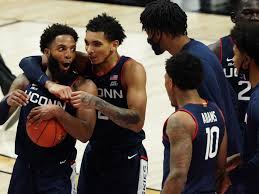
UConn Shows Full Recovery in Week With Signature Win

In my last article for this site, I expressed frustration after UConn’s loss at Kansas and said the team would have to address essential issues to defeat North Carolina and ultimately end its nonconference schedule with momentum. Immediately the Husky players shut me up and then some. They were impressive in a double-digit win against UNC and for a majority of Saturday’s blowout of Arkansas-Pine Bluff. UConn is now 9-1 and remains in the top five of the national polls, and can earn a final signature win in Seattle against Gonzaga on Friday night.

UConn was impressive in their 87-76 win against North Carolina, particularly offensively, and led nearly the entire game. After struggling at times against Kansas’s switch-heavy defense a few days before, the Huskies burned the Tar Heels defense consistently on switches for layups and open perimeter shots. They averaged 1.23 points per possession and made nearly 69% of their 2-pointers. Cam Spencer and Alex Karaban, who were hobbled against Kansas and had poor performances, bounced back and scored a combined 41 points while shooting 16-31 (I discuss the importance of the pair’s performances last week more below). Tristen Newton had a typically well-rounded performance, recording 14 points, 5 rebounds and 5 assists, and freshman Solomon Ball had a breakout performance, scoring 13 and draining three 3-pointers. Ultimately, UConn had 25 assists against just 8 turnovers.

North Carolina scored effectively against the defense, with R.J. Davis (26 points) and Harrison Ingram (20) burning Husky defenders consistently in the first half and early in the second. The defense struggled to help and close out on the perimeter at times, but the Huskies upped their pressure and intensity as the game wore on.  After the Tar Heels cut the deficit to 65-60 with 11 minutes remaining, UConn went on a 18-6 run. During this stretch, the defense consistently forced UNC into tough shots and forced multiple turnovers and blocks. Newton, Diarra, and Clinigan and Johnson played strong defense up top and in the paint to shut UNC down, and Stephen Castle played excellent D in his first game back from energy.

While UConn slept walk through the first few minutes of Saturday’s game against Arkansas-Pine Bluff, the offense woke up in a big way. With 3:54 left in the first half, the Huskies led the Golden Eagles just 31-29. After that point, they outscored Arkansas-Pine Bluff 70-34. After his 3-point shot had deserted him for a few games, Karaban had much better touch, draining six threes and finishing with a career-high 26 points and 7 assists. Newton had 16 points and 6 assists, and Spencer hit five treys and earned 4 assists. Clinigan was very effective on both ends, putting up 11 and 7 and blocking three shots in just 21 minutes. Finally, Castle looked very good in his second game back, scoring 7 points and recording 4 blocks and rebounds. UConn shot 56% and went 13-28 from deep, and got to the free throw line 31 times, making 22. It had 21 assists and outrebounded the Golden Eagles 42-28. On defense, the Huskies blocked nine shots and stole the ball five times. They held Arkansas-Pine Bluff to 35.6% shooting overall and 31% inside the arc.

UConn is now 9-1, and these two wins solidified its place as one of the best teams in the country and at the top of the Big East pecking order, along with Creighton and Marquette. Defeating Gonzaga in Seattle Friday will further demonstrate to observers that UConn can win against elite nonconference opponents in hostile environments. Below, I further discuss my thoughts on the UNC and Arkansas-Pine Bluff wins and the positives and negatives I drew from them.

Karaban and Spencer Come Back to Life

Against Kansas, it looked like injuries were heavily limiting Karaban and Spencer on both ends. Karaban’s shot was ineffective against the Jayhawks due to a finger injury, as he was just 2-7 from behind the arc. Meanwhile, Spencer had hurt toes on both of his feet, making it difficult for him to get good lift on his shots and move effectively on both ends. Spencer scored just 6 points while shooting 2-12, and both he and Karaban struggled to keep up on the defensive end. Prior to the North Carolina game, both men were a game time decision, and it was thought they would have minutes restriction. Because of this, it was easy to understand the skepticism myself and others shared about UConn being able to beat UNC at less than full strength.

Among the pair, Spencer was the first one to break out offensively against the Tar Heels. The senior scored 16 of his 23 points in the first half of the win, getting on the board via a series of layups, free throws, and 3-pointers. Spencer did not look stiff or slow in any shape or form. Rather, he showed off his ability to find open shots from anywhere on the floor, while still creating scoring opportunities for others. Against Kansas, Spencer had looked frustrated and angry at himself throughout. Against North Carolina, he played with that same intensity but instead fed off of it and showed their players he wouldn’t back down, even earning a technical after a little too much trash talking. While a lot of players had solid games against UNC, Spencer, who also earned 7 rebounds and 6 assists, was their MVP. After again playing well against Arkansas-Pine Bluff, my worries about Spencer have subsided.  

Karaban found ways to contribute against UNC around the basket and by moving the ball. He ultimately shot 6-8 inside the arc (mostly on cuts to the basket and on putbacks) to finish with 18 points, and had 9 rebounds and 5 assists. As discussed somewhat earlier however, the win against Arkansas-Pine Bluff was the first time Karaban’s shot has looked 100 percent for a while. Karaban was 6-9 from deep and did an excellent job of moving without the ball and off screens to get open 3-point attempts in the corner. He was also successful again at getting to the rim for baskets and rebounded and passed the ball well, finishing with 3 assists. Finally, while the competition wasn’t high level, Karaban was strong on the defensive end against the Golden Eagles. It will be important to see if Karaban can keep his offense going against another strong defense in Gonzaga. What Karaban needs to remember is to not fall into a pattern of just taking3-pointers against the Bulldogs if his outside shots aren’t falling, and to be aggressive going to the basket when appropriate to create plays for himself and others.

Freshman Continue to Contribute the More They Play

After difficulty acclimating to the speed of the college game or just finding minutes at all in such a talented rotation, Ball and fellow frosh Jaylin Stewart made a big case for themselves against UNC and Arkansas-Pine Bluff. With Castle making valuable contributions in both wins in limited movements, it seems like UConn and Dan Hurley is getting closer to deciding that Castle, Ball and Stewart will get the large majority of minutes played among the freshman, barring more injury.

Ball averaged 11 points between the two wins, shooting 7-15 overall and 4-11 from deep. The shooting guard is showing a strong ability to finish around the rim using his athleticism and has demonstrated a nice touch on floaters. While Ball’s shooting from deep is inconsistent and he has a tendency to rush 3-pointers, I’ll give him praise for not being afraid of the big shot and forcing defenders to challenge him beyond the arc. Ball certainly came up big against North Carolina from there, making a trio of 3-pointers that gave UConn momentum at essential times. He also has done a good job of handling the ball well and playing with high energy on both ends during his starting stint with Castle injured and then on minute restrictions. Hopefully, Ball’s improvement during this stretch increased his confidence and will allow him to make an immediate impact off the bench when Castle moves back to the starting guard spot in the next game or two.

Prior to the game against Arkansas-Pine Bluff, Jaylin Stewart had played intermittently this season. Against the Golden Eagles however, the forward was aggressive on the offensive end and rewarded with a season-high 15 minutes. Stewart scored 7 points, making all three of his 2-pointers, and had 2 rebounds and an assist. Stewart also got to the line for three shots, though he only made one. He demonstrated the ability to beat defenders off the dribble and shoot over them, as well as strong athleticism. Stewart will have to keep his defensive effort up and shoot better at the charity stripe to consistently get more playing time, but I believe that he can be a solid member of the rotation by the second half of the season.

While I can’t imagine being worried about Castle’s ability to contribute either way, he demonstrated that he could make an impact in multiple ways in limited minutes against the Tar Heels and Golden Eagles. The acclaimed freshman had 3 points, 4 rebounds, and both an assist and steal in just 11 minutes against UNC, and then put up 7 points, 4 rebounds, 4 assists and 2 steals in 18 minutes in the second win. It’s clear that Castle can beat defenders in the paint and create offense even when not fully healthy. His strength and reflexes allowed him to rebound well in the wins, and his passing was solid. What was most impressive against the two teams was Castle’s defense. His ability and length can allow him to hassle defenders and create turnovers. As long as he gets fully healthy, I expect Castle to start having a few breakout games in the next few weeks and show why he is one of the best freshmen in the country.   

UConn’s Ball Movement and Rebounding is Elite

The Huskies ability to share the ball and get assists, which helps create the team’s depth, and it’s rebounding were big areas of strength last year, and have remained so throughout this nonconference schedule. UConn is running an intricate offense that is great at confusing defenses and finding players for high-percentage shots. Through 10 games, the Huskies percentage of assists on made field goals is 60.8%, which ranks 29th in the country. They recorded 24 assists on 35 field goals against North Carolina, and 33 assists on 69 field goals against Arkansas-Pine Bluff. UConn’s passing is a thing of beauty, and it has helped lead to the balance the team has throughout its lineup. Four players (Newton, Spencer, Karaban and Clinigan) are averaging double figures, led by Newton’s 17 points per game. Castle is just under that at 9.8 points in less than 20 minutes of play.

Rebounding, especially on the offensive end, has been a huge emphasis of all of Hurley’s teams, and it unsurprisingly a huge strength again this season. UConn has consistently outrebounded its opponents, usually significantly so, and is grabbing roughly 42 per game. It is grabbing 38.9% of its offensive rebounds, which ranks seventh in the country. The biggest difference this season is that the Huskies guards are some of its best rebounders, with Newton grabbing 7.2 per game.

UConn Needs to Improve Significantly at Guarding Teams From Deep

The Huskies still have a very strong defense despite losing important talent and athleticism from last year’s roster. Opponents are making just 47% of their 2-point shots, which ranks sixth in the country, and the team is blocking a bunch of shots again. However, their opponents have been getting hot on 3-pointers, making 37% .4% of them, which is one of the highest percentages allowed by any team. While that mark may be a little inflated due to a few opponents shooting significantly better than their normal rates beyond the arc, the UConn players have consistently allowed guys to get free for wide-open 3-pointers, and been burned as a result. There could be a few reasons for this, including miscommunication by defenders, poor decision making, and the Huskies deliberately leaving a lesser perimeter shooter open to guard the paint. I know Hurley puts an emphasis on guarding the rim, but if opponents can stay in games by getting hot from three UConn will be susceptible to upsets, especially in March. Hurley has been emphasizing the need for the team to stop allowing so many 3-pointers, and hopefully they will have made changes to defending from there in practice during this long break that will pay off in games.   

Donavon Clinigan Still a Question Mark

Even with the injury issues to his foot and having to play his way back into shape because of a lack of live practice in the preseason, Clinigan has still been an excellent defender. He is constantly altering or blocking shots and limiting opposing big men’s freedom of movement. The sophomore slowed down Bacot against North Carolina and shut down the Arkansas-Pine Bluff bigs, and no opposing center has been completely successful against Clinigan so far this season. On offense however, it is clear Clinigan is more limited than expected. His ability to finish around the rim is inconsistent, partially due to a lack of lift caused by the foot injury. This is also holding Clinigan back from showing the same explosiveness he had as a rookie. In addition, Clinigan’s foul shooting has still not improved, as he is making just over half of his shots there. I am holding out hope that the Bristol native will start living up to preseason expectations in a month or so. The current version of Clinigan, however, is holding back UConn from reaching its full potential as a team.

There’s No Such Thing as a Good Loss

To all UConn fans, I say don’t believe what you here. While the team showed a lot of toughness coming back and almost winning in a hostile environment in Friday’s 69-65 loss at Kansas, there is ultimately no such thing as a “good loss”. UConn did not play well against the Jayhawks, with no player having a strong all-around game besides Tristen Newton. In fact, if it wasn’t for an amazing performance by Newton, the team would have been blown out. The Huskies did a putrid job with penetrating the defense and creating easy scoring opportunities for much of the game, looked significantly less athletic than Kansas, and continued to have defensive lapses that ultimately allowed the Jayhawks to go on a decisive rally to end the game. Throw in a lousy performance at the free throw line (8-15) and Cam Stewart injuring both his toes and having it badly affect his shooting performance, and it was all too much for UConn to overcome. While this issues may have been for just one game, they are definitely ones that could affect the team’s performances against North Carolina and Gonzaga.

The Huskies are in a very vulnerable position heading into their game with the Tar Heels at MSG Tuesday night. With Spencer hobbled (the pain in his feet clearly affected his shooting accuracy against Kansas), Donovan Clinigan still dealing with a foot that continues to hurt him and affect his athleticism, and Alex Karaban ‘s injured finger possibly affecting his shooting accuracy as well, it isn’t an ideal time for the team to be facing such tough back-to-back opponents. Dan Hurley even admitted on Monday that Spencer, Clinigan and Karaban have been limited in practice, and that it is not a guarantee that Spencer will play. While Stephen Castle is likely to return against UNC, I am sure he will be on a minutes restriction. Considering that North Carolina has an elite offense that likes to push the ball, you have to hope that one or two of those aforementioned guys as well as Castle can keep up on both ends and be effective. Otherwise, there is a very good chance the Huskies will lose. It would help if Hurley was willing to play any freshman besides Solomon Ball if those players are struggling, even if he is reluctant to. The group did not play one minute against Kansas.

Below, I provide a brief analysis of the areas UConn struggled in against Kansas, and the possible steps they can take to get back on track against UNC. I still believe that the Huskies can be an elite team and beat anyone at their best. Now, it’s time to prove it against the Tar Heels and then Gonzaga.

UConn’s Offense Was Ineffective Against Kansas

There are ugly offenses, and then there was the Huskies offense against Kansas. While the team was ultimately able to get to 65 points and average 1.08 points per possession, those numbers do not tell the whole story. UConn started very cold, allowing Kansas to get out to a 16-5 start, and it remained very inconsistent from there. While a lot of the struggles can be attributed to the Jayhawks suffocating defense and the intensity of the crowd, the Huskies still could have done a lot of things better. Players did not try hard enough to move the ball on the perimeter or help Newton and Spencer by coming to the ball. UConn rarely pushed the ball off rebounds, and took to long to get into offensive sets, leading to low-percentage shots. While players were forced to take a lot of challenging perimeter shots because of Kansas’s ability to pressure the ball, they were still able to get enough open shots that everyone besides Newton should have been a little more effective from beyond the arc. The remainder of the roster shot 5-19 from three, with Karaban and Spencer combining to go 3-14. As tough as it may have been, the Huskies should have tried to attack the basket more and get more opportunities for offensive rebounds and free throws. Only three players reached the line. Finally, UConn had Clinigan setting too many screens instead of focusing on him playing in the low post. The sophomore took just seven 2-pointers and was unable to get enough easy shots, ultimately going just 3-7. UConn should have an easier time scoring against North Carolina. The Tar Heels have allowed every power conference team to score 70 points, struggle at defending the 3-point line and foul frequently.

The Defense Was Poor at the Worst Times

Like its overpowering defense, the Kansas offense was surprisingly efficient, especially at the beginning and end of the game. The Jayhawks jumped out to a 16-5 lead, making everything, and leaving the UConn players gob smacked. While they cooled off somewhat from there, they still went into halftime shooting over 50%. After shooting hot and cold for much of the second half, allowing the Huskies to briefly take the lead, Kansas seized it back by going on an 11-0 run starting with 6:53 remaining that featured three consecutive treys by Kevin McCullar, a subpar 3-point shooter, and Hunter Dickinson. McCullar hit one more backbreaking three to seal the game as UConn furiously tried to come back. Kansas, which had been inconsistent offensively against the best teams on its schedule and does not have great depth and shooters, definitely played its A game offensively at times. Shooting 9-14 from three is an obscene percentage, for instance. Still, the Huskies could have done a lot more to try and slow down Kansas.

My biggest frustration with the defense was that it just didn’t throw in enough wrinkles to try and slow down Kansas. Hurley didn’t have his players ramp up the ball pressure significantly and did not try and trap the Jayhawks until the final two minutes of the game. With the Huskies struggling so much to get good shots and allowing regular fastbreak opportunities off their poor shots, trying to play a defense that could hopefully lead to turnovers and easy baskets would have been a godsend. UConn also never played zone defense when Kansas was hot, and the one time it experimented on D by playing Clinigan and Sampon Johnson together, it blew up in the team’s faces, as the Jayhawks picked the moment to go on the 11-0 run that sealed their win.

While the Huskies decision to focus on guarding the paint instead of the 3-point line made sense at the beginning of the game because Kansas does not take many treys and the defense wanted to slow down Hunter Dickenson, UConn should have began playing the perimeter tighter earlier in the game. Even when they began doing so, players were consistently late on closing out. The defense had a habit of losing guys they were assigned to guard, leading to open jumpers, and were beaten off the dribble way too frequently, especially in the first half. The injury to Spencer did not help, as he is not particularly athletic or a good-on-ball defender even at full strength.

However, Karaban was by far the worst defender. He was abused off the dribble by the bigger and stronger KJ Adams, who finished with 18 points and was probably Kansas’s best all-around player. Once again, Karaban showed that he can be burned defensively by bigger guys, and his inability to keep his hands up while guarding ultimately led to Karaban fouling out. The one player I will give kudos for his defense is Clinigan, who did a great job of denying Dickinson the ball and altering his shots, holding the All-American to 3-8 shooting in the paint while blocking three shots. Hopefully, Hurley came up with some wrinkles to slow down North Carolina in practice while still protecting his hobbled players.

The Injuries Held Back UConn on Both Ends, and Stephen Castle is not Going to be an Immediate Solution

UConn was blessed to not have any long-term injury issues outside of the loss of Johnson, who would have played very little anyway. Maybe the gods are cursing them for their good fortune right now, as the current starting lineup looks like a MASH unit. The most concerning injury is to Spencer. As we saw against Kansas, his injured toes were a big factor in the senior’s 3-pointers constantly being short, affected his ability to play defense and drive to the basket, and even hindered his free throw shooting, as Spencer missed his first two attempts of the season. Spencer is a gamer and I expect him to play at least a little bit against North Carolina, but if his shots aren’t falling and his mobility is limited, I can’t expect Spencer to give UConn much on Tuesday.

While Clinigan has done a valiant job of playing through a foot injury that his still not fully healed, it is still limiting his athleticism and ability to grab rebounds and finish around the rim. Clinigan will again have to face an elite big man Tuesday in UNC’s Armando Bacot, and hopefully UConn’s guards will do a better job of getting him quality shots in the paint. Karban’s hurt finger is seemingly hurting his shot more than expected, as he has been terrible from beyond the arc in the last three games, including 2-7 against Kansas. Hopefully, it will recover quickly and Karaban will be smart by trying to score more at the rim and on free throws instead of 3-pointers. Finally, while I have high expectations for Castle and am glad his knee healed quickly, I don’t expect him to play a ton against North Carolina or to even be highly effective, at least as reflected in the box score. Castle has not yet faced a high-quality opponent, and it is going to take him a little while to get adjusted and get back up to game speed. Hopefully, all these injuries won’t be long term. In the meantime however, UConn will demonstrate their mettle if they can overcome them to beat North Carolina and then Gonzaga.

Extend the Rotation, Coach

This is more of a general issue I have with Hurley than just being focused on the Kansas game. I am never going to understand his reluctance to play most freshman extended minutes, even when it makes sense. UConn had one of the best recruiting classes in the country. With Spencer hobbling around, Karaban struggling on both ends and Solomon Ball mostly invisible against the Jayhawks, why didn’t he bring in Jaylin Stewart and possibly Jayden Ross, even if it had only been for three or four minutes at most. There wasn’t anything to lose, and Stewart has shown promise so far this season and Ross is a quality 3-point shooter. Yes, the freshman might not have been able to handle the intense environment of Allen Fieldhouse. But you don’t know until you try, and Stewart possibly could have made an impact at all against North Carolina and possibly Gonzaga, and will be unprepared for the rigors of conference play when it starts late this month. Hurley has to be willing to give a little rope, especially when the situation calls for it, and the Husky freshman deserve the opportunity to prove themselves. This is not a particularly deep team. Give the freshman consistent minutes as the season goes along, or Hurley may have most of them transfer.

Despite how frustrated I was after the Kansas loss, I believe UConn will beat North Carolina Tuesday. They match up with the Tar Heels better, and I cannot imagine the team will perform so poorly offensively outside of Newton for the second consecutive game. No matter what though, it will be a close game, and the Huskies still must prove they can win those. UConn has a lot of talent on both ends and is an elite offensive team and solid defensive one. It definitely lacks the depth or defensive ability last year’s squad had right now however and is not as good as that group was at this time last year. Against UNC, the Huskies have the chance to prove me wrong.

UConn Demonstrates its Excellence at Empire Classic

UConn fans generally believed this year’s Huskies would be pretty good despite losing one of the best trios in UConn history (Adama Sanogo, Jordan Hawkins and Andre Jackson) from last year’s team. Tristen Newton could take on a bigger scoring load and possibly become one of the best point guards in the Big East, and Donovan Clinigan and Alex Karban had the potential to be two of the best sophomores in the country. Combine this trio with a senior transfer whose skills were a perfect fit for the team’s needs in Cam Spencer, the athleticism and potential of backup center Samson Johnson, and a freshman class that was ranked one of the best in the nation, and the Huskies could again be one of the best in the country.

Despite all this talent, there was reason to be skeptical of how successful UConn could be in its nonconference schedule. There was no guarantee that Newton, Karaban and especially Clinigan could consistently perform well both statistically and as leaders on and off the court, that Spencer would quickly acclimate to Storrs, that Sanogo could be a reliable backup after barely playing his first two seasons, and that the freshman class could contribute immediately. Like all freshman, the group, even five-star guard Stephen Castle, were guaranteed to take their lumps all season. In addition, the Huskies are playing their hardest non-conference schedule since the Jim Calhoun era, with neutral court or away games against Indiana, Texas, Kansas, North Carolina and Gonzaga. There was the chance that a young team could struggle against that early gauntlet.

UConn looked very good in its first three games against Northern Arizona, Stonehill and Mississippi Valley State, especially offensively. It won each game by at least 34 points while averaging 96 points. Newton, Karaban, and Spencer played especially well in the opening week, while Castle had a dynamite first two college games before injuring his ankle. While Castle is shooting to return by the Kansas game on December 1st, his injury would make it harder to win the Empire Classic, which was scheduled on the 19th and 20th and featured Indiana, Texas and Louisville. Overcoming Castle’s injury and winning the Classic would go a long way towards showing UConn could overcome his loss and prove the program can be just as good as last year.

After the results of the Empire Classic at Madison Square Garden, it’s clear that fans needn’t have worried about UConn’s talent level or ability to gel, as it beat up on Indiana and outplayed a plucky Texas team in the final. It beat Indiana 77-57 in the first game and Texas 81-71 to earn the championship and improve to 5-0 (they improved to 6-0 with a 90-60 win against the 25th ). With these double-digit wins, the team extended its streak of out of conference wins by double digits to 22 games, one short of the Division 1 record.

The Huskies, who are third in the KenPom rankings and fifth in the AP Poll, are clearly one of the best the teams in the country. Below, I discuss a few of the biggest strengths UConn showed at the Empire Classic, as well as one or two areas of concern. I certainly have more confidence in UConn than a week ago.

The Huskies Offense Shows Almost No Weaknesses

In the wins at the Empire Classic, UConn shot a combined 47.9% overall and nearly 84% at the free throw line. Players did an outstanding job of moving the ball and obtaining quality shots, especially around the rim. The Huskies were able to attack the basket both individually and off pick-and-rolls and cuts. While UConn’s perimeter shooting wasn’t quite as good and they made just 30.4% of its 3-pointers against Indiana and Texas, players were able to make jumpers to propel runs or in the clutch, particularly Karaban and Spencer. The team’s slick passing and offensive creativity is evident by the 37 assists it racked up in the win. Four players had multiple assists against both the Hoosiers and Texas, with Newton averaging a combined 7.

After committing 14 turnovers against the Hoosiers, the Huskies reverted to the strong ball handling it exhibited in their first three wins, committing just six against the Longhorns. Finally, UConn’s offensive rebounding prowess carried over from last year’s squad. It averaged 13 at the Empire Classic, resulting in a significant amount of second chance points, and has again been one of the best teams in the nation on the offensive boards through two weeks. In addition to Clinigan and Sanogo, Newton, senior guard Hassan Diarra and freshman guard Solomon Ball performed well in this area against Indiana and Texas.

Tristen Newton and Alex Karaban Step up and Take Action

As touched on above, Newton and Karaban needed to take on bigger leadership roles and become more well-rounded players this season for UConn to reach its potential. The initial results through three games were promising, and the duo’s performance at the Empire Classic was excellent overall.

Newton scored a combined 31 points at the tournament on 38.5% shooting, while going 10-12 at the free throw line. As the point guard, he dished out 14 assists while committing just 5 turnovers. Newton was outstanding against Indiana, scoring 23 points on 7-15 shooting and 10 free throws. Newton, an elite rebounder, grabbed 11 boards, and recorded 6 assists and 2 steals. The win was a showcase for Newton’s abilities to finish at the rim and force contact to earn foul shots, anticipate rebound opportunities, and improvement in running an offense. While Newton’s shooting was off against the Longhorns and he only finished with 8 points, he recorded 8 assists, 4 rebounds and a block. Throughout the Empire Classic, Newton played his usual solid defense and directed teammates on the court and in huddles. The senior is confirming that he can take on a bigger load for the Huskies as both a scorer and facilitator. Hopefully, his success against premier programs at MSG will carry over to the games against Kansas, North Carolina, and Gonzaga in early December.

Karban displayed his versatility and ability to step up when needed most at the Empire Classic. He scored 33 points on 54.2% shooting and made 6 free throws between the two games. He had 6 rebounds in both games, and a steal in both. Karaban gave UConn a leg up early against Indiana with a few beautiful perimeter shots. Against Texas, Karaban again got off to a good start and then iced the game with three straight jumpers beginning with five minutes remaining, after the Longhorns had got within four points. All these shots were very well-defended. Karaban was the best player in the win, finishing with 20 points and draining four 3-pointers. While Karaban can still strund ggle defensively against larger bigs, he has improved overall and did a strong job of limiting Texas’s Brock Cunningham. I am very confident that Karaban will continue to improve on both sides of the ball and always bring energy and toughness to the floor.

Spencer Continues the Pipeline of Essential Transfers

R.J. Cole. Tyrese Martin. Tristen Newton, Naheim Alleyne, and Joey Calcaterra. UConn has hit on several transfers under Hurley that have helped the Huskies become a championship program again. Spencer is the next player in that group, and his performance at the Empire Classic demonstrated why he is a perfect fit for the Huskies. The fifth-year senior averaged 17 points at the event on 45% shooting and made all 12 of his free throws, while also averaging 4.5 rebounds and 3.5 assists. Spencer did an outstanding job of finishing at the rim off cuts and forcing contact, and helped propel runs in both games through 3-pointers and free throws. He continues to be a reliable second ball handler and an excellent passer. Spencer has quickly announced himself as a perfect fit for this year’s team by providing valuable experience and the shooting and ball-handling that was lost with the departures of Jordan Hawkins and Andre Jackson.

Backups With Strong Performances in Bigger Roles

With Stephen Castle out for a few weeks and Donovan Clinigan not at full strength due to missed time in preseason and sickness, UConn badly needed its bench to shine at the Empire Classic. Senior point guard Hassan Diarra and junior center Samson Johnson are currently the most experienced bench players, and they displayed the value of that experience and their biggest strengths against Indiana and Texas.

Diarra had a frustrating first season in Storrs, but he had played well in limited minutes as the first or second guard of the bench in the opening three games. In the Empire Classic, he picked up freshman Solomon Ball, who was making just his second and third career starts, and was a spark plug on offense as well as defense. Diarra had 6 assists, 5 boards and a block against Indiana, even as he struggled to shoot the ball. He then stuffed the staff sheet against Texas in 28 minutes, putting up 8 points and 6 rebounds while adding two assists, steals, and blocks. As always, Diarra was a huge pest on defense and made it difficult for his man to handle and move the ball. It was clear that Diarra’s teammates, particularly the freshman, were feeding off his energy and intensity in the wins.

Meanwhile, Jackson has been outstanding backing up Clinigan so far this season, even when dealing with foul trouble. His athleticism, particularly his speed, and ability to rebound and protect the paint, makes Johnson a perfect complement to Clinigan who can wear out other bigs. While Johnson was limited against Indiana because of fouls, he had the best game of his life against Texas. The native of Togo scored 15 points on 6-8 shooting, grabbed 8 boards, and blocked 2 shots in 27 minutes, and was the most essential player to the win alongside Karaban. Against the Longhorns, Johnson demonstrated how his athleticism and strength can make him both unstoppable against certain defenders at the basket (he had multiple spectacular dunks)and allow him to shut down other big men at the rim. Whenever the team needed an easy basket, the junior was there to execute alley-oops or slam down putbacks. Johnson committed just one foul in the game, and must continue to be able to defend tough opponents without fouling if he wants to consistently play a significant amount of minutes, including alongside Clinigan. While Johnson is obviously raw, he and Clinigan will be a two-headed monster at their best.

Clinigan Remains Formidable, but is Limited at the Moment

When sophomore center Donovan Clinigan injured his foot and had to sit out for roughly a month between September and October, there were big questions about how quickly he could come back to full strength and be highly effective in nonconference play after a long stretch off his feet. Clinigan’s first two weeks of the season have been a mixed bag. At the Empire Classic, he played excellent defense and rebounded very well, and was highly effective on offense at times. However, Clinigan did not display the same athleticism or finishing ability as last year and struggled with his stamina. This was heightened against Texas, as Clinigan played while sick.

Against Indiana, Clinigan was outstanding on defense and the boards, and affective on offense for stretches. He finished with 9 rebounds and had both 2 blocks and steals. While Clinigan, an outstanding passer, had two assists, he was able to take just three shots and made one. However, the Connecticut native reached the free throw line eight times and made five shots, a slight improvement after heavy struggles at the charity stripe in the opening three games. Clinigan ultimately finished with 7 points and played 30 minutes against the Hoosiers, as Dan Hurley looked to test Clinigan’s stamina against a high-level opponent and in the first game of a back-to-back. While the Indiana win was a step forward for Clinigan, the tournament’s championship game was a step back. While he  managed to finish with 7 points on 3-4 shooting, Clinigan picked up three fouls and played just 13 minutes while grabbing just 3 rebounds. Clinigan played strong defense but looked a step slow against the Texas bigs, leading to his foul trouble. In addition to having to deal with not being in full game shape, Clinigan had trouble with his breathing due to being under the weather, causing him to have to use an inhaler at times. Luckily for UConn, Johnson was there to dominate the frontcourt on both ends when Clinigan was sitting.

Considering the hype for Clinigan in the preseason, the first couple of games were somewhat frustrating. While he was great at times, the explosiveness on both ends and ability to finish at the rim has not been there consistently. However, Clinigan has still been an excellent center even while limited, and I believe he will return to being one of the best players in the country by early next year. The tough competition Clinigan faces in the remainder of the nonconference schedule will test him and  provide him the ability to quickly return to full strength.

Defense Still Needs to Improve

While UConn’s defense was very strong overall against Indiana and Texas, multiple players had difficulty covering their man and there was a lack of focus at times. Against Indiana, Karaban was owned by Malik Reneau in the paint, who was both stronger and quicker. He and remaining teammates also had periodic lapses with providing help defense or guarding dribble drives. These attention lapses continued on and off against Texas, and the Longhorns were successful at the midrange game in the second half, even if many of their shots were well-guarded. As formidable as the Husky centers are defensively, their backcourt must become more disciplined for the remainder of the games Castle misses and then over the course of the season. In particular, Karaban and Spencer must become stronger, and the freshman besides Castle. This is especially true of Stewart, who has looked particularly overmatched after being a solid defender at Rutgers last season. UConn already has an elite offense, but it will only be a great team if the defense becomes outstanding in conference play.

One Unforgettable Moment

Six seasons ago, myself and UConn Nation were despondent and had no clue if UConn could become a premier program again. The Huskies were adrift in the American Athletic Conference, and head coach Kevin Ollie seemed constantly disengaged from players and unable to to coach them effectively on either side of the ball, despite leading them to a title in 2014. After UConn finished consecutive losing seasons, the administration found a way to escape Ollie’s costly long-term contract and fire him for cause, despite the violations discovered being dubious.

Athletic Director David Benedict eventually tapped URI’s Dan Hurley to be the Huskies next head coach. While Hurley had a good track level at the mid-major level (two wins in the NCAA tourney) and a reputation as an excellent player’s coach, there was no guarantee he could succeed in the demanding environment of Storrs.

Cut to last Monday night in Houston, with the confetti falling down and UConn players and coaches as well as others celebrating the program’s fifth national championship after defeating San Diego State to win the title. It was a sight that I thought may never happen again after UConn fell apart in the second half of Ollie’s tenure, and the celebration almost moved me to tears.

While Hurley’s two previous tourney teams in Storrs were talented and very likable, this season’s squad was on another level. It had great depth, size and athleticism, which showed itself in different ways on each side of the ball.

On defense, the length and strength of Adama Sanogo and Donovan Clinigan allowed UConn to shut down the paint against most opponents, and the Huskies perimeter defenders were bigger and more effective than last season’s unit thanks to the additions of Naheim Alleyne and Hassan Diarra and improvement of Jordan Hawkins. And of course, Andre Jackson is one of the country’s best defenders at his best.

Offensively, Sanogo anchored one of the best frontcourts in the country, and UConn’s perimeter shooting, ball-handling and passing was consistently strong and elite at times. Hawkins lived up to his promise as one of the best pure shooters the program has ever seen, and Jackson continued to improve as a facilitator, and eventually as a scorer despite a limited skill set. UConn was one of the best rebounding teams in the country all season on both ends of the floor, and ranked second in offensive rebounding percentage at the end of the season.

Last year’s squad could be frustrating to watch offensively due to a lack of shooting and spacing in the front court, where Sanogo and Isiah Whaley could clog the paint. That was never a problem with this championship squad. It could score from anywhere on the floor while bullying opponents in the paint, drive to the rim effectively, and shared the bell as well as any team. (UConn’s rate of assist on made field goals was eighth in the country). At their best, this group of Huskies were extremely fun to watch and played with a sense of joy and toughness that was missing to some extent on Hurley’s earlier squads. It made nearly every game a must-watch event, which was a forgotten experience for myself and others.

As great as it was to UConn at their best in the regular season, it was just as rewarding seeing how it overcame the struggles of January to become a more well-rounded team, one that was again playing like on of the best in the nation by the end of the regular season. After losing six of eight in January, multiple players switched up their approaches on the offensive end and made both themselves and the team better as a result. Sanogo, Jackson and Hawkins especially stood out in this regard.

Sanogo, who was being constantly double-teamed, attacked the basket more directly instead of playing a traditional post-up game, and cut to the rim more for easy baskets and passes. Jackson, who was being goaded into shooting from outside and struggling mightily, got his confidence back on both ends by playing more in the “dunker’s spot” at the rim, which allowed him to score and rebound easily as well as make spectacular plays for others. Finally, Hawkins attacked the basket more for layups and free throw opportunities, while also benefiting from the improved spacing the offense had in February and March. At the same time the offense improved, UConn’s team defense got much more disciplined and focused, as the Huskies cut down on the unnecessary fouls and poor help D they played in January. Hurley’s ability to teach his players how to make these adjustments and his improved composure in games helped the UConn players compete with more confidence in games, and handle adversity when it cropped up. By the time the Huskies got to the latter stages of the NCAA tournament, they were able to always control games, ensuring there was no such adversity.

While it was easy to see UConn being capable of going on a Final Four run and maybe even winning the championship, never would I have imagined that it would dominate NCAA tournament opponents to that extent. They won the six games by an average of 20 points, and each win was by at least 13 points, including the 76-59 beatdown of San Diego State to win the title. The offense easily averaged over a point per possession (PPP) in each game while scoring 70 or more points, and held each t0 65 or fewer points and 0.95 or fewer PPP. Sanogo was the best player in the tournament, averaging over 17 points and a double-double, Hawkins averaged over 16 points and shot 50% from deep, and Tristen Newton was UConn’s best player in the championship game, scoring 19 points and earning 10 rebounds and 4 assists. Add all the intangibles Jackson brings and great performances by the bench throughout the tournament, and the perfect mixture for a championship is there.

Obviously, basketball fans who weren’t overly familiar with UConn fell in love with them as the team made its run. The team’s athleticism, shot-making and toughness jumped off the chart in each game, and it made a bunch of outstanding opponents look helpless at times. The basketball IQ and enthusiasm for the game every Husky displayed in March Madness was off the charts, as well as Hurley and the player’s composure in tight moments and ability to shack off poor plays. I know if I was a neutral fan, I would enjoy jumping on the UConn bandwagon. As nervous before and at points during each game, I was in ecstasy by the end of each win.

Now that UConn has five titles in 25 (technically 24) seasons under three different head coaches, everyone is debating over whether they qualify as a blue blood. I have always thought that title is meaningless in the grand scheme of things, especially considering how hard it is to define. All I know is that UConn wins championships when it goes deep in the tournament, and it is arguably the best men’s basketball program of the last 30 years, and that Storrs is the college basketball Capitol of the World. All I know is that this was arguably the most complete team top to bottom of any of the Huskies championship teams this century, and certainly my favorite to watch. And finally, I know that this championship has redeemed by belief that UConn can be a consistently elite program. Thank you, Dan Hurley and the 2023 championship UConn Huskies.

Examing the Coaching Staff Changes for the Huskies

The late spring is usually the quitest time for any major college basketball program, especially once the transfer and recruiting processes are mostly settled. This was not the case with the Huskies, however. Instead, the program had multiple coaches come and go from Storrs in just a few weeks. When the dust settled, UConn added one, of the most highly-regarded assistants in the country and a proven strength and conditioning coach who fits the program’s philosphies.

Below, I discuss the departures of one of the Huskies assistant coaches and their strength and conditioning coach, and the additions of Luke Murray and Gavin Roberts to take these positions. I believe Murray and Roberts are excllent hires and can make an immediate impact on the program and be extremely important to its success in the years to come.

Kevin Freeman leaves, Luke Murray replaces him

Freeman, who was a key cog on UConn’s 1999 title team, stepped down in mid-April after one season as an assistant coach. He will now lead UConn’s National C Club, a position previously occupied by current women’s assistant basketball coach Jamie Elliott. The UConn website says that the National C Club ““seeks to build and foster relationships through networking, mentoring and professional experience opportunities between former and current UConn student-athletes”.

Freeman attributed his decision to wanting to make a lifetyle chance that would allow him to spend more time with his young family while also staying within the UConn family. Freeman’s decision is certaintly understandable, and I am glad he will continue to be part of the program, where he previously served as the director of basketball administration from 2011-2018. However, it was concerning to hear that Dan Hurley was upset with Freeman’s decision to go on vaciation in early April when the Huskies were looking at players who could transfer to UConn (fellow assistant Kimani Young went on vacation as well). Like many fans, I wondered if the program could attract quality candidates for the position this late in the offseason. I shouldn’t have worried.

Murray wazs immediately seen as a top candidate for the assistant position by fans due to his success at Xavier and Louisville as an assistant to Chris Mack. Before that, Murray was an assistant for Hurley at Wagner from 2010-11 and at Rhode Island from 2013-15. While with the Musketeers from 2015-18, he helped the Muskeeters to an 81-26 record while bringing in three consecutive ranked recruiting classes. He then helped lead Lousville to a 57-28 record in three seasons and brought in a six-player class in 2019 that was ranked ninth in the country by ESPN.

Murray has connections to UConn’s program and and an understanding of recruiting in the Northeast beyond just his stints at Wagner and Rhode Island. Murray played his high school basketball at St. Luke’s School in New Canaan and went to UConn for his first semester of college before transferring to and graduating from Fairfield University. Murray built a relationship with UConn assistants while in Storrs, and seeing the success of the program helped encourage his interest in coaching in college. He worked for current Huskies assistantTom Moore when he was head at Quinnipiac, and has worked alonside Young in the New York AAU scene. He has coached with AAU programs in Springfield in addition to New York.

Murray checks all the boxes, as they say, for the type of assistant coach Hurley is looking for. He is a coach who Hurley has worked with before, can continue to strengthen UConn as a premier destination for top recruits in the Northeast, and should have a strong working relationship with the team’s other assistants. Most importantly in my mind, Murray has had demonstrated success attrracting recruits from throughout the Midwest and South and can help expand the Huskies recruiting footprint, something UConn will need to do if it wants to return to being an elite program.

Murry is highly regarded for his coaching ability throughout the college basketball world, and is seen as a future head coach. Murray was ranked 10th amoung ESPN’s list of coaches under 40 in 2020 and was named one of the top five recruiters in the country by 247sports. He also was a member of The Athletic’s list of 40 most influential figures in college basketball under the age of 40. After Murray was hired, a number of coaching figures and media members heavily praised the move. The Athletec’s Sam Vecenie wrote “Luke Murray is one of the smartest people I’ve met within basketball. One of the few that I think could legit work in NBA front office, coaching, college coaching, etc. Super smart, and REALLY knows hoops. Just a really great hire for UConn.”

I believe that Murray is about as perfect as a hire as UConn could have gotten. The 35-year old Murray will inject a lot of energy into the program, and his track record and ability to relate to high school recruits should allow him to immediately attract quality players in the 2022 and ’23 classses. In the few weeks since Murray arrived in Storrs, multiple top recruits whom Murray was going after while at Louisvillle have either expressed interest in UConn or officially gotten offers from the Huskies, and there has been indications that Murray and the staff are going after other top targets as well. With Murray there, I expect the program to get excellent classes for these two years. I am especially excited by the potential for Murray to bring in players from throughout the country and not just the Northeast. Throw in Murray’s relationship with Hurley and the rest of the coaching staff, and he is a home run hire.

Best of all, Luke is the son of Bill Murray. How awesome will it be to see him at multiple UConn games?

Strength coach Mike Rehfeldt replaced by Gavin Roberts

UConn’s second coaching departure came on April 30th when Rehfeldt left the program to return to Cincinnati, where he previously served as strength coach for eight seasons. Rehfeldt had served under Mick Cronin before he departed the Bearcats, and was hired by Hurley last July. He made a big impact on the program in his short time in Storrs, helping multiple yong players build their body strength. This effort was reflected in UConn’s rebounding prowness, as it was one of the top offensive rebounding teams in the country. Rehfeldt’s return to Cincinatti was spurred by the firing of John Brannan on April 9th and the hiring of Wes Miller as the new Bearcats head coach.

While Rehfeldt’s decision to return to Cincy was very understandable, it left UConn looking for its sixth different strength/conditioning coach in eight years. This lack of continuity definitely hurts the program, especially in the devlopment of younger players. The Huskies needed to find a proven replacement who they could trust to say multiple seasons.

Two weeks later, UConn hired Roberts. The 31-year old, who was previously at Purdue for three years as the the head strength and conditioning coach, also met all the qualifications the program wanted in a director of sports performance. While Roberts was at Purdue, the Boilermakers went 60-35. He brings to Storrs that conference’s reputation for size, strength and physical play, qualities that are part of Hurley’s philosophy. At UConn, Roberts will be responsible for in-season and offseason aspects concerning strength, conditioning, nutrition and wellness training for the program.

Following his hire, Roberts discussed his biggest prorities as a coach. Roberts cited ensuring players were healthy, building athleticism, and finding a system players need in order to thrive (from a mental, nutriotional and strenth standpoint) as his biggest immediate priorities.

I believe Roberts success at Purdue and his clear goals as a coach will make him successful as a director. If Roberts can help the players go stronger both physically and mentally, while still finding a way for a player’s increased size or weight to not take away from his athleticism, then he should make a positive impact up and down the roster. What will be just as important is ensuring Roberts will stay in Storrs for the long term so that there is some stability with the position.

The Team’s Chemistry Was Highly Visible

UConn’s chemistry has been on display all season, especially that shared by the more experienced players. But its only during this four-game winning streak that I’ve especially noticed it among all the players and the team having fun as a whole. The team was smiling and high-fiving after many big offensive plays and fastbreak baskets, and the communication and connection Sanago shared with both Cole and Jackson was unstoppable. That energy and dedication to pushing the tempo was there for all 40 minutes and allowed the Huskies to take a huge lead when they could have easily sat back and taken their foot of the gas. Whaley even said after the game that the chemistry with this year’s team was better than last year’s and the best he has experienced in his five seasons. If the players can maintain that chemistry and communication among one another against tougher teams and when everything isn’t going smoothly in the coming weeks, UConn can be one of the best teams in America.   

The Defense Was Way Too Leaky

Based on the quality of the offense, UConn clearly had its worst defensive performance in Big East play Tuesday. While a couple of the first-half threes Georgetown hit were well-contested, way too many of them were wide open. What was especially annoying to watch was Husky defenders right there barely contesting threes, something that was inexcusable considering that’s by far the Hoyas biggest strength on offense. While the post defense was hurt by the foul trouble Sanago experienced, the defenders still did not contest shots well enough in the first half, with Mohammed especially taking advantage. It is clear that Hurley emphasized playing better defense at halftime. UConn absolutely came out more aggressive in the second half and pressured ball handlers while rotating well on outside shooters, turning the game into a rout. The Huskies had a lot of leeway with an opponent like Georgetown, but that still doesn’t give them an excuse to play flat on D to start the game. If the same thing happens on the road tomorrow at DePaul, they will quickly be in danger of losing.  

Examing Takeaways from the Battle 4 Atlantis Tournament

Hello all, and welcome to another year of UConn men’s basketball coverage here at Husky Nation! I have had some technical issues with the website recently that prevented me from publishing content, but these have been ironed out and I now should be bringing you regular coverage of this year’s Huskies squad.

It has certainly been an interesting start to the season. UConn started the season with four impressive wins, but all against extremely weak competition. It was presented with its first real tests at the Battle 4 Atlantis tournament in the Bahamas Thanksgiving week, and fans were treated to three exciting games. The Huskies won a 115-109 shootout against a ranked Auburn squad in double overtime last Wednesday. On Thanksgiving, it coughed up a late lead to Michigan State and fell 64-60 but recovered the next day to win a rock fight in overtime against VCU, 70-63. The two wins earned UConn a third-place finish in the tournament and moved their AP rating up to No. 17. The team moved to 7-1 on Wednesday despite a poor performance against Maryland-Eastern Shore.

I will publish an article after the Huskies game against Grambling on Saturday focusing on their performance without the injured Tyrese Martin, but I first wanted to focus on UConn’s performance in the Bahamas. The tournament showed the best and worst tendencies of UConn, as well as the mental fortitude this squad has. Below, I have a list of the most essential observations I saw during the tournament. I hope you enjoy!

UConn Showed It Won’t Be Out-Toughed

The Huskies were without Isiah Whaley against Michigan State and Martin had to deal with a wrist injury throughout the tournament. They started each game off slow and trailed at the half to both Michigan State and VCU. UConn was ineffective on offense for long stretches against MSU and VCU, two of the best defenses in the country who successfully made these games ugly. And of course, the Huskies had a ton of trouble holding the lead late and handling pressure defense against all three teams, costing them a win against MSU. And yet, it didn’t really matter in the end. UConn overcame fatigue and various weaknesses to play all out in each game. Their hustle and teamwork were outstanding, especially on the defensive end, and their ability to execute on both ends in the winning overtimes was very promising. Throughout Dan Hurley’s tenure, the program has had trouble winning close games and in overtime against high-quality teams. This tournament gave me the confidence that won’t be the case again.

The Senior Stars Showed They’re the Heart and Soul of This Team   

The trio of RJ Cole, Tyrese Martin and Isiah Whaley certainly have their weaknesses as individual players. But they are greater than the sum of their parts as a group, and the Huskies certainly would have lost to these tournament opponents if each senior hadn’t played their best individually and as a trio at the most important moments. Cole was UConn’s best offensive player in the tourney and was great against Auburn and VCU, scoring a combined 50 points in 88 minutes with eight assists and four steals. Cole shot 8-18 from three in the wins while going 16-18 from the line. Cole made clutch shots from both beyond the arc and at the rim, and these shots along with his free throws carried UConn to both wins. Cole also did a solid job of managing the offense and played good defense at times throughout the tournament.

If Cole was the team’s most indispensable offensive player, Whaley was their most indispensable defender. The big man was the one Husky who could consistently stop Auburn players at the rim, recording seven rebounds (three offensive) and five blocks in 43 minutes to go along with four assists. Whaley returned against VCU after being forced to miss the game against MCU doing to fainting at the end of the first game and was every bit of effective on defense while also coming up huge on offense. He had four rebounds and two assists and steals and scored 16 points while going 3-3 from behind the arc, including the trey that sent the game to overtime. Whaley’s energy and hustle was infectious for the while team. His ability to affect shots allowed UConn to shut down VCU at the end of regulation and in overtime. I have no doubt that the Huskies would have beaten MSU if Whaley was available.

And now, we come to Martin, the man who has been the team’s best two-way player throughout the season. Despite injuring his elbow against Auburn (a fracture that will now keep him out 2-4 weeks), Martin fought threw it to average 12 points and over nine rebounds in the tournament on 44% shooting. Martin recorded 13 points on 5-9 shooting and eight rebounds against Auburn and had eight rebounds against VCU, and was also outstanding against MSU, earning a double-double with 16 points and 12 rebounds. Martin was able to bang with all three teams and overpowered their offense at times and was the most visibly aggressive player on the court. The trio seemed to also be the leaders of the time during timeouts and huddles and helped to make sure younger teammates were composed. With Martin out for a few weeks, Cole and Whaley are going to have to improve their games and take on an even greater leadership role. It will be interesting to see if they are up to the challenge. Ultimately, I think UConn will only go as far as Cole, Whaley and Martin can take them.

An Inability to Handle the Press and Close Out Games Continues to Plague the Program     

If you asked dedicated fans coming into the season what they hoped to see from UConn, I’m sure a common hope would be that the Huskies would be more prepared when facing the press and finding ways to break it after this being a huge weakness in 2020-21. Similarly, fans would say that UConn needed to do a better job of adding on to leads late, instead of becoming flustered and making mistakes that put opponents in position to come all the way back. `In both areas, the fans, players and coaches did not get the results they were looking for.

First, UConn seemed lost how to handle the press against Auburn and VCU, which both rely on it heavily. It had difficulty passing over and inbounding against the press and not getting trapped, resulting in multiple costly turnovers, ballhandlers (particularly Cole), being trapped along baseline corners and it taking a long time to set up offensive possessions. It didn’t help teammates failed to move towards ballhandlers to help make it easier to pass and subsequently get down the court. The struggles against the press were key to helping Auburn and VCU force overtime. Hopefully, they were a wake up for UConn and the team will work hard in upcoming practices to refine their approach against the press and Hurley will help his players realize the best strategies towards handling it. Opponents who are capable of running the press effectively will certainly run it against the Huskies until they demonstrate facing it is not a weakness.

Meanwhile, UConn let Auburn come back to force overtime in the first game and MSU to win and had to make a last-second shot to even keep the game going against VCU. In the first two games UConn easily became flustered and showed poor communication and basketball IQ on offense, while doing a poor job of limiting penetration on defense. The Huskies seemed to be playing not to lose in the games and Hurley did not appear to be able to get the team refocused during timeouts. UConn was lucky to get on track in overtimes, but it might not be so lucky in similar games going forward. The team needs to work on end-of-game drills in practice to try and mimic these situations, and come together the next time they are in a game coming down to the wire.

Adama Sanogo is a Mixed Bag   

Sanogo was brilliant on offense throughout against Auburn and at times against Michigan State. At the same time, he generally played solid defense and did a strong job of defending the rim. At the same time, his extreme reluctance to pass the ball out slowed down the offense and caused turnover issues. Ultimately however, any college basketball fan watching the tournament unfamiliar with UConn would have immediately realized Sanogo is one of the best big men in the country.

Sanogo had the best game of his young career against Auburn and the best a Huskies big has had in a long time. The sophomore was unstoppable, scoring 30 points in 30 minutes on 12-25 shooting while going 6-7 from the line and recording six rebounds and two blocks. Sanogo showcased his soft touch and abilities to score over each shoulder and bully defenders down low. Sanogo was again strong on offense and especially defense against Michigan State, earning a double-double with 18 points and 10 rebounds and smacking six blocks. Sanogo was slowed down by foul trouble and an abdominal injury against VCU, but still recorded seven rebounds, three assists and two steals. Sanogo was frequently the best player in the tournament and showed he could take over the game at times against quality competition.

And now here comes the negatives. Sanogo almost never attempted to pass the ball back out after getting it in the paint, even if he was unable to get in a quality position. This led him to become a black hole on offense when he wasn’t making shots and allowed all three opponents to double and triple-team Sanogo at will, causing him to be susceptible to turnovers. Sanogo turned it over eight times against Auburn and had 13 overall in the tournament. I recognize Sanogo is still a raw player offensively who is likely uncomfortable passing the ball out, and it doesn’t help that his teammates don’t put themselves in better positions to receive passes. But if Sanogo doesn’t develop his passing game as well as his shooting range, defenses can form clear game plans to stop him and the team’s offense will stall out. I am confident Sanogo can become a more versatile offensive player over the next two months and ultimately the best big in the Big East.

Jordan Hawkins Showed He Can Be UConn’s Next Star on a Big Stage    

During the preseason, it was said that Hawkins would have the impact on freshman-year James Bouknight and soon became the next great Huskies guard. Hawkins has only shown flashes of that potential so far, but when he’s been at his best like he was against Auburn he’s thrilling to watch.

Hawkins demonstrated his ability to score from all over the floor against the Tigers, scoring 16 points in 16 minutes. He shot 5-7 overall, making all three treys he took, and went 3-4 from the line. Hawkins displayed a beautiful stroke and the ability to get open without the ball and beat defenders. His performance in the next two games was much more inconsistent. Hawkins scored just six points overall on 2-8 shooting in 28 minutes against Michigan State and VCU, missing good looks and seemingly ignored by teammates at times despite being open, possibly due to doubts they had in Hawkins ability to handle the ball cleanly. He still used his athleticism to make a big difference on defense against MSU however, earning three blocks and two steals. While Hawkins performance was mixed overall in the tournament and his ball handling left something to be desired, it was a net positive overall.

Hawkins will have to become a better ball handler and consistent defender to reach his potential as a freshman. He also needs to manage his emotions better and not constantly wear them on his sleeves (which he did after a costly turnover against Auburn and after being frustrated with not getting the ball more). From everything I’ve seen however, Hawkins should earn more minutes and maybe even a starting spot if he improves and UConn’s guard play remains inconsistent. With Martin out, it’s now Hawkins chance to seize the moment.

Where Are Thou, Akok Akok?       

Akok went scoreless in 33 tournament minutes, going 0-5. Akok had nine combined rebounds but just one block (against AU) after two games with three blocks to start off the season. Akok did not match up well with any of the teams, which had bigger and faster frontcourt players. In the limited minutes Akok played, he looked somewhat lost and hesitant on both ends, and rarely showed the speed and athleticism that can make him such an effective rebounder and shot blocker. Against tougher competition, it was clear that Akok is still not the same player he was before his ACL injury, even if he and Hurley claim Akok is fully healthy. Akok remained a non-entity against UMES, recording two points and rebounds in just four minutes. Fans probably need to temper their expectations for Akok, but as he gets back up to game speed, his skills in transition, 3-point shooting and defense in the paint should allow him to have a big impact against the right teams. While Martin is it, Akok will be challenged more and forced to take on a bigger role on both ends. With Akok, it’s all about the right matchups. It is on himself to improve.

UConn’s 3-point shooting is again all over the place

 Hurley and the Huskies desperately wanted to strengthen their 3-point shooting and become a more balanced offense this season. At Atlantis, UConn demonstrated how making threes can make its offense way more dynamic. The Huskies, who shot 36.4% over the three games, basically won the game from beyond the arc against Auburn, draining 15-26 treys. Tyler Polley, who I briefly discuss more below, made 6-9 threes. In contrast, they probably lost the game from the perimeter against MSU, going 2-16. The Huskies weren’t very good against VCU either, going 7-24, but Whaley stepped up with three treys, a welcome sight as Whaley is trying to develop his 3-point shooting. And of course, Cole was excellent from beyond the arc the entire tournament, going 10-20 and making clutch threes constantly. While UConn can be a much better team if it could be more efficient from beyond the arc against tough competition, it is nice to see how Cole, Martin and Gaffney have all improved significantly on their 3-point shooting this season.

I just want to speak about Polley for a moment. He arguably won the Auburn game for UConn with his 3-point shooting in overtime, but in the seven other games he has been terrible from three, shooting under 22%. On the year, Polley is shooting 31.7% from there, continuing his downward trend from last season. There is no way Polley can perform at that level and get regular minutes, even if he continues to be more aggressive in attacking the basket. Polley’s distinguishing role on this team is as a 3-point specialist, and despite his “6-9” frame he has never shown the rebounding or defensive skills he should be capable of. Polley will have every opportunity to earn more minutes with Martin out, but he must improve his shooting while also becoming a more complete player to keep them.

When Will UConn be Able to Get Off to Hot Starts?

It doesn’t matter the quality of the opponent or the layoff between games: UConn has not played well at the start of the game against all eight opponents. While the team has overcome this against low-major teams and Auburn, it took them until the second half to get the lead against MSU and they barely led in the VCU game until overtime. I am not sure what the Huskies can do to change their fortunes other than maybe beginning with a different starting lineup or playing more up-tempo to start things off. If UConn continues this habit against good teams however, it will lose a few games it shouldn’t.    

Grading Each UConn Player’s 2020-21 Season

This past UConn season was very satisfying, even in despite of the issues COVID-19 and injuries caused the program. The Huskies immediately returned to the Big East and established themselves as one of the conference’s preeminent programs. They earned multiple omemorable wins and were able to recapture the hearts and minds of fans whose interest in the program had wained, as well as new fans. While James Bouknight was a star, a number of players took steps forward and or emerged as fan favorites.

From my perspective, most of the UConn players had solid seasons and a number of Huskies were especially strong on the defensive end. While the squad was definitely flawed, their depth was one of UConn’s greatest strengths. I really enjoyed watching the unique contributions of each player and am excited to see the improvements they make to their games next season.

Below, I have provided grades for each player this season based on their performances as well as other factors such as health and consistency. I have given detailed justifications for each of the grades, which I am sure many fans would disagree with. As always, my opinion is right.

R.J. Cole: B

Coming from a low major program (Howard) where he was a huge star and off a redshirt year, it was hard going into the season how successful Cole could be at the Big East level. While he got off to a shaky start and was inconsistent all year, Cole improved tremendously the second half of the season and proved he can be a quality starting point guard for UConn.

Cole averaged 12.2 points, 4.3 assists and 1.2 steals while starting 21 games. In Big East play, he jumped up to 12.9 points per game while shooting 39% and averaged 4.4 assists. Cole developed into the team’s biggest 3-point threat, shooting 38.6% from deep on 4.3 attempts per game. Cole scored in double figures in 12 straight games starting with the win against DePaul on January 11th. After tough losses to Seton Hall and Providence the second week of January, Cole had a season-high 24 points and 7 assists and shot 5-7 from three in the huge win over Xaivier. For the remainder of the season, Cole averaged 12 points and 4.4 assists in nine games while improving his shooting. In addition to the Xavier win, Cole had standout games against Central (17 points, 7 assists and 4 steals), St. John’S (18 points on 4-7 shooting from three and 5 assists), Georgetown (17 points, 7 assists and 6 steals), Marquette (21 points on 9-14 shooting), and DePaul (14 points and 8 assists).

Cole’s most consistent strength was managing the offense. He is a strong ball handler and is able to consistently find teammates with quality passes. While his assist totals don’t stand out a huge amount, they could have been significantly hire if teammates didn’t struggle so much at finishing shots. Cole also does a very good job of avoiding turnovers. He committed just 1.7 per game and had a 2.52 assist-to-turnover ratio. His assist rate of 26.0 ranked seventh during Big East play. Cole was especially good at running an up-tempo offense.

Cole is a very streaky shooter, which is reflected in his season field goal percentage of .387. In the second half of the season, Cole changed his offensive approach to focus more on his midrange game and taking shots from behind the arc, which allowed him to avoid matching up against bigger defenders in the paint, where Cole significantly truggled to score. He became much more effective with this approach, especially from three, and his shooting numbers inproved across the board. Cole ended the season with effective field goal and true shooting percentages of 46.9% and 51.2%.

On defense, Cole is a mixed bag. He defends the passing lanes well and can force steals and poor passes (he had four or more steals in four games). Cole struggles to defend bigger guards in the paint due to his lack of size and speed. Ultimately, he finished the season with a defensive rating of 101.9, which is slightly below average.

By the end of the season, Cole had established himself as a quality guard despite his flaws. If he can take more effective shots next season and continue to improve on defense, he will likely be one of the best point guards in the Big East. The arrival of star recruit Jordan Hawkins will motivate Cole to improve.

Tyrese Martin: B

If I had done this article at midseason, I would have probably graded Martin slightly higher. However, his offensive contribution fell off significantly when Bouknight returned, although he continued to be a force on the boards. Still, Martin had a very impressive season for a player moving from a mid-major to a ower conference while dealing with the complications of COVID-19.

Martin averaged 10.3 points and 7.5 rebounds (3 offensive) while shooting .440. In conference play, he averaged 11.3 and 7.5 while shooting .474. Martin started every game but one. He had a very strong January, scoring in double-digits in every game but one while averaging 13 points and just under five rebounds. Martin ultimately had 13 double-digit scoring games and had 10 or more rebounds in six games. Standout games for Martin included 11 points and 7 rebounds against USC, 14 points, 6 rebounds and 6 steals against St. John’s, 15 and 9 against Xavier, and 9 and 11 against Villanova. Martin owned the trilogy of DePaul, Butler and Providence. He averaged 18 points and 8 rebounds against the Blue Deamons in three games, 17.5 and 6.5 against the Bulldogs, and 15.5 and 8 against the Friards, helping UConn go 6-1 in these games.

Martin’s biggest consistent strength was his rebounding. He had five or more rebounds in every game but one, and was especially strong on the offensive boards, grabbing four or more in eight games. Martin’s offensive rebounding percentage of 10.3% ranked fourth in the Big East, and his defensive rebounding percentage of 16.2% was 17th. Martin was especially skilled at beating players to loose rebounds and jumping over defenders to snag boards.

Martin had a solid season offensively. He was able to score from anywhere on the floor and especially inside and frequently scored points in bunches. Martin is also a solid ball handler and passer. His effective field goal and true shooting percentages were .482 and .51.1, and Martin ranked 14th and 18th in Big East play in these categories. He was 15th offensive rating at 110.7. However, Martin was the biggest offender on the team in missing quality scoring opportunities at the rim. He consistently left layups short or banked them too hard off the backboard, and had similar issues on putback attempts. He will have to work on his shooting technique in the offseason to get these percentages up to an acceptable level. Following Bouknight’s return, he regularly got lost on offense and struggled shooting, scoring in double figures just twice in the last eight games. This culminated with him going 1-10 and scoring just 2 points against Maryland in the season-ending loss.

Martin was also solid on defense throughout the season. While he had some difficulty with hedging and could occaisonally lose players, he was ultimately a strong one-one one defender and a threat to steal the ball (he had five games with multiple steals). Martin finished with a defensive rating of 97.2.

I immediately fell in love with Martin and his high-energy, hard-nosed style of play. He is a joy to watch on the boards, and I believe he could be even better there next year. Although Maritn may not have as many scoring opportunities as a senior with the arrival of a talented group of freshman, I am confident he will work this offseason to become a more efficient offensive player. There is a good chance that Martin can be the Huskies best all-around player next season.

Isiah Whaley: B

After his emergence in the second half of the 2019-20 season, Whaley continued to be a force for the Huskies, especially on the defensive end. He was recognized for his performance by being named the Big East Defensive Player of the Year.

Whaley averaged eight points and 6.2 rebounds per game (2.5 offensive), adding 2.6 blocks for good measure. Whaley was 20th in the country in block percentage (10.5) and second in the conference at 10.6. He started all 23 games. Whaley scored in double-dights nine times and reached double-dights in rebounds four times, earning four double-doubles. He had multiple blocks in 15 games and blocked five or more shots four times. Standout performances for Whaley included 10 points and rebounds, four assists and five blocks against Hartford, 15 points and 13 rebounds against Marqueete, 12 pwoints, 10 rebounds, four assists and five blocks against Xavier, and a season-high 17 points and 10 rebounds against Seton Hall. In the three games against Creighton, Whaley averaged 10 points and 6.3 rebounds.

UConn should be very happy that Whaley is returning, as he can continue to be the anchor of their defense. He was elite on that end this past season. Whaley can shot down bigs inside by altering and blocking shots and forcing poor passes and steals, while also effectively guarding players out on the peremiter. While I have pretty mixed feelings about the defense’s heavily reliance on hedging, there’s no doubt that Whaley is the key when it does work. In addition to the aforementioned blocking statistics, he also stole the ball on 2.2% of possesions, ranking 19th in the Big East in this category according to KenPom. On the boards, Whaley grabbed 8.5% of offensive rebounding opportunities and 16% of defensive rebounding opportunities in conference play, ranking 10th and 18th. He is very skilled at blocking out defenders and getting to the team’s missed shots on rebound opportunities.

Whaley’s offensive performance was more mixed. At his best, Whaley can overpower defenders inside and get a ton of putbacks. He also showed a promising ability to hit midrange jumpers and threes this year, even making treys at a .348 click in 23 attempts. However, there’s no excuse for Whaley’s inconsistency with making shots at the rim. Like many of his teammates, He consistently missed easy scoring opportunities and putbacks, dragging down his offensive numbers. Whaley made only shot .479, nearly down .06 from his junior season, and his true shooting and effective field goal percentages dropped at similar rates. Whaley also struggled heavily at the free throw line, shooting just .479. Whaley’s numbers were also hurt regularly by foul trouble, as he averaged 2.9 fouls per game and fouled out of five games.

Having Whaley back for a fifth year will be huge for the Huskies. He will provide leadership, excellent defense and rebounding, and another offensive threat in the post alongside Sanogo. If Whaley can be more consistent on offense next year and continue to make more shots on the peremiter, along with doing a better job of avoiding foul trouble, he could see his numbers increase significantly and put himself in position for a pro career.

Adama Sanogo-B+

Sanogo would be my pick for the best UConn freshman big man since Andre Drummond. His stats s do not illustrate how impactful he was for the Huskies, particularly on the offensive end. Sanogo quickly developed on offense, and as he got more playing time he displayed a variety of movesand the ability to bully defenders. At the same time, he also demonstrated he can be a vert effectuve defender and shot blocker.

Sanogo averaged 7.3 points, 4.8 rebounds and 0.9 blocks in just 17 minutes of play. The center shot 55.4% from the field. In conference play, he grabed 5.2 rebounds and recorded 1.1 blocks per game. Sanogo began to emerge as a force starting with the loss to St. John’s on January 18th, when he scored in double figures for the first time with 12 points and recorded four rebounds and two assists in just 17 minutes of play. Over the remainder of the regular season, Sanogo averaged 9.1 points, 5.6 rebounds and more than a block per game in 15 contests. They scored in double-digits in seven games.

Besides the game against St. John’s, other standout efforts for Sanogo included 13 points and 5 rebounds in the second loss to Creighton, 12 in the first loss to Seton Hall, nine points, eight rebounds and five blocksin thewas first loss against Providence, 16 points, nine rebounds and two blocks in the win against Seton Hall, 14 points against DePaul, and 13 blocks and five rebounds in the Big East tourney game against Creighton. In the two wins against Georgetown, Sanogo averaged nine points,eight rebounds and 1.5 blocks. In the second win, he had his only double-double of the season.

While Sanogo’s range may have been limited, he became highly efficient as a shooter as the season progressed. He made a majority of shots in nearly every Big East game, and had effective field goal and true shooting percentages of 55.4 and 56.8 for the season. Sanogo’s field 55% field goal percentage ranked 14th in Big East play according to KenPom. Sanogo became adapt at backing down defenders and shooting over them, and also developed an excellent drop step move. While he rarely showed it, Sanogo was also able to step out and make short jumpers by the end of the season. He was probably the best finisher on the Huskies.

Sanogo is also an adept rebounder and his rate rebounding rates were outstanding. His defensive rebounding percentage of 25.5% ranked first in the Big East according to KenPom, and his offensive rebounding rate of 8.9% was seventh. Sanogo grabbed 1.4 offensive boards per game on the season. He did an excellent job of reading rebounds off the rim and outmusclingplayers to the ball as well as finishing off rebounds. Per 40 minutes of play, he grabbed 11.2 rebounds. Samogo is already a skilled shot blocker and his block percentage of 6.8 was third in the conference. He had multiple blocks in five contests.

In addition to his shot blocking, Sanogo developed into a solid overall defender over the course of the season, and finished with a defensive rating of 93.9. However, his biggest flaw as a player was his struggles with foul trouble. Sanogo averaged 2.8 fouls per game in less than 20 minutes, and finished with at least four fouls in seven games. These struggles consistently forced him to the bench during key minutes and was a huge factor in a couple of losses. Sanogo had a tendency to get called for touch fouls and be overly physical when unnecessary, leading to fouls. He will need to learn to be a more disciplined defender to step forward next season. Sanogo will also need to expand his shooting range to take a step forward on offense.

Sanogo is very exciting to watch. He is an extremely skilled offensive player and a huge force on defense. UConn reached its full potential as a team when it began to use Sanogo more, and he was hugely responsible for the team’s run at the end of the regular season. If he can work this offseason to evolve on both sides of the ball, Sanogo can be one of the elite big men in the Big East next season.

Tyler Polley: B-

This rating may seem too low for the now fifth-year senior, who was named the Big East Sixth Player of the Year. However, it is a reflection of Polley’s limitations as a player and his inconsistency from behind the arc. Polley averaged 7.5 points per game and shot 35.2% from behind the arc. In conference play, he shot 36.9% from three. None of Polley’s other stats stood out, and he grabbed just two rebound per game despite his” 6-9″ frame. He averaged two fewer points than in his injury-shortened junior season, when he shot just over 40% from behind the arc. Thanks to his 3-point shooting, Polley’s offensive rating in conference play was 118.5, sixth in the Big East according to KenPom.

Polley’s signature moment of the season was his three-game stretch from January 5th-11th following the injury of Bouknight. Against Marquette, Butler and DePaul, Polley averaged 18 points and shot 13-24 from three, with a high of 23 points against Marqueete on 5-8 shooting from behind the arc. That week’s performance earned Polley the Big East Player of the Week award. Besides these three games, Polley had double-digit scoring games against Xavier and Georgetown (10 and 11 points) as well as in the season opener against Central, where he scored 14. Polley also had strong games against Marquette, Providence and DePaul, scoring nine points in each.

Polley was extremely important for UConn during the season as their biggest 3-point threat. He provided reliable 3-point shooting to a team that was starved for it, and his ability to stretch the floor attracted attention and made it easier for teammates to score in the midrange and especially inside. And Polley’s great stretch of games right after Bouknight’sinjury helped keep the Huskies on track and confident. Despite this, I think Polley’s in consistency from three hindered the team at times. He had a tendency to go cold for long stretches, making things much more difficult on the offense. After the aforementioned stretch of games, Polley did not hit more that three tries in a game the remainder of the season, and only reached this mark twice. He fell into a habit of taking a lot of off-balance threes instead of pump-faking or passing the ball, and his teammates did a poor job at times of getting him opportunities off the catch. Ultimately, Polley’s 3-point shooting percntage dropped nearly five points from his junior year mark. Polley rarely attempted shots inside the arc and either did not make or attempt a 2-pointer in 10 games. Polley was the best free throw shooter on the team at 90.5% but rately put himself in position to get to the line, earning less than two opportunities per game.

While you can find faults in Polley’s offense, the big issue I have with him is his lack of versatility. I don’t expect Polley to do a huge amount of rebounding considering he is almost always playing on the peremiter, but there is still no excuse for a “6-9” guy to only be grabbing two rebounds per game. The coaches need to work with Polley in the offseason to improve his ability to read rebounding opportunities. Polley rarely attemps to create scorig opportunities for teammates. He is also going to have to work hard to improve on defense and in guarding the peremiter in the offseason, as he had the worst defensive rating of any player in the regular rotation (105.1). Polley is always going to get significant minutes next year because of his prowess from the peremiter, but he has to find a way to contribute when his shots aren’t falling.

Polley’s struggles last year needs to be viewed in context, as he missed a large portion of his junior season to an Achilles injury and then could not follow a normal recovery schedule due to COVID-19. Polley frequently appeared less mobile last season than he was before the injury, and this would have limited his ability to get open and play defense. If he is at full strength next year, I expect his statistics to be at or surpas what they were in the past, especially from three.

Polley’s decision to come back for a fifth year at UConn was a pleasant surprise. I am glad he will get a full season to show what he can do when healthy. If he can work to make his game more well-rounded this offseason, he can have a great final year at Storrs and put himself in position to have good opportunities to play professionally. Along with Whaley, he will be able to be a great leader for the freshman and other underclassmen to follow.

Jalen Gaffney B-

If I were doing this grades at midseason, Gaffney’s would definitely be lower. All credit to the sophomore guard, however. Gaffney took a step forward in February and January to become a more efficient offensive player and shooter, particularly from the peremiter. In a disappointing NCAA tournament loss, Gaffney was arguably UConn’s best player.

Gaffney finished the season averaging 6.1 points per game on 41% shooting and 36.2% from three, and 1.5 assists. In the final 12 games of the season, Gaffney scored 6.6 points per game on 44.8% shooting, and had three of his four double-digit scoring games. Gaffney’s best performances came against Hartford (15 points, two steals and two blocks), the first game against Seton Hall (a season-high 2o points on 5-11 shooting and two steals), the second game against Georgetown (15 points on 6-6 shooting) and the season-ending loss to Maryland (12 points on 4-6 shooting and three steals).

Gaffney definitely looked like a different player at times towards the end of the season. While he did not attack the basket as much as he should have, he showed the ability to consistently score inside when he did. With his size and athleticism, Gaffney is more effective at attacking the basket than Cole. Gaffney also improved his midrange shooting over the course of the season, and emerged as the third best 3-point shooter on the term behind Cole and Polley (he actually shot at a slightly higher percentage than Polley). Ultimately, Gaffney significantly improved his effective field goal and true shooting percentages from freshman year to 55.4% and 49%, respectively. Gaffney also improved his ball-handling and lowered his turnover percentage on possessions to 17.6%. His free throw percentage of 82.2% was the best on the term among players with more than 40 attempts.

While Gaffney made significant strides on the offensive end, his defense still leaves a lot to be desired. While he can rack up steals, Gaffney can struggle with staying in front of his man and playing help defense, and is pretty susceptible to reach-in fouls and foul trouble. Gaffney’s defensive rating was below average at 101.2, which was actually slightly lower than his freshman year rating. If he wants to establish himself as a starter next year, Gaffney will need to significantly improve on the defensive end. On offense, he needs to become a more consistent shooter. More than anything else, however, Gaffney will need to play more aggressively on offense next season and attack the basket more frequently, as well as improve at creating scoring opportunities for teammates. Too much of the time, Gaffney just gives the ball up to a teammate immediately and shys away from making something happen. He needs to realize that his offensive strengths are different from Cole’s and that the two will be a much more effective duo when Gaffney upps his aggresiveness.

I am probably looking forward to watching Gaffney next season more than any other play. I am eager to see what improvements he made during the offseason, and if a lightbulb as gone off and he plays with a more aggressive mentality. I think Gaffney has more too lose next season than anyone. If his defense has improved and he is scoring more and more effectively, than he can be a huge part of the Huskies success. If Gaffney continues to play hesitant and his defense is shaky, however, than he will likely not start and UConn will proably struggle.

Aandre Jackson: B

I struggled with the decision to give Jackson a grade due to missing seven games to injury and playing five minutes or less in three of his first four career games, but I ultimately decided that Jackson played enough games (16 with an average of 16.1 minutes) to qualify. The freshman shooting guard rebounded from breaking a bone in his left wrist in practice following the Creighton game on December 20th and missing seven games to became a central member of the UConn rotation. Jackson averaged 2.7 points, 2.9 rebounds and 1.6 assists, and had a steal in seven games, and played very strong defense at times.

While Jackson never scored in double digits, he had five games of five points or more, and had multiple assists in eight games. Standout performances for Jackson included his return in the first game against Seton Hall (seven points and four rebounds), the second win against Marquette (eight points,eight rebounds and two assists) and the Big East Tourney win against DePaul (6, three rebounds and three assists in 15 minutes).

While Jackson’s total resume for the season may be less than the sum of its parts, those parts were very impressive at times. In particular, Jackson’s passing and defense stood out in many games. He consistently showed great court vision when finding open teammates and unselfishness when handling the ball and regularly made spectacular passes in the backcourt. Jackson’s assist numbers would have been significantly higher if his teammates had done a better job finishing at the rim. On defense, Jackson used his “6-9” wingspan to pressure opposing guards and make it difficult for them to get the ball to teammates on the perimeter and in the paint, and was able to force turnovers. He has the potential to be UConn’s best backcourt defender next year if he can become more disciplined. While Jackson is highly limited on offense (see more below), he can score effectively at the rim and is a great dunker.

Like almost all freshman to some extent, Jackson is still a pretty flawed player despite his tremendous athleticism, especially on offense. Jackson rarely showed the ability to hit a shot outside of 10 feet and was horrendous from three, going 2-17 and failing to hit one in the last nine games. While the freshman may have shot over 63% inside the arc, most of the 2-pointers he made were right at the rim. Both Jackson’s shot selection and mechanics were poor. As great of a passer Jackson could be, he was not a disciplined ball handler and had multiple turnovers in five games. On defense, he struggled heavily with foul trouble and was especially susceptible to silly touch and reach-in fouls that kept him off the court at crucual times. Jackson committed three or more fouls in 10 games.

With his passing, defense and memorable dunks, Jackson is already one of the most enjoyable players to watch on the Huskies. He showed so much potential as a freshman, and I give him a lot of credit for overcoming the difficulties of COVID-19 and injuries to become a valuable member of the backcourt. Jackson definitely has a long way to go to becoming a servicible offensive player, but I am confident he will be able to tighten up his jumpshot this offseason so that he can become an effective shooter next year. If Jackson does that and can be a more disciplined defender as a sophomore, he can join Cole as a lead guard for the Huskies.

With the emergence of Adama Sanogo, Carlton settled into a firm backup role in his final season at UConn. Cartlon started just one game and averaged only 11.3 minutes per game a year after starting every game and averaging over 20 minutes per game. Carlton largely responded well to his new role, averaging 3.5 points and 3.7 rebounds per game and providing valuable veteran leadership. The senior center scored five points or more five times and had six games with five rebounds or more, including two in double-digits. Signature games for Carlton included the Huskies huge win against USC (nine points and 11 rebounds), his lone double-double against DePaul (11 points and 10 rebounds), the win over Providence (seven points, seven rebounds and two blocks), and in the regular season finale against Georgetown (seven points and rebounds).

Carlton was most valuable to UConn as a rebounder and defender. He was consistently strong on the boards and especially as an offensive rebounder, averaging 1.6 per game. Carlton, who is excellent at boxing out, grabbed at least one rebound in every game that he played more than three minutes except for one. He grabbed rebounds on 18.4% of the possessions he played, a career high. On defense, Carlton overcome occasional foul trouble to regularly provide rim protection and shot blocking. He earned blocks on 4.2% of the possessions he played.

On offense, Carlton was inconsistent but largely more effective than as a junior despite his limited opportunities. He underperformed at scoring around the rim and finishing shots and shot only 48.2%. However, Carlton improved his assist rate and ball handling, and went scoreless in just four games. His offensive rating on KenPom went up seven points from his junior year to 99.6.

Carlton definitely ended his four years at UConn on a high note. After a disappointing junior year, he bounced back on both ends and provided a steady presence as a backup. Carlton came up big in the most important games, particularly against USC and at Providence, but he made a big impact whenever he played significant minutes. He also did a great job mentoring Sanogo. In the bigger picture, Carlton had an impressive career at UConn. Along with Whaley and Polley, he was a key figure in the program’s turnaround during Hurley’s tenure, and always represented the program well. I am sure Carlton will continue to play well as a fifth-year senior at Houston, and I wish him the best of luck.

Brendan Adams :C+

It was up-and down season for the junior guard in his final year at UConn. On one hand, Adams stepped in to provide much-needed experience and stability on offense as a starter when Bouknight was injured, and had a few strong games. On the other hand, Adams struggled heavily on offense at times against the tougher competition the Big East offered. It was not surprising that he decided to move on to George Washington as a grad transfer, as it was basically guranteed he would lose minutes next season.

Adams played 16 games, starting 6, and averaged just over 20 minutes. He scored 4.5 points per game, nearly three points lower than the previous season, and 1.5 assists. He had strong games against Central Connecticut in the season opener (15 points, his only double-digit scoring game of the season, and three assists), the first wins against DePaul (eight points( and Butler (nine points, three assists and two steals), St. John’s (seven points, three rebounds, and three assists)) and the second game against Creighton (six points and season-high nine rebounds). Adams had eight games with multiple assists while committing multiple turnovers in just five contests. He had assists on 12.7% of the possessions he played, a career high.

Adams was thrust into a big role when Bouknight went down with his injury against Marqueete on January 5th. Over the next three weeks, Adams played over 25 minutes in the next five games, starting all of them While he struggled heavily with shooting the ball over this stretch, Adams was a reliable third ball handler alongside Cole and Gaffney and was strong in the role. He had 12 assists to just six turnovers during these games, and added six steals. Adams also provided solid defense at times. Even after his role diminished greatly with the return of Bouknight, Adams continued to handle the ball well.

The biggest knock against Adams throughout the season was his shooting. While Adams was never a particularly good shooter in his first two seasons, his numbers plummeted as a junior. Adams shot just under 30% from the field and 31% inside the arc. In coference play, he shot 26.7%. Adams clearly struggled to make shots against the stronger and quicker guards in conference, and his shot selection wasn’t great. In addition, his defense continued to be inconsistent and he finished with a defensive rating of 102.1.

Adams had a mediocre season, but he was still huge for the Huskies as a role player and stepped up in a big way when he was asked to play more. In addition, he continued to be an important team leader, especially for the less experienced guards. As the first player to commit to Hurley when he came to UConn, Adams helped attract others to Storrs, and it was clear how much Hurley appreciated him as a player and person. I’m also really impressed that he managed to get his degree in three years. I am sure he can thrive in a bigger role and at a lower level at GW. Thanks for everything you did for UConn, Brendan.

Akok Akok: Incomplete

In the end, it seems like our expectations for Akok coming into the season were too high. He did not return until January 9th from his Achilles injury, and only played seven games before being shut down after the Marquette win on February 27th. Akok played just 29 minutes and had only nine points and three rebounds, with seven of the points coming against Xavier. He injured his shin soon after coming back, and Akok did not show the same athleticism, mobility and energy he played with last year. The sophomore was especially limited on defense and the boards, as he blocked just one shot. Hurley was pretty upfront about Akok not being able to contribute consistently due to these factors and Covid-19 interfering with his recovery schedule.

After a lost season, I am really curious to see how effective Akok can be next season. If he is fully recovered, Akok should provide UConn more quality defense in the paint and a second shot blocker to go with Whaley. On offense, Akok could help the Huskies stretch the floor with his shooting, while still scoring realibiliy inside. Akok will definitely be UConn’s biggest “addition” for next season.

Richie Springs: Incomplete

The redshirt freshman barely got on the floor this season, appearing in just five games and for a total of 13 minutes. Springs scored three points against DePaul in two games and against Georgetown. The coverage of Springs in the preseason most significantly focused upon his reebounding ability and that was apparent, as he grabbed five rebounds.

I hoped that Spring would get an opportunity to play a handful of minutes here and there with bigs either injured or in foul trouble, but it is clear that Dan Hurley did not think Springs was ready to play meaningful minutes. It was also hard to get him in games when the Huskies were rarely involved in any blowouts. I just hope that Springs works hard this offseason to improve his defense and shooting so that he will be in position to play next season.

Loss to Maryland Illustrates Huskies weaknesses in stark detail

Coming into the 2020-21 season, Dan Hurley said two of the team’s main goals for the season were to finish in the top three of the Big East standings and qualify for the NCAA tournament. Despite taking a bumpy ride to get there, UConn reached those goals and returned to national prominence. James Bouknight proved himself to be one of the best players in the country when healthy, Adama Sanogo emerged as the best Huskies freshman big man since Andre Drummond, and transfers R.J. Cole and Tyrese Martin made huge impacts on both sides of the ball. UConn became an extremely strong defensive team and on the boards, and could be very fun to watch on offense, especially when it ran and shared the ball well. The Huskies earned signature wins against USC, Xavier without Bouknight, Seton Hall and Marquette.

As strong as the Huskies were in some areas, however, they were pretty weak in others. Their offense was extremely inconsistent and they did not shoot very well, especially for a team of their caliber. UConn played at a slow tempo, often seemingly to their detriment, and did not share the ball well at times. While Cole emerged as a solid second option to Bouknight late in the season, for much of the season te team’s best or second-best player was different from game to game. On defense, the team struggled to avoid foul trouble, especially from its bigs, and sometimes did a poor job of playing help defense. Most glaringly, the Huskies defense was burned by teams who played five-out offense in losses (Villanova, Creighton, Maryland). All of these weaknesses came to a head in Saturday’s first-round loss to Maryland.

In the 63-54 loss, UConn shot just 23.1% in the first half and 32% in the game. It had more offensive rebounds (22) than field goals (21), and went completely cold in the final minutes of the first half after tying the game at 19 with 7:54 left, getting outscored 14-3 for the remeainder of the half. The Huskies continued to struggle to execute on both sides of the ball in the opening minutes of the second half, and their comeback attempt was thwarted by poor shot selection and an inability to convert at the free throw line, where the team went 5-12. Ultimately, UConn scored just 0.93 points per possession despite taking 22 more shots than Maryland, while the Terrapins scored 1.09.

Maryland and its pack-line defense were all over James Bouknight, who shot 6-16 and just 1-6 from three to finish with 15 points. Bouknight seemed to always have at least two defenders on him when he tried to shoot, and the sophomore did a poor job of handling the ball (three turnovers) and finding open teammates in what was almost definitely his final game in a Husky uniform. The Terrapins were able to clog the paint because of UConn’s inability to make midrange and 3-point shots consistently (where it went 7-23). Bouknight got very little help from Cole and Martin, with the trio combining to shoot 10-37. The only Husky who had a strong offensive game was Jaylen Gaffney, who scored 12 on 4-6 shooting in 20 minutes.

The UConn defense had a mostly disappointing performance as well. It really struggled to cover Maryland on the perimeter and defenders were regularly late to to the ball. The Terrapins went 9-18 from behind the arc, with Aaron Wiggins shooting 4-6 from three, and they shot over 50 percent overall and recorded 13 assists. The Huskies also struggled to defend Maryland’s guards off the dribble as well, and were helpless to stop David Ayala, who finished with 23 points on 8-14 shooting. Maryland’s players took advantage of their ability to draw defenders out to force UConn into foul trouble. Andre Jackson played just eight minutes due to four fouls, and Sanogo committed two fouls and played just 16 minutes overall while struggling to keep up on defense.

Below, I examine further how weaknesses on offense and defense as well as a lack of tournament experience helped doom the Huskies.

UConn’s poor shooting and inability to finish at the rim consistently was at its most glaring, leading to its ugliest offensive performance of the season

Anyone who consistently watched the Huskies this year knows that they were an inefficient offensive team, even when Bouknight was playing. While the offense was ranked 27th in KenPom as of Monday, this ranking is hugely bolstered by UConn’s skills on the offensive glass. Dig a little deeper, and the team is ranked poorly in all types of shooting and offensive rankings. This includes an effective field goal percentage of 49.0% (215th in the country) and 2-point and 3-point shooting percentages of 48.3% (233) and 33.5% (176) according to KenPom, a 3-point rate of 33.4 (271st) and assist rate (which measures assists to field goals made) of 49.3 (230th) according to barttorvik.com, and 78th in offensive ratings according to masseyratings.com.

At the guard and forward spots, UConn does did not have a high-quality shooter. After returning from his injury, Bouknight’s shooting was never at the level that it was early in the season and he struggled with turnovers, and obviously his offensive performance and shot selection was very poor in the last two games. Cole’s 3-point shooting improved tremendously over the course of the season and he finished at 38.6% for the year, but he struggled tremendously with scoring at the rim the entire season and can fall into the habit of hogging the ball and taking poor shots instead of looking to pass. Even with his improved offensive performance at the end of the season, especially behind the arc, Gaffney still only shot 41% on the season and has demonstrated he is better at shooting guard then the point, and Jackson is currently extremely limited offensively. At forward, Martin absolutely fell off a cliff offensively after Bouknight returned and Polley did not evolve at all while shooting the lowest percentage from three of his career. While Whaley showed a decent midrange game and shot well from beyond the arc at times, he is also limited offensively and Sanogo has little range at this point. As discussed more below, UConn’s lack of shooting and inability to stretch the floor against some times can make players outside of Bouknight easy to guard.

The Huskies inability to score on open shots and putbacks at the rim at times is even more confuding than their struggles from the perimeter. While the loss to Maryland was the most blatent example of this, the team was plagued by the issue both in other losses as well as some wins.MAs a team, UConn made 56.4% of their shots at the rim and 58.2% of putbacks, lowever than many teams of their caliber. Many players seem to have a habit of either not going up strong at the rim or putting the ball up too hard when attempting layups, and have a tendancy of forcing shots at the rim instead of looking for open teammates. Cole and Martin, who were first and third on the team in shots at the rim, are the biggtest offenders in this regard, making just 37% and 54.4% of their shots from there. Martin and Whaley also struggled to make putbacks compared to the average player, making just half and 56.7% of their putbacks, respectively. I am not sure what Hurley and his players can do in drills and practice to improve at shooting around the rim and on putbacks next season, but it is imperative that they do to make the next step, especially for a program where offensive rebounding is a huge part of their team’s DNA.

The way the game played out again showed the danger of being too dependent on one player

For many college basketball fans, especially those who didn’t pay heavy attention to UConn, this year’s team was defined by the greatness of James Bouknight. Fans who regularly followed the team know that this isn’t the case, and that the Huskies are at their best when multiple players are contributing. Too much of the time this did not happen however, and against Creighton and Marquette Bouknight was out on an island with almost no help. I already discussed the struggles of he as well as Cole and Martin, but Sanogo and Jackson also had poor games and Polley did nothing outside of his two threes. Besides Gaffney, everyone else appeared ratteled and overwhelmed as the game went on and were trying to do to much, whether that meant forcing shots or trying to make unnecessary passes when teammates were not ready. It was deflating to see, especially when you knew this was the chance for UConn to show its depth and athleticism to the biggest possible audience.

The final two games of the season captured a snapshot of Bouknight at his worst and most overwhelmed. As I said before, the star’s shooting was diminished when he returned, but its almost impossible for anyone to be efficient offensively when two or three defenders are draped over them at all times. What Bouknight can be called out for is trying to do to much and score no matter what, leaving him to take poor shots and putting his defense in poor position. I would have liked to see Bouknight show more trust in his teammates and create plays for them, even if it had not paid off. I just hope Bouknight’s recent struggles has fans forget just how fantastic he can be, and how much he did to help the program turn around.

With the departure of Bouknight and the arrival of highly-touted freshman as well as possibly multiple transfer players, next year’s team will almost definitely be more balanced on both ends of the floor. Even if there isn’t a number one option at Bouknight’s level however, multiple players will still need to emerge as UConn’s offensive leaders for the team to be consistently successful.

The team’s final two losses clearly showed it was better when it played at a faster tempo

One of the Huskies defining features as a team was the slow tempo they played at. According to KenPom, their adjusted tempo is currently 65.6, which is 308th in the country, and their average possession length 18.8 seconds, 318th in the country. It was understandable that Hurley wanted the team to play at a slower pace when Bouknight was out to keep games lower-scoring. Starting with the win against Xavier however, UConn made a clear effort to play at a faster pace, and kep this up for the remainder of the regular season and its win over DePaul in the Big East quarterfinals. It scored over one point per possession in each of its final seven wins and at least 70 points in six of them. The offense looked much more efficient when it played at a faster tempo, with players sharing the ball better and the team being able to take advantage of its depth. In particular, Cole, Gaffney and Jackson appeared to be much more comfortable playing at a faster pace. In addition, it allowed the Huskies to take advantage of its athleticism.

Against Creigton and Maryland, they were forced to bring the ball up slowly and play a more plodding style, and the results were not pretty. I’ve already talked about how inefficient the team looked in the losses. UConn looked uncomfortable playing at that tempo, and once Bouknight’s shots weren’t falling the team appeared overmatched. Their shot selection declined in both games, and it was more difficult for them to score in transition. As a fan, it was also more difficult to enjoy the game with the tempo they were playing.

Next season, it is my hope that the team consistently plays at a faster tempo, especially if the guard play has improved. I believe it takes advantage of both the team’s and individual players biggest strengths, and it will make it more difficult for opponents to contain the offense. I believe Hurley wants to play this way at all, and I hope the aforementioned losses serve as a wake-up call.

The season-ending loss underlined that opponents focused on perimeter shooting and five-out offenses were the Huskies Acchilles heel

For the entire season, UConn defended the three very well and generally played strong peremiter defense. However, many of their losses came against teams which were especially strong from the peremiter, such as Creigthon, Villanova and now Maryland. The Huskies are arguably overly reliant on the hard hedge, and these offenses are able to take advantage of players like Sanogo and Carlton who do not have the speed to defend well on the peremiter. In addition, these teams were able to take advantage of Cole’s lack of size to shoot over him and beat defenders off the dribble at times. Next year, UConn has to find a way to adjust its defense so that it can defend these types of offenses more easily. This could mean occasionally playing a zone or pressing, being less relient on the hard edge, or attracking larger guards through the transfer portal. Basketball teams are playing these types of offenses more and more in the modern age, and the Huskies have to get with the times.

Previewing the DePaul Game: Four Things to Watch For

Hello Husky fans, it’s Big East tournament time! It’s great to have the program back in the Big East tournament for the first time since 2013, and it feels even better when UConn is considered one of the favorites for the championship. I am not going to be doing game observations on each game (unless the team sadly loses in the quarterfinals) and instead cover the two or three games as a whole if the Huskies advance past Thursday. I will write similar game previews to this however, and also provide observations on the tournament as a whole on Twitter/Facebook. I am so excited for the chance to write about the tournament, and be on the edge of my seat in each game.

First up, the Huskies get to play DePaul at 9:00 for the third time this season after the No. 11 Deamon Deacons upset Providence 70-62 late Wednesday night. Javon Freeman-Liberty and Charlie Moore each scored 21 points, and DePaul held Providence to 35.1% shooting and outrebounded the Friars 46-35. The Deamon Deacons, who entered the tournament having lost nine of 10 games, improved to 5-13. UConn defeated DePaul 82-61 with Bouknight and 60-53 on January 11th just after he was injured. The winner will play either No. 2 CrnOeighton or No. 10 Butler in the second game on Friday.

Below, I have five things to watch for in the game relating to how the teams match up, what UConn is looking for from certain players, and the ramifications for each team based on the outcome.

(1) Will UConn’s “other guards” play at a high level?

In the two wins against DePaul, Cole did an excellent job of shutting down their top scorer Charlie Moore, holding him to just 17 total points on 24 attempts. Moore has been playing his best basketball as of late, scoring 20 points in three of the last five games and, and had 21 and seven rebounds against Providence. Javon Freeman-Liberty is a strong second bannana for the Deamon Deacons and also had 21 against the Friars. Cole needs to again play strong defense on Moore while also making it hard for him to make plays for Freeman-Liberty and others. At the same time, Jackson and Gaffney need to avoid foul trouble to give Bouknight adequate help in guarding Freeman-Liberty. I believe Cole as well as Gaffney and especially Jackson (with his great length) can slow down the two, but if Moore and Freeeman-Liberty can go off and get some help, DePaul will make life difficult for the UConn defense.

Cole will have to continue to play at a high level to keep the offense humming against a strong Deamon Deacons defense. It would be nice to see his shooting touch return after going just 1-7 against Georgetown, but Cole doesn’t have to have 20 points for UConn to win as long as he’s handling the ball well and creating good scoring opportunities for teammates. I’m actually more interested to see how Gaffney plays after one of the best games of his career on Saturday (15 points on 6-6 shooting and three 3-pointers). The sophomore has shown more aggressiveness and great athleticism recently, and if he continues to play well the Huskies should win comfortably. Jackson has taken no shots and has just three total points in the last two games, and I think it is imperative that Hurley sets up some scoring opportunities for him early so he gets engaged on offense and does more than just pass.

Suffice to say, I am not worried about Bouknight on either end.

(2) Can UConn make threes?

DePaul is holding teams to 31.9% shooting from three in the Big East, good for second in the conference. UConn is fifth in the conference at 34.4%, but we all know how inconsistent they have been from behind the arc throughout the season. The Huskies were great from three against a team that defends them well in Georgetown (12-28 for 42.9%). If they can shoot near that rate on Thursday, then it will open op scoring opportunities in the paint and for Bouknight and Cole and the team will easily win. It will especially be important for UConn to find ways for Tyler Polley to get open and make some open looks, as he will no doubt be closely guarded. However, if the team struggles from three, then a lot of pressure will be put on Bouknight and the big men to bail them out and the game could be a nail-biter.

(3) Can Tyrese Martin and the bigs perform well on both ends?

Amada Sanogo, Isiah Whaley and Josh Carlton each had strong performances agaist Georgetown, and Sanogo and Carlton did a solid job of avoiding foul trouble. It will be important for the experienced Whaley to have a strong all-around game and avoid foul trouble so pressure can be taken off Sanogo in his first tournament go-around. Similarly,it would be great for UConn if Carlton could provide 10-15 effective minutes, especially if either Sanogo or Whaley is struggling. In a perfect world, Akok Akok could also give the Huskies 5-10 good minutes and another excellent defensive presence. The bigs and Martin will need to shut down DePaul’s secondary scoring threats and give the Deamon Deacons nowhere to go on offense if either Moore or Freeman-Liberty are not scoring. DePaul is a strong rebounding team like UConn, and if UConn wins the battle of boards it will be in great position to win, even if it struggles to make shots. Finally, I would like to see Martin pick it up on offense a little bit and start giving the Huskies a reliable third scoring threat. Since the return of Bouknight, Martin has fallen off on offense, especially from deep.

(4) Can Bouknight building a mark for himself in tournament play?

Everybody whose been watching knows that Bouknight has already proved himself to be one of the best players the program has ever seen in just two years. Tonight is the start of a chance for him to to start leading UConn to a huge program accomplishment (first Big East confence tournament championship since 2011) and make people realize he is one of the best players in the country. I certaintly think Bouknight will answer this call.

Observations on loss to Villanova: Bouknight is held in check, offense struggles to execute, and UConn overpowered in the paint

UConn’s game at Villanova on Saturday was the biggest it has played in a long time. The No. 10 Wildcats were the best opponent the Huskies have played this season and the class of the Big East. A win against Villanova would have a been a huge accomplishment and an indication that the program can compete with the best that the program has to offer. Alas, it was not to be.

Behind an outstanding start from James Bouknight, UConn stuck with Villanova for the entire first half and early portion of the second. However, Bouknight was completely locked up by the Wildcats in the second half and got no help from his teammates on offense. Meanwhile, an experienced Villanova squad demonstrated its talent and composure down the stretch and took control of the game, ultimately winning 68-60.

UConn’s (10-6, 7-6 Big East) two-game winning streak came to an end, while the Wildcats (14-3, 9-2) got back on track after a loss to St. John’s. The Huskies shot just 29.6% in the second half against a defense that has been inconsistent,with Bouknight going 1-8. Villanova finished with four players in double figures, with senior Colin Gillipsie dominating UConn’s defenders inside to the tune of 20 points and six rebounds.

As Bouknight has done in multiple other games, he came out firing, scoring 10 of the team’s first 12 points. However, he took a hard fall on his previously injured left elbow midway through the half, and made only two more shots after coming back in. While the Huskies weren’t exactly lighting it up on offense otherwise, Tyrese Martin and Jalen Gaffney combined for 11 points, and UConn trailed Villanova by just two at halftime, 32-30. Its defense played strong in the first half, especially in defending the 3-pointer, and the Huskies benefited from some unusually poor free throw shooting by Villanova.

Both teams continued to struggle on offense early in the second half and traded baskets. Adama Sanogo, who started the half off strong, hit a hook shot with roughly 14 minutes to give UConn its final lead at 42-41. From there, Villanova went on a 14-5 to help decide the game. Star forward Jeremiah Robinson-Earl scored six points during this spurt, and the Wildcats repeatedly scored on either layups or free throws. The Huskies struggled to guard Villanova and especially Robinson-Earl and Gillipsee around the rim. The Wildcat players distributed the ball well and used their strength and some crafty low-post moves against UConn’s guards to get some easy baskets. The Huskies were also hurt by tight officiating and out-of bounds calls that didn’t go their way.

Meanwhile, on offense, UConn’s shooting dried up and they were unable to hit any shots for a long stretch. After Sanogo made a jumper at the 10:51 to cut the deficit to one, the offense went 7:05 without making a field goal. A visably fatigued and frustrated Bouknight was constanty double and triple-teamed during this stretch and tried to do too much, taking off-balance shots and turning the ball over multiple times. His teammated did not fare much better, as they often settled for contested jumpers and 3-pointers and were unable to take advantage of the few looks they got inside. The Huskies would fall behind 57-47 with 4:25 remaining.

After Villanova took their 10-point lead, UConn finally started showing some signs of life. Martin earned a 3-point play, and R.J. Cole and Sanogo followed with a 3-pointer and layup to cut the deficit to 60-55 with 2:13 remaining. Gillipsee hit his second consecutive three to put the Wildcats by eight, and then Villanova closed it out from the line.

The Huskies ended the game shooting just 36.4% and 25.9% from three. They also only shot 13-19 at the line. Bouknight finished with a double-double of 21 points and 10 rebounds, but had just the one 3-pointer in the second half and committed five turnovers. Cole, who played just four minutes in the first half due to his foul trouble, was the only other Husky who scored in double figures with 10 points but shot just 2-10 (2-8 on threes) and had only two assists. Martin grabbed 11 rebounds but scored just nine points and went 0-4 from three. This was the first game in which Martin scored in single figures since January 5th against Marqueete. Sanogo was the only player besides Bouknight who had a decent offensive game, scoring eight points on 4-6 shooting in 20 minutes. Tyler Polley hit just a single three in 25 minutes, and Whaley had a poor offensive game, scoring just two points and missing multiple quality shots. The Huskies had just eight assists and only made 11 layups. While the team committed just 10 turnovers, seven of them came on steals. UConn’s 60 points were the fewest an opponent has scored against Villanova since Jan. 23rd.

The Wildcats shot just 41.5% and 5-22 from behind the arc, and this was only the third time this season they scored under 70 points. However, Villanova received the balanced scoring they are known for, with four players (Gillipsie, Robinson-Earl, Jermaine Samuels, and Justin Moore) scoring in double figures. Robinson-Earl grabbed 11 reobunds and Samuels recorded three steals. The Wildcats committed just eight turnovers, and UConn recorded only eight points off them. As has been the pattern in the Huskies losses, they were outrebounded 38-36 and did not win on the offensive boards (both teams had 10).

Even with the loss to Villanova, UConn is still in solid shape to earn an at-large berth to the NCAA tournament. As of Monday morning, it is fifth in the Big East. Among the ranking systems, the Huskies are 36th in KenPom, 31st in ESPN’s BPI rankings, and 54th in the NET rankings. While they are just 3-6 in either Quad 1 or Quad 2 games, they are 7-0 in Quad 3 and 4 games. If the team can run the table or go 4-1 in their final five games starting tomorrow against Georgetown, then I am confident they will make it, especially with a solid run in the Big East tournament. However, if UConn struggles and loses at Seton Hall, then it will need a deep tournament run.

Here are my observations on Saturday’s loss at Villanova:

James Bouknight is Brought Down to Earth

In the opening 11 minutes, Bouknight looked unstoppable in his second game back from injury. He showcased all facets of his game, knocking down 3-pointers, weaving his way for the defense for layups, and regularly getting to the free throw line. Bouknight appeared too athletic for Villanova’s defenders to contain, and myself and all other UConn fans probably started imagining him having a similar performance to his 40-point outing against Creighton.

In the last 30 minutes, everything changed. After returning to the game following the fall on his inured elbow, Bouknight’s shooting was poor and he went scoreless the remainder of the first half. His second half performance was ugly. Villanova upped its pressure on Bouknight as his teammates struggled, double and triple-teaming the sophomore and not allowing him to get any open shots. Bouknight responded to the pressure poorly. He dribbled into pressure, failed to share the ball and tried to do too much, leading to poor shots and turnovers and stagnation on offense. Bouknight definitely became fatigued and wore down, and his frustration was evident in the poor body language he showed.

In no way do I hold Bouknight’s offensive struggles against him. Villanova’s defense did a great job against him as the game went on, and it’s understandable that he got frustrated and tired playing 36 minutes. I expect his cardio and conditioning with each game he plays. What Bouknight can control when he is struggling shooting the ball is finding other ways to contribute, whether its creating scoring opportunities for teammates and sharing the ball or playing strong defense (Bouknight got burned regularly on defense by the Wildcat players). He can also maintain good body language and act as a floor leader, which UConn consistently needs. I expect the Villanova performance to be a blip and that Bouknight will continue to improve and mature down the stretch.

UConn’s guard play was very disappointing overall

Outside of Bouknight, the Huskies guard play has been frustrating all season and especially at the point. It seems like the team doesn’t know what they are going to get from game to game, especially when UConn plays a quality team. Against Villanova, R.J. Cole and company were bad on both ends. On offense, Cole, Gaffney, and Andre Jackson shot 4-16 overall and 4-12 from three, combining for just 17 points and five assists .On defense, the trio had a lot of difficulty containing Gillipsie and the other Wildcats guards inside. The loss did a perfect job illustrating the gulf in guard talent as a whole between Villanova and UConn.

On Saturday, all the worst defencicies of the Husky guards showed up at the worst time. That includes Cole’s inconsistent shooting and tendancies to hog the ball at times and the difficulties he has guarding bigger and stronger opponents, Gaffney’s reluctance to shoot the ball or push tempo, and Jackson’s lack of discipline on defense (he fouled out in 16 minutes). The point guards deferred too much to Bouknight even when he was getting locked up, and did not push the tempo or try to find the Husky bigs enough in the paint. It would have been nice to see Brendan Adams play to provide help on defense and a possible spark on offense, but Hurley surprisingly chose not to use him.

Cole, Gaffney, and to a lesser extent Jackson, need to be more efficient the remainder of the regular season and in the conference tournament, and Hurley needs to find a way to put them in the best position for success. Bouknight cannot carry everyone on his back.

The Huskies did not get enough from their bigs

Adama Sanogo and especially Isiah Whaley had checkered days on both ends in a game where UConn really needed reliable paint presences, while Akok Akok again could not provide the Huskies any support. Sanogo scored efficiently but was able to play just 20 minutes because of foul trouble, while Whaley gave the team absolutely nothing on offense, shooting 1-5 and again failing to get to the free throw line. The senior continues to struggle on offense and miss shots around the rim, and is not showing the same energy or aggressiveness he exhibited on that side of the floor late last season. Meanwhile, Akok played just four minutes and again went scoreless.

Whaley and Sanogo’s surprising struggles with rebounding were also key to Villanova winning. The duo combined for just five rebounds, only one offensive, and did a poor job of boxing out. Even though UConn was a better rebounding team then the Wildcats, Villanova was able to win the boards and offset their struggles on the premiter. While Whaley had three blocks, he and Sanogo struggled at times to defend players. As part of the Huskies defensive game plan, they and the other bigs also rarely double-teamed players to protect against outlet passes, a decision that ended up backfiring for Hurley and the team.

Tomorrow’s matchup with Georgetown is the ideal opportunity for Whaley and Sanogo to rebound and have strong games, with Akok and Carlton ideally contributing as well. The Hoyas have a strong frontcourt and are excellent on the boards, averaging 41 rebounds as well. The UConn bigs must compete hard on the boards, play smart defense, and be aggressive on offense to ensure a win. Against Georgetown and going forward, the Huskies must be more effective in the frontcourt and give Martin and the backcourt the support it needs.

Villanova demonstrated much more compusre then UConn

The Wildcats have a winning mentality as a program, and their core is mainly made up of juniors and seniors (although Robinson-Earl and Justin Moore are sophomores). The Huskies are primarily made up of freshman and sophomores or first-year players, and can still lack chemistry due to injuries and paused due to COVID-19. Villanova has extensive experience playing high-pressure games, including in the NCAA tournament, while UConn is in its first year back in the Big East and has no one on its roster with tournament experience. These factors partially help to explain why the Wildcat players seemed so much calmer then the Huskies players down the stretch on Saturday.

UConn looked rattled and upset with their offensive struggles and inability to shut down Villanova in the paint. The Wildcats, in contrast, kept their cool and took it to the Huskies, and shook it off when players made mistakes or things didn’t go their way. While UConn competed hard throughout the game, players needs to be able to handle aeversity better in close games against high-end teams, especially the less experienced team members. If they can find strategies for keeping composure and energy in these games, then the Huskies will end the season well.