
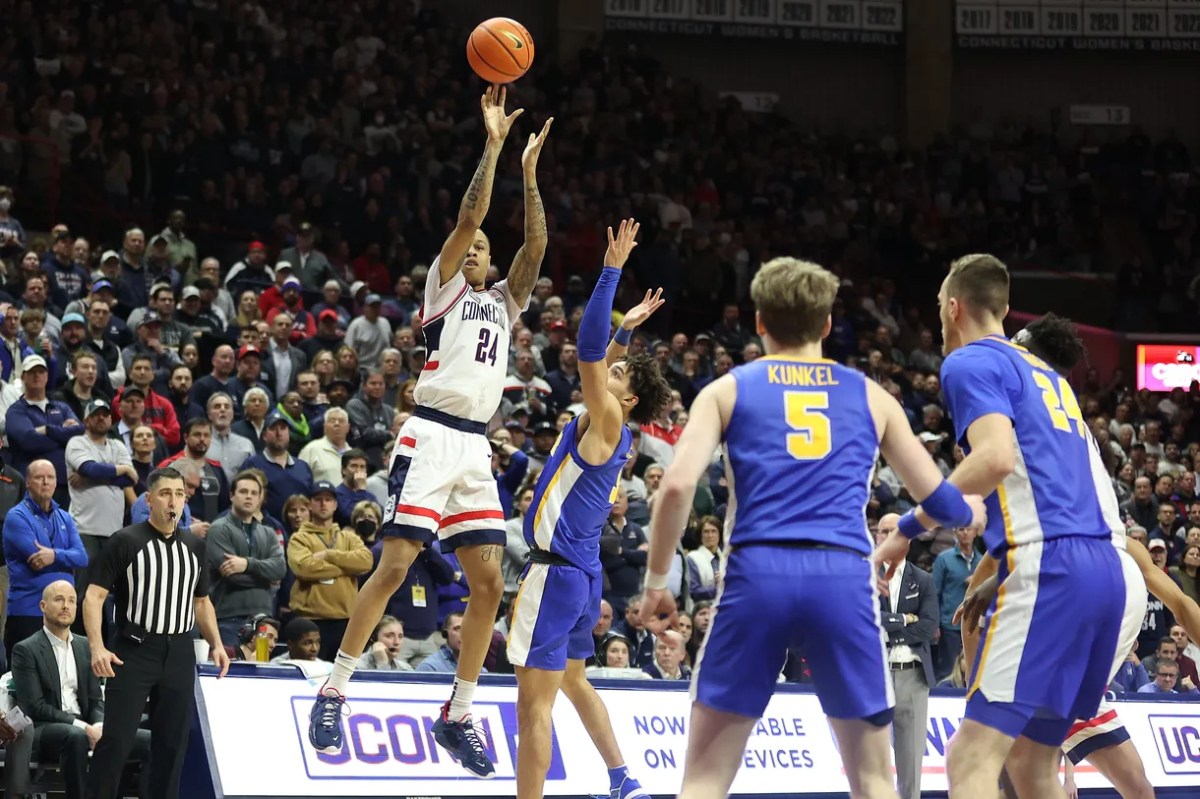
I wrote this article ranking the performance of the bench players on No. 21 UConn prior to the Marquette win last week, with an explanation of why I chose the grade. Now, I am publishing the article I wrote but did not publish last week assigning grades to the Huskies five main starters. I will provide updated grades/evaluations on the individual starters performance against Creighton shortly. This was a lot of work, but I enjoyed much of it. I look forward to seeing your feedback!
Jordan Hawkins: B+
Hawkins got a ton of press prior to the season for the improvement in his perimeter shooting and overall offensive game, and was named to the preseason All-Big East Second Team. It was evident that the sophomore would be UConn’s go-to scorer along with Sanogo if he played up to his potential. So far, Hawkins has mostly lived up to the hype offensively, and has been playing his best all-around basketball recently even if the team has been inconsistent overall. The season still has a long way to go, but Hawkins is making a case to be seen as one of the best shooters in UConn program history.
In 23 games (he missed three due to a concussion), Hawkins is averaging 16.4 points on 42.1% shooting overall and 40.1% on 3-pointers, while also making over 86% of his foul shots. These are all a huge leap from Hawkins freshman season, when the freshman showed a lot of potential but also delt with injury trouble and confidence issues and shot just 35.3% on 5.8 points per game.
Hawkins has been on fire in the last seven games, dating back to the loss to St. John’s on Jan. 15th. In that stretch , he has averaged 21.1 points and shot 50% on 88 attempts, while also draining 44.2% of 3-pointers and 92.5% of foul shots. Hawkins has had four 20-point games during this run, including 26 at DePaul in a win, and 31 in the heartbreaking loss to Seton Hall. For the season, Hawkins has scored 20 or more in nine games and in single digits just three times.
Hawkins has been a dangerous scorer all season, but he has flipped a switch in the last month. His movement without the ball, confidence and quick and fluid shooting form has allowed Hawkins to be lethal on 3-pointers coming off of screens. He has benefited greatly from UConn recently improving its screening on the perimeter, as it has given Hawkins open looks from beyond the arc. Earlier in the season and especially during the first month of conference play, Hawkins had struggled to get open looks at times because defenders were keying in on him and being as physical with Hawkins as possible without earning fouls. He also has shown the ability to go on individual runs and carry the Huskies for multiple minutes at a time and make clutch shots against tough opponents. Hawkins nearly led UConn back from a 15-point halftime deficit against Xavier, and his multiple treys early against Marquette gave the team momentum and put it in control for the remainder of the game.
As great as his 3-point shooting has been, what has especially impressed recently is Hawkins newfound focus on attacking the basket. Earlier in the season, he frequently focused on just shooting from deep and thus could disappear from games if defenders stuck on Hawkins . Since the beginning of January however, Hawkins has regularly used his athleticism and size to attack the basket for quality layup attempts, while also pulling up for quality midrange jumpers. Hawkins has recognized that the threat of his 3-point shot allows him to effectively fake out defenders and then drive for open looks, particularly in the paint. Hawkins has improved at finishing at the rim over the course of the season, and he is outstanding at forcing contact (including behind the 3-point line) to earn free throws, where he is money. Hawkins has made 55.6% of his shots inside the arc during this aforementioned hot streak.
Hawkins has also improved his offensive game as a sophomore in other areas. Hawkins is averaging 4 rebounds per game, double his average from last season, and has especially improved on the defensive boards. Hawkins has grabbed at least 5 rebounds seven times since the start of the New Year. He reacts quickly when in good position to grab rebounds, and his athleticism allows him to beat other guards to loose balls off the boards. While Hawkins ball handling still leaves a lot to be desired, he has improved his dribbling and passing this season and cut down on turnovers. Hawkins has committed more than three turnovers in a game just once. Meanwhile, Hawkins had dished out multiple assists in seven games.
On defense, I believe Hawkins has improved the most from one season to the next that I can remember by a UConn guard in recent program history. As a freshman, Hawkins lacked the strength to effectively guard bigger guards, and his footwork wasn’t efficient enough to stay in front of his man at times. This resulted in cheap fouls when Hawkins tried to force steals to make up for being beat off the dribble. While Hawkins upper-body strength will need to improve for him to be successful in the NBA, the strength training he did in the offseason has allowed Hawkins to better body up defenders. At the same time, he has improved his footwork and ability to force turnovers without fouling. Hawkins is averaging nearly one steal per game, and has earned multiple steals in six games. Hawkins size and agility has helped him develop the ability to block shots after not showing that skill as a freshman. He has blocked 15 shots and has four games with 2 blocks.
Hawkins can still continue to improve the remainder of the season in multiple areas. While it can be difficult for him to get quality perimeter shots in a game because of how much opponents focus on containing him, Hawkins needs to do a better job of being effective over 40 minutes. He has a tendency to explode on offense for a short amount of time and then disappear. Depending on when this occurs, Hawkins doing so can make it much more difficult for UConn to win, especially if his teammates are inconsistent. Hawkins can also fall into a tendency of focusing on taking 3-pointers at the expense of everything else, even if he is cold. Slowly but surely, Hawkins has developed more variety in his offensive game, but he can still run hot and cold like many shooters. I don’t know if Hawkins can do much to improve his ball-handling in season, but he still needs to strengthen his handle if he enters the NBA draft in the offseason. On defense, Hawkins can still be more disciplined and avoid either biting on fakes or reaching for the ball and picking up silly fouls that limit his playing time. Like seemingly all of the Husky guards, Hawkins sometimes fails to provide help defense or communicating on that end with teammates, allowing for easy drives to the basket for opponents.
As frustrating as this season has been for UConn as a whole, they have gotten nearly everything they could ask from Hawkins. He is developing into a great all-around player and not just a shooter, and has even displayed vocal leadership skills during games, a far cry from his lack of confidence as a freshman. Hawkins is one of the best players in the Big East, and has supplanted Sanogo as the Huskies best player. Hopefully, Hawkins will decide to return to Storrs for a junior season even if he has projected as a first-round pick. Either way, however he is capable of leading UConn on tournament runs and creating a memorable legacy.
Adama Sanogo: B+
Sanogo was selected as the preseason Player of the Year in the Big East and was also put on the Wooden Award watch list. While Sanogo’s season has probably not gone as smoothly as expected, he still has frequently been dominant offensively and a centerpiece for UConn alongside Jordan Hawkins.
Sanogo is averaging 17.2 points in 25 games, 2.4 more than last season. He has also been much more efficient offensively and is shooting more than 58% from the field, a significant improvement from last season. Sanogo has shown even better touch in the paint this year, while still bullying opposing bigs. Fans heard that Sanogo was working on his midrange and perimeter shooting during the offseason, and he has showed great form on 3-pointers while making over 39% on 33 attempts. Finally, Sanogo is shooting 75.9% on free throws, an excellent percentage for a big man. This efficiency has resulted in Sanogo having double-digit scoring performances in every game but two, eight 20-point games, and four double-doubles.
As great as Sanogo is offensively, he has been a black hole at times, especially during UConn’s January struggles. The offense has had a bad habit of feeding the ball to the junior at the expense of getting other players involved and creating good scoring opportunities for the entire lineup. Sanogo’s teammates have also failed to move without the ball towards Sanogo in these situations so that he has open passing lanes when guarded. At the same time, Sanogo has continued his habit of taking way too long to take shots in the paint, and not passing the ball out and repositioning when well-guarded. As a result, teams have easily been able to double-team Sanogo consistently and either force him into difficult shots or turnovers.
After UConn’s loss to Seton Hall, Hurley and the team made a few important adjustments offensively that has allowed Sanogo to still be effective, but within the normal flow of the offense. Hurley has positioned Sanogo at the top of the key and had him set screens for the guards regularly, allowing the Huskies and particularly Newton and Hawkins to get around defenders and attack the basket effectively. Instead of attempting all his shots in the paint or beyond the arc, Sanogo has attacked the basket from the top of the key a few times a game on layup attempts. Because of Sanogo’s strength and agility, this has been a very high-percentage play. Finally, Sanogo has finally started to pass the ball out of the paint more and shown better accuracy when doing so. He has averaged 2 assists over the last five games while committing just four turnovers. Sanogo’s growth as a player bodes well for the Huskies success during the remainder of the season.
While Sanogo’s scoring has continued to be elite, his rebounding and defense hasn’t lived up to the expectations he set last season. His rebounding has dropped from an average of 8.8 last season to 7.2, as have the percentage of both defensive and offensive rebounds he has grabbed. I would be very surprised if Sanogo reached last season’s mark of 10 games with double-digit rebounds unless UConn goes on a tournament run. Although part of Sanogo’s rebounding numbers going down is the result of having strong rebounding guards in Hawkins and Newton and the addition of Clinigan (even if they rarely play together) and Hurley having him defend on the perimeter, I believe that Sanogo has also demonstrated less effort on rebound opportunities and when boxing out. There could be a few reasons for this in theory, including Sanogo wanting to focus more on scoring or trying to avoid foul trouble, but it is disappointing to see Sanogo giving less effort on the boards at times. I hope that as UConn hits tournament play, Sanogo ramps up his effort on theboards andbecomes the elite rebounder he was last season.
Sanogo’s defense has also left something to be desired at times. With his strong footwork, Sanogo continues to be an effective one-on-one defender against most bigs. However, his help defense has been very inconsistent. Sanogo has been late on cutting off drives, and while he still does a solid job of altering shots he has ceased to be a shot-blocking threat. Sanogo has blocked just 16 shots this season and had multiple blocks in a game just three times, after averaging 1.9 per game last season. It is understandable that Sanogo wants to avoid defensive fouls considering how much responsibility he has on offense, and UConn’s system of having Sanogo consistently run high-hedge defense makes it difficult for him to get back and help teammates defend the paint. Still, Sanogo needs to stop getting caught watching the ball or half-heartedly blocking out defensively. UConn needs him to be a skilled two-way player to capture their remaining must-win games and tournament victories.
Tristen Newton: B
Newton’s season has been a bit of a roller coaster as well. The highly touted senior guard transfer had a tough time adjusting to UConn’s early on in nonconference play, but eventually appeared to be learning how to run its offense and be a complimentary scorer by the time of the Phil Knight Invitational. However, Newton’s scoring began to drop off a cliff at the end of the nonconference schedule, and through the first half of conference play in December until the middle of January. Newton wasn’t picking up the slack enough elsewhere on offense or defense to mitigate his disappearance, leading heavily to UConn’s struggles after starting 3-0 in the Big East. Since an ugly loss to St. John’s however, Newton has had a resurgence and flashed all the talent Huskies fans have heard about, and the team has subsequently fled off his versatility and energy. UConn needs a quality point guard, and Newton is finally filling the role.
Newton is averaging 10.5 points, 4.2 rebounds and 1.2 steals per game. He is averaging 4.4 assists, but has committed 2.3 turnovers per game. Newton ‘s shooting percentage inside the arc has dropped significantly due to his struggles, but he has continued to improve his 3-point shooting from last season and is now up to 34.9%. Newton continues to be money from the foul line, making 80.7 of hid free throws. He has scored in double figures 12 times and 20 or more points on four occasions. Newton earns a lot of his assists at his best, and has five games of at least six dimes. Finally, he has gotten to the 4-rebound mark 12 times. Newton has earned multiple steals in seven games.
Newton has been on a tear since the St. John’s loss on Jan. 18th. Since, he has averaged just under 15 points in six games, including 20-point performances at DePaul and against Xavier, while shooting 46.6% overall ,38.1% from deep and over 80% at the line on 38 attempts. Before this stretch, Newton had scored in double figures just twice in Big East play. He has done a little bit of everything else as well, averaging just over six assists and under five rebounds while grabbing two steals. Newton’s most impressive performance came in the signature win against Marquette, as he recorded 12 points and assists and grabbed 10 rebounds in 35 minutes. It was Newton’s second triple-double already this season, with Shabazz Napier being the only other Husky to accomplish this feat.
After an All-AAC Conference junior season at East Carolina in which he averaged roughly 17 points and 5 assists, expectations may have been too high for Newton. Yes, he was a versatile guard with size and strength and a nose for the basket, but the level of competition was a big step up for a player who is not a natural point guard, especially after the conference has had more depth than preseason reports indicated. It was always going to take him a while to create chemistry with players in regular season competition, and that only became harder when Andre Jackson returned to the starting lineup and the two had difficulty co-existing on the floor while Jackson tried to take on a point guard role that he unfortunately wasn’t well suited for.
After being generally effective on offense the first month-plus of the season and relying on his ability to get to the line to rack up points, Newton steadily faded to the background for a while. He stopped being aggressive offensively and rarely attacked the basket when the team desperately needed him to (From the first Xavier loss to the St. John’s game, Newton took jut 9 free throws and made 5). Newton looked reluctant to shoot a significant amount of the time, making difficult passes in the paint instead of attacking the basket for layup opportunities. Newton’s disengagement with the rest of the team offensively and relative defensive struggles was a direct reason why the Huskies became a one-trick pony on offense and suffered their 2-6 stretch in January.
Since that team, Newton has looked completely different. It appears that Dan Hurley talked to him and urged Newton to attack the basket more and initiate the offense quicker, and Newton embraced the challenge. He is now consistently driving the ball and playing more quickly, while also moving without the ball on the perimeter and getting better 3-point looks. Newton has also been highly effectively in the zone defenses UConn has employed and especially at pressuring ball handlers in the full court with his size and strength. He has consistently seemed to be having fun, and appears to be taking on a bigger leadership role during timeouts and other game situations. The UConn offense flows much better when Newton has the ball frequently, especially during significant moments. He is the lynchpin and floor general right now that UConn fans were looking for. A team needs a reliable point guard to have postseason success, and this version of Newton can finally bring it to the UConn program.
Andre Jackson: B-Jackson has been up-and-down as a player since the moment he arrived in Storrs, but his junior career has been a special case. When the junior is at the peak of his powers, he is extremely versatile, a team leader, and an absolute joy to watch. But when Jackson has played his worst, he has played out of control on both ends and been a black hole on offense, where his confidence has been shaken.
Jackson is averaging 5.8 points, 6.2 rebounds and 4.4 assists per game in 22 games, while shooting 36.4%. The point forward ‘s PPG and field goal averaging have gone down compared to his sophomore season, although Jackson’s assist-to-turnover ratio has improved significantly. He has four double-digit games for both points and rebounds, although he hasn’t scored in double digits in the new year. Jackson has dished out six or more assists in seven games, and come up with multiple steals in a significant number of games. Even if Johnson doesn’t score a lot of points in a game, at his best he’s a stat stuffer.
Jackson’s worst tendencies have slowly emerged however, with the New Year’s Eve loss at Xavier being the jumping off point for these struggles. In the 11 games since, Jackson has seen his scoring average and shooting percentage go slightly down. While he is averaging nearly the same assists, Jackson has Bommited multiple turnovers seven times. Even if Jackson’s raw stats have only gone down a little bit, he has made multiple mistakes on offense during crucial moments in each loss, while playing with a lack of intelligence on defense.
Jackson had had two distinct stages this season, with the last two wins against Georgetown and Marquette possibly signifying the start of a third stage. Starting with the Phil Knight Invitational Thanksgiving week until the end of December, Jackson contributed heavily on both ends and was the team’s sparkplug. The junior was doing a great job running the offense alongside Tristen Newton and finding scoring opportunities for teammates, while also grabbing offensive boards. Jackson was doing just enough to score via floaters, baskets at the rim and the occasional three, and with his teammates scoring so efficiently Jackson’s scoring wasn’t really needed. Most importantly, Jackson was playing exquisite defense, pressuring his man constantly and forcing turnovers and poor shots.
As the calendar flipped to the new year however, Jackson’s quality of play plummeted on both ends along with the team’s as a whole. He lost all confidence shooting the ball, and frequently had poor selection when doing so. Jackson frequently refused to attack the basket and occasionally turned the ball over when doing so. His floater (Jackson’s go-to-shot) deserted him, and he began to be bated into taking risky 3-pointers when defenders stay off of Jackson. This led to ugly shooting lines on threes like a 4-12 performance at Xavier and 0-3 marks against both Providence and the Musketeers. While Jackson continued to rebound well, he began to play out of control when running the offense and making risky passes that either led to turnovers or teammates not being in the right position to score.
What was more frustrating then Jackson’s struggles on offense was his disappearance on the defensive end. After living up to his accolades as a defender early Jackson declined heavily in the first half of the Big East schedule. Jackson become overaggressive on defense, committing silly fouls and having to be removed by Dan Hurley as a result, and repeatedly tried to block his man’s shots from behind instead of working harder to stay in front of players. Combine all of this with Jackson’s shaky help defense, and he was the player most responsible for the Huskies defensive decline when they lost six of eight games. Jackson’s defensive struggles carried over to the offensive end and caused the junior to become disengaged at times while not fulfilling his status as UConn’s leader.
After the Huskies second loss to Xavier and Jackson’s 2-point performance against DePaul, he and Hurley said that the coaches and Jackson were working to tighten up his defense and putting him in situations on offense where he could make plays more efficiently. In the wins since against Georgetown and Marquette, Jackson has demonstrated this hard work paid off. Jackson’s defense has continued to be aggressive while also more disciplined and focused. He held Hoyas star Primo Spears scoreless, and was et defending multiple Creighton players while helping to force poor shots and defenders. Jackson’s rebounding and passing was solid in multiple games, especially against Georgetown. Instead of taking jumpers and 3-pointers, Jackson focused on getting open for scoring opportunities around the basket on layups and putbacks and dunks, resulting in a combined 12 points on 5-12 shooting. It has been great to see Jackson not just more effective, but having a lot more fun on the court in these wins. When he is playing loose and with energy, all the other Huskies feed off of it.
The remaining regular season and tournament games will be huge for Andre Jackson’s legacy at UConn. Can he prove that he and the team have truly righted the ship? Can Jackson show improvement on offense while playing up to his potential in other phases of the game? And maybe most importantly, can Jackson truly be the leader of the next Huskies team that goes on a tournament run? Jackson is capable of answering all these questions with a triumphant yes. Now it’s just time for him to be a great player, and not just a great athlete.
Alex Karaban: B+
If Dan Hurley wanted to create a freshman big who is well-rounded offensively in a lab, he probably couldn’t do any better than Alex Karaban. The freshman power/small forward from Massachusetts’s has already demonstrated that he can score from nearly anywhere on the floor, particularly in the paint and behind the arc. When you combine that scoring ability with quality passing, solid rebounding and quickly-improving defense, and you have a Husky who is qualified to be the Big East Freshman of the Year.
Karaban, whom UConn has relied on heavily at forward with Samson Johnson out nearly the entire season, is averaging 9.8 PPG, 4.1 RPB, and 1.8 APG in 28.7 minutes. He is shooting 46.9% on field goals , 39.7% on 3-pointers and 82.1% at the free throw line. Karaban’s offensive metrics on KenPom and elsewhere are off the charts, especially for a freshman. He has scored in double figures 15 times, and has hit his season high of three 3-pointers in eight games, most recently in the last two wins. Karaban has scored in double figures five of the past eight games, with a high of 17 in the first matchup with Marquette. While Karaban doesn’t have any games with a huge amount of assists, he has dished out multiple ones in 12 games. Karaban was named the conference Freshman of the Week for the week of Jan. 29th after averaging 7.5 points, 4.5 assists and 4 rebounds, which was the fifth time this season he has received the honor.
Karaban ‘s best offensive skill right now is shooting 3-pointers. He is excellent at moving without the ball, has quality form and does not hesitate no matter the moment, has evidenced by his 3-pointer late at Georgetown that gave UConn a 63-61 lead it never relinquished. Karaban has already established a solid post game and can score effectively on both layups and post-ups. As Karaban works on getting stronger in the offseason, it could allow him to score more effectively in the post while also stretching defenders out beyond the 3-point line. In addition to scoring Karaban’s court awareness and basketball IQ has allowed him to be a quality screener in the pick-and-roll and an excellent passer, especially compared to the average freshman. Adama Sanogo and Donavon Clinigan have particularly benefited from Karaban’s passing skills.
On defense, Karaban has also consistently gotten better. While he needs to add a lot of upper-body strength and doesn’t have the athleticism a lot of the power forwards he’s facing in the Big East (a conference with excellent big men), Karaban has learned how to challenge shots and go after rebounds inside without fouling, and how he can position himself to challenge shots. Karaban’s recent improvement at avoiding foul trouble has allowed him to make a more consistent impact on offense, particularly from beyond the arc.
Alex Karaban quickly proved himself to be an indispensable player for the Huskies. Currently, I would argue he is their third-most reliable player beyond Jordan Hawkins and Sanogo. If Karaban is this developed as a freshman, I cannot imagine how good he will be as a junior or senior. Slowly but surely Karaban is building a legacy in Storrs, one that may lead to a tournament run in March.

 HUSKY NATION