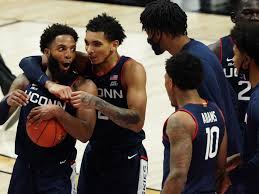
Thanking James Bouknight: A look back at one of the most impactful players in UConn history

James Bouknight’s UConn career got off to a rocky start. While the guard was a huge recruit for the program and Dan Hurley, he still was not ranked as high as his talent level (four stars and 53rd-ranked player in the class of 2019 according to MaxPreps) due to injury issues in high school. Bouknight then was suspended for the first three games of his freshman season due to alledgelly fleeing a car crash. These incidents and issues caused fans to have significant questions about Bouknight’s abilities and character. Personally, I was worried Bouknight would be another freshman with great athletic abilities who played very inconsistently, despite Hurley’s statements that he expected Bouknight to be good enough to only play two years in Storrs before being drafted by the NBA.

From the first moment he stepped on the court as a freshman, Bouknight showed he belonged. He scored a combined 40 points in his first three games at the Charleston Classic, including 19 against a strong Xavier squad, and also had 14 in a nonconference win against New Hampshire. As American Athletic Conference play went along, Bouknight really came into his own. He scored in double figures in 12 straight games starting on January 16th, and led the Huskies to a five-game winning streak to end the season. Bouknight was able to use his athleticism and speed to become an effective scorer, and became a more efficient shooter and rebounder and began to take over games the deeper he got into his freshman year. Signature performances for Bouknight came in big wins against Tulsa (22 points on 4-5 shooting from three), Cincinatti (23 points) and Houston (17 points and 7 rebounds). He ultimately averaged 13 points and 4.1 rebounds with an effective field goal percentage of 50.7%, and averaged 15.3 points in conference. Bouknight’s 109.5 offensive rating in conference play was 10th in the entire AAC.

After ending the 2020 regular season on such a high note, expectations were sky-high for Bouknight as a sophomore and he was preseason second-team All Big East. He immediately set about exceeeding them. Bouknight averaged over 23 points in the first five games, including scoring 40 against Creighton, while also rebounding well , creating quality scoring opportunities for teammates, and playing solid defense. He shot well and scored effortlessly both at the rim and on the perimeter.

Entering the first game against Marquette, Bouknight was one of the hottest players in the country and looked like he had the chance to be the best player in the Big East. This was why it was so heartbreaking to see him injure his elbow against the Golden Eagles and miss the next eight games, during which the team went 4-4. UConn’s offense was extremely inconsistent without Bouknight, and none of his teammates could create their own shot at anywhere near the same level. At the same time, it was also heartbreaking that Bouknight never played at the same level when he returned.

With Bouknight’s return on February 16th against Providence, the Huskies turned a corner and played much better through the remainder of the regular season and the conference tournament quarterfinal win against DePaul, going 6-1 during the stretch. The offense was much more efficient and played at a faster pace, and Bouknight’s presence and playmaking ability helped R.J. Cole become a much bigger offensive threat. While Bouknight was just as dangerous of an offensive player as ever and scored 20 or more points against Villanova, Marquette and Georgetown twice, his efficiency and stamina never returned to the same level it was at pre-injury. Bouknight was especially inconsistent from behind the arc and in handling the ball and struggled with turnovers. In addition, the cramping that forced him out of the quarterfinal win against DePaul foreshadowed the ugly ending to Bouknight’s career.

As great and important as Bouknight’s career at UConn was, his play in the team’s losses to Creighton and Maryland to end the season caused a small number of fans to cast Bouknight as not living up to his full potential and or not “tough enough”, which I feel is extremely false. Yes, his offensive stats in the losses (29 combined points on 10-30 shooting and seven turnovers) were not good enough for the Huskies to win, and Bouknight fell into a trap of playing “hero ball”in both games. Your best player has to show up in the most important games, and he didn’t rise to the occasion. However, Bouknight got very little help from his teammates, and it was hard for Bouknight to be effective when he was constantly double and triple-teamed by the Bluejays and Terrapins and the offense became bogged down. Combine these factors with the issues Bouknight had with stamina after returning and the after effects of the cramping against the Bluejays, and his struggles can largely be foregiven. UConn’s biggest weaknesses were exposed in the contests, and there was only so much Bouknight could do to try and get the team on track. From what I saw, his effort level was always impressive in tournament play. If anything, Bouknight was trying so hard that he did not play within himself against DePaul and Creighton.

For the season, Bouknight scored 18.7 points per game and averaged 5.7 rebounds and 1.1 steals while playing 15 of the Huskies 23 games. The sophomore averaged 20.7 points in conference play. Bouknight had an effective field goal % of 49.8% and a true shooting percentage of 54.6%, and was ninth in the conference in free throw percentage (8o.4%) and fifteenth in 2-point shooting percentage (54.9%). His body of work added up to a spot on the All- Big East first team. After Bouknight had such a great season despite a serious elbow injury, he should have been recognized as one of the best sophomores in recent UConn history. However, a surprising number of fans did not appreciate how important Bouknight’s season and career could be for the Husky program going forward.

UConn had other standout players in recent seasons before Bouknight’s arrival, with the most prominent examples being Jalen Adams, Daniel Hamilton and Christian Vital. However, Bouknight was the program’s best player since Shabazz Napier. He is a dynamic offensive player and a stronger all-around player than he is given credit for. Bouknight’s game could translate very well to the NBA, where he will be able to play in offenses that are much more wide open and not be forced to carry so much of his teams’ scoring load. At the same time, he will heavily benefit from being part of an organization’s strength and conditioning program, as Bouknight needs to improve in this area to reach his full potential. Bouknight certainly will need to improve in other areas as well, with his perimeter shooting, defense and ability to play for contact coming immediately to mind. But NBA coaches and general managers certaintly feel like he can quickly become an impact player, as mock drafts currently have him as a lottery pick or being drafted just outside the lottery. Bouknight would be the first lottery pick from UConn since Andre Drummond in 2012.

Bouknight left fans with so many memorable moments in less than two full years of play (his performances at the Charleston Classic and against Cincinatti, Tulsa and Houston as a freshman, his games against USC and Creighton early this past season, his first few games back from injury in February) and deserves to be appreciated more by UConn fans. No, he did not lead the Huskies to tournament success, and did not take on a clear leadership role as a sophomore. However, he helped the program get back on the right track and emerged as a star, something the program desperately needed. Having Bouknight drafted high and hopefully find success in the NBA will make it easier for UConn to attract talented recruits who want to not only match his accomplishments in Storrs, but exceed them. This, in turn would allow the Huskies to have more regular season and tournament success in the future. Bouknight represented the program well, and his full impact on it will not be known for a few more years. It was an honor to watch you, James.
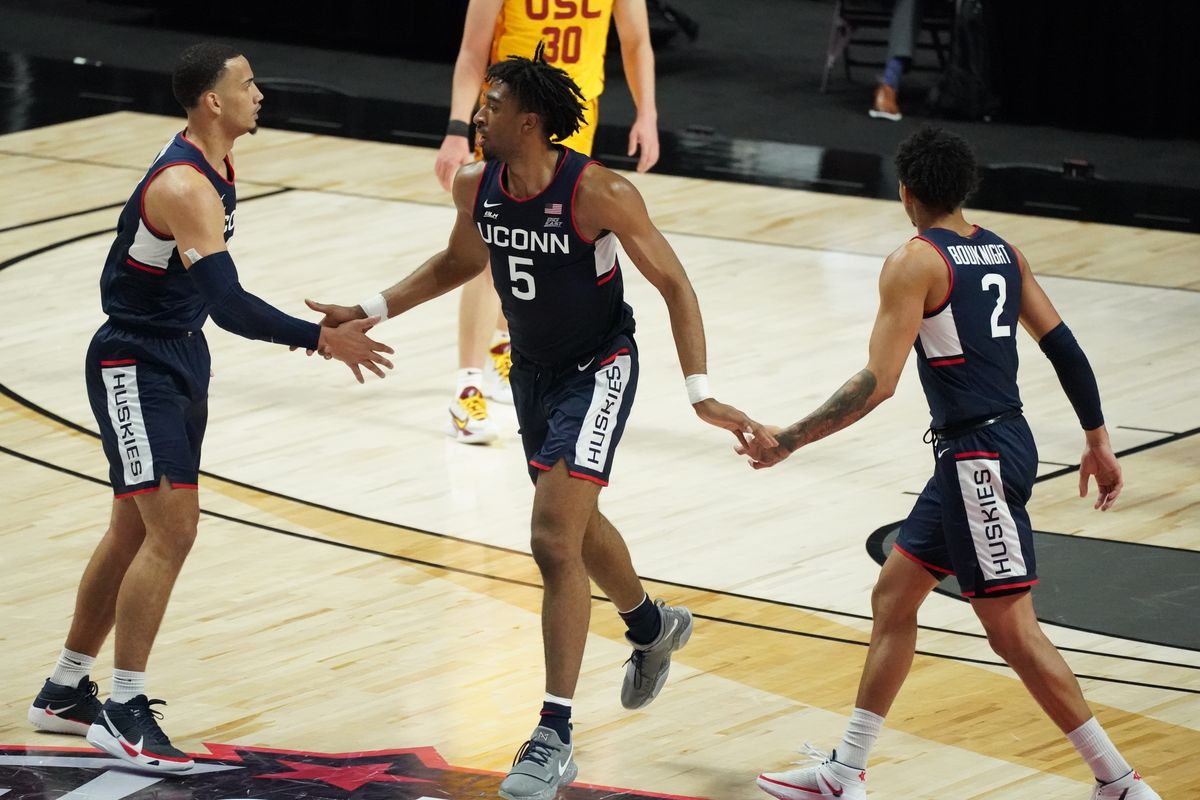
Observations on UConn’s loss to Creighton: James Bouknight and a strong defense unable to ensure a victory

I thought they had the win “in the bag”, so they say.

With just 21 seconds remaining in the second half , two free throws by Jalen Gaffney gave UConn a 66-62 Tead. All the Huskies needed to do was to make one more defensive stop and hit any free throw opportunities, and they could earn an upset win against the No. 9 Bluejays in the program’s first game back in the Big East. Instead, UConn had two poor defensive poessions, and junior point guard R.J. Cole missed two free throw attempts, allowing Creighton to send the game into overtime tied at 66. The Huskies offense continued to struggle mightily and the team ran out of gas at the end, ultimately falling 76-74.

For UConn (now 3-1), the loss was most defined by two things: James Bouknight’s unforgettable performance and poor offensive play by his teammate. As discussed more below, Bouknight was absolutely electric, scoring 40 points and shooting 13-24 from the field and 5-12 from the 3-point line , with 4 rebounds for good measure. The sophomore demonstrated the ability to score from anywhere on the floor and through defenders. He got barely any help, however. The other Huskies ultimately shot just over 25% (11-43), with Cole hitting the only other two 3-pointers. The other guards shot particularly poorly, and none of the big men were particularly effective on offense, partly due to foul trouble.

On one hand, it was an extremely frustrating loss. The Huskies blew the lead late in regulation, played poorly on offense as a team, and were consistently outrebounded by Creighton (6-2). Beating a top-10 team would have been a great welcome back to the Big East and a warning to UConn’s confrencemates that it should be freared, but the opportunity slipped away. However, Bouknight and the defense (particularly Cole’s)putting Marqueete on the ropes in the program’s first game in 17 days is commendable, and hopefully demonstrates that the Huskies can play with anyone. I think that if UConn can have a more consistent schedule, it can develop as a team and win similar games in January and February.

Below are six observations on the Huskies loss to Creighton.

James Bouknight demonstrates that he can be a superstar

All UConn fans know that Bouknight can be a great scorer and all-around offensive player at his best. The sophomore guard had excellent starts to his first three games, and rebounded the ball when in the wins. Overall, Bouknight was averaging 18.7 points and 6.3 rebounds. However, he also disappeared for stretches of each contest and had defensive lapses, causing Dan Hurley to repeatedly talk about the need for Bouknight to be better and more consistent for the Huskies to be successful.

Sunday was Bouknight’s chance to show he could put together a full 40-minute performance and propel the Huskies to a win against a top conference foe. Bouknight couldn’t succeed in the second task, but he showed on a national stage throughout the game that he can be one of the best scorers in the country.

Overall, Bouknight scored or assisted on 62.5 percent of UConn’s field goals. In the first half he got off to a quick start, and when the Huskies went on a cold streak and fell behind by 15, Bouknight took over and scored 10 points in the final five minutes the score 33-29 at the break. In the second half,he came out on fire and scored 13 points in just over five minutes, putting UConn up again. From there, Bouknight did struggle to score for much of the rest of the game, missing six of eight field goals and scoring just five points the remainder of the second half while being constantly double-teamed. However, Bouknight did continue to pass the ball well and set up plays for others as well as playing passable defense, and was the game’s best player for msot of its 45 minutes.

During his hot streaks, Bouknight’s ability to hit shots all over the floor and beat defenders was extremely impressive. From the outside, he was able to get good looks off screens and hit jumpers with defender’s hands in his faces, continuisly displaying a good stroke. Bouknight beet defenders off the dribble regularly and was able to score in traffic, earning multiple three-point plays. He looked quicker and stronger than almost any other player, including All-American candidate Mark Zegorowski.

Bouknight is not going to score 40 points every night, but if his teammates give him more help, he will finish with a high number of points per game and hopefully be a consistently efficient scorer. In addition, having more scoring threats can lesson the burden on Bouknight and allow him to contribute in a wider variety of areas. One thing is for sure: After four games, it is clear Bouknight should have received peseason first-team All Big honors aend not second team.

Right now, UConn has almost no reliable scoring threats

I’ve talked about the greatness of Bouknight and how he is capable of scoring in bunches. Through four games, there is not another player who looks capable of regularly scoring in double-digits. R.J. Cole had two great seasons at Howard before coming to UConn but had a terrible shooting day against Creighton, going 2-13 overall and 2-8 from three, finishing with 12 points. Most egregiously, Cole missed the two aforementioned free throws at the end of regulation that would have sealed a win, his first missed free throws of the season. Throughout the game, Cole appeared to be either rushing many of his shots or shooting them off balance. He looked very frustrated, especially after missing the free throws. So far this season, Cole is averaging 11.3 points and 3.3 assists, but shooting just 31.7% overall and 25% on 2-point attempts. Cole was seen as the most likely secondary scoring option heading into the season, but the game still looks to be too quick for him at times and it appears he is trying to do too much. I think Cole will improve a lot as the schedule becomes more consistent, but it could be a bumpy road at times, especially against the best Big East teams.

While Cole at least negated some of his offensive struggles by shutting down Marc Zegarowski, the other Huskies, particularly the guards, were unable to do the same. Tyrese Martin went 1-6 and finished with just 2 points, Jalen Gaffney shot 1-8 overall and 0-5 from three on his way to 4 points, and Brendan Adams scored just 2 points and shot 1-5. Gaffney missed four shots in overtime. Andre Jackson was scoreless in 5 minutes of play. The offensive performance of the UConn bigs was also hurt due partly to foul trouble. Josh Carlton picked up four fouls and took just 3 shots in 19 minutes of play and finished with 2 points, while Isiah Whaley was a perfect 3-3 and had 7 points but also played just 19 minutes. Whaley fouling out in the final minute of regulation was a game changer, as his absence helped Creighton to get to the rim easier on its final two possessions and ultimately tie the game at 66 off an out-of-bounds play. The absence of Tyler Polley, whom had to sit out due to not having cleared all COVID-19 protocols yet, also loomed large. If Polley had shot well from the perimeter, he could have opened up the offense and hopefully make it easier for players to get into the paint and find UConn’s bigs for scoring opportunities.

The Huskies guards did a poor job of moving the ball and getting teammates involved, and consistently took ill-advised shoots that were either well-guarded or rushed. The UConn backcourt failed to get their big men involved enough (in contrast to Creighton), in particular Carlton. If the team had gotten more scoring opportunities for the bigs, it may had opened up the floor a little and given Bouknight better looks at the basket late in the second half and overtime. Hopefully, the return of Akok Akok by late January will make the offemse more efficient everywhere.

The UConn defense was impressive against an excellent offensive team, particularly R.J. Cole

Creighton entered the matchup as one of the highest scoring teams in the country, averaging 82.3 points per game. The Bluejays have a deep lineup led by Zegarowski, one of the most talented players in the country who had scored 20 points in the previous game against St. John’s.

After getting off to a good start and taking a 29-17 lead with 4:41 remaining in the first half, Creighton was cold for most of the remainder of regulation. It eventually ended the day having shot just 41.5% overall and 7-27 from three. It committed 16 turnovers (UConn had 13) and allowed 9 steals. While Christian Bishop had an excellent day (19 points on 8-11 shooting, 5 rebounds, game-tying basket at end of regulation) and Mitch Ballock was good (13 on 4-7 shooting), most of the Bluejays struggled on offense, especially Zegarowski(11 points on 4-14 shooting, 1-8 from three, 5 turnovers)

UConn’s guards hounded Zegarowski and the other Creighton ballhandlers and regularly forced turnovers and loose balls. They were particularly adepth at jumping the passing lanes. R.J. Cole, who made improving his defense a priority in the last year, did an excellent job of forcing off-balance shots by Zegarowski and made it difficult for him to create plays and pass the ball. While UConn’s big men could have done a better job rebounding the ball (more on this below), Whaley and Carlton played solid defense and repeatedly interfering with shots when not sitting due to foul trouble. The duo combined for four blocks (3 by Carlton) and 3 steals when in.

Through 4 games, UConn has established itself as a very good defense. It is holding opponents to 66.5 points per game and forcing 12.8 turnovers a game, while recording 7 steals and 6 .3blocks, ranking sixth in the country. Opponents have shot just 40% overall and 28.2% from three. According to Ken Pomeroy’s advanced analytics, UConn’s adjusted defense totals rank 48th in the country. Most importantly, the Huskies have played their best defense against power conference foes.

R.J. Cole showed a lot of maturtity and guts after the loss.

Not a lot of college athletes would be willing to call themselves out and apologizing to fans for not making a play in a close loss, especially one who has only been with a program for four games. Cole is obviously unique though, and his willingness to apologize to fans directly over Twitter for missing the two free throws that could habe guranteed a win is brave and demonstrates the leadership skills Hurley and other team members have praised Cole for having. Cole has nothing to apologize for considering his defensive performance and the fact that other players didn’t execute as well. I believe he will become a better shooter and a key secondary scorer as he becomes accustomed to playing at this level. UConn is lucky to have a player with Cole’s talent and leadership ability.

UConn did not rebound at the level we are accustomed to seeing

Against USC, a big factor in UConn winning was its ability to control the boards even against the Trojans imposing front line. Against Creighton however, the Huskies allowed plenty of second-chance scoring opportunities and were regularly beaten out for key rebounds, grabbing just 63 percent of Creighton’s misses however. The Bluejays ultimately won the rebounding battle 48-41, grabbing 33 defensive rebounds. Denzel Mahoney led the way with 13 rebounds.

Tyrese Martin continued to show he’s an excellent rebounder, grabbing 4 offensive boards and 10 overall. Jalen Gaffney also had 7 rebounds. Whaley and especially Carlton were disappointing however, being frequently outhustled. Hurt by foul trouble, the pair combined for just eight boards, only two coming on offense. With UConn’s offensive struggles, it needs to consistently outrebound teams to give the offense momentum and second-chance opportunities, and take advantage when their opponents struggle at shooting the ball.

A reminder to fans: This was still an impressive effort and hopefully a stepping stone to bigger things.

If you looked at the online discourse about the loss to Creighton aftterwards, you could be forvgiven for thinking that the Huskies completely embarassed themselves in the final few minutes of the game. Yes, this loss was extremely frustrating, especially with the program’s recent history of blowing games late to power conference teams. In the end though, UConn, down two starters (Polley and Akok) still took a top-10 team to overtime after a 17-day layoff, a team that has one of the best offenses in the country. There are a lot of good teams that would be blown out in a similar situation. Even as the Huskies went stale on offense, they continued to play good D and never gave off. As the schedule hopefully becomes more normal, UConn will be winning these types of games in a few weeks.