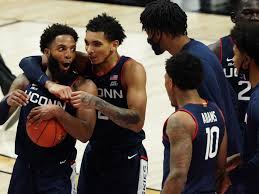
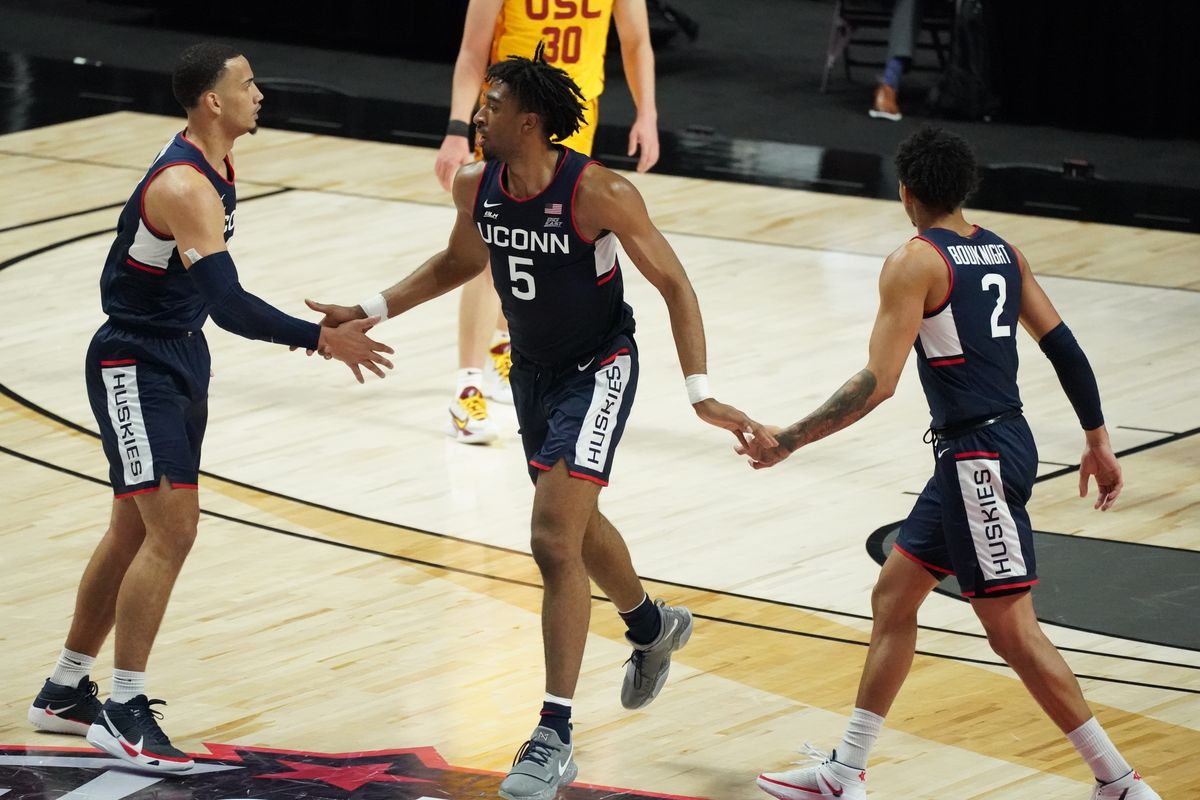
Examing Takeaways from the Battle 4 Atlantis Tournament

Hello all, and welcome to another year of UConn men’s basketball coverage here at Husky Nation! I have had some technical issues with the website recently that prevented me from publishing content, but these have been ironed out and I now should be bringing you regular coverage of this year’s Huskies squad.

It has certainly been an interesting start to the season. UConn started the season with four impressive wins, but all against extremely weak competition. It was presented with its first real tests at the Battle 4 Atlantis tournament in the Bahamas Thanksgiving week, and fans were treated to three exciting games. The Huskies won a 115-109 shootout against a ranked Auburn squad in double overtime last Wednesday. On Thanksgiving, it coughed up a late lead to Michigan State and fell 64-60 but recovered the next day to win a rock fight in overtime against VCU, 70-63. The two wins earned UConn a third-place finish in the tournament and moved their AP rating up to No. 17. The team moved to 7-1 on Wednesday despite a poor performance against Maryland-Eastern Shore.

I will publish an article after the Huskies game against Grambling on Saturday focusing on their performance without the injured Tyrese Martin, but I first wanted to focus on UConn’s performance in the Bahamas. The tournament showed the best and worst tendencies of UConn, as well as the mental fortitude this squad has. Below, I have a list of the most essential observations I saw during the tournament. I hope you enjoy!

UConn Showed It Won’t Be Out-Toughed

The Huskies were without Isiah Whaley against Michigan State and Martin had to deal with a wrist injury throughout the tournament. They started each game off slow and trailed at the half to both Michigan State and VCU. UConn was ineffective on offense for long stretches against MSU and VCU, two of the best defenses in the country who successfully made these games ugly. And of course, the Huskies had a ton of trouble holding the lead late and handling pressure defense against all three teams, costing them a win against MSU. And yet, it didn’t really matter in the end. UConn overcame fatigue and various weaknesses to play all out in each game. Their hustle and teamwork were outstanding, especially on the defensive end, and their ability to execute on both ends in the winning overtimes was very promising. Throughout Dan Hurley’s tenure, the program has had trouble winning close games and in overtime against high-quality teams. This tournament gave me the confidence that won’t be the case again.

The Senior Stars Showed They’re the Heart and Soul of This Team   

The trio of RJ Cole, Tyrese Martin and Isiah Whaley certainly have their weaknesses as individual players. But they are greater than the sum of their parts as a group, and the Huskies certainly would have lost to these tournament opponents if each senior hadn’t played their best individually and as a trio at the most important moments. Cole was UConn’s best offensive player in the tourney and was great against Auburn and VCU, scoring a combined 50 points in 88 minutes with eight assists and four steals. Cole shot 8-18 from three in the wins while going 16-18 from the line. Cole made clutch shots from both beyond the arc and at the rim, and these shots along with his free throws carried UConn to both wins. Cole also did a solid job of managing the offense and played good defense at times throughout the tournament.

If Cole was the team’s most indispensable offensive player, Whaley was their most indispensable defender. The big man was the one Husky who could consistently stop Auburn players at the rim, recording seven rebounds (three offensive) and five blocks in 43 minutes to go along with four assists. Whaley returned against VCU after being forced to miss the game against MCU doing to fainting at the end of the first game and was every bit of effective on defense while also coming up huge on offense. He had four rebounds and two assists and steals and scored 16 points while going 3-3 from behind the arc, including the trey that sent the game to overtime. Whaley’s energy and hustle was infectious for the while team. His ability to affect shots allowed UConn to shut down VCU at the end of regulation and in overtime. I have no doubt that the Huskies would have beaten MSU if Whaley was available.

And now, we come to Martin, the man who has been the team’s best two-way player throughout the season. Despite injuring his elbow against Auburn (a fracture that will now keep him out 2-4 weeks), Martin fought threw it to average 12 points and over nine rebounds in the tournament on 44% shooting. Martin recorded 13 points on 5-9 shooting and eight rebounds against Auburn and had eight rebounds against VCU, and was also outstanding against MSU, earning a double-double with 16 points and 12 rebounds. Martin was able to bang with all three teams and overpowered their offense at times and was the most visibly aggressive player on the court. The trio seemed to also be the leaders of the time during timeouts and huddles and helped to make sure younger teammates were composed. With Martin out for a few weeks, Cole and Whaley are going to have to improve their games and take on an even greater leadership role. It will be interesting to see if they are up to the challenge. Ultimately, I think UConn will only go as far as Cole, Whaley and Martin can take them.

An Inability to Handle the Press and Close Out Games Continues to Plague the Program     

If you asked dedicated fans coming into the season what they hoped to see from UConn, I’m sure a common hope would be that the Huskies would be more prepared when facing the press and finding ways to break it after this being a huge weakness in 2020-21. Similarly, fans would say that UConn needed to do a better job of adding on to leads late, instead of becoming flustered and making mistakes that put opponents in position to come all the way back. `In both areas, the fans, players and coaches did not get the results they were looking for.

First, UConn seemed lost how to handle the press against Auburn and VCU, which both rely on it heavily. It had difficulty passing over and inbounding against the press and not getting trapped, resulting in multiple costly turnovers, ballhandlers (particularly Cole), being trapped along baseline corners and it taking a long time to set up offensive possessions. It didn’t help teammates failed to move towards ballhandlers to help make it easier to pass and subsequently get down the court. The struggles against the press were key to helping Auburn and VCU force overtime. Hopefully, they were a wake up for UConn and the team will work hard in upcoming practices to refine their approach against the press and Hurley will help his players realize the best strategies towards handling it. Opponents who are capable of running the press effectively will certainly run it against the Huskies until they demonstrate facing it is not a weakness.

Meanwhile, UConn let Auburn come back to force overtime in the first game and MSU to win and had to make a last-second shot to even keep the game going against VCU. In the first two games UConn easily became flustered and showed poor communication and basketball IQ on offense, while doing a poor job of limiting penetration on defense. The Huskies seemed to be playing not to lose in the games and Hurley did not appear to be able to get the team refocused during timeouts. UConn was lucky to get on track in overtimes, but it might not be so lucky in similar games going forward. The team needs to work on end-of-game drills in practice to try and mimic these situations, and come together the next time they are in a game coming down to the wire.

Adama Sanogo is a Mixed Bag   

Sanogo was brilliant on offense throughout against Auburn and at times against Michigan State. At the same time, he generally played solid defense and did a strong job of defending the rim. At the same time, his extreme reluctance to pass the ball out slowed down the offense and caused turnover issues. Ultimately however, any college basketball fan watching the tournament unfamiliar with UConn would have immediately realized Sanogo is one of the best big men in the country.

Sanogo had the best game of his young career against Auburn and the best a Huskies big has had in a long time. The sophomore was unstoppable, scoring 30 points in 30 minutes on 12-25 shooting while going 6-7 from the line and recording six rebounds and two blocks. Sanogo showcased his soft touch and abilities to score over each shoulder and bully defenders down low. Sanogo was again strong on offense and especially defense against Michigan State, earning a double-double with 18 points and 10 rebounds and smacking six blocks. Sanogo was slowed down by foul trouble and an abdominal injury against VCU, but still recorded seven rebounds, three assists and two steals. Sanogo was frequently the best player in the tournament and showed he could take over the game at times against quality competition.

And now here comes the negatives. Sanogo almost never attempted to pass the ball back out after getting it in the paint, even if he was unable to get in a quality position. This led him to become a black hole on offense when he wasn’t making shots and allowed all three opponents to double and triple-team Sanogo at will, causing him to be susceptible to turnovers. Sanogo turned it over eight times against Auburn and had 13 overall in the tournament. I recognize Sanogo is still a raw player offensively who is likely uncomfortable passing the ball out, and it doesn’t help that his teammates don’t put themselves in better positions to receive passes. But if Sanogo doesn’t develop his passing game as well as his shooting range, defenses can form clear game plans to stop him and the team’s offense will stall out. I am confident Sanogo can become a more versatile offensive player over the next two months and ultimately the best big in the Big East.

Jordan Hawkins Showed He Can Be UConn’s Next Star on a Big Stage    

During the preseason, it was said that Hawkins would have the impact on freshman-year James Bouknight and soon became the next great Huskies guard. Hawkins has only shown flashes of that potential so far, but when he’s been at his best like he was against Auburn he’s thrilling to watch.

Hawkins demonstrated his ability to score from all over the floor against the Tigers, scoring 16 points in 16 minutes. He shot 5-7 overall, making all three treys he took, and went 3-4 from the line. Hawkins displayed a beautiful stroke and the ability to get open without the ball and beat defenders. His performance in the next two games was much more inconsistent. Hawkins scored just six points overall on 2-8 shooting in 28 minutes against Michigan State and VCU, missing good looks and seemingly ignored by teammates at times despite being open, possibly due to doubts they had in Hawkins ability to handle the ball cleanly. He still used his athleticism to make a big difference on defense against MSU however, earning three blocks and two steals. While Hawkins performance was mixed overall in the tournament and his ball handling left something to be desired, it was a net positive overall.

Hawkins will have to become a better ball handler and consistent defender to reach his potential as a freshman. He also needs to manage his emotions better and not constantly wear them on his sleeves (which he did after a costly turnover against Auburn and after being frustrated with not getting the ball more). From everything I’ve seen however, Hawkins should earn more minutes and maybe even a starting spot if he improves and UConn’s guard play remains inconsistent. With Martin out, it’s now Hawkins chance to seize the moment.

Where Are Thou, Akok Akok?       

Akok went scoreless in 33 tournament minutes, going 0-5. Akok had nine combined rebounds but just one block (against AU) after two games with three blocks to start off the season. Akok did not match up well with any of the teams, which had bigger and faster frontcourt players. In the limited minutes Akok played, he looked somewhat lost and hesitant on both ends, and rarely showed the speed and athleticism that can make him such an effective rebounder and shot blocker. Against tougher competition, it was clear that Akok is still not the same player he was before his ACL injury, even if he and Hurley claim Akok is fully healthy. Akok remained a non-entity against UMES, recording two points and rebounds in just four minutes. Fans probably need to temper their expectations for Akok, but as he gets back up to game speed, his skills in transition, 3-point shooting and defense in the paint should allow him to have a big impact against the right teams. While Martin is it, Akok will be challenged more and forced to take on a bigger role on both ends. With Akok, it’s all about the right matchups. It is on himself to improve.

UConn’s 3-point shooting is again all over the place

 Hurley and the Huskies desperately wanted to strengthen their 3-point shooting and become a more balanced offense this season. At Atlantis, UConn demonstrated how making threes can make its offense way more dynamic. The Huskies, who shot 36.4% over the three games, basically won the game from beyond the arc against Auburn, draining 15-26 treys. Tyler Polley, who I briefly discuss more below, made 6-9 threes. In contrast, they probably lost the game from the perimeter against MSU, going 2-16. The Huskies weren’t very good against VCU either, going 7-24, but Whaley stepped up with three treys, a welcome sight as Whaley is trying to develop his 3-point shooting. And of course, Cole was excellent from beyond the arc the entire tournament, going 10-20 and making clutch threes constantly. While UConn can be a much better team if it could be more efficient from beyond the arc against tough competition, it is nice to see how Cole, Martin and Gaffney have all improved significantly on their 3-point shooting this season.

I just want to speak about Polley for a moment. He arguably won the Auburn game for UConn with his 3-point shooting in overtime, but in the seven other games he has been terrible from three, shooting under 22%. On the year, Polley is shooting 31.7% from there, continuing his downward trend from last season. There is no way Polley can perform at that level and get regular minutes, even if he continues to be more aggressive in attacking the basket. Polley’s distinguishing role on this team is as a 3-point specialist, and despite his “6-9” frame he has never shown the rebounding or defensive skills he should be capable of. Polley will have every opportunity to earn more minutes with Martin out, but he must improve his shooting while also becoming a more complete player to keep them.

When Will UConn be Able to Get Off to Hot Starts?

It doesn’t matter the quality of the opponent or the layoff between games: UConn has not played well at the start of the game against all eight opponents. While the team has overcome this against low-major teams and Auburn, it took them until the second half to get the lead against MSU and they barely led in the VCU game until overtime. I am not sure what the Huskies can do to change their fortunes other than maybe beginning with a different starting lineup or playing more up-tempo to start things off. If UConn continues this habit against good teams however, it will lose a few games it shouldn’t.    

Grading Each UConn Player’s 2020-21 Season

This past UConn season was very satisfying, even in despite of the issues COVID-19 and injuries caused the program. The Huskies immediately returned to the Big East and established themselves as one of the conference’s preeminent programs. They earned multiple omemorable wins and were able to recapture the hearts and minds of fans whose interest in the program had wained, as well as new fans. While James Bouknight was a star, a number of players took steps forward and or emerged as fan favorites.

From my perspective, most of the UConn players had solid seasons and a number of Huskies were especially strong on the defensive end. While the squad was definitely flawed, their depth was one of UConn’s greatest strengths. I really enjoyed watching the unique contributions of each player and am excited to see the improvements they make to their games next season.

Below, I have provided grades for each player this season based on their performances as well as other factors such as health and consistency. I have given detailed justifications for each of the grades, which I am sure many fans would disagree with. As always, my opinion is right.

R.J. Cole: B

Coming from a low major program (Howard) where he was a huge star and off a redshirt year, it was hard going into the season how successful Cole could be at the Big East level. While he got off to a shaky start and was inconsistent all year, Cole improved tremendously the second half of the season and proved he can be a quality starting point guard for UConn.

Cole averaged 12.2 points, 4.3 assists and 1.2 steals while starting 21 games. In Big East play, he jumped up to 12.9 points per game while shooting 39% and averaged 4.4 assists. Cole developed into the team’s biggest 3-point threat, shooting 38.6% from deep on 4.3 attempts per game. Cole scored in double figures in 12 straight games starting with the win against DePaul on January 11th. After tough losses to Seton Hall and Providence the second week of January, Cole had a season-high 24 points and 7 assists and shot 5-7 from three in the huge win over Xaivier. For the remainder of the season, Cole averaged 12 points and 4.4 assists in nine games while improving his shooting. In addition to the Xavier win, Cole had standout games against Central (17 points, 7 assists and 4 steals), St. John’S (18 points on 4-7 shooting from three and 5 assists), Georgetown (17 points, 7 assists and 6 steals), Marquette (21 points on 9-14 shooting), and DePaul (14 points and 8 assists).

Cole’s most consistent strength was managing the offense. He is a strong ball handler and is able to consistently find teammates with quality passes. While his assist totals don’t stand out a huge amount, they could have been significantly hire if teammates didn’t struggle so much at finishing shots. Cole also does a very good job of avoiding turnovers. He committed just 1.7 per game and had a 2.52 assist-to-turnover ratio. His assist rate of 26.0 ranked seventh during Big East play. Cole was especially good at running an up-tempo offense.

Cole is a very streaky shooter, which is reflected in his season field goal percentage of .387. In the second half of the season, Cole changed his offensive approach to focus more on his midrange game and taking shots from behind the arc, which allowed him to avoid matching up against bigger defenders in the paint, where Cole significantly truggled to score. He became much more effective with this approach, especially from three, and his shooting numbers inproved across the board. Cole ended the season with effective field goal and true shooting percentages of 46.9% and 51.2%.

On defense, Cole is a mixed bag. He defends the passing lanes well and can force steals and poor passes (he had four or more steals in four games). Cole struggles to defend bigger guards in the paint due to his lack of size and speed. Ultimately, he finished the season with a defensive rating of 101.9, which is slightly below average.

By the end of the season, Cole had established himself as a quality guard despite his flaws. If he can take more effective shots next season and continue to improve on defense, he will likely be one of the best point guards in the Big East. The arrival of star recruit Jordan Hawkins will motivate Cole to improve.

Tyrese Martin: B

If I had done this article at midseason, I would have probably graded Martin slightly higher. However, his offensive contribution fell off significantly when Bouknight returned, although he continued to be a force on the boards. Still, Martin had a very impressive season for a player moving from a mid-major to a ower conference while dealing with the complications of COVID-19.

Martin averaged 10.3 points and 7.5 rebounds (3 offensive) while shooting .440. In conference play, he averaged 11.3 and 7.5 while shooting .474. Martin started every game but one. He had a very strong January, scoring in double-digits in every game but one while averaging 13 points and just under five rebounds. Martin ultimately had 13 double-digit scoring games and had 10 or more rebounds in six games. Standout games for Martin included 11 points and 7 rebounds against USC, 14 points, 6 rebounds and 6 steals against St. John’s, 15 and 9 against Xavier, and 9 and 11 against Villanova. Martin owned the trilogy of DePaul, Butler and Providence. He averaged 18 points and 8 rebounds against the Blue Deamons in three games, 17.5 and 6.5 against the Bulldogs, and 15.5 and 8 against the Friards, helping UConn go 6-1 in these games.

Martin’s biggest consistent strength was his rebounding. He had five or more rebounds in every game but one, and was especially strong on the offensive boards, grabbing four or more in eight games. Martin’s offensive rebounding percentage of 10.3% ranked fourth in the Big East, and his defensive rebounding percentage of 16.2% was 17th. Martin was especially skilled at beating players to loose rebounds and jumping over defenders to snag boards.

Martin had a solid season offensively. He was able to score from anywhere on the floor and especially inside and frequently scored points in bunches. Martin is also a solid ball handler and passer. His effective field goal and true shooting percentages were .482 and .51.1, and Martin ranked 14th and 18th in Big East play in these categories. He was 15th offensive rating at 110.7. However, Martin was the biggest offender on the team in missing quality scoring opportunities at the rim. He consistently left layups short or banked them too hard off the backboard, and had similar issues on putback attempts. He will have to work on his shooting technique in the offseason to get these percentages up to an acceptable level. Following Bouknight’s return, he regularly got lost on offense and struggled shooting, scoring in double figures just twice in the last eight games. This culminated with him going 1-10 and scoring just 2 points against Maryland in the season-ending loss.

Martin was also solid on defense throughout the season. While he had some difficulty with hedging and could occaisonally lose players, he was ultimately a strong one-one one defender and a threat to steal the ball (he had five games with multiple steals). Martin finished with a defensive rating of 97.2.

I immediately fell in love with Martin and his high-energy, hard-nosed style of play. He is a joy to watch on the boards, and I believe he could be even better there next year. Although Maritn may not have as many scoring opportunities as a senior with the arrival of a talented group of freshman, I am confident he will work this offseason to become a more efficient offensive player. There is a good chance that Martin can be the Huskies best all-around player next season.

Isiah Whaley: B

After his emergence in the second half of the 2019-20 season, Whaley continued to be a force for the Huskies, especially on the defensive end. He was recognized for his performance by being named the Big East Defensive Player of the Year.

Whaley averaged eight points and 6.2 rebounds per game (2.5 offensive), adding 2.6 blocks for good measure. Whaley was 20th in the country in block percentage (10.5) and second in the conference at 10.6. He started all 23 games. Whaley scored in double-dights nine times and reached double-dights in rebounds four times, earning four double-doubles. He had multiple blocks in 15 games and blocked five or more shots four times. Standout performances for Whaley included 10 points and rebounds, four assists and five blocks against Hartford, 15 points and 13 rebounds against Marqueete, 12 pwoints, 10 rebounds, four assists and five blocks against Xavier, and a season-high 17 points and 10 rebounds against Seton Hall. In the three games against Creighton, Whaley averaged 10 points and 6.3 rebounds.

UConn should be very happy that Whaley is returning, as he can continue to be the anchor of their defense. He was elite on that end this past season. Whaley can shot down bigs inside by altering and blocking shots and forcing poor passes and steals, while also effectively guarding players out on the peremiter. While I have pretty mixed feelings about the defense’s heavily reliance on hedging, there’s no doubt that Whaley is the key when it does work. In addition to the aforementioned blocking statistics, he also stole the ball on 2.2% of possesions, ranking 19th in the Big East in this category according to KenPom. On the boards, Whaley grabbed 8.5% of offensive rebounding opportunities and 16% of defensive rebounding opportunities in conference play, ranking 10th and 18th. He is very skilled at blocking out defenders and getting to the team’s missed shots on rebound opportunities.

Whaley’s offensive performance was more mixed. At his best, Whaley can overpower defenders inside and get a ton of putbacks. He also showed a promising ability to hit midrange jumpers and threes this year, even making treys at a .348 click in 23 attempts. However, there’s no excuse for Whaley’s inconsistency with making shots at the rim. Like many of his teammates, He consistently missed easy scoring opportunities and putbacks, dragging down his offensive numbers. Whaley made only shot .479, nearly down .06 from his junior season, and his true shooting and effective field goal percentages dropped at similar rates. Whaley also struggled heavily at the free throw line, shooting just .479. Whaley’s numbers were also hurt regularly by foul trouble, as he averaged 2.9 fouls per game and fouled out of five games.

Having Whaley back for a fifth year will be huge for the Huskies. He will provide leadership, excellent defense and rebounding, and another offensive threat in the post alongside Sanogo. If Whaley can be more consistent on offense next year and continue to make more shots on the peremiter, along with doing a better job of avoiding foul trouble, he could see his numbers increase significantly and put himself in position for a pro career.

Adama Sanogo-B+

Sanogo would be my pick for the best UConn freshman big man since Andre Drummond. His stats s do not illustrate how impactful he was for the Huskies, particularly on the offensive end. Sanogo quickly developed on offense, and as he got more playing time he displayed a variety of movesand the ability to bully defenders. At the same time, he also demonstrated he can be a vert effectuve defender and shot blocker.

Sanogo averaged 7.3 points, 4.8 rebounds and 0.9 blocks in just 17 minutes of play. The center shot 55.4% from the field. In conference play, he grabed 5.2 rebounds and recorded 1.1 blocks per game. Sanogo began to emerge as a force starting with the loss to St. John’s on January 18th, when he scored in double figures for the first time with 12 points and recorded four rebounds and two assists in just 17 minutes of play. Over the remainder of the regular season, Sanogo averaged 9.1 points, 5.6 rebounds and more than a block per game in 15 contests. They scored in double-digits in seven games.

Besides the game against St. John’s, other standout efforts for Sanogo included 13 points and 5 rebounds in the second loss to Creighton, 12 in the first loss to Seton Hall, nine points, eight rebounds and five blocksin thewas first loss against Providence, 16 points, nine rebounds and two blocks in the win against Seton Hall, 14 points against DePaul, and 13 blocks and five rebounds in the Big East tourney game against Creighton. In the two wins against Georgetown, Sanogo averaged nine points,eight rebounds and 1.5 blocks. In the second win, he had his only double-double of the season.

While Sanogo’s range may have been limited, he became highly efficient as a shooter as the season progressed. He made a majority of shots in nearly every Big East game, and had effective field goal and true shooting percentages of 55.4 and 56.8 for the season. Sanogo’s field 55% field goal percentage ranked 14th in Big East play according to KenPom. Sanogo became adapt at backing down defenders and shooting over them, and also developed an excellent drop step move. While he rarely showed it, Sanogo was also able to step out and make short jumpers by the end of the season. He was probably the best finisher on the Huskies.

Sanogo is also an adept rebounder and his rate rebounding rates were outstanding. His defensive rebounding percentage of 25.5% ranked first in the Big East according to KenPom, and his offensive rebounding rate of 8.9% was seventh. Sanogo grabbed 1.4 offensive boards per game on the season. He did an excellent job of reading rebounds off the rim and outmusclingplayers to the ball as well as finishing off rebounds. Per 40 minutes of play, he grabbed 11.2 rebounds. Samogo is already a skilled shot blocker and his block percentage of 6.8 was third in the conference. He had multiple blocks in five contests.

In addition to his shot blocking, Sanogo developed into a solid overall defender over the course of the season, and finished with a defensive rating of 93.9. However, his biggest flaw as a player was his struggles with foul trouble. Sanogo averaged 2.8 fouls per game in less than 20 minutes, and finished with at least four fouls in seven games. These struggles consistently forced him to the bench during key minutes and was a huge factor in a couple of losses. Sanogo had a tendency to get called for touch fouls and be overly physical when unnecessary, leading to fouls. He will need to learn to be a more disciplined defender to step forward next season. Sanogo will also need to expand his shooting range to take a step forward on offense.

Sanogo is very exciting to watch. He is an extremely skilled offensive player and a huge force on defense. UConn reached its full potential as a team when it began to use Sanogo more, and he was hugely responsible for the team’s run at the end of the regular season. If he can work this offseason to evolve on both sides of the ball, Sanogo can be one of the elite big men in the Big East next season.

Tyler Polley: B-

This rating may seem too low for the now fifth-year senior, who was named the Big East Sixth Player of the Year. However, it is a reflection of Polley’s limitations as a player and his inconsistency from behind the arc. Polley averaged 7.5 points per game and shot 35.2% from behind the arc. In conference play, he shot 36.9% from three. None of Polley’s other stats stood out, and he grabbed just two rebound per game despite his” 6-9″ frame. He averaged two fewer points than in his injury-shortened junior season, when he shot just over 40% from behind the arc. Thanks to his 3-point shooting, Polley’s offensive rating in conference play was 118.5, sixth in the Big East according to KenPom.

Polley’s signature moment of the season was his three-game stretch from January 5th-11th following the injury of Bouknight. Against Marquette, Butler and DePaul, Polley averaged 18 points and shot 13-24 from three, with a high of 23 points against Marqueete on 5-8 shooting from behind the arc. That week’s performance earned Polley the Big East Player of the Week award. Besides these three games, Polley had double-digit scoring games against Xavier and Georgetown (10 and 11 points) as well as in the season opener against Central, where he scored 14. Polley also had strong games against Marquette, Providence and DePaul, scoring nine points in each.

Polley was extremely important for UConn during the season as their biggest 3-point threat. He provided reliable 3-point shooting to a team that was starved for it, and his ability to stretch the floor attracted attention and made it easier for teammates to score in the midrange and especially inside. And Polley’s great stretch of games right after Bouknight’sinjury helped keep the Huskies on track and confident. Despite this, I think Polley’s in consistency from three hindered the team at times. He had a tendency to go cold for long stretches, making things much more difficult on the offense. After the aforementioned stretch of games, Polley did not hit more that three tries in a game the remainder of the season, and only reached this mark twice. He fell into a habit of taking a lot of off-balance threes instead of pump-faking or passing the ball, and his teammates did a poor job at times of getting him opportunities off the catch. Ultimately, Polley’s 3-point shooting percntage dropped nearly five points from his junior year mark. Polley rarely attempted shots inside the arc and either did not make or attempt a 2-pointer in 10 games. Polley was the best free throw shooter on the team at 90.5% but rately put himself in position to get to the line, earning less than two opportunities per game.

While you can find faults in Polley’s offense, the big issue I have with him is his lack of versatility. I don’t expect Polley to do a huge amount of rebounding considering he is almost always playing on the peremiter, but there is still no excuse for a “6-9” guy to only be grabbing two rebounds per game. The coaches need to work with Polley in the offseason to improve his ability to read rebounding opportunities. Polley rarely attemps to create scorig opportunities for teammates. He is also going to have to work hard to improve on defense and in guarding the peremiter in the offseason, as he had the worst defensive rating of any player in the regular rotation (105.1). Polley is always going to get significant minutes next year because of his prowess from the peremiter, but he has to find a way to contribute when his shots aren’t falling.

Polley’s struggles last year needs to be viewed in context, as he missed a large portion of his junior season to an Achilles injury and then could not follow a normal recovery schedule due to COVID-19. Polley frequently appeared less mobile last season than he was before the injury, and this would have limited his ability to get open and play defense. If he is at full strength next year, I expect his statistics to be at or surpas what they were in the past, especially from three.

Polley’s decision to come back for a fifth year at UConn was a pleasant surprise. I am glad he will get a full season to show what he can do when healthy. If he can work to make his game more well-rounded this offseason, he can have a great final year at Storrs and put himself in position to have good opportunities to play professionally. Along with Whaley, he will be able to be a great leader for the freshman and other underclassmen to follow.

Jalen Gaffney B-

If I were doing this grades at midseason, Gaffney’s would definitely be lower. All credit to the sophomore guard, however. Gaffney took a step forward in February and January to become a more efficient offensive player and shooter, particularly from the peremiter. In a disappointing NCAA tournament loss, Gaffney was arguably UConn’s best player.

Gaffney finished the season averaging 6.1 points per game on 41% shooting and 36.2% from three, and 1.5 assists. In the final 12 games of the season, Gaffney scored 6.6 points per game on 44.8% shooting, and had three of his four double-digit scoring games. Gaffney’s best performances came against Hartford (15 points, two steals and two blocks), the first game against Seton Hall (a season-high 2o points on 5-11 shooting and two steals), the second game against Georgetown (15 points on 6-6 shooting) and the season-ending loss to Maryland (12 points on 4-6 shooting and three steals).

Gaffney definitely looked like a different player at times towards the end of the season. While he did not attack the basket as much as he should have, he showed the ability to consistently score inside when he did. With his size and athleticism, Gaffney is more effective at attacking the basket than Cole. Gaffney also improved his midrange shooting over the course of the season, and emerged as the third best 3-point shooter on the term behind Cole and Polley (he actually shot at a slightly higher percentage than Polley). Ultimately, Gaffney significantly improved his effective field goal and true shooting percentages from freshman year to 55.4% and 49%, respectively. Gaffney also improved his ball-handling and lowered his turnover percentage on possessions to 17.6%. His free throw percentage of 82.2% was the best on the term among players with more than 40 attempts.

While Gaffney made significant strides on the offensive end, his defense still leaves a lot to be desired. While he can rack up steals, Gaffney can struggle with staying in front of his man and playing help defense, and is pretty susceptible to reach-in fouls and foul trouble. Gaffney’s defensive rating was below average at 101.2, which was actually slightly lower than his freshman year rating. If he wants to establish himself as a starter next year, Gaffney will need to significantly improve on the defensive end. On offense, he needs to become a more consistent shooter. More than anything else, however, Gaffney will need to play more aggressively on offense next season and attack the basket more frequently, as well as improve at creating scoring opportunities for teammates. Too much of the time, Gaffney just gives the ball up to a teammate immediately and shys away from making something happen. He needs to realize that his offensive strengths are different from Cole’s and that the two will be a much more effective duo when Gaffney upps his aggresiveness.

I am probably looking forward to watching Gaffney next season more than any other play. I am eager to see what improvements he made during the offseason, and if a lightbulb as gone off and he plays with a more aggressive mentality. I think Gaffney has more too lose next season than anyone. If his defense has improved and he is scoring more and more effectively, than he can be a huge part of the Huskies success. If Gaffney continues to play hesitant and his defense is shaky, however, than he will likely not start and UConn will proably struggle.

Aandre Jackson: B

I struggled with the decision to give Jackson a grade due to missing seven games to injury and playing five minutes or less in three of his first four career games, but I ultimately decided that Jackson played enough games (16 with an average of 16.1 minutes) to qualify. The freshman shooting guard rebounded from breaking a bone in his left wrist in practice following the Creighton game on December 20th and missing seven games to became a central member of the UConn rotation. Jackson averaged 2.7 points, 2.9 rebounds and 1.6 assists, and had a steal in seven games, and played very strong defense at times.

While Jackson never scored in double digits, he had five games of five points or more, and had multiple assists in eight games. Standout performances for Jackson included his return in the first game against Seton Hall (seven points and four rebounds), the second win against Marquette (eight points,eight rebounds and two assists) and the Big East Tourney win against DePaul (6, three rebounds and three assists in 15 minutes).

While Jackson’s total resume for the season may be less than the sum of its parts, those parts were very impressive at times. In particular, Jackson’s passing and defense stood out in many games. He consistently showed great court vision when finding open teammates and unselfishness when handling the ball and regularly made spectacular passes in the backcourt. Jackson’s assist numbers would have been significantly higher if his teammates had done a better job finishing at the rim. On defense, Jackson used his “6-9” wingspan to pressure opposing guards and make it difficult for them to get the ball to teammates on the perimeter and in the paint, and was able to force turnovers. He has the potential to be UConn’s best backcourt defender next year if he can become more disciplined. While Jackson is highly limited on offense (see more below), he can score effectively at the rim and is a great dunker.

Like almost all freshman to some extent, Jackson is still a pretty flawed player despite his tremendous athleticism, especially on offense. Jackson rarely showed the ability to hit a shot outside of 10 feet and was horrendous from three, going 2-17 and failing to hit one in the last nine games. While the freshman may have shot over 63% inside the arc, most of the 2-pointers he made were right at the rim. Both Jackson’s shot selection and mechanics were poor. As great of a passer Jackson could be, he was not a disciplined ball handler and had multiple turnovers in five games. On defense, he struggled heavily with foul trouble and was especially susceptible to silly touch and reach-in fouls that kept him off the court at crucual times. Jackson committed three or more fouls in 10 games.

With his passing, defense and memorable dunks, Jackson is already one of the most enjoyable players to watch on the Huskies. He showed so much potential as a freshman, and I give him a lot of credit for overcoming the difficulties of COVID-19 and injuries to become a valuable member of the backcourt. Jackson definitely has a long way to go to becoming a servicible offensive player, but I am confident he will be able to tighten up his jumpshot this offseason so that he can become an effective shooter next year. If Jackson does that and can be a more disciplined defender as a sophomore, he can join Cole as a lead guard for the Huskies.

With the emergence of Adama Sanogo, Carlton settled into a firm backup role in his final season at UConn. Cartlon started just one game and averaged only 11.3 minutes per game a year after starting every game and averaging over 20 minutes per game. Carlton largely responded well to his new role, averaging 3.5 points and 3.7 rebounds per game and providing valuable veteran leadership. The senior center scored five points or more five times and had six games with five rebounds or more, including two in double-digits. Signature games for Carlton included the Huskies huge win against USC (nine points and 11 rebounds), his lone double-double against DePaul (11 points and 10 rebounds), the win over Providence (seven points, seven rebounds and two blocks), and in the regular season finale against Georgetown (seven points and rebounds).

Carlton was most valuable to UConn as a rebounder and defender. He was consistently strong on the boards and especially as an offensive rebounder, averaging 1.6 per game. Carlton, who is excellent at boxing out, grabbed at least one rebound in every game that he played more than three minutes except for one. He grabbed rebounds on 18.4% of the possessions he played, a career high. On defense, Carlton overcome occasional foul trouble to regularly provide rim protection and shot blocking. He earned blocks on 4.2% of the possessions he played.

On offense, Carlton was inconsistent but largely more effective than as a junior despite his limited opportunities. He underperformed at scoring around the rim and finishing shots and shot only 48.2%. However, Carlton improved his assist rate and ball handling, and went scoreless in just four games. His offensive rating on KenPom went up seven points from his junior year to 99.6.

Carlton definitely ended his four years at UConn on a high note. After a disappointing junior year, he bounced back on both ends and provided a steady presence as a backup. Carlton came up big in the most important games, particularly against USC and at Providence, but he made a big impact whenever he played significant minutes. He also did a great job mentoring Sanogo. In the bigger picture, Carlton had an impressive career at UConn. Along with Whaley and Polley, he was a key figure in the program’s turnaround during Hurley’s tenure, and always represented the program well. I am sure Carlton will continue to play well as a fifth-year senior at Houston, and I wish him the best of luck.

Brendan Adams :C+

It was up-and down season for the junior guard in his final year at UConn. On one hand, Adams stepped in to provide much-needed experience and stability on offense as a starter when Bouknight was injured, and had a few strong games. On the other hand, Adams struggled heavily on offense at times against the tougher competition the Big East offered. It was not surprising that he decided to move on to George Washington as a grad transfer, as it was basically guranteed he would lose minutes next season.

Adams played 16 games, starting 6, and averaged just over 20 minutes. He scored 4.5 points per game, nearly three points lower than the previous season, and 1.5 assists. He had strong games against Central Connecticut in the season opener (15 points, his only double-digit scoring game of the season, and three assists), the first wins against DePaul (eight points( and Butler (nine points, three assists and two steals), St. John’s (seven points, three rebounds, and three assists)) and the second game against Creighton (six points and season-high nine rebounds). Adams had eight games with multiple assists while committing multiple turnovers in just five contests. He had assists on 12.7% of the possessions he played, a career high.

Adams was thrust into a big role when Bouknight went down with his injury against Marqueete on January 5th. Over the next three weeks, Adams played over 25 minutes in the next five games, starting all of them While he struggled heavily with shooting the ball over this stretch, Adams was a reliable third ball handler alongside Cole and Gaffney and was strong in the role. He had 12 assists to just six turnovers during these games, and added six steals. Adams also provided solid defense at times. Even after his role diminished greatly with the return of Bouknight, Adams continued to handle the ball well.

The biggest knock against Adams throughout the season was his shooting. While Adams was never a particularly good shooter in his first two seasons, his numbers plummeted as a junior. Adams shot just under 30% from the field and 31% inside the arc. In coference play, he shot 26.7%. Adams clearly struggled to make shots against the stronger and quicker guards in conference, and his shot selection wasn’t great. In addition, his defense continued to be inconsistent and he finished with a defensive rating of 102.1.

Adams had a mediocre season, but he was still huge for the Huskies as a role player and stepped up in a big way when he was asked to play more. In addition, he continued to be an important team leader, especially for the less experienced guards. As the first player to commit to Hurley when he came to UConn, Adams helped attract others to Storrs, and it was clear how much Hurley appreciated him as a player and person. I’m also really impressed that he managed to get his degree in three years. I am sure he can thrive in a bigger role and at a lower level at GW. Thanks for everything you did for UConn, Brendan.

Akok Akok: Incomplete

In the end, it seems like our expectations for Akok coming into the season were too high. He did not return until January 9th from his Achilles injury, and only played seven games before being shut down after the Marquette win on February 27th. Akok played just 29 minutes and had only nine points and three rebounds, with seven of the points coming against Xavier. He injured his shin soon after coming back, and Akok did not show the same athleticism, mobility and energy he played with last year. The sophomore was especially limited on defense and the boards, as he blocked just one shot. Hurley was pretty upfront about Akok not being able to contribute consistently due to these factors and Covid-19 interfering with his recovery schedule.

After a lost season, I am really curious to see how effective Akok can be next season. If he is fully recovered, Akok should provide UConn more quality defense in the paint and a second shot blocker to go with Whaley. On offense, Akok could help the Huskies stretch the floor with his shooting, while still scoring realibiliy inside. Akok will definitely be UConn’s biggest “addition” for next season.

Richie Springs: Incomplete

The redshirt freshman barely got on the floor this season, appearing in just five games and for a total of 13 minutes. Springs scored three points against DePaul in two games and against Georgetown. The coverage of Springs in the preseason most significantly focused upon his reebounding ability and that was apparent, as he grabbed five rebounds.

I hoped that Spring would get an opportunity to play a handful of minutes here and there with bigs either injured or in foul trouble, but it is clear that Dan Hurley did not think Springs was ready to play meaningful minutes. It was also hard to get him in games when the Huskies were rarely involved in any blowouts. I just hope that Springs works hard this offseason to improve his defense and shooting so that he will be in position to play next season.

Thanking James Bouknight: A look back at one of the most impactful players in UConn history

James Bouknight’s UConn career got off to a rocky start. While the guard was a huge recruit for the program and Dan Hurley, he still was not ranked as high as his talent level (four stars and 53rd-ranked player in the class of 2019 according to MaxPreps) due to injury issues in high school. Bouknight then was suspended for the first three games of his freshman season due to alledgelly fleeing a car crash. These incidents and issues caused fans to have significant questions about Bouknight’s abilities and character. Personally, I was worried Bouknight would be another freshman with great athletic abilities who played very inconsistently, despite Hurley’s statements that he expected Bouknight to be good enough to only play two years in Storrs before being drafted by the NBA.

From the first moment he stepped on the court as a freshman, Bouknight showed he belonged. He scored a combined 40 points in his first three games at the Charleston Classic, including 19 against a strong Xavier squad, and also had 14 in a nonconference win against New Hampshire. As American Athletic Conference play went along, Bouknight really came into his own. He scored in double figures in 12 straight games starting on January 16th, and led the Huskies to a five-game winning streak to end the season. Bouknight was able to use his athleticism and speed to become an effective scorer, and became a more efficient shooter and rebounder and began to take over games the deeper he got into his freshman year. Signature performances for Bouknight came in big wins against Tulsa (22 points on 4-5 shooting from three), Cincinatti (23 points) and Houston (17 points and 7 rebounds). He ultimately averaged 13 points and 4.1 rebounds with an effective field goal percentage of 50.7%, and averaged 15.3 points in conference. Bouknight’s 109.5 offensive rating in conference play was 10th in the entire AAC.

After ending the 2020 regular season on such a high note, expectations were sky-high for Bouknight as a sophomore and he was preseason second-team All Big East. He immediately set about exceeeding them. Bouknight averaged over 23 points in the first five games, including scoring 40 against Creighton, while also rebounding well , creating quality scoring opportunities for teammates, and playing solid defense. He shot well and scored effortlessly both at the rim and on the perimeter.

Entering the first game against Marquette, Bouknight was one of the hottest players in the country and looked like he had the chance to be the best player in the Big East. This was why it was so heartbreaking to see him injure his elbow against the Golden Eagles and miss the next eight games, during which the team went 4-4. UConn’s offense was extremely inconsistent without Bouknight, and none of his teammates could create their own shot at anywhere near the same level. At the same time, it was also heartbreaking that Bouknight never played at the same level when he returned.

With Bouknight’s return on February 16th against Providence, the Huskies turned a corner and played much better through the remainder of the regular season and the conference tournament quarterfinal win against DePaul, going 6-1 during the stretch. The offense was much more efficient and played at a faster pace, and Bouknight’s presence and playmaking ability helped R.J. Cole become a much bigger offensive threat. While Bouknight was just as dangerous of an offensive player as ever and scored 20 or more points against Villanova, Marquette and Georgetown twice, his efficiency and stamina never returned to the same level it was at pre-injury. Bouknight was especially inconsistent from behind the arc and in handling the ball and struggled with turnovers. In addition, the cramping that forced him out of the quarterfinal win against DePaul foreshadowed the ugly ending to Bouknight’s career.

As great and important as Bouknight’s career at UConn was, his play in the team’s losses to Creighton and Maryland to end the season caused a small number of fans to cast Bouknight as not living up to his full potential and or not “tough enough”, which I feel is extremely false. Yes, his offensive stats in the losses (29 combined points on 10-30 shooting and seven turnovers) were not good enough for the Huskies to win, and Bouknight fell into a trap of playing “hero ball”in both games. Your best player has to show up in the most important games, and he didn’t rise to the occasion. However, Bouknight got very little help from his teammates, and it was hard for Bouknight to be effective when he was constantly double and triple-teamed by the Bluejays and Terrapins and the offense became bogged down. Combine these factors with the issues Bouknight had with stamina after returning and the after effects of the cramping against the Bluejays, and his struggles can largely be foregiven. UConn’s biggest weaknesses were exposed in the contests, and there was only so much Bouknight could do to try and get the team on track. From what I saw, his effort level was always impressive in tournament play. If anything, Bouknight was trying so hard that he did not play within himself against DePaul and Creighton.

For the season, Bouknight scored 18.7 points per game and averaged 5.7 rebounds and 1.1 steals while playing 15 of the Huskies 23 games. The sophomore averaged 20.7 points in conference play. Bouknight had an effective field goal % of 49.8% and a true shooting percentage of 54.6%, and was ninth in the conference in free throw percentage (8o.4%) and fifteenth in 2-point shooting percentage (54.9%). His body of work added up to a spot on the All- Big East first team. After Bouknight had such a great season despite a serious elbow injury, he should have been recognized as one of the best sophomores in recent UConn history. However, a surprising number of fans did not appreciate how important Bouknight’s season and career could be for the Husky program going forward.

UConn had other standout players in recent seasons before Bouknight’s arrival, with the most prominent examples being Jalen Adams, Daniel Hamilton and Christian Vital. However, Bouknight was the program’s best player since Shabazz Napier. He is a dynamic offensive player and a stronger all-around player than he is given credit for. Bouknight’s game could translate very well to the NBA, where he will be able to play in offenses that are much more wide open and not be forced to carry so much of his teams’ scoring load. At the same time, he will heavily benefit from being part of an organization’s strength and conditioning program, as Bouknight needs to improve in this area to reach his full potential. Bouknight certainly will need to improve in other areas as well, with his perimeter shooting, defense and ability to play for contact coming immediately to mind. But NBA coaches and general managers certaintly feel like he can quickly become an impact player, as mock drafts currently have him as a lottery pick or being drafted just outside the lottery. Bouknight would be the first lottery pick from UConn since Andre Drummond in 2012.

Bouknight left fans with so many memorable moments in less than two full years of play (his performances at the Charleston Classic and against Cincinatti, Tulsa and Houston as a freshman, his games against USC and Creighton early this past season, his first few games back from injury in February) and deserves to be appreciated more by UConn fans. No, he did not lead the Huskies to tournament success, and did not take on a clear leadership role as a sophomore. However, he helped the program get back on the right track and emerged as a star, something the program desperately needed. Having Bouknight drafted high and hopefully find success in the NBA will make it easier for UConn to attract talented recruits who want to not only match his accomplishments in Storrs, but exceed them. This, in turn would allow the Huskies to have more regular season and tournament success in the future. Bouknight represented the program well, and his full impact on it will not be known for a few more years. It was an honor to watch you, James.

Previewing the First-Round NCAA Tournament Game Against Maryland: Five things to watch for

Five long years after UConn was in the NCAA tournament, the program is finally back where it belongs. In year three of Dan Hurley’s rebuild, he has the 15-8 Huskies competing in March Madness. This is despite a crazy regular season that featured significant injury issues and multiple COVID-19 pauses and cancelled games. Led by James Bouknight, UConn is No. 7 in the East region and will play No. 10 Maryland (16-13) out of the Big 10. Even after losing to Creighton in the semifinals of the Big East tournament, the Huskeies are a trendy Final Four pick largely because of going 11-3 this season with Bouknight. As we now however, they are defined by much more than just one player.

UConn and Maryland is definitely a fascinating matchup and will likely be a close game throughout. While both teams play at a very slow pace, on offense they are otherwise very different. The Terrapins are extremely guard-oriented (four of their five leading scorers are guards and they regularly play five-out), while the Huskies are led by a singular scorer and frequently score many of their points in the paint. In addition, Maryland rarely puts any effort into offensive rebounding and is one of the worst offensive rebounding teams in the country, while UConn is one of the best. Both teams are high-quality defensive squads, with the Huskies defense ranked 24th in KenPom and the Terrapins 27th. Both teams have players who won Defensive Player of the Year in their conferences (Isiah Whaley and Darryl Morsell, who will primarily guard Bouknight). All signs point to the contest being a slow paced and bare-knuckle affair. Y

Can Bouknight score effectively against Morsell?

Did I just say the Huskies were more than one player? Is this the most juicy matchup of the game? Yes. Morsell, a “6-5” senior guard, had a defensive ratting of 99.2 and 1.3 defensive win shares this seazon. He fits the mold of the long, physical guards whfo have given Bouknight trouble this season, with examples being Marquette’s Koby McEwan and Damian Jefferson of Creighton. Bouknight must concentrate on not forcing shots and scoring within the flow of the offense, likely on jump shots. At the same time, he needs to be able to share the ball with his teammates when he is pressured, which he did a poor job of doing last game (granted, no one else was making shots for much of the game).

In UConn’s rcent losses with Bouknight, he has shown a tendancy og getting easily frustrated and losing concentration when defenders are heavily physical with him. This has led to a pattern of costly misses and turnovers. Bouknight cannot do this against Morsell. If he is struggling and or the Huskies are losing, their best player still needs to keep his cool and be a leader on the floor.

How well can UConn rebound on the offensive end, and can they take advantage of their opportunities?

This game is tailor-made for the Huskies to have a huge advantage on the boards. They are sixth in the country in offensive rebounding percentage at 36.8%, while Maryland is solid but unspectacular on the defensive boards. In contrast its percentage is 20.9%, 327th in the country. The Terrapins make a conscious effort to get back on defense after taking shots to allow them to shut down transition opportunities for opponents, a strategy that has worked more often than not.

UConn has a golden opportunity to bounce back from its poor performance on the boards against Creighton. If it can limit to Maryland to one shot per possession and regularly get second-chance opportunities on the other end, then the Huskies will be in very good shape to win. The one catch is that they regularly struggle to score at the rim, even on bunnies and putback opportunities. If that happens, this will be a very frustrating night.

Can UConn outperform Maryland from behind the arc?

The Terrapins are not a great 3-point shooting team, but they are a strong one and consistently emphasize scoring from beyond arc and on the peremiter in general. In Big-10 play, they took the highest percentage of threes for any team at 37.4%, and shot 34.6%, good for fifth in the league. Donta Scott, a forward, shoots 43.7% from three on the season, and leading scorer Eric Ayala (14.9 points per game) shoots 33.5%. Meanwhile, UConn was an average 3-point shooting team this season but is extremely inconsistent. Bouknight has shot just 30.3% from three since returning, and Tyrese Martin has made only one in the last six games. In addition, Tyler Polley has gone just 6-19 from behind the arc in the last three games.

The Huskies defend the three very well, limiting opponents to 31.6% from behind the arc. Maryland can make it difficult for them though, as their guards are bigger than UConn’s. If the Huskies regularly use the hard hedge on defense, will Adama Sanogo and Whaley be forced to defend the Terrapins guards from deep? Will R.J. Cole be able to effectively defend on thepereimeter if needed despite a height difference? On the other end, Maryland does not defend the three particularly well. Can Polley, Cole and others hit a few threes to get momentum and open up the offense, especially early? It will be fascinating to see how things play out.

How effective can Cole be?

Cole was cleared two days ago to play after being in concusion protocol for a few days. When he came out against Creighton with less than five minutes ago due to falling onto the floor and getting cut, a five-point quickly slipped away and UConn ultimately lost 11-3. Cole has been great in the last eight games, averaging 15 points, 5.1 assists and 1.3 steals, and the team will need him to be at full strength and run the offense efficiently. At the same time, the junior will need to overcome his lack of size to have a strong defensive game. If Cole is rusty and ineffective, the Huskies have little chance of winning.

Can multiple players have good games?

I’ve already discussed the need for Bouknight and Cole to play well, but they will need others to step up. In particular, Sanogo, Martin and Polley need to provide support on both ends. Sanogo has to find a way to avoid foul trouble so he can provide help on the boards and in guarding the rim, while continuing to play well on offense. This would be the perfect game for Martin to snap out of his offensive funk and hopefully be a third reliable scoring option. Finally, Polley making a few threes, ideally early, would open up the offense in a huge way. Jalen Gaffney could also be valuable on offense if he stays agressive. If UConn could share the ball effectively and at least two of these players perform well, I am very confident it will win.

My thoughts on UConn Making the NCAA tournament

Three days, folks. In three days, the Huskies basketball program will be back in the NCAA tournament where it belongs. It’s a wonderful thing to say.

UConn (15-7), which is competing in March Madness for the first time since 2016, is seeded seventh in the East region and will be facing No. 10 Maryland (16-13) on Saturday. If it wins, it would almost definitely face No. 2 Alabama (24-6), which is playing No. 15 Iona in the first round. on Monday. As with most 7-10 tournament games, it appears to be a toss-up, though most metrics have UConn slightly favored (Ken Pomery gives it a 57% chance of winning, with the predicted score 66-64).

I will certaintly have more analysis of the game and the keys to the Huskies winning later in the week. First, however, I wanted to briefly reflect on the program’s accomplishment and its significance both in the moment and for the future. No matter what happens against Maryland and other opponents if UConn wins, earning an at-large bid in 2021 can be the first step in UConn eventually becoming an elite program again.

Here is a list and description of my immediate thoughts below. Please enjoy.

Getting to the NCAA tournament is a wonderful reward for all the seniors have given to the program

Isiah Whaley, Tyler Polley and Josh Carlton have each faced a ton of challenges during their UConn careers. As freshman, the trio had to experience the ugly final season of the Kevin Ollie regime. Whaley was buried on the bench as a sophomore and at the start of his junior season until he broke out during conference play. Polley was having a solid junior season before tearing his ACL, and had his recovery process interfered with due to COVID-19. After being named the American Athletic Conference Most Improved Player as a sophomore, Carlton had a disappointing junior year and lost his starting spot at center this season. And of course, they were unable to compete in tournament play last season when it was shut down due to the virus. Through all of this and their wild, truncated senior season, Whaley, Polley and Carlton have been model players for the program.

Any of the seniors could have understandably transfered to play at another school when Ollie was fired, and yet they stuck it out and showed tremendous loyalty to the program, Dan Hurley and their teammates. Whaley, Polley and Carlton have each had impressive careers in different ways and acted as team leaders this season. They did well in the classroom and earned their degrees in four years, and none of the three got in any trouble, at least that I am aware of. Whether any of the seniors stays at UConn to play a fifth year or not, they deserve the honor of playing in the tournament for the Huskies. The team wouldn’t be where it is without them, and the seniors legacies are secured.

Dan Hurley helps lead yet anothe program to its goal

Hurley is nicknamed “The Carpenter” for a reason-he builds programs, and quickly. Despite being just 48 and having only coached for 11 seasons, Hurley has turned around each of the three program’s he’s coached (Wagner, Rhode Island, and now UConn). At URI, he led the Rams to their first NCAA tournament appearance and win of the century in 2017, and did the same the next year. Now in just three short years, he’s completely turned around UConn basketball as it returned to its rightful home in the Big East, and reached one of the team’s major goals this season by leading it to a tournament berth.

Hurley has helped this year’s squad build an identity based around excellent defense and rebounding as well as depth. His abilities as a teacher and leader can be seen through the improvement of the team as well as the development of individual players like James Bouknight, Adama Sanogo and Isiah Whaley. Hurley has helped build a buzz around UConn, and his strengths as a recruiter already have and will continue to pay off. Hurley is far from perfect as a coach, and he would be the first to admit it. At this point though, it is clear Hurley is the right man to lead UConn going forward.

Qualifying for the tournament is the next huge step for UConn to get back in the national spotlight

The program began to receive national attention again last year when it was announced it would return to the Big East starting in 2020-21, and James Bouknight’s emergence as one of the country’s top freshman at the end of last season also drew some eyes. However, the attention really started to come in the preseason when the Huskies were picked to finish fourth in the Big East. Their win over USC and strong start amped up the excitement surrounding UConn even more. While the team’s struggles during the middle of the season caused awareness of it to ebb somewhat, the Huskies great play down the stretch with Bouknight back led them to be the favorite to win the Big East tournament among both pundits/writers and college basketball fans. Even after the loss to Creighton, UConn is a trendy Final Four pick. Having most of the Huskies Big East games broadcast on national television again (mainly through FS1 and Fox) has also been a huge boom, as it makes it much easier for causual college basketball fans to check out the team.

Making the tournament is already a huge step, especially in this crazy season. Now if UConn can win multiple games in March Madness and make a deep run, I think it will solidify the program as the second most prominent in the Big East going forward. Although the Huskies “brand” has diminished somewhat in the last half decade, Hurley , Bouknight, and to a lesser extent Sanogo and Whaley are bringing it back, and recruits and national writers/pundits are taking notice. The program has a great chance to get causual fans to notice too.

James Bouknight has the perfect chance to establish himself as one of the UConn greats to all fans

Bouknight has played less than two full seasons at UConn, and yet its utterly agreed amongst the program’s fans that he is one of the most talented players to ever put on a Huskies uniform. The shooting guard is an extremely skilled offensive player who seemingly can get a basket whenever he wants. Bouknight is also an underrated rebounder and defender, and many would argue the best player in the Big East. As talented as Bouknight is however, his injury issues and poor performance against Creighton in the Big East semifinals caused his reputation to take a bit of a hit.

Bouknight has still not shown that he can take over a game and lead the Huskies to victory on the biggest stages. March Madness will give him a chance to remedy that though. First, he will get to face off against Big 10 Defensive Player of the Year Darryl Morsell, who will be Maryland’s the primary defender on Bouknight Saturday. If he wins that battle and leads the Huskies to the win, Bouknight will likely have the opportunity to lead the team to a victory against No. 2 Alabama and then beyond the Sweet Sixteen. While Bouknight will need help from his teammates, I believe he can easily take over any game and earn signature tournament moments. Bouknight can put himself on a stage with Kemba, Shabazz, and other UConn legends over the next two weeks. Let’s hope he does.

Previewing the Semifinals Game Against Creighton: Four Things to Watch For

UConn. Creighton. Big East tournament semifinals. What more could you ask for?

Later tonight, the third-seeded Huskies (15-6) play arguably the program’s biggest game since 2014 against the No. 2 Bluejays (19-7), who just destroyed Butler for the second straight game yesterday in the quarterfinals. Of couse, UConn did the same thing in the late game, defeating No. 11 DePaul 94-60. Both teams are coming in playing great basketball, in a contest that seems more like a conference tournament final than semifinal. Add in the fact that the Huskies are looking to get revenge after two close losses to Creighton in the regular season, and the game adds even more intrigue.

UConn certaintly looked outstanding in all three phases of the game against Butler despite missing James Bouknight for much of the second half due to cramps related to dehydration. Four players scored in double figures, with Tyrese Martin, R.J. Cole and Amanda Sanogo each putting up 14 points. Every player scored, and eight had more than five points. The Huskies did a great job of sharing the ball and pushing the tempo. Cole had eight assists and three other players had at least three, and the team committed just eight turnovers. UConn’s atleticism was on constant display, with multiple highlight-reel dunks.

The Huskies also continued to dominate the boards for the third consecutive game. UConn had 52 rebounds overall and 24 offensive to the Deamon Deacons 32. It grabbed 29 of DePaul’s 36 missed shots and 24 of their own 38, and ultimately finished with an offensive rebounding rate of 53.3%. Martin had 20 rebounds for a double-double and Whaley grabbed eight. Finally, the Huskies defense was very efficient, holding DePaul to 36.8% shooting and turning it over 15 times. UConn shut down star guard Charlie Moore for the third time this season, limiting him to eight points on 3-9 shooting.

To beat Creighton, the Huskies will have to outplay them in all these phases as well. Below, I talk about the importance of UConn’s defense shutting down Creighton’s guards, especially from three, its need to score in the paint and rebound well, and the status of Bouknight.

(1) How well can UConn’s defense guard the peremiter?

Creighton has an elite offensive team, ranking ninth in the country in offensive rating via KenPom and second in conference play in points per game. The Bluejays have a very balanced offense with five players averaging double figures, led by Marcus Zegarowski. Where its most dangerous however, is behind the arc, where they have three players shooting 40 percent or more (Zegarowski, Damien Jefferson, Mitchell Blalock). In its 87-56 win against Butler on Thursday, Creighton shot 13-24 from three.

UConn must limit the amount of open 3-point looks the Bluejays get, and the defenders cannot get caught up in screens or consistently fail to revolve over on shooters. Two ways they can do this is by limiting the playmaking of Zegarowski, which Cole was able to do in the first game between the teams, and by causing turnovers (Creighton averages 11.3 per game in conference). If the game disolves into a shootout, the Huskies will be in trouble.

(2) Will UConn be able to win the battle in the paint and on the boards?

On paper, the Huskies definitely have the advantage down low with Isiah Whaley, Sanogo, and Josh Carlton, with Martin providing them assistance. On offense, they have an efficient scorer in Sanogo, and all of the aforementioned guys can score at the rim and off of missed shots. UConn has been dominating the offensive boards and can continue to do so against Creighton, which is not known for its rebounding. However, the Huskies have to do a better job of scoring at the rim and especially on second opportunities then they did against DePaul, as they regularly failed to score off offensive rebounds on Thursday night. It will be important for UConn to get to the line regularly and finish through contact.

On defense, the Huskies need to stay disciplined in the paint and avoid foul trouble, especially from red-hot Sanogo. They must do a better job of staying on the floor and not biting on faked shots, even if this means the the team gets fewer blocks. The guards need to avoid being beaten on drives and pressure Zegarowski and ball handlers so that the Bluejays have few easy layup opportunities. If Andre Jackson can avoid foul trouble, he can provide much-needed length to slow down Creighton’s players and help clog the passing lanes.

(3) Can UConn make enough 3-pointers to win?

If the Huskies get into a total 3-point shootout, it’s unlikely they will have a chance. If they are able to limit Creighton on the peremiter however, they will still need to make key threes when needed to gurantee a victory. UConn struggled from three against DePaul, especially in the second half, and will need to take smarter shots and not rush opportunities. It would especially be huge if either Bouknight or Martin got going from behind the arc. If UConn is running its offense efficiently there should be good opportunities for Tyler Polley, and if nothing else he can be a key decoy and draw defenders out of the middle.

(4) Will Bouknight be aAt or close to 100 percent?

Although it initially looked bad when Bouknight had to come out in the second half, it seems like it was just a bad case of the cramps and it was reported that he recovered fine. It’s likely Bouknight will start the game, but Hurley and UConn have to closely watch Bouknight’s stamina and make sure he is hydrated properly. If the sophomore’s athleticism and mobility is limited, the path to winning becomes much tougher.

Observations on win against Georgetown: UConn has unforgettable offensive performance, everyone chips in, and defense shows up in first half

Going into Saturday’s contest against Georgetown, UConn was determined to avoid a letdown of any kind. It needed a win to ensure a berth in the NCAA tournament, and wanted one last regular season opportunity to show just how good the Huskies could be in front of a national television audience. Danny Hurley certaintly emphasized this to players, reminding them again and again leading up to the game to not relax and let up in any way.

Well, guess what? Hurley and the fans had nothing to worry about. On Senior Day, UConn came out and absolutely blasted the Hoyas off the floor in the first few minutes and never let off on the offensive end, and their defense in the first half was outstanding as well. The Huskies grabbed an astounding 51-24 lead at halftime, the largest deficit the program has led at halftime in more than a decade. They then cruised in the second half even as the defense slipped, ultimately winning 98-82. UConn improved to 14-6 and 11-6 in the Big East, its fourth consecutive win and six in seventh games This locked up third place in the Big East for it. Georgetown ended the regular season 9-12 and 7-9 in conference, which ended up being eighth.

Six players ultimately scored in double figures for the Huskies, led by James Bouknight with 21 and Jalen Gaffney with 15. Tyrese Martin, Isiah Whaley, Tyler Polley and Adama Sanogo each were in double figures as well, and Sanogo had a double-double with 10 rebounds R.J. Cole struggled to score but dished out eight assists. UConn shot 59.3% and 12-28 from three, good for 42.9%. The 12 threes were a season high, as were the 51 first-half points. The 98 points were the most the program has scored in a conference game since the 104 the 2016 squad put up against Cincinatti in the AAC tournament quarterfinals. The Huskies also won the rebounding battle and had more assists and blocks than Georgetown.

UConn established its dominance from the opening tip. They sprinted out to a 15-2 lead and made six of its first seven shots while holding the Hoyas scoreless for the first 3:30. Bouknight scored eight out of these points, knocking down two gorgeous 3-pointers and making a dunk. Whaley was also strong early, making a wide-open 3-pointer and scoring five points. The defense immediately made its presence felt. It consistently challenged shots in the paint and guarded the passing lanes well, forcing turnovers and generally making it difficult for Georgetown to move the ball and find open shots.

As the half went on, the Huskies began to get help from others besides just Bouknight and Whaley. Gaffney went off, making four consecutive baskets for 1o points to give them a 33-16 lead with 7:21 left in the half. Both of Gaffney’s threes as well as a dunk were assisted on by Cole. Gaffney used his athleticism to beat defenders going to the basket and moved well without the ball on the perimeter to hit his open threes. Martin and Josh Carlton would each end the first half strong. Martin hit multiple jumpers and did a great job finishing around the rim, ultimately making five of his six 2-pointers on the day. Carlton finished around the rim and at the line and scored seven points in the half. Throughout the first half, the Huskies did an outstanding job of pushing the tempo, sharing and handling the ball and taking intelligent shots.

UConn struggled with foul trouble at times in the first half at times but was still extremely effective, limiting Georgetown to 30% shooting and not allowing any 3-pointers. Half of the Hoyas points came at the free throw line. Throughout the half, Sanogo (who finished with two blocks), Carlton and Whaley defended the paint well and altered shots, while the Huskies guards and Martin played tight defense on Georgetown’s guards and forwards and forced costly turnovers that continuisly led to fastbreak baskets, while also denying these players on the perimeter.

In the second half, both offenses were on fire and played fast and loose, while the defenses appeared disengaged for much of the final 20 minutes. UConn scored 47 but the Hoyas outscored it by 11. The Huskies continued to get scoring from a number of players and moved and rebounded the ball well, while Georgetown attacked the basket effectively and finally began to get going on the peremiter. The Hoyas hit eight of 13 threes after not making one in the first half, with Jhavon Blair going 4-5 and Chudier Bile 3-3 from behind the arc. I am sure Hurley will harp on UConn’s defensive performance in the second half leading up to the Big East tournament.

The Huskies offense was great in every area. They scored 32 points in the paint and 17 fastbreak points and outrebounded Georgetown 35-26. 11 players ended up scoring for UConn. All the seniors had solid days, as Whaley finished 11 points and went a perfect 5-5 from the field, Polley had 11 and hit three 3-pointers, and Carlton had seven points and rebounds in 13 minutes. Seven players had multiple assists, with Cole having the aforementioned eight and Andre Jackson three.

Georgetown ultimately shot 46.6% for the game and went 20-25 from the line. Blair led it with 22 points, and Qudus Whab had 16 points and seven rebounds on 7-11 shooting and Bile 15. Dante Harris earned six assists and Bile three steals. The Hoyas finished with 13 turnovers to 11 assists. They entered the game having won four of five contests.

As of Monday night, UConn was ranked 23rd on KenPom and considered a lock for the NCAA tournament by nearly all prognasticators. The team is a trendy pick to win the Big East tournament after injuries to Villanova, and after Saturday’s decisive win it is clear the Huskies are playing their best basketball of the season. They will face the winner of the first round contest between No. 6. Providence and No. 11 DePaul in the Big East quarterfinals on Thursday. If the players can continue to stay focused and execute at a high level, there is no telling what the ceiling is for this team.

Below are my game observations on the win against Georgetown:

The team functions as a complete unit

There’s no doubt that UConn is defined by James Bouknight, and to a lesser extent Cole. However, myself and other observers have harped on how important the team’s depth is to its success, and this win was a perfect illustration of that. While Bouknight helped get the offense going at the start of the game, his teammates immediately got involved themselves in either scoring or setting up opportunities (as in the case of Cole and Jackson). Martin was more efficient and aggressive on the offensive end after going scoreless in the previous game, and Gaffney built upon some recent promising play. He did not hesitate at all when open and made a variety of shots, going 6-6 from the field. This was tied for Gaffney’s second-highest scoring game of the year. The only player who went scoreless was Andrew Hurley, who played less than a minute.

As discussed above, UConn kept its foot on the pedal on offense even after getting its large early lead and refrained from playing one-on-one basketball, with players instead constantly getting their teammates involved. Combine that with outstanding shooting from a number of players and good ball handling, and the Huskies had a recipe for running up the score.

That gang mentality and depth was seen on the bards and defense as well. While Sanogo and Carlton took on the rebounding load, 10 different players grabbed a board and six had multiple rebounds. The defensive performances were great in the first half, with the guards setting the tone by the turnovers they helped cause and the big men through the shots they either blocked or altered. Some of the Husky defenders are raw or inconsistent, but neither all of them have become better over the course of the season and showed their skills in that half.

The ability of multiple players besides Bouknight to step up on either end of the floor will be very valuable in the Big East tournament. While I expect Bouknight to play very well in the tournament, all the teams will be keying in on him and do their best to limit the sophomore’s scoring opportunities. There will be opportunities for others, and if they can pick up the scoring load then UConn will be able to win the championship as long as the defense plays at a high level. I look forward to seeing if the Husky players can come through in this manner on that stage.

UConn finally got off to an excellent start

Throughout the season, the Huskies have more often than not fallen behind early in games, a habit that has continued even during the team’s strong recent performances. That was why it was so rewarding to see UConn blow Georgetown out of the water early and establish that they had control of the game early in the first half. While the Hoyas don’t exactly have a great defense, the Huskies executed well enough that there was no chance at a Georgetown comeback when combined with UConn’s strong defense. It needs to start its conference tournament games with that same killer intensity to maintain momentum.

The seniors all have the Senior Day they deserve

Isiah Whaley, Tyler Polley and Josh Carlton certainly haven’t had a regular senior year. After having had their junior seasons cut short by the arrival of the Covid-19 pandemic, the trio have had to deal with the game and practice schedules being affected heavily by the pandemic, injuries to teammates as well as themselves, and various struggles on the court. Each of them had memorable performances on Senior Day in front of their families and friends while leading UConn to the win. Whaley had 11 points and shot 5-5, Polley scored 11 and hit three 3-pointers, and Carlton had an excellent first half and put up seven points and rebounds. Whether any of them return for a fifth year or not, they have given a ton to the program and shown a lot of loyalty and development. I am so happy they will have the opportunity to compete in the NCAA tournament.

Jalen Gaffney shows his offensive abilities

Over the last few games, Gaffney has shown brief flashes of his athleticism and offensive skills. That all came together against Georgetown. The sophomore showed a great stroke from deep and was smart when taking the ball to the basket, and again demonstrated that he can beat any guard defending him using his strength and speed. While Gaffney has dhown over the course of the season that he is better when playing off ball, he also did an efficient job of running the offense when filling in for Cole at point, and had multiple assists for the second time in three games. Gaffney still has a long way to go to become a quality defender, but he should be able to be a valuable offensive piece in the conference and NCAA tournaments in the right situations. He just needs to continue to take those opportunities and not shy away from them.

UConn is establishing itself as a threat in tournament play and a darling of writers

With Bouknight the Huskies are 10-2, and since the second half in their first game at Georgetown on Feb. 23rd they have outscored opponents by 59 points. They are playing great on offense since his return and nearly as good on defense. As alreadt mentioned, UConn was ranked 23rd in KenPom as of Monday night and have also shot up in NET and other ranking systems. It seems like every progranasticator is picking the team to win the Big East tournament after the issues Villanova and Creighton are experiencing, and it seems feasable the Huskies could be a seven seed in the NCAA tournament if they win in the Big East quarterfinals and even higher if they win in the semifinals or the whole tournament. I certainly expect UConn to win at least one game in the Big tournament and have a shot at winning it outright, although I feel they could have a harder path than people believe right now. I will maintain the same stance I have had for a while: If the Huskies play at their highest level, they can beat anyone, even a No. 1 seed.

Observations on win against Seton Hall: Whaley and Sanogo dominate, Huskies get lots of contributions, and team bolsters resume

Even with UConn’s much-improved play in the previous two weeks, it entered Wednesday’s contest at Seton Hall needing a signature win against the Pirates to help ensure they will make the NCAA tournament for the first time since 2016. Seton Hall, a fellow bubble team, had lost two consecutive games but also had a week to prepare and defeated the Huskies 80-72 on February 6th, the most points they had allowed this season. To get revenge, UConn needed to neutralize star big man Sandro Mamukelashvili and the rest of the Pirates frontcourt, which had dominated the Huskies in the first matchup.

For UConn, winning the big men battle, and by extension the game, was a challenge it passed with flying colors. After a chaotic first half that saw the team grab the lead at the very end, the Huskies started the second half off hot and controlled the game from there, going on to win 69-58. It was their second straight win and fifth in six games, and improved UConn’s record to 13-6 and 10-6 in the Big East, good for third place. Seton Hall dropped to 13-11 and fourth in the conference at 10-8, and has a must-win game at St. John’s tomorrow.

Senior Isiah Whaley and freshman Adama Sanogo dominated at forward and center on both ends. Whaley had 17 points, 10 rebounds and two assists and blocks, while Sanogo went for 16, nine and two. The pair each played over 30 minutes after foul trouble in the first game against the Pirates. Whaley was the main defender against Mamukelashvili and did an outstanding job on him. After scoring 22 points and going 10-12 at the free throw line in the first game against UConn, he shot 7-20 on Wednesday, only reaching the line three times.

The first half was a game of runs. UConn unfortunately again spottedd their opponent a lead early, falling behind 13-4 in the first five minutes after allowed a trio of 3-pointers. The Huskies eventually found their footing thanks to Sanogo, who hit their first three field goals, and went on an 11-2 run. They tied it at 17 with 9:46 remaining on a wide-open three by Whaley, with Andre Jackson earning an assist. Whaley also set the tone on defense during this run, blocking consecutive shots by Mamukelashvili.

UConn went ice cold on offense after tying the game, going nearly five minutes without scoring as they were unable to hit any jumpers or layups. Seton Hall took advantage of the struggles, going on a 7-0 run to take a 24-17 advantage at the 6:02 mark.

The Huskies responded by tightening up their defense even more and putting up a wall around the paint, holding the Pirates scoreless for the final 4:01. R.J. Cole and James Bouknight, who had struggled with their shooting all half, finally got going and hit a pair of threee pointers, and Whaley ended the half with a putback layup to give UConn a 27-26 halftime lead.

UConn immediately carried over this momentum to the beginning of the second half, scoring the opening six points and eventuallly taking a 12-point lead at 44-32 7:35 into the half on a Cole 3-pointer. During their great opening stretch, the Huskies did a good job of finding Sanogo and Whaley down low and the pair overpowered defenders, consistently making layups. The team also continued to do an excellent job of rebounding on both ends and challenging Seton Hall’s shots. Uconn was able to widen its lead despite Bouknight having to come out when he picked up his third foul at the 16:58 mark. Ultimately, UConn would go on a 25-15 run between the 4:10 mark of the first half and the under-eight media timeout in the second.

UConn continued to maintain a comfortable lead the remainder of the game, with the Pirates only occasionally cutting it to single digits. The Huskies responded with big baskets when necessary, and did an excellent job of closing the game out at the line. UConn had its best free throw shooting game of the season, making 15 of 16.

The Huskies won the game with their defense and on the boards. UConn held Seton Hall to 40% shooting and 5-19 from three. Just three Pirates players scored over four points. Seton Hall reached the foul line 32 times in the first game between the teams, but got there just 14 times on Wednesday, making only nine shots. Arond the rim, Whaley, Sanogo and others did an excellent job of protecting the rim and either altering shots or forcing Pirate players to look elsewhere for poor opportunities without fouling. The Huskies guards and forwards, particularly Tyrese Martin, did a strong job of pressuring ball handlers and guarding outside shooters. Seton Hall rarely got good looks beginning at the end of the first half and much of the second.

On the boards, UConn outrebounded Seton Hall 40-28 and had 13 offensive rebounds to the Pirates nine, with Whaley and Sanogo grabbing five and four, respectively. The Huskies were able to get valuable second-chance opportunities and did not allow Seton Hall to get second looks while struggling. This was the second time in three games UConn has had at least 40 rebounds.

In addition to Sanogo and Whaley, Bouknight and Cole ultimately had solid games despite their early shooting struggles. Cole finished with 14 points on 5-12 shooting and hit two threes, although he had justo ne assist. Bouknight shot only 3-10 but succeded in getting to the free throw line, going 7-8. Martin went scoreless but contributed significantly on defense and on the boards, grabbing six rebounds and earning two steals.

Despite his struggles shooting, Mamukelashvili still managed to finish with a double-double, recording 20 and 10. Jared Rhoden scored 16 on 5-9 shooting. Cale went just 1-6 from three.

While UConn definitely passed the eye test when one viewed bubble candidates, beating Seton Hall was huge for proving their case as an NCAA tournament time. If the Huskies avoid a slippup at home tomorrow against Georgetown and win at least a game or two in the Big East tournament, they will earn a good seed for March Madness. UConn will play the winner of the game between the six and eleven seeds in the Big East quarterfinals on Thursday.

Here are my game observations on the win against Seton Hall:

Whaley and Sanogo are a two-headed monster

Since Sanogo officially secured the starting job at center late in January, UConn has been trying to figure out how he and Whaley can best coexist at the four and five positions. It has immediately been a bumpy road at times. Sanogo has been inconsistent on both ends as freshman usually are, and struggled to execute the hard hedge defense that Hurley loves so much while avoiding foul trouble. Meanwhile, Whaley has struggled to score when playing power forward next to Sanogo (he can’t rely on scoring on putbacks and similar plays as easily) and also regularly experienced issues with fouls as well.

It wasn’t a surprise that some fans wondered whether Whaley and Sanogo could play together effectively, and that having them do so can have a detrimental effect to spacing. Against Seton Hall, the pair demonstrated that they can, with each having one of their best performances of the season.

Whaley and Sanogo combined for 33 points on 15-25 shooting, 19 rebounds (nine offensive) and four blocks against the Pirates, with the senior playing 33 minutes and the freshman 31. Whaley, who was in full energizer bunny mode playing in front of fans for one of first times this season, set a season high in points and had zero fouls for only the second time this season. After being schooled by Mamukelashvili in their first matchup, Whaley set the tone early with blocks and was more disciplined in his rim protection, taking Mamukelashvili out of his comfort zone and forcing him to take difficult outside shots. On offense, Whaley had eye-catching dunks and putbacks and hit a few outside shots that stretched the floor, and continued to do a good job screening for Sanogo and others.

After it seemed like Sanogo was maybe hitting a freshman wall (he entered the game having scored four points or less in three of the Huskies last five contests), he killed any doubts, earning career-highs in both points (16) and rebounds (nine). Sanogo continues to improve his offensive game and footwork, and demonstrated the ability to both back down the Pirate defenders and use fake-out moves to score as well as pass effectively out of the post. It was great to see his aggressiveness early when the UConn offense really needed a lift. Sanogo is also consistently improving as a defender and getting better at avoding foul trouble, having not fouled out since the first Seton Hall game. He demonstrated his improved speed when hedging and recovering on Wednesday.

Wednesday’s win showed just how good Whaley and Sanogo can be when they play cohesively. On offense, Whaley can finish plays at the rim, screen well in the paint and step out and hit shots when necessary, while Sanogo can use multiple moves to score in the post, allowing him to draw multiple defenders, and pass effectively. On defense, the two do a great job of guarding the rim and blocking shots (especially Whaley) and can hedge effectively, and Whaley can guard multiple positions. At their best, the combo recall the great big men tandems UConn had under Jim Calhoun. Whaley and Sanogo are not going to match up with every team as well as they did with Seton Hall, but if they can continue to provide excellent post defense and solid offense, UConn should be able to go on a run in tournament play.

Nearly everyone brings something to the table

Myself and others have focused on the performances of Whaley and Sanogo, but beating Seton Hall was a collective effort. Cole rebounded from a slow start to make some big shots in the second half and did a solid job of running the offense. Bouknight continues to be inconsistent since returning, but was smart enough to attack the basket and get to the line when his shot wasn’t falling and again rebounded well, grabbing six boards. Tyrese Martin continues to struggle with his shot and went scoreless, but remained the Huskies Swiss Army knife, picking up six rebounds and two steals and shutting down whomever he faced on defensed. Andre Jackson also again played solid defense, and Jalen Gaffney provided valuable minutes when Bouknight was in foul trouble and scored four points. Tyler Polley was the only player whom had a poor game, going scoreless and attempting no three pointers in 13 minutes.

This win showed that UConn can beat a quality team on the road even when Bouknight is not at his best. While Bouknight will be the biggest key to determining just how far the team can go this season and helps make his teammates better, the Huskies are currently demonstrating that they are more than the sum of their parts. UConn is peaking at the right time. They are a quality defensive team and are consistently strong on the glass, and have a lot of offensive depth, with multiple players (especially Cole) able to step up at any time. Teams will not be looking forward to forcing the Huskies during March Madness.

The team is becoming better prepared at responding to slow starts and closing out games

While UConn needs to get better at starting games off well and grabbing early leads in the pressure-filled environment of tournament play, you have to give the team credit for being able to rebound when it starts off slow. Despite this occuring in the last two games as well as against Xavier, the Huskies maintained composure and tightened up their defense while making adjustments on offense that allow the team to rally. There haven’t been reoccurences similar to what fans saw in the first contest against Seton Hall, where UConn fell far enough behind that a comeback was impossible.

Earlier in the season, UConn had multiple losses where they lost composure late and made inexplicable mistakes that allowed opponents to come back (see the first Creighton loss and the game against St. John’s). Over time, however, the Huskies have been able to show maturity and leadership and close games out by making free throws and handling opponent’s press. They have now done this in each of the last three games and been able to earn double-digit wins as a result. I am now confident that UConn will be able to maintain leads and close out games as well as pull off comebacks, even against quality tournament teams.

Hurley appears to have a handle on the identity of his team

Earlier in the season and especially when Bouknight was out, it seemed like UConn didn’t have an idea of how the Huskies pieces fit together. A lot of this was understandable considering how much the team’s game and practice schedule was affected by Covid-19, the large number of new players UConn had, and how important its injured players were to the team’s success.

Still, the Huskies were frequently a confunding team. They appeared to look best on offense when they pushed the tempo and attempted to get points in transition, but played at an extremely slow pace largely as an effort to limit the number of possessions opponents could have with Bouknight out. Hurley rarely made any adjustments on defense, even when the team played inconsistently on that end during the middle of the season. While different players stepped up on offense from game to game, Uconn appeared to lack a leader with Bouknight out. Finally, Hurley’s substitution patterns and use of timeouts was suspect.

Starting with the game at Xavier on February 13th, the Huskies have slowly but surely found that identity. The return of Bouknight is a significant part of that, but not the only factor. Cole has emerged as a team leader and improved signicantly on offense while improving his shot selection. The offense has begun playing at a quicker pace in general, especially off turnovers and rebounds,, becoming more efficient as a result. Since returning from injury, Jackson has been a significant weapon on defense and improved UConn’s ball movement. The defense has played better overall, with the improvement of Sanogo a large part of that. Hurley’s benching of Cole motivated him to improve, and the coach seems to have figured out is main rotation. He has also appeared willing to use timeouts more when necessary. It finally seemes like the Huskies are living up to their potential.

With the win against Xavier, UConn has improved its KenPom rating to 26th as of Friday night and seems to have locked up an NCAA tournament berth according to bracket projections, with the team most frequently projected as a No. 10 seed. If the Huskies can take care of business against Georgetown and perform well in the Big East tournament, they will bump up their seeding.

Observations on win against Marquette: UConn has best offensive performance in conference play, Cole continues hot streak, and team again deales with foul trouble

Back at the beginning of January, Marquette seemed to be on the way to handing UConn an ugly loss before it came back from 18 down to earn its biggest comeback win of the season so far. This was the game that James Bouknight injured is elbow before missing nearly six weeks. On Saturday, the Golden Eagles came into Storrs looking for revenge and to build momentum after upsetting North Carolina three days before.

The Huskies were in danger of a trap game and suffering a costly loss as they try to eanr an NCAA tournament berth. UConn quickly dispelled any possibility of this, however, as they shut down Marqueette in the first half and got on an offensive role midway through the half. Behind Bouknight and R.J. Cole, the Huskies kept up their great offensive play the rest of the game and went on to have one of their largest wins of the season, defeating the Golden Eagles 80-62. UConn moved to 12-6 and 9-6 in the Big East, while Marquette fell to 11-13 and 6-11 in conference.

Bouknight continued his excellent offensive play since returning, scoring 24 points on 9-15 shooting and earning two steals. Cole was the MVP of the game however, scoring 21 points on 9-14 shooting and 3-6 from three and recording three assists. Cole has now scored 38 points in the last two games and totaled 10 assists against just two turnovers. Bouknight has averaged just under 21 points in four games since returning.

UConn struggled in the first five minutes, committing five turnovers and falling behind 11-6. The defense quickly got on track however, holding Marquette scoreless for 8:05 and causing it to commit five turnovers during this stretch. The Huskies did an outsanding job of pressuring the Golden Eagles players and making it difficult for them to score in the paint while consistently altering or blocking shots at the rim. They would miss their first 10 layups. Marquette was unable to adjust to their struggles in the paint by making shots from the outside, and would ultimately go 4-16 from beyond the arc in the game.

On offense, UConn began to get going midway through the half before exploding in the final 7:30, during which it scored 20 points to take a 38-21 halftime lead. Bouknight gave the team its first lead on a jumper at the 12:34 mark, and Tyrese Martin and Jalen Gaffney combined for the next eight points, with six coming on layups.

Cole and Tyler Polley led the aforementioned offensive spurt. The pair each hit two 3-pointers during it, and Cole would score eight points in the final 5:13. The offense did an excellent job of moving and handling the ball in the final minutes of the half, and took advantage of Marquette’s turnovers and quick shots to push the ball and score fastbreak points. The Huskies were effective both in the paint and on jumpers. They scored 20 points in the paint during the first half and ended it on a 26-10 run.

At the beginning of the second half, UConn’s bigs as well as Martin struggled with foul trouble. Isiah Whaley and Sanogo each picked up their third fouls before the first TV timeout and Marquette would quickly be put in the bonus. In addition, Josh Carlton rolled his ankle 3:04 in and did not return, limiting the Huskies frontcourt even more.

While UConn’s foul trouble and improved offensive play by the Golden Eagles put pressure on the Huskies offense, Cole and Bouknight were able to carry it in the opening 10 minutes of the second half, scoring 17 consecutive points for the Huskies. The pair killed Marquette in the halfcourt, consistently making jumpers and keeping defenders off balance.

The Golden Eagles were able to get as close as 11 points in the second half, but UConn always responded as other players eventually got going on offense. The Huskies did an outstanding job of handling the ball and commited just two turnovers after the game’s opening five minutes. Even as the Marquette offense executed better on offense in the second half, UConn’s defense continued to pressure them and force turnovers.

UConn shot 51.6% for the game despite going just 6-21 from three (it made up for this by shooting 62.8% inside the arc). It scored 40 points in the paint and 17 fastbreak points. The 18-point win was the Huskies largest in the calander year and third-largest of the season. It was the fourth time they have scored 80 or more points.

In addition to Bouknight’s 24 points and Cole’s 21, three other players scored over five points. Polley shot 3-6 from behid the arc to finish with nine points. Andre Jackson had one of his best overall games. The freshman earned eight points and rebounds and added two assists in 27 minutes while playing strong defense. Martin scored six and was again great on the boards, grabbing eight (three offensive). Sanogo had seven rebounds in 15 minutes, and Gaffney earned four assists and did not commit a turnover. UConn had 12 assists.

UConn held Marquette to 39.3% shooting from the field and 25% from three, and it went 14-21 at the line. The Golden Eagles committed 15 turnovers against just eight assists. After the Huskies struggled with foul trouble at the beginning of the second half, they did a better job of avoiding them for the remainder of the game. The UConn guards did a strong job of pressuring Marquette’s ball handlers throughout the game, with Jackson especially using his wingspain to limit player’s passing and shooting abilities. The Huskies bigs did a strong job of defending when they were on the floor. Dawson Garcia led the Golden Eagles with 18 points and grabbed eight rebounds, and Justin Lewis shot 5-9 and finished with 14.

The win helped UConn move up six spots to 28th in the KenPom standings, where they still are as of Monday night. It is also now ranked 25th in BPI and 28th in the Sagarin ratings, and is 36th in the NET rankings. The Huskies look to be in pretty good shape for an NCAA tournament berth, and can probably ensure it by winning at Seton Hall on Wednesday or a game or two in the Big East tournament.

Here are my observations on the win against Marequette:

R.J. Cole centerpiece of a great offensive performance

The epitome of a quality point guard is a player who can run an offense efficiently and put teammates in a position to succeed, score effectively when necessary, play strong defense, and most importantly, act as one of the team’s leaders. Over the course of the season, Cole has become a quality point guard for UConn, and he is peaking at the right time.

Cole was very good against Marquette in all facets of the game. After a sloppy start by the Huskies, the redshirt junior did a very good job of running the offense. He helped push the tempo, leading to great fastbreak opportunities, and made sure to get teammates consistently involved and in position to score. Cole helped kickstart UConn’s offensive run in the final eight minutes of the first half and made two key 3-pointers. When the team got in foul trouble at the beginning of the second half, he and Bouknight stepped up and led the offense. Cole did an excellent job of pulling up to hit open jumpers and beating defenders off the dribble. Throughout the game, he played strong defense and limited the Golden Eagles ability to shoot from the outside.

In addition to scoring when needed, Cole also visibly provided leadership on the floor. He was consistently communicating with teammates on the floor and in the huddle, and the joy he expressed clearly rubbed off on the Huskies other players. In recent games, Cole has become more vocal both in games and practices, and UConn clearly needed vocal leaders. I am confident he will continue to grow as a leader in the remainder of the season.

Cole has now averaged 17 points on 46.2% shooting AND 43.2% from three and just under five assists in the Huskies last five games, recording a 4-1 assist to turnover ratio. He and Bouknight are a great duo together now that Cole’s improved so much, and they are establishing themselves as one of the best backcourts in the Big East. If Cole can help lead UConn to a win at Seton Hall tomorrow, it will be a great indication of how much he’s grown.

UConn demonstrates their impressive depth on offense

I’ve already gone into Cole’s great game, and Bouknight improved as the game went on and scored successfully in the midrange and at the rim to make up for his struggles behind the arc. After inconsistent offensive performances as a team against Villanova and Georgetown, UConn again showed how effective their offense can be when it gets solid contributions on that end from multiple players.

Thanks to the Huskies depth, they were able to suceed on offense both in the paint and from midrange and behind the arc. Polley joined Cole in providing scoring from 3-point range, making three triples in 21 minutes. The senior knocked down open opportunities and did a good job of getting himself in quality shooting position, even shot faking on one of his makes. Polley scored nine or more points for the third time in five games, and is shooting 39.1% on threes in that stretch. Jackson (who I discuss more below) was able to score at the rim effectively and on fastbreak opportunities (going 3-4 on 2-pointers) and again had a spectacular dunk, and he also again passed the ball well. Martin did not make a three for the third consecutive game and fouled out, but again finished well at the rim. His offensive rebounding continues to be outstanding, as he has grabbed multiple offensive boards in six consecutive games. Finally, Gaffney made two nice jumpers and his four assists were the most in a game this season.

The excellent offensive performances by UConn;s guards and forwards offset the struggles of Whaley, Sanogo and Carlton, whom were all limited by foul trouble or injury and scored just eight combiend points on 4-10 shooting in 43 minutes. The Huskies will need this group (depending on the health of Carlton) to improve their play against Seton Hall’s big frontline. With their depth, however, the offense should be able to consistently make up for struggles in certain areas and perform well in each game going forward. UConn is more than just Bouknight and ColIn e.

The Huskies defense is playing at a high level again

During UConn’s struggles in the middle of the season, its defense was nearly as central to the struggles as the offense, despite a large portion of the attention going to that side of the ball. The defense allowed at least 70 points in each of the losses the team suffered without Bouknight, and players did a poor job of playing help defense and regularly limiting layups or foul trouble. Since Bouknight returned however, the Huskies have played much better team defense as a whole and held opponents under 70 points in four straight games. It is defending the rim better and playing stronger help defense while continuing to limit teams from beyond the arc. UConn has returned to being a strong defensive rebounding team after being inconsistent in that area during the middle of the season.

Against Marquette, the UConn defense played one of its best halfs of the season in the opening 20 minutes, holding the Golden Eagles to 21 points. The defense completely shut down the paint and challenged jumpers and threes, and its pressure made it difficult for Marquette to find open shooters and caused costly turnovers the Huskies offense took advantage of. Even when foul trouble early in the second half limited the effectiveness of the defense, UConn forced enough turnovers and limited the Golden Eagles ability to score outside of the paint, squashing any hope of a Marquette comeback.

The Huskies are now first in conference play in points allowed per game (64.9)and blocks (2.8), second in opponent field goal percentage (41.6%)and third in assists allowed per game (11.6). They need to do a better job of avoiding foul trouble, especially against Seton Hall, but at their best UConn can be an elite defensive team. This will allow them to beat any opponent.

Andre Jackson shows off his versatility

After an exciting showing in his first three games back from injury, Jackson hit a little bit of a wall in the three games prior to Saturday’s contest, scoring just four points and grabbing nine rebounds while dealing with foul trouble. The freshman was excellent against Marquette however, recording eight points eight pints and rebounds with two assists in 27 minutes, his second highest total of the season. On offense, Jackson used his speed and athleticism to score effectively at the rim, and handled the ball well after committing three turnovers against Georgetown. Jackson demonstrated his toughness when rebounding in traffic, and used his wingspan to harras ball defenders while doing a better job of avoiding ticky-tack fouls. Overall, Jackson provided much needed defense and rebounding with the bigs being limited.

Saturday’s win did a great job of demonstrating what Jackson can bring to UConn. Yes, he is very raw and a limited shooter, and is prone to lapses on defense. However, it is clear at this point that Jackson will always bring a lot of energy and much-neededd athleticm to the Huskies and can be an effective passer, rebounder and defender. If Jackson is able to stay on the floor, he will be a Swiss Army knife for the team and can make a positive impact even if he is not scoring.

UConn is again hurt by foul trouble

The Huskies defensive approach leaves them vulnerable to foul trouble. They consistently use the hard hedge and focus heavily on limiting the ability for opponents to make threes, and their bigs regularly defend players at the top of the key. While UConn is usually effective on defense overall, this style of play makes it hard for big men to get back and guard the rim, especially slower bigs like Sanogo and Carlton. In addition, Whaley’s physical style of play and habit of constantly trying to block shots regularly puts him in foul trouble even as he makes it hard for players to score. While it seems like Hurley is going to play this style of defense no matter what, the bigs need to be more disciplined, especially in a league like the Big East where the officials call a lot of fouls. Saturday is a great place to start, as Seton Hall has an excellent frontcourt which burned UConn in the team’s first meeting. More than probably any other factor, the defensive play of the big men will decide who wins that game.

Observations on win against Georgetown: RJ Cole has signature game, UConn dominates boards, and team has great second half

During the halftime break in Tuesday’s game against Georgetown, I joined many other Husky fans in eviscirating the team. After watching the team play an ugly 15 minutes of basketball after a great start and go into halftime down one, I attacked the team’s lack of discipline and asked where the player’s passion was. Little did I know that UConn was going to play one of its best halves of the season.

After going into halftime down 26-25, the Huskies got it together on offense early in the second half. In the last 13:51, they outscored the Hoyas 30-16 and went on to win 70-57. The win improved UConn to 11-6 and 8-6 in the Big East, and insured the team would firmly stay on the bubble for the NCAA tournament. Georgetown dropped to 7-11 and 5-8 in conference.

After inconsistent first halfs, the duo of Cole and James Bouknight were outstanding in the second half. The pair each scored 14 points in the half, with Cole shooting 7-9. The redshort junior had his best all-around game of the season, scoring 17 points and disching out steven assists to go with six steals. Cole did not commit a turnover. Bouknight finished with 20 points on 8-17 shooting and grabbed 10 rebounds for his second consecutive double-double. UConn shot 56.3% in the second half.

The Huskies had an outstanding start to the game and went into the first TV timeout leading 12-2. After that, everything changed. UConn went into a shooting funk for the remainder of the first half and went scoreless for seven minutes at one point. It missed a number of open shots and second-chance opportunities, while also rushing contested shots. The Huskies were reckless with the ball and ultimatelly committed 11 turnovers in the opening 20 minutes.

While UConn rebounded and defended very well, Georgetown was able to get the ball inside and reach the free throw line, making nine of 11 shots at the charity shots. Timothy Ighoefe made a 3-pointer on the Hoyas last shot of the half to put them up 26-25 going into the locker room.

After their poor offensive play in the second half, both teams started the second half playing well on that end. Led by Cole and Bouknight, UConn began to move the ball and shoot well and attacked the rim. Georgetown did the same, with the Huskies defenders out of position on multiple posssessions. With 10:54 remaining, the squads were tied at 44.

From then on, it was all UConn. While the Huskies struggled from behind the arc, they hit shots from everywhere else. Cole was the catalyst, knocking down jumpers and tough shots in the paint while also creating good scoring opportunities for teammates. After being quiet for most of the first half, Bouknight was much more aggressive in the second half and made some spectacular plays, including a dunk off an alley-oop pass from Cole. Almost everyone else got in on the action at points, and UConn continued to dominate the boards and handled the ball better, committing just three turnovers in the second half.

The Huskies were much more disciplined on defense in the second half. They continued to challenge shots behind the arc and defended the paint better while mostly avoiding fouling. UConn also benefited from Georgetown missing a lot of open shots. The Hoyas would ultimately finishing the game having shot just 35.8% and 4-19 from three.

UConn finished the game shooting 45.5% despite going just 2-11 from three. In addition to the 37 combined points from Bouknight and Cole, Sanogo and Whaley had strong all-around games. Sanogo had eight points and seven rebounds (three offensive) along with two blocks in 21 minutes, and Whaley had seven points and rebounds (six offensive) and two blocks in 21 minutes. Martin had eight points and five rebounds. Andre Jackson and Jalen Gaffney continued to struggle. Jackson went scoreless in 13 minutes and committed three turnovers, while Gaffney scored just three points and did not have an assist in 10 minutes. Qudus Wahab had an excellent game for Georgetown, earning a double-double with 18 points and 10 rebounds.

The Huskies ability to win 50-50 balls and impressive effort when going after loose balls is reflected in the game’s rebounding and turnover numbers. Despite Georgetown having the best rebounding numbers in the Big East entering the game, UConn won the rebounding battle 46-30 and recorded 18 offensive rebounds to the Hoyas nine. Five players grabbed at least five rebounds for the Huskies. They had eight steals and helped force Georgetown to commit 15 turnovers, with five of its players recording multiple turnovers.

The win moved UConn up to 35th in the KenPom rankings, and they are now 32nd in the rankings as of Thursday night. If the team can win all its four remaining games this should gurantee them a berth in the NCAA tournament, and three wins should be enough, especially if the Huskies can win one or two games in the Big East tournament.

Here are my observations on the win against Georgetown:

Cole takes on a aleadership role

While Cole avoided the ball-handling and sloppiness issues that many of his teammates experienced in the first half, he still struggled to shoot the ball, going 1-7. Cole missed open shots frommidrange and also rushed shots. It looked like he could be on the way to having a similar performance to his showing against Villanova, where Cole went 2-10 and had just two assists.

The R.J. Cole that appeared in the second half was a completely different player. Cole went 6-8 from the field for 14 points and dished out four assists. He used his pull-up jumper to catch defenders off guard and beat defenders at the rim despite the height disaprity between him and the Hoya guards. Cole was able to find teammates inside and on the perimeter for good scoring opportunities, and avoided waiting until late in the shot clock to start running the offense. Most importantly, Cole clearly took on a leadership role on the floor, helping to lead conversations in the huddle and constantly communicating with teammates on offense. Hurley said after the game that he was proud of Cole’s play, and it was clear his teammates were as well.

A few weeks ago, Dan Hurley pulled Cole out of the starting lineup to insert the message that ne needed to improve his play and effort level. Since then, he has been a different player. Cole has averaged 16 points and recorded a 21-4 assist to turnover ratio over the last four games while adding nine steals, and seized the starting role back from Gaffney. He has run the offense at a quicker pace and helped to take advantage of fastbreak opportunities, and it’s clear that he and Bouknight play very well off of one another. Cole established himself as the team leader by holding a player’s only meeting after the loss to Providence in which the team discussed how each player could fill their roles better, and he has only built on that leadership role since. It took a while, but Cole is finally meeting the expectations for him coming into the season.

UConn returns to controlling the boards

The Huskies have been a very strong rebounding team over the course of the season, and are currently second in the Big East in offensive rebounds per game (12.5) and third in total rebounds (36.9). However, they had not been quite as effective on the boards recently, and had not won the rebounding battle in most losses. With Georgetown as the best rebounding team in the Big East, it was essential that UConn beat the Hoyas on the boards to gurantee a win.

The Huskies didn;t just outrebound Georgetown: it obliterated them. They had 46 rebounds to the Hoyas 30 and snatched 18 offensive boards. The players did an excellent job of boxing out and outhusted Georgetown’s players to many long rebounds, especially on the offensive end. Even if UConn’s rebounding prowess did not lead to many second-chance points (nine), it allowed them to control the tempo and get great fastbreak opportunities. The guards got in on the action as well as the bigs, earning 21 boards. The team’s rebounding numbers reflected their hustle and aggressiveness throughout the game. UConn will need to continue to control the boards to go undefeated the rest of the regular season.

UConn has their best defensive performance in a long time

Georgetown is not a great offensive team, far from it. However, the Hoyas entered the game playing much better defense than early in the season. They scored 78 and 81 points in their wins against Butler and Seton Hall, and had put up more then 70 in four of their five previous games. UConn quickly ended the team’s offensive resurgence. The defense did an excellent job of challenging 3-point shots and altering ones around the rin, and frequently got back on defense even after committing turnovers. By doing so and then avoiding silly fouls in the second half, the Huskies eventually wore down Georgetown. While they struggled to stop Wahab, they did an excellent job on the team’s other top players. Jhavon Blair shot just 1-5 from three and finished with just nine points, and Jhamorko Pickett went just 3-12 from the field. The Hoyas missed a lot of open shots, but UConn still deserves praise for its defensive effort.

Sanogo and Whaley return to owning the paint

At times this season, Sanogo and Whaley have been a very effective duo. In the three games leading up to the matchup with Georgetown, however, they each had played very inconsistently. When UConn needed them to step up against Georgetown, they met the challenge.

Sanogo had not played up to the level they established in late January and early February in the aftorementioned games, scoring a combined 14 points and averaging four rebounds while dealing with foul trouble. Against the Hoyas, UConn fed him the ball more and Sanogo took advantage, working around multiple defenders on his way to eight points on 4-7 shooting. The freshman did an excellent job on the boards in 21 minutes, grabbing three offensive boards and seven in total. He was able to anticipate rebound opportunities well and consistently beat Georgetown players to balls. Sanogo also earned two blocks, and did a better job of avoiding foul trouble than normal, picking up just three. If Sanogo is able to stay on the floor, he is capable of having strong games against the remaining schedule. Sanogo played well in the Huskies first game against Seton Hall.

Whaley was still blocking shots at a great rate before Tuesday’s game, but the senior had only scored five or more points against one opponent (Xavier) and recently had not had big rebounding games outside of the win against the Musketeers. Like Sanogo, Whaley had also struggled with foul trouble. Against Georgetown, he was extremely effective on both ends of the floor. Whaley was outstanding on the offensive boards, recording six, and had seven total. While he missed multiple putbacks, Whaley still finished with stevn points on 3-6 shooting. He also finished with two blocks, and helped alter many shots. Whaley was all over the place and played with a ton of energy every moment he was on the floor, and it was clear his teammates were feeding of of this. If Whaley continues to play with that some level of passion, he will have a big impact on the team even if he doesn’t score a ton of points.